How to Answer "What Are Your Weaknesses?" With 5 Sample Answers
by Larbi SahliLast Updated
A three-part formula for answering 'What are your weaknesses?' plus 5 sample answers by career stage, the follow-up probes, and the mistakes that cost offers.
On this page
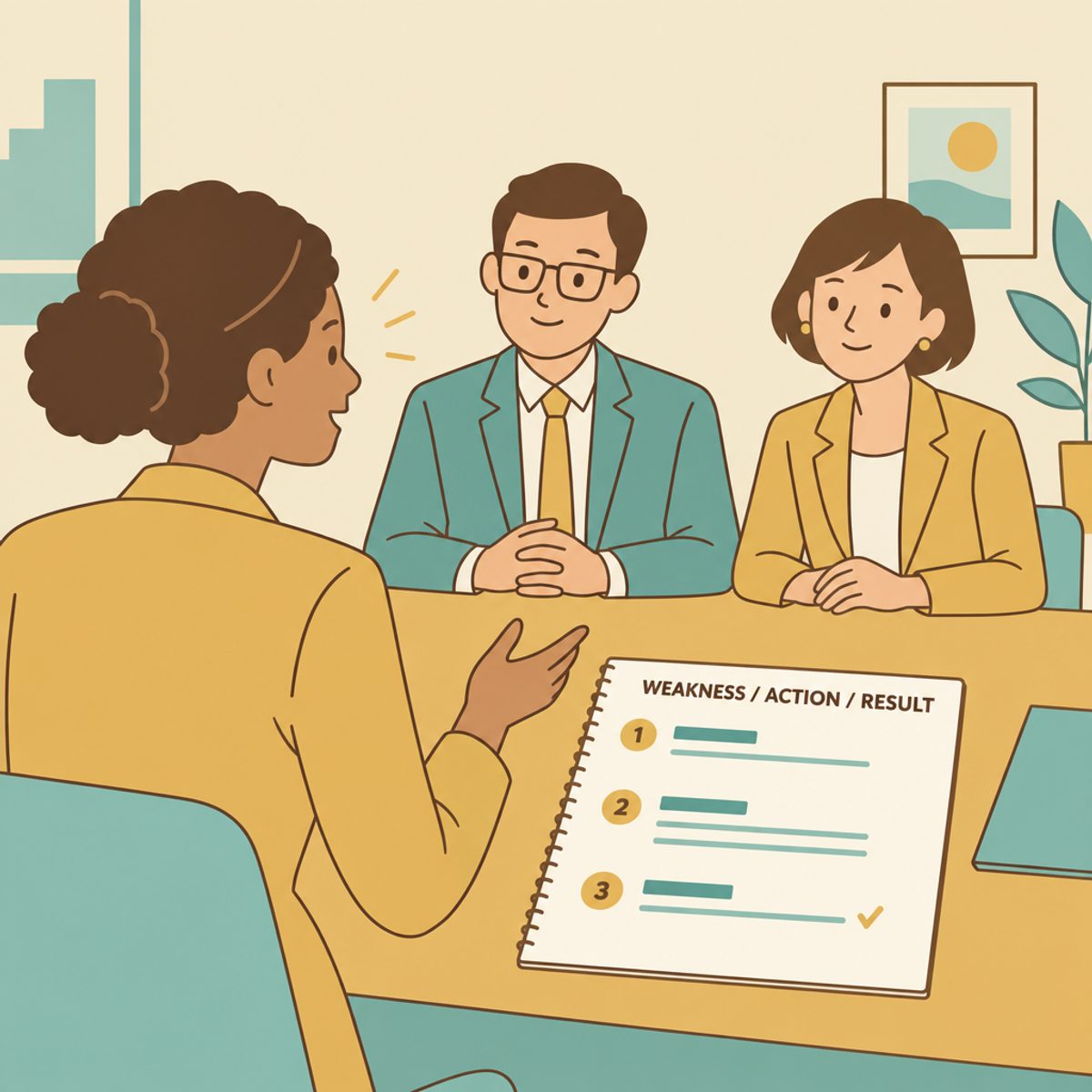
Name one real weakness that is not core to the job, describe the specific step you are taking to fix it, and give evidence the fix is working. That is the whole formula. For example: "I over-prepare before delegating, so I set a 48-hour handoff rule, and my last two projects shipped without me touching every task." Honest, bounded, and improving. Interviewers accept that answer every time.
What the interviewer is actually checking
Nobody asks this question hoping you have no flaws. The interviewer already assumes you do. They are testing four things, and your answer passes or fails on each one separately.
Self-awareness. Can you see your own gaps clearly? A candidate who names a specific, believable weakness signals they will spot their own mistakes on the job instead of needing a manager to point them out.
Coachability. The improvement step matters more than the weakness itself. Someone actively working on a flaw takes feedback well. Someone with no improvement step will hear feedback the same way in the role: as an attack.
Honesty under mild pressure. This is a low-stakes chance to watch you handle an uncomfortable question. Dodging it with "I'm a perfectionist" tells them you will also dodge "why did this project slip?" six months from now.
Fit with the role's core requirements. A weakness that sits far from the job's center is fine. One that sits on top of it is disqualifying, no matter how gracefully you frame it. An accountant who struggles with attention to detail has answered a different question: "why shouldn't we hire you?"
The three-part structure, step by step
Every strong weakness answer has the same skeleton. Build yours in this order, then say it in under 60 seconds.
- Name one real weakness in one sentence. A skill or habit, stated plainly, with no softening preamble. "I tend to hold onto tasks too long before asking for help." Skills and habits are fixable; personality flaws ("I'm too emotional") sound permanent and make interviewers nervous.
- Describe the concrete step you are taking. A system, a course, a habit with a trigger. "I now flag anything I've been stuck on for more than half a day in my team's channel." Vague effort ("I'm working on it") reads as no effort.
- Give evidence it is working. A recent, checkable result. "Last quarter I caught a data issue two days earlier than I would have a year ago, because I raised it instead of grinding on it alone." Evidence is what separates a rehearsed script from a real story.
How to pick your weakness: check it against the job description
Before you settle on a weakness, open the posting and list its top three requirements. Your weakness must not touch any of them. That is the entire selection rule, and it is why the same answer can be excellent for one interview and fatal for the next.
Then apply two more filters. First, it has to be true. Interviewers probe, and a fabricated weakness collapses on the second question because you have no real improvement story behind it. Second, it should be something you have actually been working on for a while, so the evidence in part three exists. If you are choosing between a weakness you started fixing last week and one you started fixing last year, pick the older one. The story is better.
5 sample answers by career stage
Do not memorize these. Steal the structure, swap in your own weakness, your own fix, and your own evidence. An interviewer who has heard a sample answer verbatim (and they have) will push until the script runs out.
1. Student or new graduate (fresher)
"I've had limited experience juggling competing deadlines outside a classroom, where due dates are set for you. During my final-year capstone I was coordinating my own timeline for the first time, and I underestimated two milestones early on. Since then I plan every week on Sunday, break work into two-day chunks, and build in a buffer before anything I owe someone else. My capstone was delivered on time, and I've run my internship tasks the same way since. It's a habit now, not a fix."
Why it works for freshers: it admits the obvious (you are new) without apologizing for it, and it shows a self-built system rather than waiting for a manager to install one. Inexperience is the one weakness a new grad can name safely, because the interviewer already knows it. The mistake is naming it with no system attached.
2. Mid-career professional
"I go deep on execution and used to surface problems later than I should have. On one project I spent three days trying to solve a vendor data issue myself before telling my manager, which cost us schedule. Now I run a standing rule: anything blocked for more than a day gets flagged in writing, with what I've tried. My current manager has actually stopped checking in on my long-running work, because the updates arrive before she asks."
Why it works: it names a real cost ("cost us schedule"), which makes the honesty credible, and the evidence is behavioral. A manager who stopped asking for updates is a detail nobody invents.
3. Career changer
"Coming from teaching into project coordination, my gap is formal project tooling. I ran complex multi-stakeholder work for years, but on paper and in spreadsheets. So over the past six months I completed a project management fundamentals course and rebuilt a school event I'd run, end to end, in Asana, with dependencies and a real critical path. The planning instincts transferred immediately. The tooling is catching up fast, and I can show you the board."
Why it works: it separates the transferable core skill (running complex work) from the fixable surface gap (a specific tool), and it offers proof on the spot. If this is your situation, the same separation should run through your whole application. Our career change guide covers how to make it in the resume, too.
4. Senior leader
"My weakness is impatience with slow decisions. Early in my director role I would push teams to a call before everyone with context had weighed in, and twice we reversed decisions that better input would have caught. I now run a simple rule for anything consequential: I ask each function's lead for their read in writing before the meeting, and I speak last. My skip-level feedback this year specifically flagged that people feel heard in my reviews, which was not true two years ago."
Why it works: seniors get judged on a harder standard. A junior weakness ("public speaking") from a VP candidate sounds evasive. This answer admits a leadership-level flaw with real consequences, and the evidence comes from other people's feedback, which is the only evidence that counts at that level.
5. Returning after a career gap
"After three years out for family care, my technical weakness was currency: the tools moved while I was gone. I treated the last four months as a structured refresh, recertified in the two platforms this role lists, and rebuilt a full sample project with the current stack rather than the one I left on. The fundamentals never went anywhere. What was rusty is now current, and I can walk you through the project."
Why it works: it names the gap once, without apology, and immediately pivots to the refresh plan and its output. The interviewer's unspoken concern is "are they current?", and this answers it before they ask. If the gap also needs handling in your application, explaining an employment gap in your cover letter uses the same no-apology approach.
Weaknesses that fit one role and sink another
There is no universally "good weakness to say in an interview." There are only weaknesses that sit far from a specific job's core. The same admission that reads as refreshing honesty in one interview reads as a disqualifier in the next. Check your candidate weakness against this pattern before you commit to it.
| Weakness | Usually safe for | Sinks the interview for |
|---|---|---|
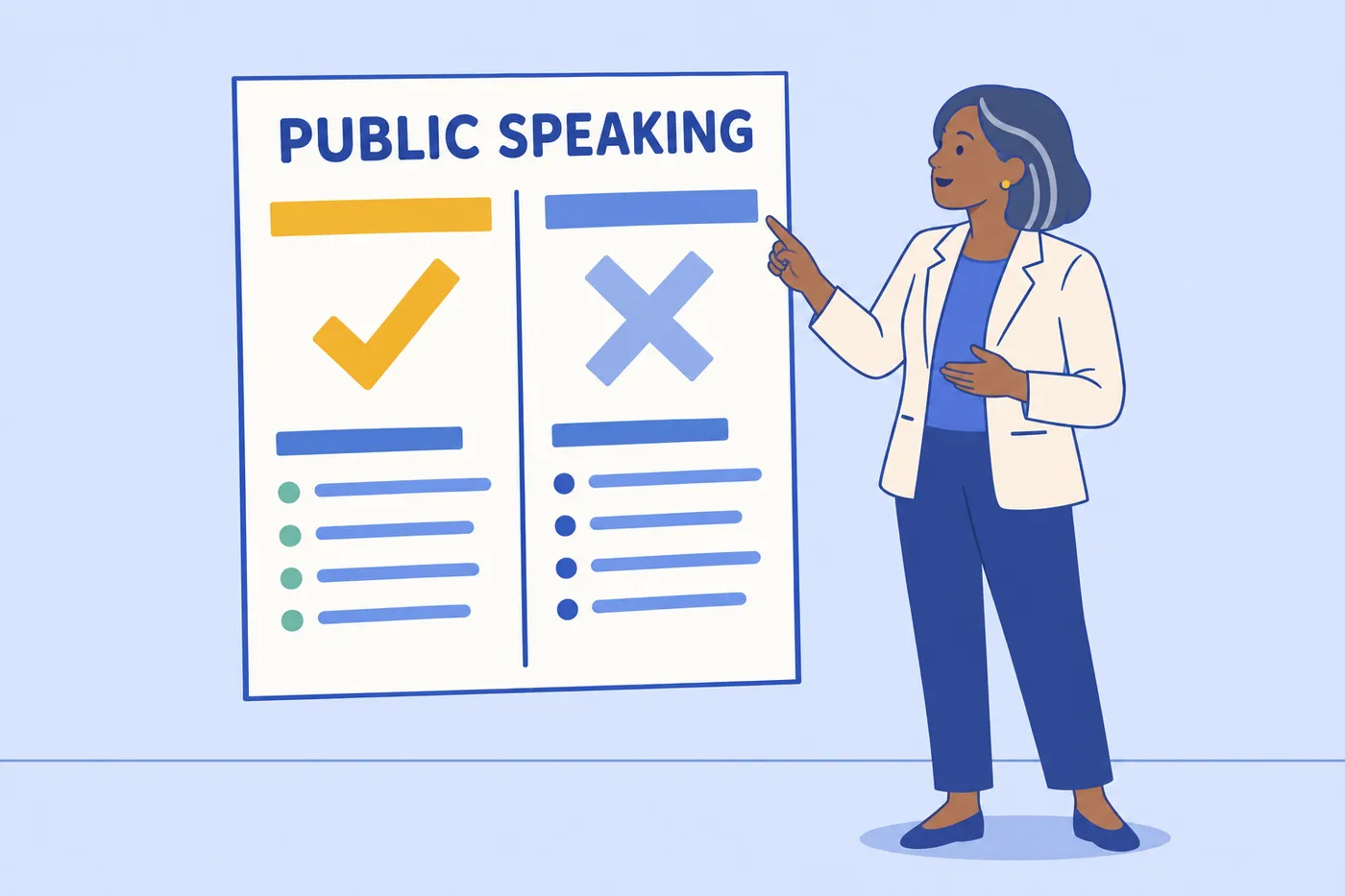
| Public speaking / large-group presenting | Developer, accountant, data analyst, lab roles | Sales, teaching, training, PR, consulting |
| Delegating too slowly | Individual contributor roles, specialists | Manager, team lead, director, chief of staff |
| Impatience with slow processes | Startups, sales, fast-turnaround production | Compliance, healthcare, government, audit |
| Attention to detail under time pressure | Big-picture strategy roles, early-stage generalists | Accounting, QA, legal, pharmacy, data entry |
| Discomfort with ambiguity / loose specs | Process-heavy operations, regulated industries | Product management, founding teams, research |
| Limited experience with a named tool | Any role where the tool is trainable and secondary | Any role where the tool is in the job title |
The last row is the one people miss. "I'm still getting comfortable with Excel" is harmless for a designer and fatal for a financial analyst. Read the posting's requirements section literally: anything listed in the first three bullets, or repeated more than once, is core, and your weakness cannot touch it.
"What is your greatest weakness?" and the follow-up probes
"Greatest weakness" is the same question with a superlative attached. Do not treat "greatest" as an invitation to confess something bigger. Give the same three-part answer, and if pressed on whether it is really your greatest, say plainly that it is the one with the most impact on your work, which is the honest reading of the question.
Good interviewers rarely stop at one answer. Prepare for the three standard probes before you walk in.
"Tell me three weaknesses"
This probe exists to get past your rehearsed answer. Prepare three in advance: one skill gap (a tool or technique), one working habit (like the delegation or flagging examples above), and one knowledge gap (a domain or industry area you are still learning). Each needs its own improvement step, though the second and third can be shorter. A candidate who produces a thoughtful second and third weakness without flinching is more convincing than one with a single polished answer.
"What would your manager say your weakness is?"
This is a consistency check, and sometimes a literal one if they call your references. The only safe answer is a real piece of feedback you actually received, ideally the same weakness you already named, described from your manager's side. "My last manager would say I sat on problems too long before raising them. She was right, and the flagging rule I mentioned came directly from that conversation." If your answer here contradicts your first answer, the interviewer now believes neither.
"Tell me about a time you failed"
The behavioral version of the same question. Pick a real failure connected to your named weakness, tell it with the STAR method (situation, task, action, result), and spend most of your time on what changed afterward. A failure story where your weakness caused the failure and your improvement step came out of it ties the whole interview together. It is the strongest possible evidence that your first answer was true.
Mistakes that cost offers
Most weakness answers fail the same six ways. Every one of these is avoidable.
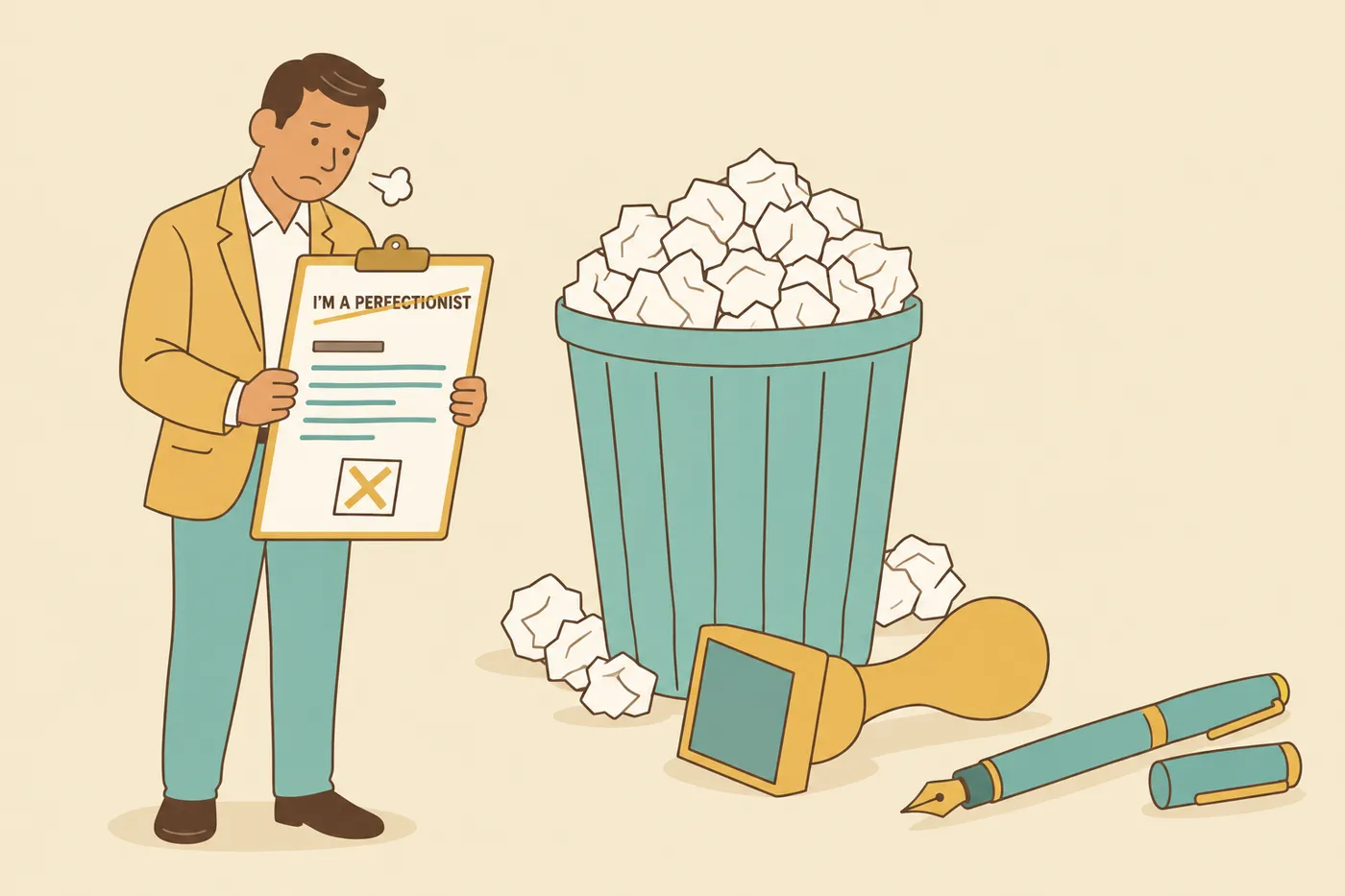
- The disguised strength. "I'm a perfectionist," "I work too hard," "I care too much." Interviewers have heard each of these hundreds of times, and the message received is: this candidate will not be straight with me. It is the single most common failure on this question.
- Claiming you have none. Reads as either zero self-awareness or zero honesty. Both are worse than any real weakness you could have named.
- Naming a core-skill weakness. Check the posting first. A weakness in the job's top three requirements ends the conversation, however well you frame the improvement step.
- Oversharing. Health details, conflicts with a previous manager, anything that sounds like venting. The question asks for one professional weakness, in about 60 seconds, and then you stop talking. Filling silence after a good answer is how good answers get worse.
- No improvement step. A weakness with no fix attached is a liability disclosure. The fix is the answer; the weakness is only the setup.
- Inventing a weakness. A fabricated flaw has no real story behind it, so the first follow-up question ("tell me about a time that happened") exposes it. If you have to invent one, you picked the wrong weakness, not a clever one.
If your history is non-linear: gaps, switches, and short stints
A gap, a career change, or several short jobs gives you a ready-made weakness answer, and using it well beats hoping nobody asks. The interviewer has your resume in front of them. If your history raises a question, they are already asking it silently, and answering it inside the weakness question lets you control the framing.
Two rules keep this honest. First, name the pattern yourself, once, without apology, then move directly to what you did about it. "Three roles in four years taught me I was choosing companies for the title rather than the work. I built a written list of what I actually need in a role, and this posting matches it point for point." Second, never contradict your resume. If your resume shows a gap ending in March and your answer says January, the interviewer notices, and the mismatch costs more than the gap ever would. Reread your own dates before the interview; a surprising number of candidates get tripped up by their own document.
Short stints framed this way convert a red flag into evidence of self-awareness, which is the exact trait the question tests. A career changer can do the same by treating the change itself as the answer, as in sample three above.
Practice it against your resume, not against a script
The weakness answer travels with two siblings: "tell me about yourself" and "why should we hire you?". All three fail the same way when they float free of your actual record. The fix is to rehearse against the document the interviewer is holding.
This is what interview practice in Roleframe is built around. Remi, its career copilot, reads what is actually on your resume and builds the strengths-and-weaknesses round from it: strength answers tied to specific lines in your own record rather than generic virtues, paired with weakness answers structured to show ownership and an improvement step. Anything that cannot be traced back to your resume does not make the set, which matters because an interviewer holding your resume will make exactly the same check. Then it runs the practice round question by question, scores your answers, and tells you where they went thin, so you find out your evidence is vague in rehearsal instead of in the room.
Rehearse out loud at least three times, including the three follow-up probes above. The written version of your answer is never the one that comes out of your mouth, and the third spoken run is usually the first good one.
Frequently asked questions
- What is the best answer to "What is your weakness?"
The best answer names one real weakness that is not core to the job, the specific step you are taking to fix it, and evidence the fix is working. For example: "I used to surface problems late because I'd try to solve everything alone. Now anything blocked more than a day gets flagged in writing, and my manager stopped needing to check in on my long-running work." There is no single best weakness, only the best one for the specific posting in front of you.
- What are 5 examples of good weaknesses to say in an interview?
Five that work for most roles, provided none sits on the job's core requirements: discomfort with public speaking, delegating too slowly, raising blockers later than you should, limited experience with a specific named tool, and impatience with slow decision processes. Each only works with an improvement step and evidence attached. Check every candidate weakness against the posting's top three requirements before using it.
- What are 5 strengths and 5 weaknesses for a job interview?
Strengths that land well: a technical skill named in the posting, structured planning, clear written communication, staying calm under deadline pressure, and coaching others. Weaknesses that stay safe: presenting to large groups, slow delegation, flagging blockers late, a secondary-tool gap, and impatience with long processes. Pick strengths you can back with a specific line from your resume and weaknesses far from the role's core. Generic virtues with no evidence behind them fail on the first follow-up question.
- How do I answer "What is your biggest weakness?"
The same way as "what are your weaknesses," with one adjustment: do not treat "biggest" as a demand for a bigger confession. Give your prepared three-part answer, and if pressed, say it is the weakness with the most day-to-day impact on your work. That is an honest reading of the question and it keeps you on the answer you can defend.
- What is a good weakness answer for freshers with no experience?
Name the inexperience directly and attach a system to it. Limited experience managing your own deadlines, or nerves presenting to groups, both work well for new graduates because the interviewer already assumes them. What they are checking is whether you built your own fix, like a weekly planning habit or volunteering for every class presentation. A fresher who claims an experienced-sounding weakness like "delegating" sounds coached, since there was nobody to delegate to.
- Should I say "I'm a perfectionist" as my weakness?
No. It is the most overused answer to this question, and interviewers read it as a refusal to answer honestly. The same goes for "I work too hard" and "I care too much." If perfectionism genuinely slows your work, reframe it as its real cost, such as "I polish deliverables past the point of diminishing returns, so I now set a hard timebox for final review," which is a legitimate answer because it names the cost and the fix.
- How long should my weakness answer be?
About 45 to 60 seconds spoken, roughly four to six sentences. One sentence for the weakness, two or three for the improvement step and evidence, then stop. Candidates lose more ground by talking past a good answer than by keeping it short, and a tight answer invites the follow-up questions you have already prepared for.

Ready to start your new resume?
Writing a resume takes time, and even a polished one can miss what a hiring manager is looking for. Roleframe helps you build a clear, ATS-safe resume in minutes and tailor it to the job you want.


