What Are the Highest Paying Trades?
by Larbi SahliLast Updated
The highest paying trades ranked by BLS median pay, with apprenticeship terms, time to journey level, and the license or certificate each trade requires.

On this page
Elevator and escalator installers are the highest paying trade in the Bureau of Labor Statistics Occupational Outlook Handbook, measured by median pay, with electrical power-line installers close behind. Both are learned through a paid registered apprenticeship rather than a degree. The full ranking below pairs each trade with its typical apprenticeship term and the license or certificate that gates journey-level pay.
How this ranking works
The order comes from median annual pay in the BLS Occupational Outlook Handbook (OOH), the federal dataset every serious trade-pay list is built on. Median means half of workers in the occupation earn more and half earn less, so it describes an experienced, journey-level worker, not a first-year apprentice.
One honest caveat that most ranking pages skip: the OOH updates its figures every year, and a dollar amount printed in an article goes stale fast. The rank order barely moves from year to year. So this page gives you the stable part, the order, the entry path, and the credential each trade requires, and points you to the OOH occupation page when you want the current dollar figure.
What counts as a trade here: a skilled manual occupation you enter through an apprenticeship, a trade school program, or an employer-sponsored credential. That excludes roles some lists sneak in to inflate their numbers, like sonographers and respiratory therapists, which require an associate degree and belong on a healthcare list, not a trades list.
The highest paying trades, ranked
| Rank | Trade | Pay tier (BLS OOH median) | Entry path | Typical time to journey level | Credential that gates journey-level work |
|---|---|---|---|---|---|
| 1 | Elevator and escalator installers and repairers | Highest of any trade | Union registered apprenticeship | About 4 years | State elevator mechanic license, required in many states |
| 2 | Electrical power-line installers and repairers | Close second | Utility or union apprenticeship | 3 to 4 years | Apprenticeship completion; Class A CDL commonly required |
| 3 | Aircraft mechanics and avionics technicians | Upper tier | FAA-approved school or documented experience | About 2 years of school, longer via experience | FAA Airframe and Powerplant (A&P) certificate |
| 4 | Boilermakers | Upper tier | Union registered apprenticeship | About 4 years | Apprenticeship completion plus code welding certifications |
| 5 | Electricians | Upper tier | Registered apprenticeship, union or open shop | 4 to 5 years | State or local journeyman electrician license |
| 6 | Plumbers, pipefitters, and steamfitters | Upper tier | Registered apprenticeship | 4 to 5 years | State journeyman plumbing license |
| 7 | Structural iron and steel workers | Mid tier | Union apprenticeship | 3 to 4 years | Apprenticeship completion; rigging and welding certs |
| 8 | Crane and heavy equipment operators | Mid tier | Apprenticeship or operator school | About 3 years | NCCCO certification for cranes; CDL for many roles |
| 9 | HVAC technicians | Mid tier | Apprenticeship or trade school | 2 to 5 years depending on path | EPA Section 608 certification; state license in some states |
| 10 | Welders | Entry tier, high ceiling | Trade school or certificate program | Months to first job; years to top certifications | AWS welding certifications, code certs per employer |
The top two deserve a closer look, because they win for different reasons.
Elevator work pays the most because the supply of workers is deliberately small. Apprenticeship classes are limited, entry requires an aptitude test, and many states license elevator mechanics the way they license electricians. Tight supply plus buildings that cannot legally run an out-of-code elevator equals pricing power for the people who can fix them.
Line work pays nearly as much for a different reason: the job is dangerous, outdoors, and on call. When a storm takes down a grid, linemen work restoration shifts at overtime and premium rates, which is why the gap between a lineman's base scale and actual W-2 earnings can be enormous.
Aircraft mechanics are the outlier in how you enter. There is no apprenticeship percentage scale; you either complete an FAA-approved program or document supervised work experience, then pass the written, oral, and practical exams for the Airframe and Powerplant certificate. The A&P is federal, so it travels across all fifty states, which none of the state trade licenses on this list do.
Apprentice pay versus journey-level pay
The medians above describe journey-level workers. An apprentice earns less, but earns from day one, and the raise schedule is written into the program before you start.
Registered apprenticeships listed on apprenticeship.gov set apprentice wages as a percentage of journey-level scale, rising in scheduled steps as you log on-the-job hours and complete classroom instruction. You do not negotiate these raises and your employer cannot skip them; they are part of the program standards. Union programs typically add health coverage and pension contributions during training.
This is the structural advantage of the trades over a degree: the training years are paid years. A four-year electrical apprentice finishes with a license, four years of income, and no student debt, while a four-year degree holder finishes with a credential and, usually, a loan balance. When you compare career earnings, count both sides of that ledger.
Why pay spreads so widely inside one trade
Two electricians with the same license can earn wildly different amounts. The median hides five variables that matter more than the trade you pick.
- Overtime and on-call work. Linemen on storm restoration, elevator mechanics on service contracts, and boilermakers during plant outage season all bank heavy premium hours. In these trades, overtime is not a bonus; it is the business model.
- Union scale versus open shop. Collectively bargained scale, plus benefits and pension, generally beats open-shop pay for the same work in the same city. Prevailing-wage rules on public projects push pay up further.
- Travel and per diem. Traveling welders, pipeline crews, and outage boilermakers trade being home for day-rate plus per-diem packages that a local shop cannot match.
- Specialization. An elevator adjuster, a controls-focused electrician, or a welder certified on exotic alloys prices above the base trade because fewer people can do the work.
- Geography. Union-dense, high-cost metros pay well above the national median; the same license in a rural open-shop market pays under it. State OOH data shows the spread if you want to check your own market.
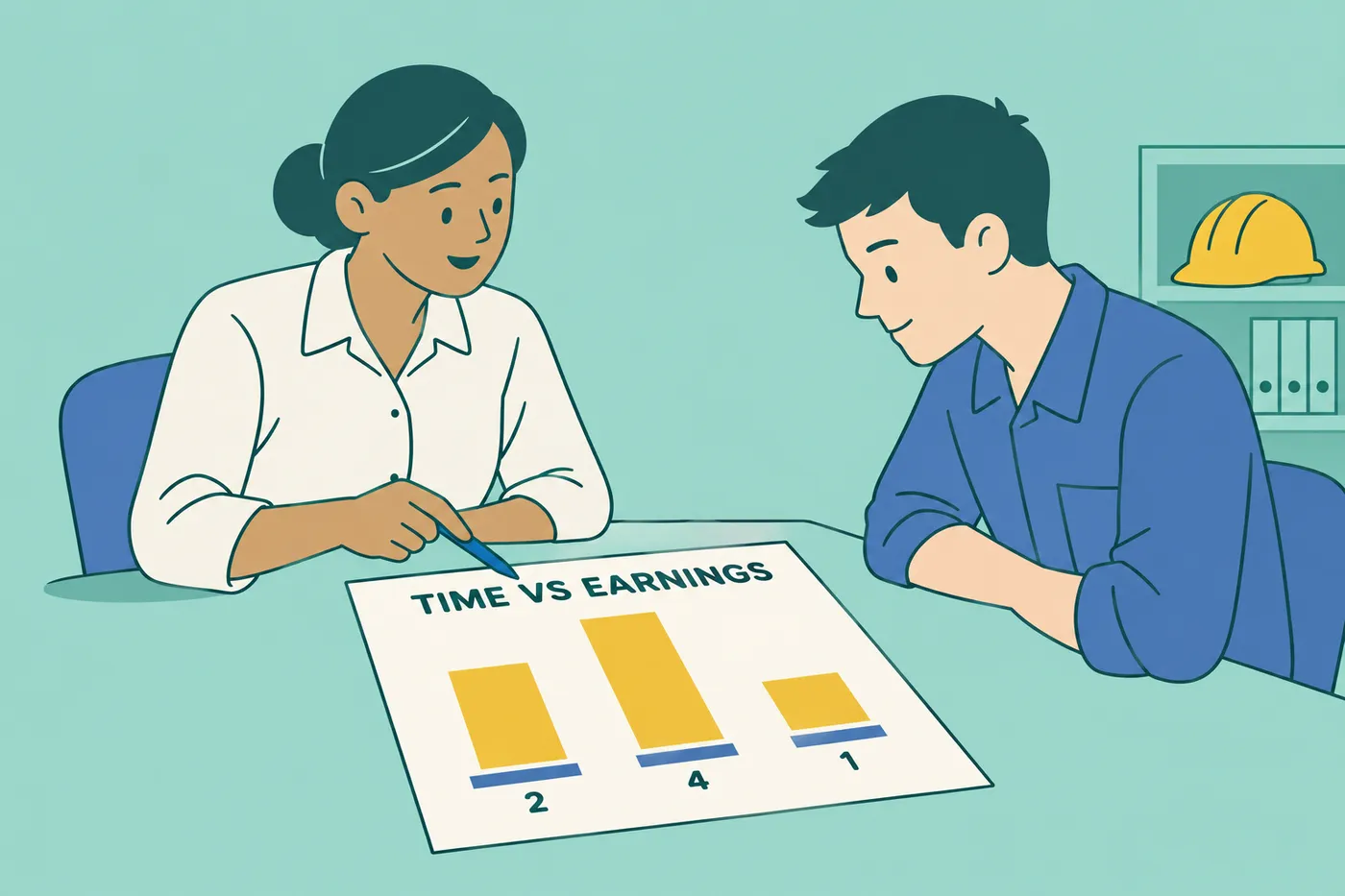
Best trades to learn for pay: time to qualify versus earnings
The highest paying trade is not automatically the best trade to learn, because the doors are different sizes. Weigh how long qualification takes, and how hard the program is to get into, against where the pay lands.
- Fastest to a paycheck: welding. A certificate program takes months, not years, and employers test your actual welds. Entry pay sits at the bottom of this list, but code-certified and traveling welders climb well past the trade's median.
- Fastest to a credential that matters: HVAC. EPA Section 608 certification can be earned quickly, and you train on the job from there. The HVAC apprenticeship route is covered step by step in our guide to HVAC apprenticeship requirements, hours, and pay steps.
- Best pay per year of training: line work. Roughly a three-to-four-year apprenticeship for a near-top median, with overtime upside. The costs are physical risk, weather, and storm callouts.
- Highest ceiling, hardest door: elevator. Apprenticeship slots are scarce and competitive, with an aptitude test and often a waitlist. If you get in, you are in the best-paid trade in the OOH.
- Most durable middle path: electrician or plumber. Four to five years to a journeyman license, steady demand in every zip code, and a master license later opens contractor self-employment, which is where the real top earners in both trades sit. The license stages for plumbing are mapped in our plumbing apprenticeship guide.
Licenses and certifications that gate the higher-paid work
In most of these trades, pay steps up when a credential does. Employers are not paying for years served; they are paying for what you are legally allowed to sign off on.
- Journeyman and master electrician licenses. Issued by states or municipalities after logged hours plus an exam. Journeyman lets you work unsupervised; master lets you pull permits and run a contracting business.
- State plumbing licenses. Same structure: apprentice, journeyman, master, each gated by logged hours and an exam, with the top tier required to contract independently.
- State elevator mechanic licenses. Many states require one for journey-level elevator work, which is a big part of why the trade pays what it does.
- EPA Section 608 certification. Federal, and mandatory for anyone handling refrigerants. Universal certification covers all equipment types and is the version worth taking.
- FAA Airframe and Powerplant (A&P) certificate. The federal gate for aircraft mechanic work, valid nationwide.
- AWS welding certifications. Performance-based certs from the American Welding Society; code work (structural, pipe, pressure vessel) requires them and pays accordingly.
- CDL and NCCCO. A commercial driver's license is standard for line and heavy equipment work; crane operation requires NCCCO or an equivalent accepted certification.
Notice the pattern: the trades at the top of the ranking are the ones with the hardest gates. A license restricts supply, and restricted supply is what a high median pay figure actually measures.
Moving into a high paying trade from another job
None of these trades require a degree, and none of them care that you spent five years doing something else. Apprenticeship programs select on an aptitude test, usually math-heavy, an interview, and reliability signals, not on a linear resume.
Practical moves that work. Take a pre-apprenticeship or helper job to get trade-adjacent hours and a foreman who will vouch for you. Apply to several programs at once, because union apprenticeships often take cohorts only once or twice a year and a single application can mean a year of waiting. Brush up on algebra and fractions before the test; it is the most common reason otherwise strong applicants wash out of selection.
A mixed work history helps more than people expect. Service trades like HVAC and plumbing put a worker in a customer's home, so retail and customer-facing experience reads as an asset. Military experience often earns direct-entry credit toward apprenticeship hours. If you are planning the move deliberately, our career change guide covers the decision and transition end to end, and there is a dedicated guide to writing a career change resume that gets interviews.
Putting trade training, licenses and logged hours on your resume
For licensed trades, the license is the headline. Put it in a certifications section near the top, with the issuing state, license number, and expiration, and repeat the credential in your resume title line: "Journeyman Electrician, State of Ohio." A recruiter filtering applicants for a licensed role searches for the license name first; where exactly to place it depends on the posting, and we break that down in where to put certifications on a resume.
If you are mid-apprenticeship, logged hours are your strongest number. State them the way your program logs them: on-the-job hours completed, classroom hours completed, and your current step. A contractor hiring a third-year apprentice wants to know exactly how far you are from journeyman, so tell them.
Journey-level applicants should quantify the work itself: service calls per week, callback rate, size and type of installs, code inspections passed. Job postings for higher-paid trade roles name specific credentials and systems, and missing one exact term can filter you out before a human reads the page. Roleframe's fit report shows how your resume scores against a specific posting and which required keywords, like a certification name or equipment type, you have not written down; here is how to check your resume against a job description. Submit the finished resume as a PDF so your formatting survives whatever system the contractor uses.
Frequently asked questions
- What trade has the highest pay?
Elevator and escalator installers and repairers have the highest median pay of any trade in the BLS Occupational Outlook Handbook, with electrical power-line installers close behind. The trade-off is access: elevator apprenticeships are scarce, competitive, and gated by an aptitude test, and many states require an elevator mechanic license for journey-level work.
- How do you make $100,000 a year without a degree?
The most realistic trade routes are line work with storm and overtime hours, elevator work at journey level, union electrical or pipefitting scale in high-cost metros, and traveling code welding with per diem. In every case the six-figure years come from a credential plus premium hours or travel, not from base scale alone. None of these paths require a degree; all require an apprenticeship or certification.
- What trade can make $200K a year?
No trade has a median anywhere near that, so treat any list claiming otherwise with suspicion. The people who get there are outliers: linemen stacking storm restoration seasons, rig welders on pipeline travel schedules, elevator adjusters on heavy service overtime, and master electricians or plumbers who own contracting businesses, where the income is business profit rather than a wage.
- Are apprentices paid during training?
Yes, from day one. Registered apprenticeships pay a set percentage of journey-level scale that rises in scheduled steps as you log on-the-job and classroom hours, and union programs usually add health coverage and pension contributions. The published median for a trade reflects journey-level workers, so expect first-year pay well below it with a contractual path upward.
- What are the highest paying trades for women?
The same ones, and that is the point of union scale: the collectively bargained rate is the rate, regardless of who holds the tools. Elevator work, line work, and electrical offer the strongest pay, and many apprenticeship programs and tradeswomen organizations run pre-apprenticeship tracks specifically to bring more women into them. Selection is by aptitude test and interview, not by background.
- Which states pay trades the most?
Pay tracks union density, prevailing-wage laws, and cost of living more than the state name. Union-dense, high-cost metros pay well above the national median for the same license; California generally runs high on scale and prevailing wage, while Texas offers heavy job volume in a mostly open-shop market at lower rates. The OOH publishes state-level data for each occupation, so check your specific trade and metro before you commit to a program.
- Do the highest paying trades require a college degree?
No. Every trade on this list is entered through a registered apprenticeship, a trade school certificate, or an employer-sponsored program, and you are paid while you train. The gates are licenses and certifications, like a journeyman electrician license, EPA Section 608, or the FAA A&P certificate, which are earned through logged hours and exams rather than tuition.


Ready to start your new resume?
Writing a resume takes time, and even a polished one can miss what a hiring manager is looking for. Roleframe helps you build a clear, ATS-safe resume in minutes and tailor it to the job you want.


