What Are the Best Entry-Level Careers?
by Larbi SahliLast Updated
The best entry-level careers are registered nurse, dental hygienist, electrician and respiratory therapist. See the ranking method, licenses and entry paths.

On this page
The best entry-level careers are registered nurse, dental hygienist, electrician, and respiratory therapist. Each appears in the Bureau of Labor Statistics (BLS) Occupational Outlook Handbook as requiring no prior work experience in a related occupation, and each combines strong median pay, projected growth, steady annual openings, and a license you can earn in two to five years. Accountant, software developer, plumber, and HVAC technician round out the top ten.
The best entry-level careers, ranked
Ten careers survive the filter and score well across all four fields. Every one is open to someone who has never worked in the field before. What varies is the classroom time, the exam that gates entry, and how soon you get paid. Each also has a growth path past the entry title, which the sections below walk through career by career.
| Rank | Career | Entry path | Time to entry | License or exam (issuing body) | BLS code for pay lookup |
|---|---|---|---|---|---|
| 1 | Registered nurse | ADN or BSN degree | 2-4 years | NCLEX-RN (NCSBN), licensed by your state board of nursing | 29-1141 |
| 2 | Dental hygienist | Associate degree | About 3 years | NBDHE (Joint Commission on National Dental Examinations) plus a state clinical exam and license | 29-1292 |
| 3 | Electrician | Paid apprenticeship | 4-5 years, paid throughout | State journeyman electrician license | 47-2111 |
| 4 | Respiratory therapist | Associate degree | About 2 years | NBRC credential, CRT then RRT (National Board for Respiratory Care), plus a state license | 29-1126 |
| 5 | Accountant | Bachelor's degree | 4 years | None to start; CPA later through your state board of accountancy | 13-2011 |
| 6 | Software developer | Bachelor's degree or portfolio | 0-4 years | None | 15-1252 |
| 7 | Plumber | Paid apprenticeship | 4-5 years, paid throughout | State journeyman plumber license | 47-2152 |
| 8 | HVAC technician | Apprenticeship or trade school | Months to 2 years | EPA Section 608 certification (U.S. EPA) | 49-9021 |
| 9 | Welder | Trade school or on-the-job | Months | AWS Certified Welder (American Welding Society) | 51-4121 |
| 10 | Truck driver | CDL school | Under 3 months | Class A CDL (state DMV, under FMCSA training rules) | 53-3032 |
How this ranking works
The list starts with a filter most rankings skip. The BLS Occupational Outlook Handbook (OOH) tags every occupation with a field called work experience in a related occupation. Only occupations where that field reads None made the pool, which is the honest definition of entry-level: nobody expects you to have done a similar job before. That cut removes roles like marketing manager that show up on entry-level lists despite requiring years of prior work.
Each surviving career was then scored on four fields you can verify yourself:
- Median annual wage, from the occupation's OOH page (which draws on the OEWS wage survey)
- Projected percent employment growth over the BLS ten-year projection window
- Projected annual job openings, from the same projections table
- Years from enrolling to your first paid, licensed day of work
Every career is ranked 1 through 10 on each field, the ranks are summed, and years to entry counts double, because it is the variable a first-job searcher can least afford to misjudge. Lowest total wins. Nothing else, no editorial thumb on the scale, no sponsored placements.
You will notice no dollar figures in the table, and that is deliberate. BLS refreshes OEWS wages every spring and its projections on their own cycle, so a number printed in an article goes stale within a year and nobody comes back to fix it. Every OOH page prints its data year next to the wage, and every OEWS table carries a reference date. Look the occupation up by the code in the last column, and read the year before you read the number.
Why the BLS median is not your first paycheck
A median is the middle of everyone doing the job, including the nurse with twenty years of seniority and the electrician running his own crew. As a new entrant you start near the bottom of that distribution, so the headline wage on an OOH page overstates what your first offers will look like, sometimes by a lot in careers with long pay ladders.
The closer estimate is the 25th percentile wage in the BLS Occupational Employment and Wage Statistics (OEWS) tables: the figure a quarter of workers in the occupation earn less than. It skews toward the newer, lower-paid end of the field, which is exactly where you will be in year one. OEWS also breaks wages out by state and metro area, and location moves entry pay more than any negotiation tactic will.
The lookup takes two minutes. Search OEWS for the occupation code from the table above, open your state's row, and read the 25th percentile next to the median. A wide gap between the two means a long climb; a narrow gap means the career pays close to its headline early. Licensed careers with a fixed scope of practice tend to run narrow bands, while unlicensed fields like software run some of the widest.
Best entry-level careers with a bachelor's degree
Accountant
Accounting is the rare degree career where demand is structural: every company closes its books, in every economy. Year one as a staff accountant means reconciliations, month-end close, and, in public accounting, a busy season that will test your stamina. The CPA comes later and is optional for many corporate roles. It is issued by your state board of accountancy, and most states require credit hours beyond a standard bachelor's, so plan the extra coursework before you graduate rather than after.
Registered nurse, BSN route
The Bachelor of Science in Nursing takes four years and sits the same NCLEX-RN exam as the two-year route, but many hospital systems prefer or require it for hiring and promotion. A typical first year runs through a structured nurse residency, usually on a medical-surgical floor, usually with nights and weekends. The trade for that schedule is unusual bargaining power for a first job: hospitals compete for new graduates, and the license travels to any state in the Nurse Licensure Compact.
Software developer
No license, no board, no exam. The credential is what you have shipped, which cuts both ways: nothing gates entry, so the junior market is crowded, and internships plus a public portfolio decide who gets callbacks. Year one is tickets, code review, and learning a codebase larger than anything school showed you. If this is your route, study an entry-level software engineer resume example before you apply. The difference between a project list and a project argument is most of the game.
Entry-level healthcare careers through an associate degree and a licensing exam
Dental hygienist
The path is an associate degree, usually about three years including prerequisites, and admission to hygiene programs is more competitive than the degree's length suggests. Licensing runs in two parts: the written National Board Dental Hygiene Examination (NBDHE), administered by the Joint Commission on National Dental Examinations, then a state or regional clinical exam that leads to your state license. What you get for it is rare in healthcare: daytime hours, no on-call, and a role that flexes to part-time better than almost any other clinical job.
Registered nurse, ADN route
The Associate Degree in Nursing takes about two years at a community college and leads to the same NCLEX-RN, developed by the National Council of State Boards of Nursing and licensed through your state board. Same exam, same RN license, half the school. Some hospital systems will eventually want a BSN, and the standard play handles that: start working as an ADN nurse, then finish an RN-to-BSN bridge online while employed, often with tuition assistance covering it.
Respiratory therapist
An associate degree gets you to the National Board for Respiratory Care (NBRC) exams: the CRT credential first, the RRT for most hospital jobs, plus a state license. The work is hospital-based, on ventilators, in intensive care units and emergency departments, so it shares nursing's schedule with a narrower, deeper scope. It is the least-known career on this list relative to how well it scores, which keeps program admissions less brutal than nursing's.
Paid apprenticeships: strong first careers after high school
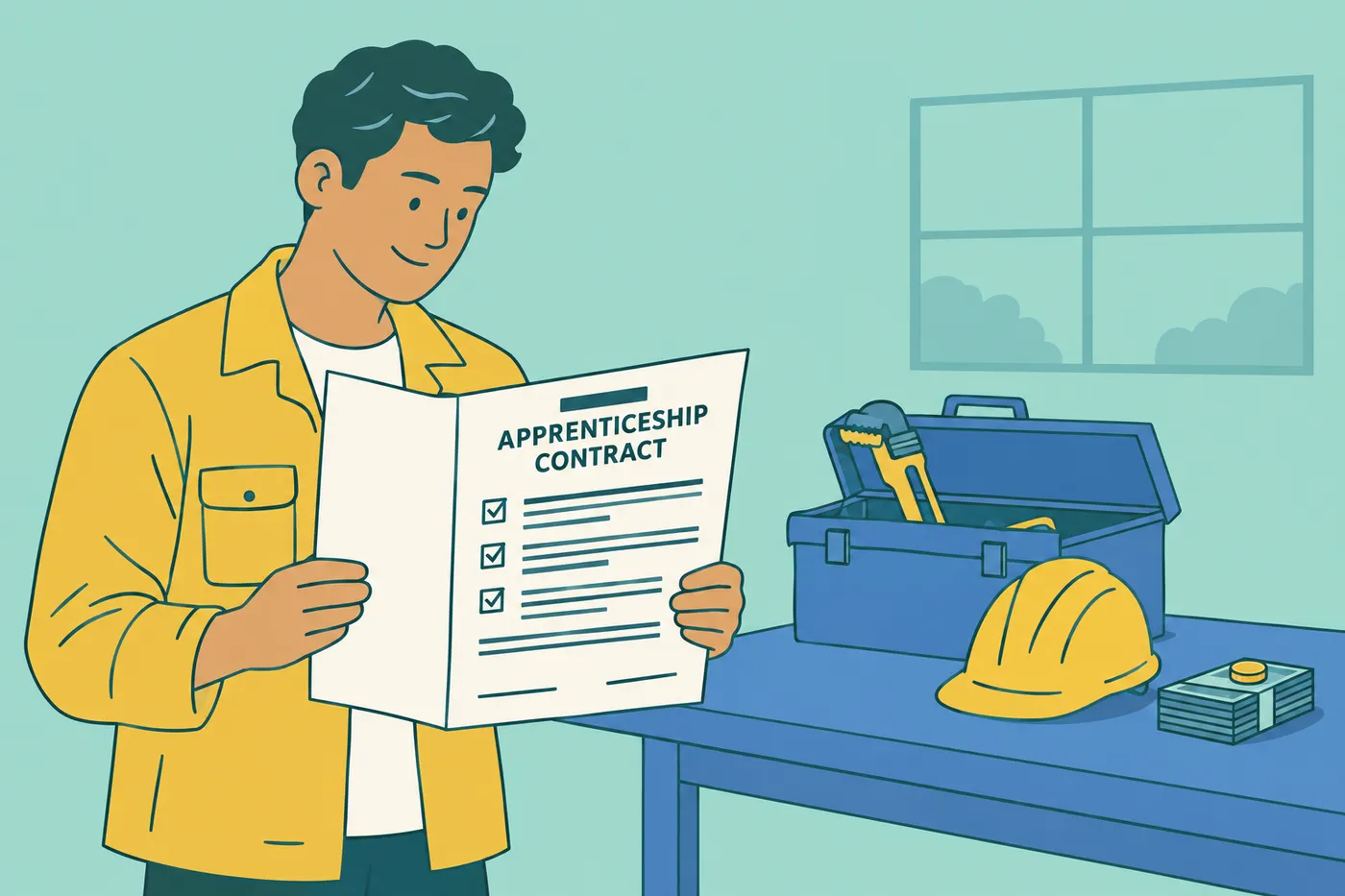
An apprenticeship flips the cost of entry. You are paid from your first week, on a wage scale that steps up each year, and you finish with a state journeyman license instead of student debt. For a high school graduate who wants a career without tuition, this is the strongest first move on the list.
Electricians and plumbers both run four to five years to the journeyman license, through a union program or an open-shop employer. The catch is getting in: good programs carry waitlists, and applying to several at once is normal. Hours, license stages, and pay steps for the plumbing route are covered in our plumbing apprenticeship guide.
HVAC reaches a first paycheck faster. The EPA Section 608 certification, a federal requirement for anyone handling refrigerants, can be earned in weeks, and the trade knowledge follows through an HVAC apprenticeship or trade school. Welding is faster still: the American Welding Society (AWS) Certified Welder test is performance-based with no prerequisite courses, and pay climbs with each welding process you certify on and how far you are willing to travel for work.
Best entry-level jobs you can start within three months
Three credentials get you earning inside a quarter, and each opens a door rather than closing one.
- CDL truck driver: a Class A commercial driver's license, issued by your state DMV after training with an FMCSA-registered provider. It leads to endorsements like tanker and hazmat, specialized freight, and, for people who want off the road later, dispatch and logistics roles.
- Phlebotomist: a short certificate course plus a national certification exam. The pay is modest; the value is the hospital badge. Health systems routinely fund employees into medical lab tech and nursing programs, and phlebotomy is the classic first rung.
- Pharmacy technician: the PTCB exam (Pharmacy Technician Certification Board) plus state registration. Retail comes first; hospital pharmacy and sterile compounding pay better and come with experience.
Treat all three as launch jobs, with a named next step and a rough date attached. A phlebotomist who enrolls in a nursing bridge is on a career; one who does not is in a job. If pharmacy is the direction, our pharmacy technician resume example shows what employers screen for at this level.
Picking an entry-level career when your history is not linear
Career changers and people with messy work histories should weight the ranking differently: time to entry and the license matter more, the eventual ceiling less. Three patterns come up constantly.
A license resets the signal. A recruiter reading "RN, licensed 2026" or "journeyman electrician" does not go hunting through the work history behind it. The credential answers the competence question that a patchy resume raises, which makes the exam-gated careers on this list, nursing, respiratory therapy, dental hygiene, and the trades, the best entry-level jobs for career changers, gaps and all.
Apprenticeships solve the income problem. Retraining through a bachelor's means four unpaid years. Retraining through an electrical or plumbing apprenticeship means a paycheck from week one, which is what makes starting over survivable at 35 with rent due.
Military service maps more directly than most veterans assume. Medics and corpsmen have bridge routes into respiratory therapy and nursing programs, and many states waive the CDL skills test for service members with military driving experience. Several part-time jobs held at once can be grouped under a single resume heading, and an employment gap needs one factual sentence, never an apology. For the full decision process, our career change guide walks it end to end.
Getting hired into your first role
A first resume argues from credential, coursework, and proof, in that order, because there is no work history to argue from. Put the license or degree at the top, name the exam and the date you passed it, and write your clinicals, apprenticeship hours, or projects as experience with concrete detail: patients per shift, systems installed, code shipped. A summary earns its space only when it is specific; our resume summary examples for freshers show the difference between one that works and one that fills space.
The skills section is where applicant tracking system (ATS) filters look first, so it should echo the posting's exact terms. If the job asks for "EMR documentation" and you trained on Epic in clinicals, write both. Keep the document to one page, and send it as a PDF so your formatting arrives exactly as you built it.
The matching step is where Roleframe earns its place: paste the posting and the fit report shows your ATS score, the exact keywords you are missing, and a prioritized plan. Remi then helps you rewrite each bullet, and you approve every change, so the words stay yours and you can defend every line. That matters more in a first-job interview than any other, because the conversation will lean hard on the little experience you have. Prepare a 60-second answer to "tell me about yourself" that lands on why this field and what you did in training, and bring one story for each requirement in the posting.
Frequently asked questions
- What are the best entry-level jobs with no experience?
Separate "no related experience" from "no preparation." Every career in the ranking above requires zero prior work in the field, but each requires school, an exam, or an apprenticeship. Jobs that require neither, like customer service, retail sales, bank teller, and administrative assistant, are fine for income and can genuinely lead somewhere: tellers become bankers, admins become office managers. If you can spare three months, though, a CDL, a phlebotomy certificate, or the PTCB exam beats an unstructured job for long-term pay.
- How can you make $100,000 a year with no degree?
The credible no-degree paths run through time, not tricks: a skilled trade taken to journeyman or master level with overtime in a high-cost metro, commission sales once you have a track record, or specialized CDL work like tanker and hazmat freight. None of them pays that in year one. To see what the top of any occupation actually earns, look up its 90th percentile wage in the BLS OEWS tables for your state. That is the honest ceiling, and it varies enormously by location.
- What job makes $10,000 a month without a degree?
That is a top-of-the-distribution question, not an entry-level one. The roles that get there without a degree are usually commission-based sales, established owner-operator trucking, and senior trade positions, all after years of building. Be skeptical of any listing or video promising it in your first year, and check the occupation's OEWS percentile wages instead of trusting a stranger's screenshot.
- What is the best "lazy girl job"?
The trend name refers to low-stress, decent-pay, often remote roles: data entry, customer support, administrative coordination. As jobs they are fine. As careers they stall, because nothing about the work compounds. If low stress is the actual goal, dental hygiene is the stronger version of the same idea: daytime hours, no on-call, part-time friendly, and pay backed by a license rather than a trend.
- What career is Gen Z most interested in?
Interest in the skilled trades has visibly grown among younger workers, driven by student-debt aversion and a sense that hands-on work is harder to automate, alongside the long-standing pull of healthcare and tech. The better question is which career scores well on pay, growth, openings, and time to entry for you specifically. What your generation prefers on average tells you nothing about your own market.
- Should I choose the ADN or the BSN route into nursing?
Both routes sit the same NCLEX-RN and produce the same RN license. The ADN is faster and far cheaper; the BSN opens more hospital doors immediately and matters for promotion. The pragmatic compromise is ADN first, then an employer-funded RN-to-BSN bridge while you earn, provided your local hospitals hire ADN graduates. Read the actual postings in your metro before deciding, because some markets are BSN-preferred in practice even when the listing says either.


Ready to start your new resume?
Writing a resume takes time, and even a polished one can miss what a hiring manager is looking for. Roleframe helps you build a clear, ATS-safe resume in minutes and tailor it to the job you want.


