Informational Interview Questions and the Email to Ask for One
40+ informational interview questions by goal, plus the request email, a timed plan for the call, and the follow-up that keeps the contact warm.

On this page
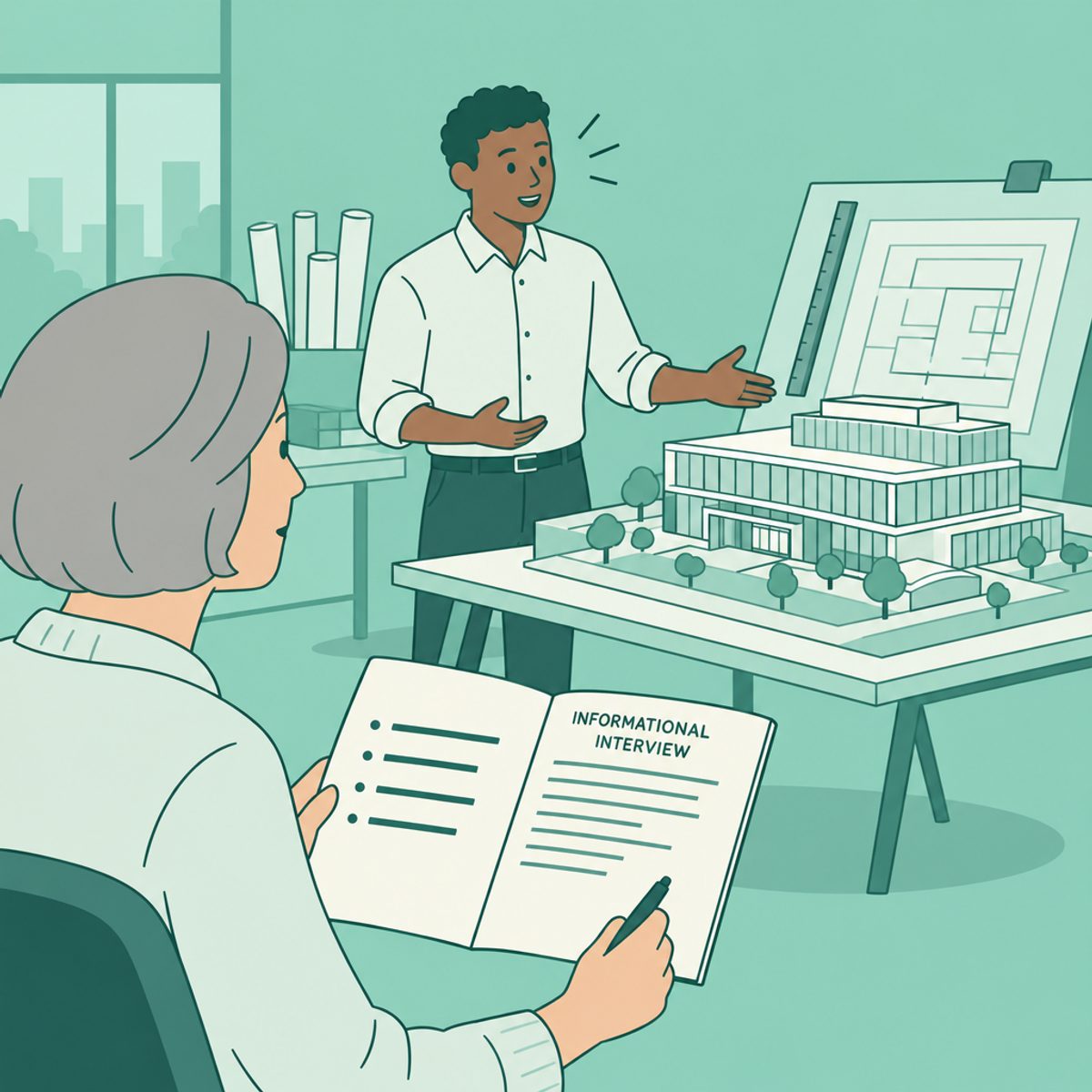
An informational interview is a short conversation with someone whose role, company or field you want to understand. UC Berkeley Career Engagement describes it as an informal conversation, often 20–30 minutes, for information and advice rather than a job interview. Make that purpose clear when requesting someone’s time.
This guide gives you ten starting questions, a 40-question bank grouped by goal, illustrative request messages, a timed conversation plan and follow-up examples. Select what helps you make a real decision; you do not need to ask every question.
10 useful informational interview questions
A useful sequence is background, daily work, field changes and advice for your next steps. Start with an open question and follow the answers rather than treating the list as a script. The suggested order below is a planning aid, not a rule or a guarantee of a warm response.
- How did you get started in this field?
- What does a typical week look like in your role?
- Which skills matter most for doing this work well?
- What do newcomers commonly misunderstand about this work?
- What has been the most rewarding part of your career so far?
- What has been the hardest part?
- What trends are changing the field right now?
- Which experiences best prepared you for your current role?
- What advice would you give someone trying to enter this field?
- Is there anyone else you'd recommend I speak with?
Ten questions may be more than you can cover in a short call. Pick the ones most relevant to your decision and ask follow-up questions when an answer needs detail. Near the end, you can ask about another perspective or resource without making an introduction feel obligatory.
The full question bank: 40 questions grouped by goal
Choose a short list before the call. Each group marks one possible priority question as “the keeper”; substitute another if it fits your goal better. Keep enough time to listen and to end at the agreed time.
Their path
- Which experiences best prepared you for your current role? (the keeper)
- How did you get into this field in the first place?
- What did your first role in the field look like, and how has your work changed since?
- What do you wish you had known earlier in your career?
- If you were starting over, what would you do differently?
- How do people typically advance from a role like yours?
The day to day
- What does a typical day or week look like for you? (the keeper)
- Which skills do you use most, day to day?
- What parts of the job do you enjoy, and which parts wear on you?
- How heavy is the workload, and does it swing with seasons or deadlines?
- What tools or software are you in all day?
- How much of your time goes to meetings versus heads-down work?
The field and where it's heading
- What trends are changing this field right now? (the keeper)
- Where do you expect the field to be in five years?
- Is demand growing, flat or shrinking? Have there been layoffs?
- Why do people leave this field, or this kind of company?
- Which parts of the field are hiring, and which are slowing?
- How is morale in the field at the moment?
Questions about demand, workload and changes in the field can be useful, but one person’s experience is not a complete market picture. Ask what they have observed directly, let them decline sensitive questions, and compare important claims with other people and independent data.
How people break in
- What qualifications do employers look for in new hires? (the keeper)
- How do most people enter this profession?
- Are there certifications, software or technologies I should learn before applying?
- How do recruiters in this field tell candidates apart?
- What does the hiring process usually look like, stage by stage?
- What would you want to see on the resume of someone trying to break in?
Ask how a qualification or tool is used, not just whether you should collect it. A useful follow-up is “Which requirements are essential for this work, and which can be learned on the job?” Confirm regulated qualifications with the relevant licensing authority before relying on anyone’s informal opinion.
The company and team
- How would you describe the culture here? (the keeper)
- How does the company evaluate performance?
- What makes this company different from its competitors?
- How does the team handle work-life balance in practice, not on the careers page?
- How long do people tend to stay in their roles?
- What professional development does the company actually support?
Advice for you
- What advice would you give someone entering this field? (the keeper)
- Knowing my background, what would you do in my position over the next six months?
- What should I read, follow or join to keep learning?
- What do people in my position commonly get wrong?
- Is the typical salary range for entry-level roles something you can speak to?
You can ask about typical pay ranges without asking for the person’s own salary. Berkeley’s suggested questions use that distinction. Try “I have seen entry-level ranges around [researched range]; does that fit what you have observed?” Let the contact decline, and treat the answer as one perspective rather than a salary guarantee.
Closing questions
- Is there anyone else you'd recommend I talk to? (the keeper)
- May I mention that you suggested I reach out?
- Can I keep you posted on where this goes?
- Is there anything I should have asked but didn't?
- Is there anything I could help you with?
Questions for three common situations
Use the following questions to adapt the bank to your situation. They are original prompts and explanations, not a report about who searches for this topic or what a particular employer asks.
For an engineering student or working engineer
- "How much of your week is hands-on engineering versus meetings, documentation and reviews?" Tells you whether the daily reality matches the part of the work you actually like.
- "Which parts of the degree show up in the job, and what did you have to learn on your own?" Tells a student what to prioritize in the semesters they have left.
- "Do engineers here specialize early, or move between systems and teams?" Helps you choose between a deep first employer and a broad one.
- “What helped interns or junior engineers succeed on your team?” This invites practical advice without asking the contact to discuss confidential hiring decisions.
- "Which tools, languages or standards should someone learn before applying to teams like yours?" Surfaces requirements the posting won't spell out.
For someone exploring nonprofit or social work
- "How is the work funded, and how does funding shape what you can do day to day?" Reveals grant cycles, program stability and how much of the job is chasing money.
- "What does burnout look like in this work, and what keeps people in it for a decade?" Tests whether the work is emotionally sustainable for you, not in the abstract.
- “Which qualifications are required for this role, and which are useful preparation?” Verify any regulated education or license requirement with the relevant authority before choosing a course.
- "How do people move between direct service and program or policy roles?" Maps where the role leads before you commit to the entry point.
- “What typical pay ranges should someone research for this kind of role and location?” This asks for market context rather than the contact’s own salary.
For a career changer testing a new field
An informational interview can help test a career-change idea before you invest heavily in courses or applications. It takes preparation and someone else’s time, so use it to answer a specific question. Compare several perspectives rather than treating one conversation as proof that a change will work. See the career change guide for a broader plan.
- “What evidence would make someone from my background a credible applicant here?” This helps you identify preparation to investigate rather than promising a hiring outcome.
- "Which skills from my current field actually transfer, and which do people overestimate?" Prevents you from leaning on a strength the new field doesn't value.
- "Has anyone on your team come from a different field? How did they get in?" Proof the route exists, and often a second person to talk to.
- "If I could do one thing in the next three months to test this move, what should it be?" Turns a vague ambition into one concrete experiment.
- “What entry routes might work for someone with my existing responsibilities and pay constraints?” Use the answer to investigate feasibility, not as a guarantee of an accessible opening.
How to ask for an informational interview
Keep the request specific: explain why you chose this person, what you hope to learn, and how much time you are asking for. Make it clear that you are seeking advice rather than disguising a job application. Give them an easy way to decline.

Where to find people
Start with people connected to your existing network, such as alumni, former coworkers or introductions made with permission. You can also contact someone whose public work is relevant to your question. A shared affiliation can explain your reason for reaching out; it does not guarantee a reply.
If you share a professional profile, check that it is current before sending a message. Do not imply a personal connection or use someone’s name as a referral without their permission.
The email, in full
The sender, recipient, college, employers and details in the messages below are fictional illustrations. Replace them with your actual situation and use your own contact/profile link. Choose a subject line that states your real reason for writing.
- Fellow Hartwell grad exploring UX research. 20 minutes?
- Marketing coordinator curious about your path into UX research
- Quick questions about moving from marketing to UX research
Hi Dana,
I found you through the Hartwell College alumni directory. I'm a marketing coordinator at a healthcare software company, and over the past year the parts of my job I look forward to most are the user surveys and the customer interviews behind our case studies. I'm exploring whether UX research is the right next move, and your path from brand marketing into research at Meridian stood out, because you started where I am now.
Could I ask you for 20 minutes on a call in the next couple of weeks? I'm hoping to learn how you made the switch and what you'd want to know before trying it. To be clear, I'm asking for information and advice, not about openings.
I know your time is tight, so if a call doesn't work, even a few sentences by email would help. Thank you either way.
Maya Torres
Marketing Coordinator, Brightwell Health
[your current professional-profile link]
The illustrative email names where the sender found the contact, explains the specific connection, asks for a short meeting and offers an email alternative. Use those elements only when they are true for you. A clear request makes the purpose easier to assess; it cannot ensure acceptance.
The professional networking message
For a short professional-network message, keep the same purpose and time request. This fictional example is a starting point:
Hi Dana, I’m a fellow Hartwell graduate exploring a move from marketing into UX research. Your public account of that transition caught my attention. Would you have 20 minutes in the next few weeks for questions about what helped you prepare? I’m asking for information and advice rather than an opening. Thank you either way. Maya
The nudge after a week of silence
No response can mean many things, including limited time or a decision not to reply. One brief follow-up after roughly a week is a reasonable option unless the person has asked not to be contacted. If it goes unanswered, stop pursuing the request.
Hi Dana, following up once on my note from last week. I’d still appreciate a short conversation about your move into UX research if you have time. If it is not convenient, no reply is needed. Thank you, Maya.
Do not treat silence as an invitation to keep sending reminders or to switch repeatedly to other channels.
Running the conversation: a plan for 25 minutes
Confirm the time available at the start and keep track of it. Give a brief introduction, then let the professional do most of the talking. The schedule below is an illustrative 25-minute plan; shorten it if you requested or were offered less time.
| Minutes | What you do |
|---|---|
| 0–2 | Thank them, give one line of context (who you are, why you wrote to them specifically), and confirm how much time they have. |
| 2–18 | Your questions. Start with their path, then the day to day, then the field. Follow interesting threads instead of marching through your list. |
| 18–20 | Check the agreed limit: “We’re nearly at the time you offered. Shall we wrap up, or is there time for one final question?” |
| 20–25 | Only if the agreed time allows: ask about another useful perspective or resource, ask permission for a future update, and thank them. |
There is no useful fixed speaking percentage to hit. Keep your background brief, ask open questions and listen. If an answer raises something important, follow that thread instead of racing through the prepared list.
An introduction can be a useful outcome, but it is optional. Ask whether there is another person or resource that would help you learn more, and whether you may mention the contact’s name. Do not assume an introduction means an endorsement or a hidden job lead.
What not to ask, and what to ask instead
Researchable basics. Check the public information first, then ask what it means in practice. Instead of “What does your company do?”, try “The team page mentions shared project ownership. How does that work on your team?”
Private or confidential information. Ask about typical ranges or general processes, not the person’s paycheck, individual performance reviews, client details or confidential hiring decisions. Respect a refusal.
An unannounced job pitch. Keep the purpose you stated in the request. If a job or referral comes up naturally, clarify whether the person is comfortable discussing it rather than assuming that access to their time creates an obligation.
If they offer to refer you, confirm what they need, which role they mean and whether you may use their name. Send accurate, tailored materials in the format and timeframe you agree on. A referral does not guarantee an interview or an offer.

The follow-up that keeps the contact
Send a brief thank-you soon after the conversation. Refer to a useful point and confirm only actions you actually plan to take. This continuation of the fictional Maya/Dana exchange assumes that the contact offered the introduction mentioned:
Subject: Thank you for the career conversation
Hi Dana,
Thank you for speaking with me. Your explanation of the difference between marketing interviews and formal research studies helped me see what I still need to learn.
I’ll review the resource you suggested and contact Priya with the introduction you offered. May I send you a short update after I have done that?
Maya
If the contact agrees to stay in touch, send an occasional substantive update when you have acted on their advice or have something useful to share. There is no universal follow-up schedule; respect their preferences and avoid treating each message as another request.
The thank-you email guide offers more wording patterns. Keep a short record of the advice, any commitments and permission to follow up so you do not rely on memory. Roleframe’s contact tracker can help organize those notes and related job-search activity.
Frequently asked questions
- Is an informational interview a real job interview?
Its stated purpose is career information and advice rather than selection for a job. Be prepared, punctual and clear about that purpose. If the contact proposes discussing a vacancy, clarify the change in scope instead of assuming that every informational conversation is a hiring assessment.
- How long should an informational interview last?
Agree on the duration with the contact and end at that time. A request for 20–30 minutes is common, but a shorter conversation can still be useful. Do not assume an enthusiastic answer means you can run over; ask whether they have time.
- What should I bring, and what should I wear?
Prepare relevant questions, know why you chose this contact, and have a way to take brief notes. Dress appropriately for the setting. Ask before recording, and do not record or share a conversation without permission. See what to wear to an interview for broader clothing guidance.
- Can I ask for a referral later?
You can ask politely about a specific opportunity if it fits the relationship, but do not make a referral the hidden price of the original conversation. Give the contact an easy way to decline, and ask permission before presenting them as your referrer.
- What if nobody replies to my request?
Send one concise follow-up if appropriate, then move on. Check that future requests explain a specific reason for choosing the person and make a manageable ask. Avoid repeated reminders or attempts to force a response through other channels.
- Should I attach my resume to the request?
A clear short introduction is usually enough for an information-seeking request. If the person offers resume feedback or asks for it, send a current version and explain the specific feedback you want. Do not let an unsolicited attachment turn the request into an unclear job pitch.
- How many questions should I prepare?
Prepare a short priority list and a few backups. Six to eight is a useful planning choice for a brief call, not a target you must complete. Listening and asking a relevant follow-up matter more than reaching the end of the list.


Ready to start your new resume?
Writing a resume takes time, and even a polished one can miss what a hiring manager is looking for. Roleframe helps you build a clear, ATS-safe resume in minutes and tailor it to the job you want.


