CV vs Resume: The Difference, and Which One to Send Where
CV vs resume: in the US a resume is short and tailored while a CV is the full academic record; elsewhere they are the same document. See both side by side.

On this page
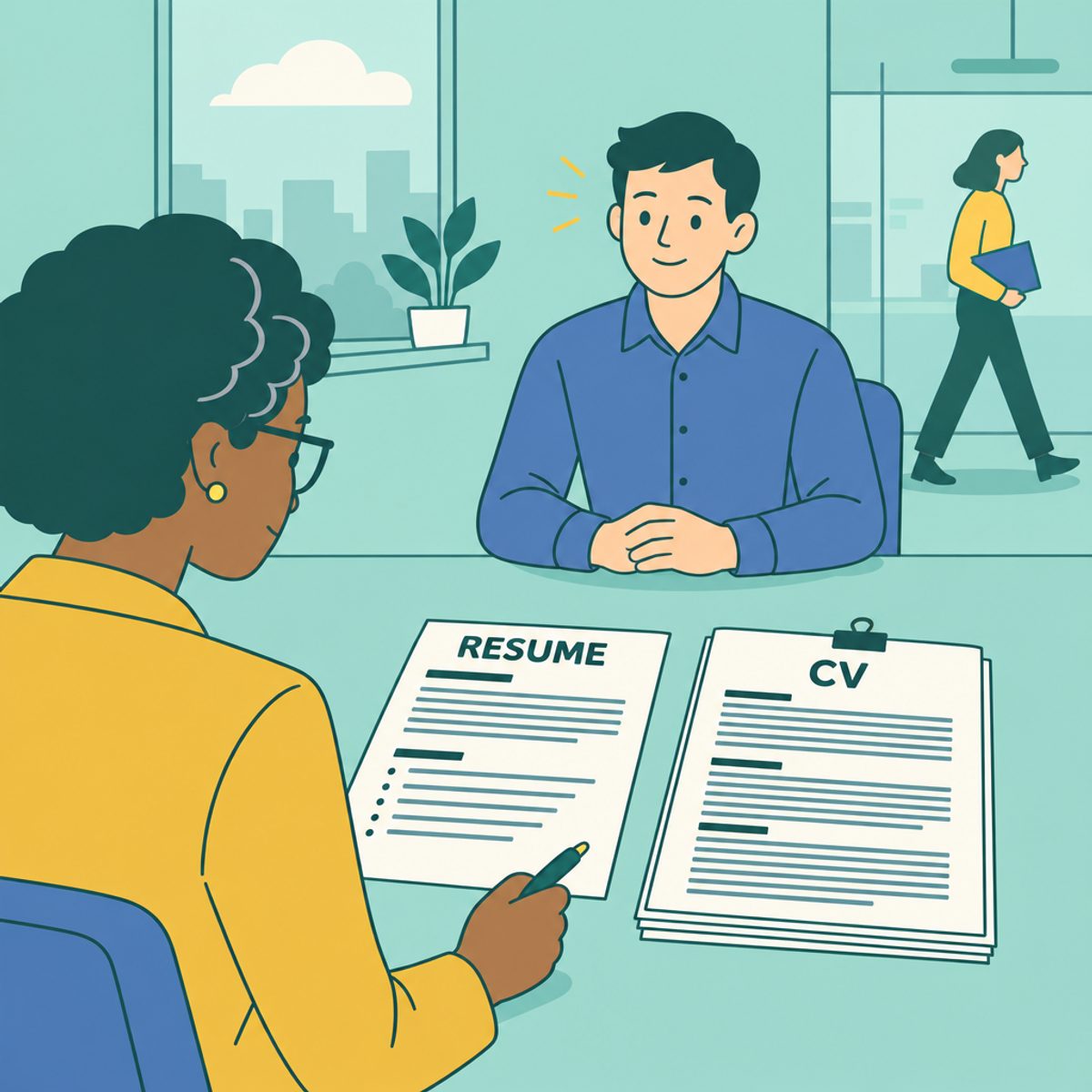
In the US and Canada, a resume is the short, tailored summary you send for most jobs. A CV (curriculum vitae, Latin for "course of life") is the long, complete record of your academic work, the document that research, teaching, medical and grant applications ask for. In the UK and Ireland, and across much of continental Europe, "CV" is simply the everyday name for the same short document Americans call a resume. That one distinction settles most of the confusion.
So "is a CV the same as a resume" depends on where you are standing. Ask it in London and the answer is yes. Ask it on a US faculty hiring committee and the answer is a firm no.
This page shows both documents for one person, side by side. It then answers which to send region by region and walks through converting each into the other. The full meaning of the term, with its pronunciation, lives on a separate page, what is a CV. This one is about the choice.
The difference at a glance
The lengths below are conventions, not rules. Per the National Institutes of Health's guidance, updated in 2026, a resume generally runs one to two pages, while a CV has no set limit as long as the content stays focused. An academic CV grows with the career; nobody trims it to fit a page count.
| Resume (US sense) | Academic CV | |
|---|---|---|
| Purpose | Get an interview for one specific job | Document your full scholarly record |
| Typical length | Usually one or two pages | Grows with the career; no set limit |
| Contents | Selected experience, skills and results relevant to the posting | Education, publications, presentations, teaching, research, grants, awards, references |
| How often it is tailored | For every application | Rarely rewritten; you select relevant sections per opportunity |
| Section order | Summary and experience first | Education and scholarship first |
| Who reads it | Recruiters and hiring managers, usually fast | Faculty committees and fellow researchers |
| Where the term is used | US and Canada | US academia; outside North America, "CV" usually means the short document |
One person, two documents
The clearest way to see the difference is the top third of each document for the same person. Meet Maya Okafor, a fictional chemistry PhD candidate applying to a postdoc and to an industry research scientist role at the same time. Same facts, same career. Two openings that could not look more different.
The CV opens with education and scholarship
Here is the top third of her academic CV, all details fictional.
- Maya Okafor | Department of Chemistry, Riverside State University | m.okafor@rsu.edu
- Education. PhD in Chemistry, expected May 2027. Dissertation, "Photocatalytic degradation of persistent organic pollutants in municipal wastewater," advised by Prof. D. Lin. BS in Chemistry, 2021.
- Publications. Okafor, M. and Lin, D., "Visible-light photocatalysis for micropollutant removal," 2026. Okafor, M., Reyes, J. and Lin, D., "TiO2 nanocomposite stability under continuous flow," 2025.
No summary, no skills list, no attempt to sell. A faculty committee reads a CV for training and output: where you studied, what you published, who you worked with. Education and the dissertation lead because they are the credential, and Harvard FAS guidance as of 2026 lists exactly these sections, publications, presentations, teaching, research and awards, as the core of an academic CV. For the complete document, section by section, see the academic curriculum vitae example.
The resume opens with a summary and results
And here is the top third of her industry resume for the research scientist role, again fictional.
- Maya Okafor | Analytical Chemist | Boston, MA | m.okafor@email.com
- Summary. "Analytical chemist (PhD expected 2027) with six years of hands-on HPLC, LC-MS/MS and method validation experience. Automated sample preparation for a 40-sample daily workflow, cutting prep time by a third, and validated two methods to ICH guidelines."
- Core skills. HPLC, LC-MS/MS, GC, method validation (ICH), Python for lab data analysis
Education drops below experience and shrinks to degree, school and year. The publication list becomes a two-item "Selected publications" section near the end. The recruiter screening this application cares what Maya can do in their lab next quarter, and per University of Pennsylvania guidance updated in October 2026, a resume should emphasize the qualifications relevant to that one position rather than inventory everything.
Academics making this move in the other direction, from a teaching career toward industry, face the same rewrite at a larger scale. The professor resume example shows how to select evidence from a long CV.
Which one to send, by region
One rule beats everything in this table: the posting's own wording wins. France's official administration site, Service-Public.fr, puts it plainly as of 2026 that the document the employer names in the vacancy notice takes precedence over any general definition. UK university careers guidance (University of St Andrews, 2026) says the same thing from the other side of the Channel. The job description determines what you submit.
| Region | The word you will see | What to send |
|---|---|---|
| US and Canada | "Resume" for most jobs; "CV" in academia, research and medicine | A tailored one-to-two-page resume for industry roles; a full academic CV when the role is scholarly |
| UK and Ireland | "CV" for nearly everything | The short, tailored document. "CV" here means what Americans call a resume |
| Continental Europe | "CV" is the ordinary term, per European Commission guidance as of 2026 | A concise CV tailored to the role; some countries expect personal details US resumes omit, so follow local norms and the posting |
| Australia and New Zealand | Both words, used interchangeably in everyday hiring | A short, tailored document under either name |
| India and South Asia | "CV," "resume" and "biodata" all circulate | A tailored resume or CV; send a biodata only when the application asks for one |
Cornell's careers guidance as of 2026 confirms the US split: industry employers generally prefer resumes, while academic, scientific and research employers commonly request CVs. If you are applying outside the US and want a layout that parses cleanly through applicant tracking systems (ATS), the ATS CV templates guide covers the file checks worth running before you send anything.
How to turn one into the other
Most people never write both documents from scratch. They have one and need the other by Friday. Here is each direction as a short procedure.
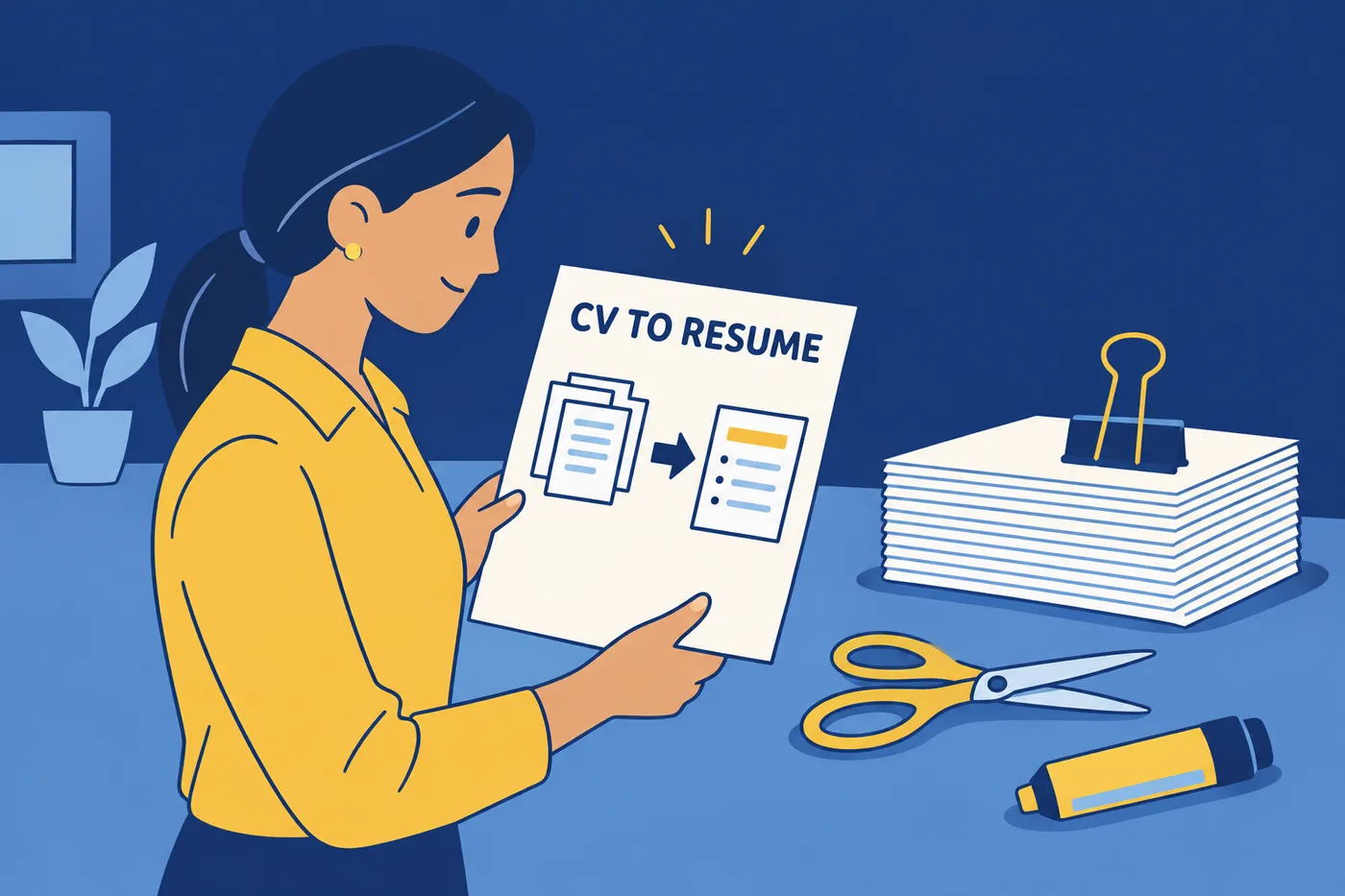
CV to resume
- Pick the one role you are targeting and write a three-line summary that names your core methods and your strongest concrete result.
- Move education below experience and trim it to degree, institution and year. The dissertation title stays only if it is relevant to the job.
- Rewrite research and teaching as outcomes: what you built, measured or improved, with a number where one exists, instead of project and course titles.
- Keep two or three publications in a short "Selected publications" section near the end. Cut the rest; the full list lives on your CV and your profile pages.
- Cut conference service, committee work and references, then keep cutting until everything left would survive a recruiter asking "why is this here?"
Whether you land on one page or two depends on how much of your experience is genuinely relevant, not on a universal rule. The one page or two decision guide walks through that call.
Resume to CV
- Restore full education detail: dissertation or thesis title, advisor, fields of study, and expected date if you are still enrolled.
- Add complete lists of publications and presentations in your field's citation style, reverse chronological within each section.
- Add teaching experience, grants and funding, professional service, affiliations, honors and awards as their own sections.
- Add named references, since academic hiring expects them on the document.
- Stop trimming for length. Completeness is the point of a CV; readability comes from clean section structure, not from cuts.
A CV built this way is a living record. The NIH's 2026 guide describes it as a document you maintain and extend over a career, selecting relevant sections for each opportunity, rather than something rewritten per application the way a resume is.
Biodata, cover letters and personal details
What is a biodata?
Biodata is a term used mainly in South Asia for a document heavier on personal details than either a resume or a CV. Expect fields for date of birth and marital status, plus nationality and sometimes family information. Some government and traditional employers ask for one. Send a biodata only when an application explicitly requests it; everywhere else, a tailored resume or CV is the expected document.
Cover letter vs CV vs resume
A cover letter is not a third option in this choice. It travels with either document and never replaces it: the resume or CV carries the evidence, and the letter explains why this role and why you. Skip the letter only when the posting says not to send one.
The personal details to leave off
US and UK employers do not expect a date of birth or a photo on your document, and marital status and nationality are equally unwelcome. Including them works against you, because screeners are trained to avoid exactly that information. Parts of continental Europe and Asia still see photos and some personal details by convention. The safe default is to include them only where local norms clearly call for them, and to follow the posting.
Your next step
Read the posting once more and send exactly what it names. For most readers of this page that means a resume, or a CV in the UK and European sense, which is the same document. You can start from a layout on the free resume templates page and build it in Roleframe's free editor, where checks run on every section as you edit. The Report scores the document and lists what to fix, and the PDF export keeps your layout with real selectable text. Always submit as PDF.
Headed for academic or medical hiring instead? Build the full CV and keep it current. Treat every new publication or grant as a line you add the week it happens, rather than a scramble before the next application.
Frequently asked questions
- What does CV stand for?
CV stands for curriculum vitae, Latin for "course of life." In US hiring it means the detailed academic record; in much of Europe it is the ordinary word for the short application document, per European Commission guidance as of 2026. The plural, if you ever need it, is curricula vitae.
- Is a CV the same as a resume?
In the UK, Ireland and much of Europe, yes: CV is the everyday name for the short, tailored document Americans call a resume. In the US and Canada, no: a CV there is the long academic record covering publications, teaching, research and awards, and the two documents serve different readers.
- Can I use my CV as my resume?
Sometimes, but not automatically. An academic CV may work for research-intensive employers whose reviewers understand your field. For most other jobs, convert it into a targeted resume: cut or greatly shorten the publication and teaching detail, and emphasize transferable skills and job-related results. Outside academic hiring in most countries, the two words name the same document, so there is nothing to convert.
- Which is better, a CV or a resume?
Neither is better universally; the right document depends on the role, the country and the employer's instructions. A targeted resume wins for most US industry jobs because it is fast to read and specific to the posting, while a CV wins for scholarly roles because committees want the complete record. When the posting names one, that answer overrides everything else.
- Is it better to send a resume or a CV?
Send the document the posting names or implies. For most US nonacademic roles that is a concise, tailored resume of one to two pages; academic, scientific and research employers commonly request CVs, per Cornell's careers guidance as of 2026. Never substitute one when the employer explicitly asks for the other.
- Do I need both a CV and a resume?
Only if you are applying to academic and industry roles at the same time. UC Davis's guidance, updated in November 2025, recommends maintaining both documents in that case, since faculty committees assess scholarly credentials while industry recruiters want a concise, skills-focused resume. Keep the CV as your complete record and cut the resume from it per application.
- Should a fresher use a CV or a resume?
Whichever the posting asks for, kept short. University of Pennsylvania guidance updated in October 2026 describes one page as typical for undergraduates and recent graduates, with one to two pages for professionals. A new graduate rarely has the publication record that makes a long CV useful, so a tight single page almost always serves you better.
- Which do I send for grad school applications?
Read the program's instructions first. Per UC Davis guidance from 2025, graduate programs may ask for a CV but often expect something closer to an expanded resume that includes publications and descriptions of research projects. Lead with the research experience and coursework relevant to the program rather than listing every activity.

Ready to start your new resume?
Writing a resume takes time, and even a polished one can miss what a hiring manager is looking for. Roleframe helps you build a clear, ATS-safe resume in minutes and tailor it to the job you want.


