Creative Thinking Examples: Practical Ideas You Can Use at Work
Creative thinking examples with observable actions: six worked cases, a self-assessment, a practice plan, and resume bullets that turn ideas into proof.

On this page
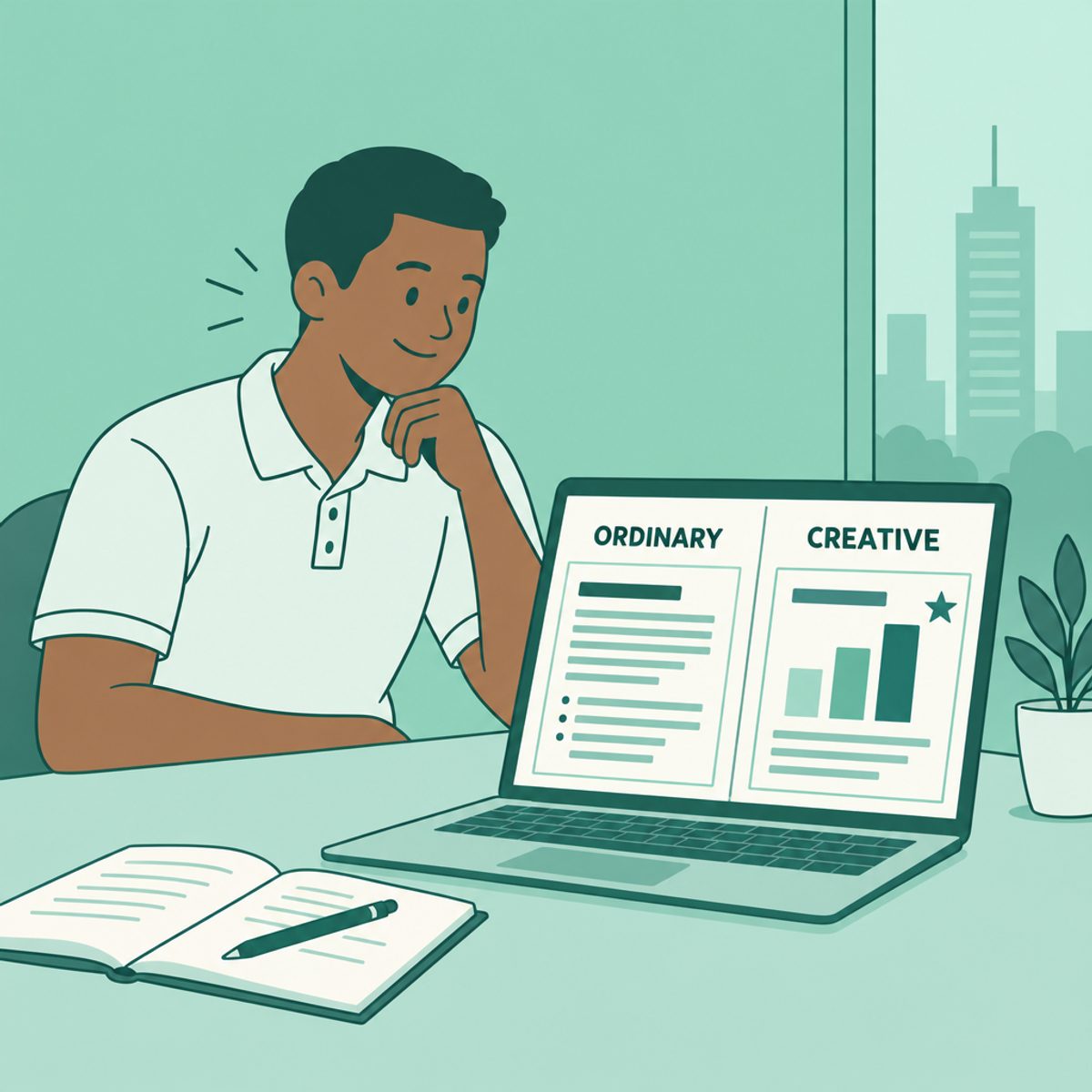
Creative thinking at work looks ordinary from the outside: a support agent who turns repeat tickets into a help-page fix, an analyst who answers a new question with data the company already owns. The OECD defines creative thinking as generating, evaluating, and improving ideas to produce original, effective solutions (OECD, 2023). The useful word is effective. An idea nobody tested is a guess. A small test with a recorded result is evidence.
Employers ask for this by name. The World Economic Forum ranks creative thinking among the five most important core skills for 2025, based on input from more than 1,000 employers representing over 14 million workers across 55 economies, and employers expect its importance to keep rising through 2030 (World Economic Forum, 2025).
This page gives you examples with observable actions, six worked cases, a quick self-assessment, a repeatable practice plan, and a way to turn all of it into resume bullets and interview answers you can defend.
What creative thinking means (and what it doesn't)
Creative thinking is three moves, usually in sequence: you generate useful alternatives to the obvious approach, you reframe the problem when the obvious framing leads nowhere, and you test an idea small enough to learn from. The OECD's 2024 framework treats it as a measurable competence built on cognitive processes, producing, assessing, and improving ideas, which separates it from creativity in the loose, artistic sense (OECD, 2024).
Two corrections to common advice follow from that. First, creative thinking does not mean producing unusual ideas; the OECD definition requires ideas to be evaluated and improved toward originality and effectiveness (OECD, 2023). Second, a brainstorming list proves ideation, nothing more. It shows none of the evaluation, refinement, or impact that makes the skill worth hiring for (OECD, 2023).
One more myth worth killing: creative thinking does not replace analytical thinking. The World Economic Forum lists both among the core skills employers value, alongside technological literacy and adaptability, so the strongest examples show a new idea that was reasoned through, tested, and delivered (World Economic Forum, 2025).
Creative thinking examples in the workplace
An example only works if someone could have watched you do it. "Thinks outside the box" describes nothing; the five examples below describe actions a manager, teammate, or customer could observe.
- A new handoff method. Shift handoffs keep dropping details, so you draft a one-page handoff checklist and pilot it with one team for two weeks before proposing it wider.
- A more accessible customer instruction. Customers keep misreading the returns instruction, so you rewrite it in plain language, add one photo per step, and compare repeat questions before and after.
- A different use of existing data. There is no budget for an account-health tool, so you use the support-ticket tags the team already applies to flag accounts with rising complaint volume and trigger early outreach.
- A lower-cost event format. The events budget shrinks, so you replace one catered info session with three short virtual demos and compare cost per attendee across formats.
- A service process experiment. The walk-in queue frustrates customers at peak hours, so you trial booked time slots alongside the open queue for one week and record wait times.
Early-career versions exist for every one of these. A club treasurer who co-hosts an event to split venue costs, a retail associate who pre-fills return forms at the door, a student who turns a group project's chaotic file sharing into a one-folder convention: same skill, smaller stage. If your experience is mostly campus or part-time work, transferable skills like these carry more weight than most students expect.
The behavior-to-evidence matrix
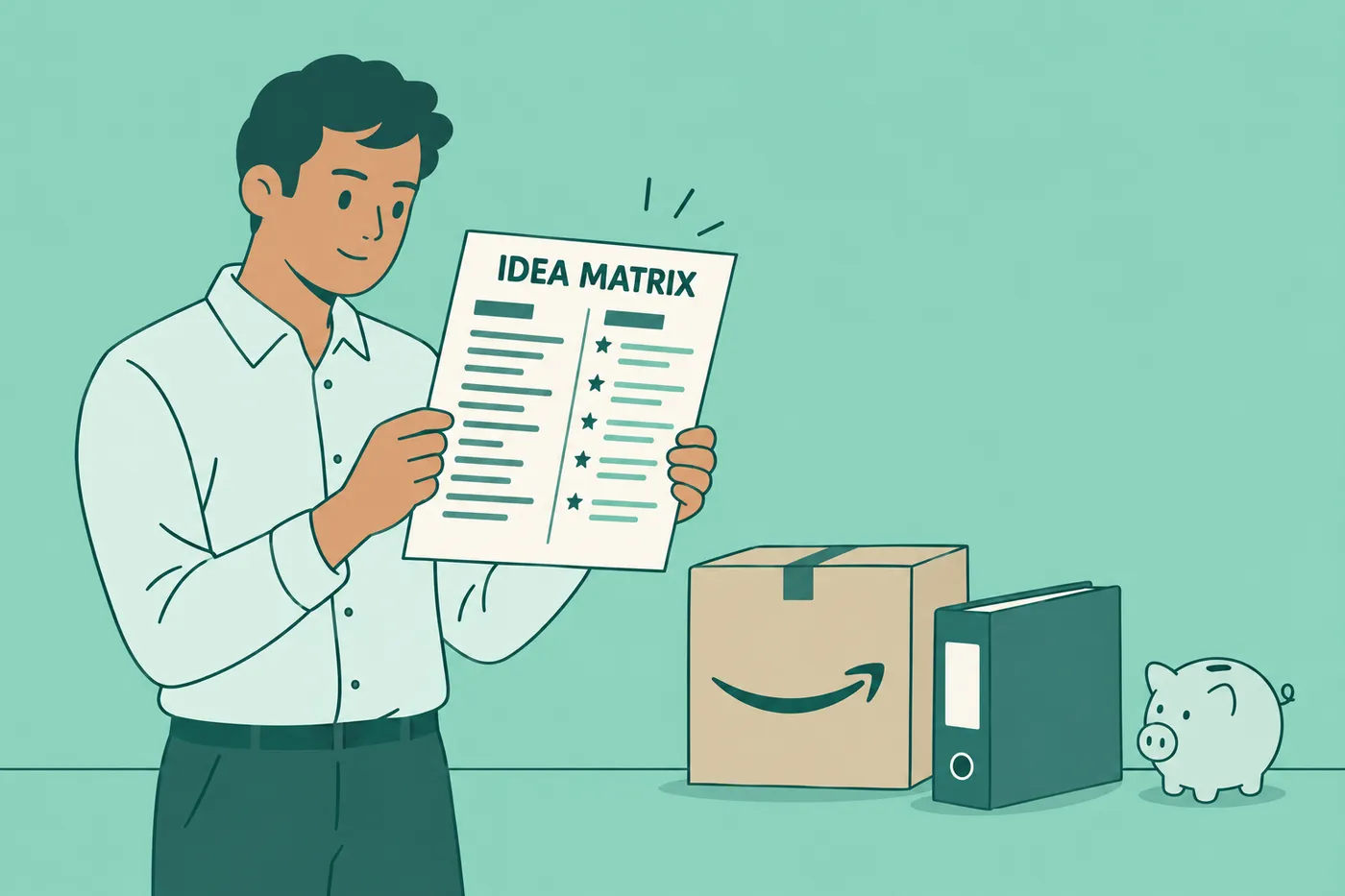
A claim becomes evidence when you can name four things: the task, the action someone could have watched, the artifact you could show on request, and the follow-up question you could survive in an interview. Run every example you plan to use through this matrix before it goes near your resume.
| Task | Observable action | Shareable artifact | Likely interview follow-up |
|---|---|---|---|
| Shift handoffs lose information | Drafted a one-page handoff checklist and piloted it with one team | The checklist plus a before-and-after note on missed items | How did you get the other shift to adopt it? |
| Customers misread a return instruction | Rewrote it in plain language and added one photo per step | Old and new versions side by side | How did you know the rewrite worked? |
| No budget for an account-health tool | Used existing support-ticket tags to flag accounts with rising complaints | The flagged list and the outreach it triggered | What did the tags miss? |
| Event budget cut | Replaced a catered session with three short virtual demos | Attendance and cost per attendee, old format vs. new | What did you lose by going virtual? |
| Walk-in queue frustrates customers | Trialed booked time slots alongside the open queue for one week | The sign-up sheet and wait-time notes from the trial | Why a trial instead of switching outright? |
| Weekly report goes unread | Cut it to one page of exceptions with the full data linked | Reply or question volume before and after, even informal | Who pushed back, and what did you change? |
Six worked cases: ordinary approach vs. creative alternative
The six cases below are original fictional illustrations written for this article. Every person, organization, and outcome in them is invented to show the shape of the skill, so borrow the structure, never the details. Each case follows the same arc: a constraint, the ordinary response, the alternative, a small test, and what the test taught. Notice that two of the six learnings include a downside. Creative thinking that notices what the idea cost is more credible than a highlight reel.
| Case (fictional) | Constraint | Ordinary approach | Creative alternative | Small test | Learning |
|---|---|---|---|---|---|
| Mara, retail associate | Returns line doubles on weekends | Ask for more weekend staff | Pre-fill return forms at the door via a QR code | One Saturday, one register | Handling got faster, but some customers still needed the paper form, so keep both |
| Dev, junior analyst | Monthly report takes days and few read it | Send it anyway and chase readers | One-page exceptions summary, full data on request | Two reporting cycles, replies tracked | Questions went up; the long report had been burying the signal |
| Lena, support agent | Password resets dominate the queue | Answer each ticket faster | Put a reset walkthrough at the top of the help page and in the auto-reply | Two weeks, reset tickets counted | Volume fell and the remaining tickets were genuine edge cases worth escalating |
| Sam, student club treasurer | A sponsor pulled out before the annual event | Cancel or shrink the event | Co-host with a sister club and split venue costs | A single co-hosted event, cost per attendee compared | Cheaper per attendee, but co-branding blurred recruitment, so next year needs a clearer split |
| Priya, office coordinator | Meeting rooms double-booked daily | Email reminders about booking etiquette | A visible release-the-room rule with a shared timer | One floor, one month | Conflicts dropped; the rule still needed a human tiebreak for leadership bookings |
| Jon, marketing coordinator | Webinar signups flat despite more emails | Send more emails | Lead the subject line with the customer's problem and shorten the signup form | An A/B split on one send | The problem-framed subject won, and the shorter form mattered more than the copy |
A quick self-assessment for any idea
Before you call an idea creative thinking, score it against four questions. None of them asks whether you feel artistic, because feeling artistic is not the skill.
- Relevant: does the idea address a problem someone actually owns, with a cost you can point to (time lost, customers annoyed, money spent)?
- Distinct: is it genuinely different from what the team already does, rather than the same approach with more effort behind it?
- Testable: can you try it small, within your own authority, in a week or two, without asking anyone to bet much on it?
- Responsive to evidence: did you define what success would look like before the test, and would a bad result actually change your mind?
Four yes answers mean you have an example worth writing down. Three or fewer means you have the start of one: a relevant, distinct idea that fails the testable question usually just needs to be shrunk until a one-week trial fits inside your job. This maps directly onto the expert consensus that the strongest example connects a new idea to a concrete problem, explains the improvement process, and reports an observable result (OECD, 2023).
How to build creative thinking skills
The fastest practical exercise is constraint reversal. Write down the constraint that makes a problem annoying, then flip it and ask what you would do in that world. "The report takes two days to build" becomes "what if we had two hours?", which forces the exceptions-only format. "We can't afford the venue" becomes "what if the venue were free?", which surfaces co-hosting and borrowed spaces. The reversal is not the answer; it is a machine for producing alternatives you would not reach by grinding harder on the original framing.
Then apply the second half of the OECD definition, the part most advice skips: evaluate and improve (OECD, 2023). Generate at least five alternatives before judging any of them, pick the one that is cheapest to test, and write a one-sentence success condition before you start. "Fewer reset tickets in two weeks" is a success condition. "People like it" is not.
Here is a weekly practice loop you can run without anyone's permission:
- Pick one recurring annoyance from your week, something that wasted your time at least twice.
- Write the constraint behind it in one sentence, then reverse the constraint and sit with the reversed world for ten minutes.
- List five alternatives without judging any of them. Quantity first, quality second.
- Choose the cheapest one to test and write its success condition in a single sentence.
- Run the test for a week, ask one affected person what changed for them, and log the idea, the test, and the result in a running idea log.
The idea log is the quiet payoff. After two months you have eight entries, and even the failed ones are usable: a test that disproved your idea, with a reason, is exactly the evaluate-and-improve behavior the skill is named for. The feedback question matters too. One affected person telling you "the checklist helped, but step four confused the night shift" gives you the improvement half of the loop for free.
Creative thinking skills on a resume
The word "creative" in a skills list proves nothing, and recruiters know it. The proof lives in experience bullets built from the four artifacts your practice loop produces: the idea log, a prototype, an experiment record, and a documented outcome or learning. Each bullet follows action, context, evidence. Everything in brackets below is a fact only you can supply. Fill it with your real number or cut the clause; never guess, because every bracket is a potential interview question.
- Customer service: "Proposed and piloted booked service slots alongside the walk-in queue for [timeframe], cutting average peak-hour wait by [X minutes]."
- Analyst: "Repurposed existing support-ticket tags to flag at-risk accounts, avoiding a planned [tool] purchase and surfacing [N] accounts for early outreach."
- Marketing: "Tested a problem-framed subject line against the standard product pitch on [send/campaign], lifting webinar signups by [X%]."
- Operations or early career: "Designed a one-page shift handoff checklist and piloted it with [team], reducing missed handoff items from [X] to [Y] per week."
A weak-to-strong rewrite makes the gap obvious. Weak: "Creative thinker with strong problem-solving skills." Strong: "Rewrote the returns instruction in plain language with step photos, reducing repeat 'how do I return this' contacts by [X%] over [timeframe]." The weak version could belong to anyone; the strong version could only belong to you, and the follow-up questions it invites are ones you can answer.
Keep the skills list honest and short: name the skill family there, and put the evidence in the bullet under the job where it happened. Resume skills section examples shows how that split works across roles. Duty-shaped bullets are hard to spot in your own writing, which is where Roleframe helps: its live checks flag a bullet that reads like a job description instead of a result while you edit, and when a fix needs a number, Remi asks you for the real figure rather than inventing one. Save the finished resume as a PDF before you submit.
Creative thinking in interviews
Prepare one answer, deeply, rather than five thinly. Build it on a real situation, the action that was specifically yours, and a result or learning someone could verify. The STAR method gives you the frame; your idea log gives you the content. A labeled example of the shape, written in first person for you to adapt:
"Our [team] kept losing details between shifts, and [consequence] was landing on the morning crew. I drafted a one-page handoff checklist, got the [shift lead] to pilot it for two weeks, and we tracked missed items before and after. Missed items went from [X] to [Y] a week, and the night shift's feedback made me simplify step four. It's still in use."
Three boundaries keep the answer credible. Credit the team where credit is due, because "we tested" followed by "my part was the checklist design" sounds stronger than claiming the whole thing. Never describe a test you did not actually run; interviewers probe exactly there. And a failed test is a legitimate answer if you can state what it taught you and what you did differently next, since evaluating and improving ideas is the half of the skill most candidates never show (OECD, 2023).
One placement rule ties the resume and the interview together: if the evidence is strong enough to survive a follow-up question, it belongs in an experience bullet, where the interviewer will find it and ask about it on your terms. The skills list is for the label; the bullet is for the proof.
Frequently asked questions
- What are 5 examples of creativity skills?
Five widely recognized creativity skills are fluency (generating many ideas), flexibility (shifting among perspectives or approaches), originality (producing novel ideas), elaboration (developing an idea with useful detail), and evaluation and improvement (judging an idea's usefulness and refining it). They apply well beyond artistic work, covering scientific problem-solving, communication, and everyday decisions (OECD, 2024; Wiley, 2023).
- What are 7 examples of creative thinking skills?
Seven practical examples are brainstorming, perspective shifting, making connections between unrelated ideas, problem reframing, generating diverse alternatives, developing original solutions, and evaluating and improving ideas. The first six support divergent thinking; evaluation and improvement add the convergent judgment that makes an idea effective rather than merely novel (OECD, 2024).
- What are the 5 points of creative thinking?
There is no single, universally accepted five-point model; the count depends on the framework. A defensible five-part summary, synthesized from established creative-thinking processes, is: understand or frame the problem, generate many ideas, vary the approaches, develop an original idea, and evaluate and refine it (OECD, 2024). Treat any numbered list you find as one framework among several, not an official standard.
- What are the 7 characteristics of creative thinking?
A seven-characteristic model used in creativity education includes fluency, flexibility, originality, elaboration, sensitivity to problems, connecting and synthesizing, and resistance to premature closure (Wiley, 2023). These describe tendencies rather than a diagnostic checklist, and other frameworks group the same territory differently.
- Why is creative thinking important at work right now?
The World Economic Forum ranks creative thinking among the five most important core skills for 2025, drawing on more than 1,000 employers representing over 14 million workers across 55 economies, and employers expect it to grow in importance through 2030 (World Economic Forum, 2025). The same report frames it as a capability that complements AI-driven work rather than competing with it, which is why it shows up in postings across 22 industry clusters, not just design or writing roles.
- Is creative thinking a hard skill or a soft skill?
It is usually classed as a soft, transferable skill, but the way you prove it looks like hard-skill evidence: a specific change, a test, and an observable result. That is why it belongs in experience bullets rather than sitting alone in the skills list. The guide to hard vs. soft skills on a resume covers how to split the label from the proof.
Turn your skills into proof.
A skills section helps most when your experience backs it up. In the editor, write each skill into a bullet about real work, then check the page against the posting before you send it.


