Scrum Master Resume Example (With the Agile Keywords That Pass ATS Filters)
by Larbi SahliLast Updated
A complete scrum master resume example, plus the Agile ceremony and coaching keywords ATS filters scan for and where to place your CSM or PSM certification.
Users have landed jobs at
- 1Password
- OpenAI
- Notion
- justworks
On this page
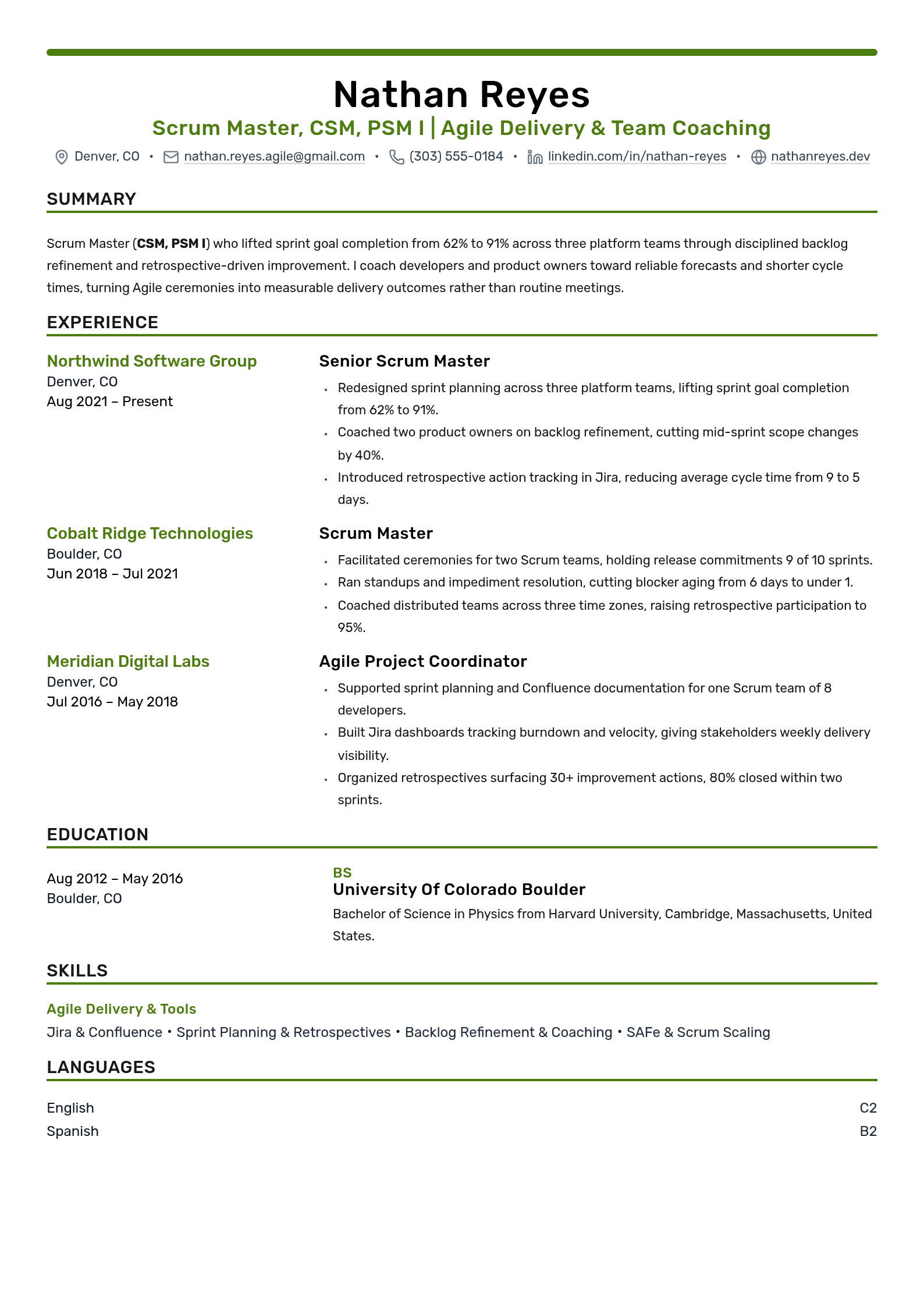
A scrum master resume fails for a predictable reason: it lists ceremonies instead of outcomes. "Facilitated daily standups, sprint planning, and retrospectives" describes the job of every scrum master on earth. It tells a hiring manager nothing about whether your teams shipped faster, whether your forecasts held, or whether the developers you served would want to work with you again.
The resumes that get interviews do two things at once. They carry the exact Agile vocabulary that applicant tracking system (ATS) filters and recruiter searches scan for, because a scrum master resume without "sprint planning" or "backlog refinement" in it gets filtered before a human reads it. And they attach a measurable result to every ceremony they name, because the human who reads it next is asking one question: did this person make teams better, or did they just run the meetings?
This guide walks through a complete scrum master resume example, the specific Agile keywords worth carrying, how to write a summary built on velocity and coaching, and how to adjust the same base resume for different tech stacks without rewriting it from scratch.
What makes a scrum master resume stand out
Hiring managers for scrum master roles have read hundreds of resumes that say "servant leader" in the first line and "removed impediments" in the third bullet. Those phrases are table stakes, not differentiators. What separates the top of the stack is evidence, and it comes in three forms.
Metrics that a scrum master actually owns. Velocity trends, sprint goal completion rates, cycle time, forecast accuracy, defect escape rates. You did not write the code, so your numbers describe the team's delivery health, not the product. "Improved sprint goal completion from roughly half of sprints to nearly all of them over two quarters" is a scrum master's number. Own it.
Coaching outcomes, not coaching activity. "Coached the team on Agile practices" is activity. "Coached two product owners on backlog refinement until refinement sessions dropped from three hours to one" is an outcome. Every coaching claim on your resume should end in a change someone else made.
Scope that matches the seniority you are applying for. A senior scrum master resume shows multiple teams, scaled frameworks like SAFe or LeSS, and influence on managers and stakeholders, not just developers. A first scrum master resume shows one team, deep ceremony fluency, and a certification. Mismatched scope is the fastest rejection: claiming "Agile transformation" when your experience is one team reads as inflation, and it gets tested hard in the interview.
One more structural point. Scrum masters sit adjacent to project managers and product owners, and recruiters often search across all three. Keep your title history honest, but make sure the scrum-specific vocabulary is dense enough that you surface in scrum master searches specifically. If your background straddles roles, the project manager resume guide and the product owner resume sample show how the keyword profiles differ.
Scrum master resume example
Here is a complete example. Notice the pattern in the experience section: every bullet names a ceremony or practice, then a change the team made, then a number the change produced. That is the template for your own bullets. Notice also where the certifications sit, near the top rather than buried at the bottom, because for this role they are a screening requirement, not a nice-to-have.
The Agile keywords that actually pass ATS filters
Scrum master postings are unusually consistent in their vocabulary, which makes ATS screening for this role more keyword-sensitive than for most jobs. Recruiters filter on ceremony names, framework names, and certification acronyms because those are the terms the hiring manager put in the requirements. If the posting says "backlog refinement" and your resume says "grooming sessions," a literal keyword filter can miss you even though you mean the same thing.
The keywords cluster into five groups. Your resume should cover all five, in the phrasing the posting uses.
| Keyword group | Terms to carry on the resume | Where they belong |
|---|---|---|
| Ceremonies | Sprint planning, daily scrum (or daily standup), sprint review, sprint retrospective, backlog refinement | Experience bullets, tied to an outcome each time |
| Frameworks and scaling | Scrum, Kanban, Scrumban, SAFe, LeSS, Agile transformation (only if true) | Summary and skills; experience if you ran one |
| Coaching and facilitation | Servant leadership, Agile coaching, facilitation, impediment removal, conflict resolution, stakeholder management | Summary and experience bullets, never as a bare skills list |
| Metrics and artifacts | Velocity, burndown chart, cycle time, sprint goal, product backlog, definition of done | Experience bullets, attached to the numbers you moved |
| Tools and certifications | Jira, Confluence, Azure DevOps, Miro, CSM, PSM I/II, A-CSM, SAFe Scrum Master (SSM) | Skills section and a dedicated certifications section |
Two rules make these keywords work instead of just existing. First, ceremony and metric keywords belong inside outcome bullets, not in a skills list. "Skills: sprint planning, retrospectives" passes a filter but embarrasses you with the human reader; "Restructured sprint planning around capacity-based commitments, raising sprint goal completion for two consecutive quarters" does both jobs. Second, spell out and abbreviate on first use: "Certified ScrumMaster (CSM)" and "Professional Scrum Master (PSM I)" cover both the recruiter who searches the acronym and the filter that matches the full name.
Resist stuffing. A resume that lists every framework from XP to SAFe without evidence reads as a keyword dump, and modern screening plus a five-minute interview question exposes it. Match the posting you are applying to. If it is a Kanban shop, your Scrumban and flow-metrics experience leads; if it is a SAFe enterprise, your PI planning exposure leads. The broader mechanics of matching are covered in our guide to ATS resume keywords.
Writing a summary focused on team velocity and coaching
The summary is three sentences, and each one has a job. The first states scope: years of experience, number of teams, and the environments you have worked in. The second states your best delivery result, ideally a velocity, predictability, or cycle-time improvement. The third states your coaching identity, the thing teams change because you were there.
Here is the difference in practice. The weak version: "Experienced scrum master and servant leader passionate about Agile methodologies and continuous improvement." Every word could belong to any candidate, and none of it survives a recruiter's seven-second first pass.
The strong version: "Scrum master with six years serving two to three concurrent software teams in fintech and healthcare. Raised sprint predictability enough that stakeholders stopped padding roadmap estimates. Known for coaching product owners on refinement until planning meetings run on time and end with commitments the team actually keeps." Scope, result, coaching identity. A hiring manager can picture that person in the room.
Avoid the word "passionate" and avoid claiming "Agile transformation" unless you led one across multiple teams with management buy-in. Both are so overused in scrum master summaries that they now read as filler. If you want more patterns, our guide on writing a professional summary includes worked examples across seniority levels.

How to detail sprint planning and retrospectives
These two ceremonies deserve the most space in your experience section, because they are where a scrum master's skill is most visible. Standups mostly run themselves; planning and retros are where teams either improve or stagnate.
For sprint planning, write about the inputs and the accuracy. What did you change about how work arrived at planning: refinement cadence, story sizing, definition of ready, capacity math? And what happened to commitment accuracy as a result? A bullet like "Introduced capacity-based sprint planning with explicit buffer for support work, cutting mid-sprint scope changes and making two-sprint forecasts reliable enough for the release calendar" shows you understand planning as a forecasting discipline, not a meeting to schedule.
For retrospectives, write about follow-through, not formats. Nobody is hired for knowing the sailboat exercise. What hiring managers want is evidence that your retros produced changes the team kept. "Ran retrospectives with a one-action rule and tracked each action to completion in Jira; the team's top recurring blocker, environment downtime, was escalated and resolved within a quarter" proves the ceremony did work in the real world.
Three to five bullets per role is the right density, with the strongest outcome first. If a bullet describes a ceremony without a consequence, cut it or find the consequence. Guidance on bullet count by role and seniority is in our answer to how many bullet points per job.
Where to list your CSM or PSM certifications
For scrum masters, certifications are a screening requirement more often than for almost any other role. Many postings name CSM or PSM explicitly in the requirements, which means recruiters filter on the acronym. That dictates placement: your certification must be visible in the top third of the page, not in a footer section after education.
The reliable pattern is to do both of these:
- Put the strongest credential in your header line or summary: "Scrum Master, CSM, PSM I" next to your name or in the summary's first sentence, so it survives the seven-second skim.
- Keep a dedicated Certifications section above Education, with the full name, the acronym, the issuing body, and the year: "Professional Scrum Master I (PSM I), Scrum.org, 2023."
Include the issuing body because CSM (Scrum Alliance) and PSM (Scrum.org) are different credentials with different renewal rules, and hiring managers know the difference. If your CSM has lapsed, either renew it before applying or list the PSM equivalent; a visibly expired certification raises a question you do not want to answer in a screen. Advanced credentials, A-CSM, PSM II, or SAFe Scrum Master (SSM), belong in the same section and matter most for senior scrum master roles at scaled organizations.
If you hold many certifications, list the ones the posting asks for first and trim the rest. The general placement logic, including when a certification should move into the header versus stay in its section, is covered in where to put certifications on a resume.
Preparing for scrum master interviews with Remi
Scrum master interviews are scenario-heavy. You will be asked how you handled a team that kept missing sprint goals, a product owner who bypassed the backlog, a developer who dominated retros. The keywords that got you the interview become the exact topics you defend in it, which is why every claim on the resume needs a real story behind it.
This is where Roleframe's interview practice earns its place in your prep. Remi, the career copilot inside the Roleframe editor, builds interview questions from what is actually on your resume, and on a tailored version, from the posting you attached. If your resume says you improved sprint predictability, Remi asks how, then scores your answer and tells you where it was thin, before a real interviewer does. It is a practice round against your own claims, one question at a time, and you can speak your answers aloud instead of typing them, which is closer to how the real interview feels.
Structure your stories with the STAR method (Situation, Task, Action, Result), and prepare one for each ceremony keyword on your resume: a planning story, a retro story, an impediment story, a coaching story, and a conflict story. If STAR is new to you, start with our practical guide to the STAR method. The scrum master twist on STAR: your "Action" is usually influence rather than authority, so name what you got other people to do and how.
Tailoring your base resume for different tech stacks
Scrum masters move between industries more easily than engineers do, but the postings still differ in ways your resume should track. A fintech posting emphasizes compliance and release governance. A startup posting emphasizes Kanban, flow, and wearing the product owner's hat when needed. An enterprise posting emphasizes SAFe, PI planning, and dependencies across teams. One generic resume splits the difference and loses to specialists on all three.
The workable system is a base resume plus a tailored version per application. Your base resume carries everything: every framework, every tool, every metric you have moved. Each tailored version reorders and rephrases to match one posting: the SAFe experience leads for the enterprise role, the Kanban metrics lead for the startup, the ceremony vocabulary shifts to match the posting's exact terms ("backlog refinement" vs "grooming," "daily scrum" vs "standup").
Three things to adjust per posting, in order of impact:
- Framework emphasis. Lead with the framework the posting names, and move unrelated ones down or out. A SAFe shop does not need three bullets about your Scrumban experiment.
- Tooling. Jira and Confluence cover most postings, but Azure DevOps shops filter on Azure DevOps. If you have touched the tool the posting names, it belongs in your skills section for that version.
- Domain vocabulary. Mirror the team context: "platform teams," "regulated environment," "distributed teams across time zones." These phrases signal fit before the interview does.
The mistake to avoid is editing your one master file for each application until it becomes a smeared average of every job you wanted. Keep the base intact and spin off versions. The full system, and why it beats one-resume-fits-all, is laid out in our guide to base resumes and tailored versions.
Import your resume and edit it live
If you already have a scrum master resume, you do not need to retype it to apply any of this. Upload it as a PDF to Roleframe and it comes back as editable blocks, roles, dates and bullets in place, with an analysis already run: a scored document with its weak sections named, not a blank canvas. From there, paste a posting and the fit report shows your ATS score against that specific job, which Agile keywords it asks for that your resume is missing, and a prioritized plan for what to change. You make the edits yourself, with Remi proposing rewrites bullet by bullet and you approving every change, so nothing lands on the page that you cannot defend in the interview.
When you export, save as PDF. It preserves your formatting exactly and parses cleanly in modern ATS software, and it is what Roleframe outputs. Send a Word file only if a specific employer explicitly asks for one, which is rare and getting rarer.
Frequently asked questions
- Is Scrum still relevant in 2026?
Yes. Job boards continue to carry scrum master postings across software, fintech, healthcare, and government, and Scrum remains the most widely named framework in those postings. What has shifted is the bar: employers increasingly want scrum masters who show delivery metrics and coaching outcomes, not just ceremony facilitation. Some organizations have folded the role into engineering management or agile coaching titles, which makes a results-driven resume more important, not less, because you may be competing for adjacent titles too.
- What is the 3-5-3 rule in Scrum?
It is shorthand for the structure of Scrum as defined in the Scrum Guide: 3 accountabilities (product owner, scrum master, developers), 5 events (the sprint itself, sprint planning, daily scrum, sprint review, sprint retrospective), and 3 artifacts (product backlog, sprint backlog, increment). Interviewers sometimes use it as a warm-up question, so know it cold. On your resume, the 5 events are your keyword backbone: each one you name should come with an outcome attached.
- What are the top responsibilities of a Scrum Master?
The ones hiring managers screen for: facilitating the Scrum events, coaching the team on self-management, coaching the product owner on backlog management, removing impediments, protecting the team from mid-sprint disruption, tracking and improving delivery metrics like velocity and cycle time, and helping the wider organization adopt Agile practices. Your resume should show evidence of most of these, phrased as outcomes rather than duties. "Removed impediments" is a duty; "escalated and resolved the team's recurring environment-downtime blocker within a quarter" is evidence.
- Is AI replacing scrum masters?
AI tools now handle some of the mechanical parts of the job: summarizing standups, drafting sprint reports, flagging burndown anomalies. What they do not do is the part that justifies the salary: coaching a defensive product owner, mediating a conflict between two senior developers, reading a room in a retro. The practical takeaway for your resume is to weight it toward the human work. A resume built on meeting facilitation looks automatable; a resume built on coaching outcomes and delivery improvements does not.
- Do I need a CSM or PSM certification to get hired?
For most postings, effectively yes: many name CSM or PSM in the requirements, and recruiters filter on the acronyms. PSM I (Scrum.org) is a one-time exam with no renewal fee; CSM (Scrum Alliance) requires a course and periodic renewal. Either satisfies most postings. If you hold neither and are targeting the role, PSM I is the faster path onto the resume. List the credential in your summary or header and in a dedicated certifications section with the issuing body and year.
- Can I write a scrum master resume with no experience in the title?
Yes, and most first scrum masters do. Mine your current role for Scrum-adjacent evidence: leading standups as a developer or QA lead, running retros, managing a Jira board, coordinating releases. Write those as scrum bullets with outcomes, add a PSM I or CSM certification to clear the screening filter, and use your summary to state the transition directly: what you have done in the framework and what you are moving toward. A career-changer resume that pretends the title existed reads worse than one that shows the evidence honestly.
- How long should a scrum master resume be?
One page for under roughly ten years of experience, two pages for senior scrum masters with multiple teams, scaled-framework work, or transformation experience worth detailing. The test is density: if page two is education and stale tools, cut it. Our breakdown of one page versus two by experience level covers the edge cases.
- Should I submit my scrum master resume as a PDF or Word document?
PDF, in nearly every case. It locks your formatting so the recruiter sees exactly what you built, and modern ATS software parses well-structured PDFs cleanly. Submit a Word file only when an employer explicitly requests one. Whatever the format, keep the layout simple: standard section headings, no text in images, and your keywords in real text the parser can read.


Ready when you are
Send the tailored resume, not the generic one.
Paste a job posting and Roleframe scores your resume against it, then helps you close the gaps one approved edit at a time, so you apply while the role is still fresh.