Retail Manager Resume Example: Formats, Metrics, and the Keywords ATS Filters Want
by Larbi SahliLast Updated
A full retail manager resume example, the operational keywords postings screen for (P&L, shrink, inventory control), and how to quantify your results.
Users have landed jobs at
- 1Password
- OpenAI
- Notion
- justworks
On this page
Retail management postings are written in a specific operational language: P&L, shrink, inventory control, visual merchandising, labor scheduling. Applicant tracking systems (ATS) and the recruiters behind them screen for that language, and most retail manager resumes fail the screen for one reason. They describe the job ("managed a team, handled inventory, drove sales") instead of proving the results in the numbers a district manager actually reviews every Monday morning.
This page fixes that. You get a complete retail manager resume example you can model, a breakdown of the operational keywords that recur across retail management postings, and the math for turning shrink, payroll, and turnover into resume bullets that survive both the ATS and the seven-second human skim.
The Anatomy of a Winning Retail Manager Resume
A retail manager resume has one job: convince a district manager or recruiter that handing you a store means the numbers get better. Everything on the page should serve that argument, in this order.
- Header with a clear title. Match the posting's language: "Store Manager" if they say store manager, "Retail Manager" if they say retail manager. Recruiters search their ATS by title, and "Retail Team Lead III (Band 4)" from your internal HR system matches nothing.
- A three-line summary that states your scope. Store volume, team size, and your best operational result. Scope is the first thing a hiring manager checks, because managing a $12M big box and managing a $900K boutique are different jobs.
- Experience section with quantified bullets. Each role gets 4-6 bullets, and the strongest bullet leads. Comp sales, shrink, payroll percentage, turnover, audit scores. Words describe; numbers prove.
- A skills section built from the posting's keywords. Inventory control, P&L management, visual merchandising, loss prevention, scheduling, POS systems by name. This is the section the ATS keyword match reads most literally.
- Education and certifications last, brief. Retail promotes on results. A degree helps at the district level; it rarely decides a store manager hire.
Format-wise, keep it to one page for under ten years of experience, two pages if you have run multiple locations or a district. Reverse-chronological order, no photo, no columns of icons, and standard section headings so the ATS parses cleanly. If you want the full reasoning on length, we broke down when a resume should be one page or two by experience level.
One formatting rule that matters more in retail than most fields: save and submit as PDF. Retail chains route applications through high-volume ATS platforms, and a PDF preserves your layout no matter what parses it on the other end.
Full Retail Manager Resume Example (Big Box Retail)
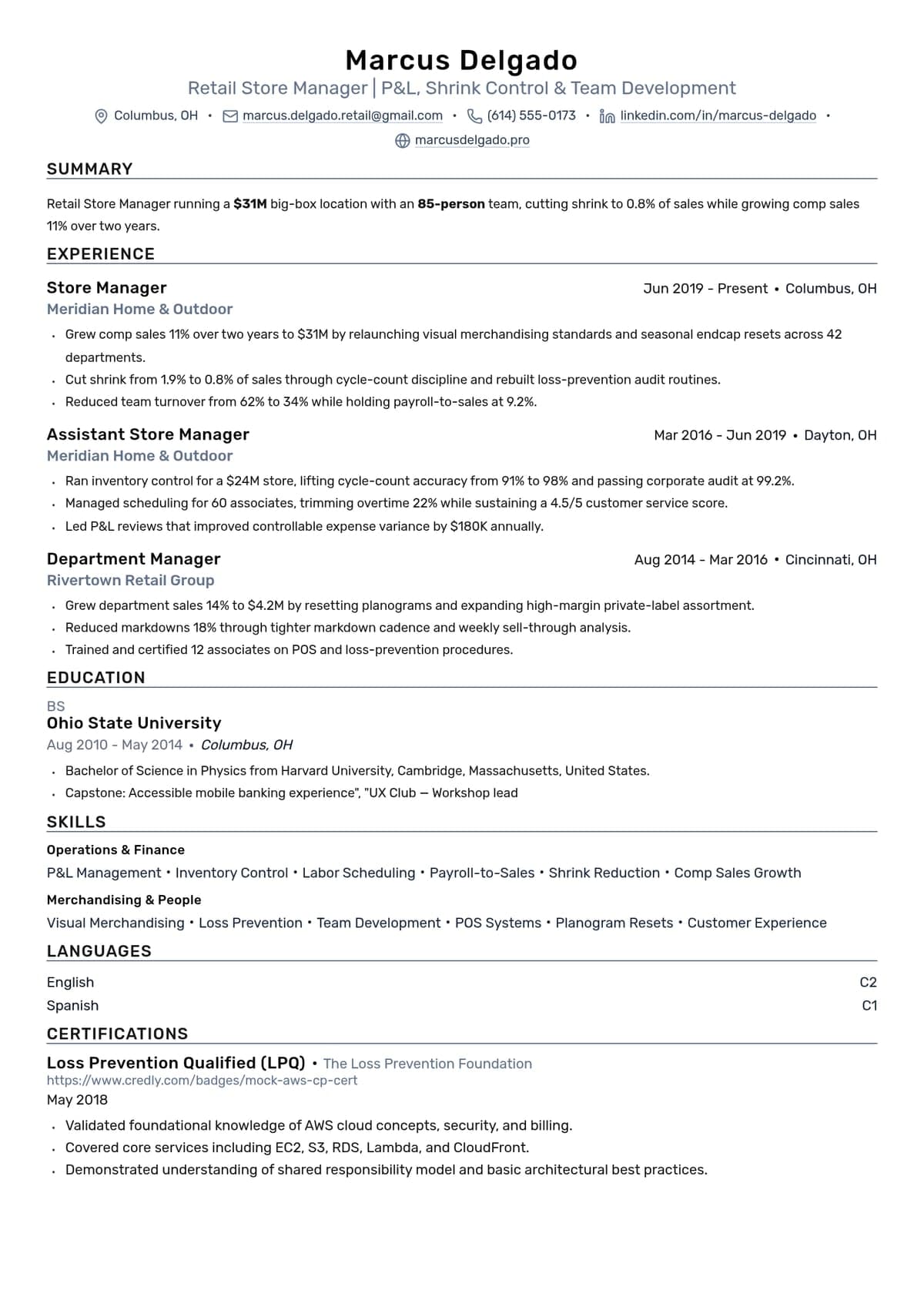
Here is what all of that looks like assembled. This example is built for big box and large-format retail, where the hiring conversation revolves around volume, P&L ownership, shrink, and leading large hourly teams. Notice how the summary states scope in the first line, and how every experience bullet pairs an operational lever with a measured outcome.
Two things to steal from this example even if your background looks different. First, the promotion path is visible: assistant manager to store manager at the same company signals that leadership above you already bet on you once. Second, no bullet says "responsible for." Every line starts with a verb and lands on a number or a concrete outcome.
Hard Skills vs. Soft Skills: What Retail ATS Filters Want
Retail management is the rare field where the soft skills genuinely matter as much as the hard ones. A manager who can read a P&L but can't retain a team runs a store that misses plan anyway. The catch is that the ATS screen and the human screen weigh them differently, and your resume has to pass both.
The ATS pass is literal. Recruiter filters scan for the operational vocabulary from the posting, and Roleframe's job-analysis engine, which reads real postings against real resumes, sees the same cluster of terms recur across retail management job descriptions again and again. These are the ones worth checking your resume against first.
| Keyword | What the employer means by it | How to prove it on your resume |
|---|---|---|
| P&L management | You own the store's profit and loss, not just its sales line | Name the volume you managed and one margin, payroll, or expense result |
| Inventory control | Counts, cycle counts, replenishment, and inventory accuracy | Inventory accuracy percentage, audit scores, or reduced out-of-stocks |
| Visual merchandising | Executing planograms and building displays that convert traffic | A display or reset tied to a sell-through or category sales lift |
| Loss prevention / shrink | Protecting margin from theft, damage, and process errors | Shrink as a percentage of sales, before and after your changes |
| Labor scheduling | Building schedules that hit payroll targets without killing service | Payroll as a percentage of sales, or coverage improvements during peaks |
| KPI / sales targets | Comp sales, conversion, average transaction value, units per transaction | Percent to plan, comp growth, or district ranking |
| Team development | Hiring, training, coaching, and promoting hourly staff | Number of promotions off your team, turnover reduction, engagement scores |
| Customer experience | NPS, customer satisfaction scores, complaint resolution | A measured CX score improvement or mystery-shop result |
Soft skills (leadership, communication, conflict resolution) belong in your bullets as demonstrated behavior, never as a list of adjectives. "Strong leader" in a skills section is noise. "Retained 9 of 11 holiday hires into permanent roles by pairing each with a trained mentor" is leadership, proven. The distinction is worth getting right across the whole document, and we cover it in depth in hard skills vs. soft skills on your resume.
The fastest way to know which keywords a specific posting screens for is to stop guessing. Paste the posting into Roleframe and the fit report lists the exact keywords it expects against the ones your resume already covers, with the gaps named. For the general method, see our guide to ATS resume keywords.
How to Quantify Shrinkage, P&L, and Turnover
Retail managers have an advantage most job seekers would kill for: the job produces numbers weekly. Comp sales, shrink results, payroll percentage, audit scores, turnover. If you ran a store, you have metrics. The problem is almost never a lack of data. It is that managers write "reduced shrink" and stop, when the number is the entire point.
Shrink
Shrink is measured as a percentage of sales, so state it that way: the before, the after, and what you changed. "Cut shrink from 2.1% to 1.3% of sales in one inventory cycle by tightening receiving verification and retraining the team on high-theft category zoning." That bullet tells a district manager three things at once: you know how shrink is measured, you diagnosed a cause, and you fixed it through process and people rather than luck.
If you don't remember the exact figures, pull them from old inventory results or state the relative change ("cut shrink by roughly a third year over year"). Never invent a precise number you can't defend, because shrink is the first thing a retail interviewer will drill into.
P&L
P&L bullets need two components: the size of what you managed and one lever you moved. Size first, because it sets your level. "Owned full P&L for a $9.5M location" reads differently from "assisted with budgeting." Then the lever: payroll held at or under target as a percentage of sales, controllable expenses cut, margin protected through markdown discipline. One strong P&L bullet per role beats four vague ones.
Turnover
Hourly turnover is retail's chronic pain, which makes a retention result one of the most persuasive bullets you can write. Quantify it as a rate change ("reduced hourly turnover from 85% to 52% annualized") or as a concrete retention outcome ("retained the full key-holder team through two peak seasons"). Pair it with the mechanism: a structured first-two-weeks training plan, a promotion pipeline, schedule stability. The mechanism is what proves it was you and repeatable, and it becomes your interview story later.
Adapting the Example for Boutique and Specialty Retail
The big box example above leans on volume and operational scale. If you manage a boutique or specialty store, copying that emphasis is a mistake, because the hiring manager is buying something different: clienteling, brand execution, and squeezing more out of every transaction rather than moving more transactions.
Shift the resume's weight accordingly.

- Lead with per-transaction and per-client metrics: units per transaction (UPT), average transaction value or average dollar sale (ADS), conversion rate, and repeat-client or client-book growth. These are the KPIs specialty retail lives on.
- Give visual merchandising more space. In a boutique, the manager often owns the creative execution, not just planogram compliance. A bullet tying a window or floor reset to a sell-through result carries real weight.
- Name the clienteling work: outreach programs, appointment selling, private events, and the tools you used to run them. "Grew the active client book 40% through structured post-purchase outreach" is a boutique manager's version of a comp-sales bullet.
- Keep the operational spine. Shrink, scheduling, and inventory control still appear in specialty postings; they just share the stage instead of headlining.
The team-size framing changes too. Leading six stylists is a coaching-intensity story rather than a scale story, so write it that way: individual development plans, product knowledge training, sales-per-hour improvement per associate. Small team, deep leadership.
Structuring Your Management Experience
Long retail careers create a structural problem: fifteen years across four banners and seven locations can read as either steady growth or a blur. Structure decides which.
- Stack roles under one employer. If you went sales associate to key holder to assistant manager to store manager at the same chain, list the company once with the roles stacked beneath it, dates on each. The promotion arc is the strongest thing on the page; make it impossible to miss.
- Compress the early years. Your associate and key-holder roles from a decade ago earn one line each, or a single "earlier roles" entry. Give the bullets to the last two management positions, where the hiring decision actually gets made. Our guide on how many bullet points per job has the exact allocation, but the principle is simple: recent scope gets the ink.
- Handle multi-store scope explicitly. If you covered a sister store, ran a remodel, or acted as interim district support, that is district-track evidence. Give it its own bullet with the scope stated: number of stores, combined volume, duration.
- Explain a step across banners in the summary, not the bullets. Moving from grocery to apparel or big box to specialty is common and fine; one summary clause ("across grocery and soft-lines formats") frames it as range instead of drift.
If you are past fifteen years, trim rather than cram. Guidance on how far back a resume should go applies doubly in retail, where a 2008 assistant manager role tells a 2026 hiring manager nothing your current P&L results don't say better.
How to Tailor Your Resume for Different Retail Sectors
Retail is not one industry. A grocery posting screens for perishables management, food safety, and department margin. Apparel screens for visual merchandising, markdown management, and seasonal transitions. Electronics and telecom want attachment rates, financing conversion, and technical product training. Luxury wants clienteling depth and brand protection. Same job title, different keyword sets, and an ATS keyword match doesn't award partial credit for the wrong sector's vocabulary.
The practical system: keep one master retail manager resume holding everything you have done, then spin off a tailored version per application that reorders and rewords for that sector's language. Your grocery version leads with shrink and perishables; your apparel version leads with merchandising and comp sales. Nothing is invented, only re-weighted. This is exactly the base resume and tailored versions workflow, and it is what Roleframe's role workspaces are built for: duplicate your base resume for a posting, read the fit report to see which sector keywords you are missing, and make the edits yourself with every change under your control.
A useful rule of thumb: if you can remove the retailer's sector from your resume and nothing changes, you haven't tailored it yet.
Using Remi to Prepare for Retail Leadership Interviews
Retail management interviews are behavioral almost end to end. Walk me through a shrink problem you solved. Tell me about firing an underperformer. How did you keep the team staffed through holiday peak. Every question expects a STAR-format story (situation, task, action, result), and the raw material for those stories is already sitting in your resume bullets.
Remi, the career copilot inside Roleframe's editor, turns that material into practice. Ask for interview prep and it builds questions from what is actually on your resume, and from the specific posting on a tailored version, then runs a live round: one question at a time, you answer, and it tells you where the answer went thin, like claiming a turnover win without naming what you changed. Because the questions come from your own bullets, the practice doubles as a resume audit. A bullet you can't tell a two-minute story about is a bullet that needs rewriting before you send the resume anywhere. If STAR structure is new to you, start with our practical guide to the STAR method in interviewing.

Drag and Drop: Putting Your Strongest Metrics First
Section order is an argument about what matters most, and the right order changes with the job. Applying to a heavy loss-prevention environment, your shrink results should be the first thing a skimming recruiter hits. Applying to a growth-focused specialty brand, comp sales and client-book bullets lead. Same resume content, different opening argument.
Most resume builders make reordering painful enough that nobody does it: fixed layouts, or moving a section means retyping it. In Roleframe's editor a section is a block you drag. Grab the handle, drop your skills section above experience or move your certifications to page two, and the block keeps its content, dates, and formatting. The judgment stays yours; the tool just removes the friction between deciding on an order and having it. For the reasoning behind which order fits which situation, see the best resume section order for your experience level.
Within the experience section, apply the same logic to bullets: strongest metric first under each role. Recruiters read the first bullet of every job and sample the rest. If your shrink turnaround is bullet five, most readers never meet it.
Build Your Retail Manager Resume for Free
You now have the structure, the keyword targets, and the math. The remaining work is assembly: open an editor, model the example above, and write your own numbers into it. Roleframe's resume editor is free with no account required: every template, drag-and-drop sections, and an unwatermarked PDF download with no card and no trial. If you already have a resume as a PDF, import it and it comes back as editable blocks with an analysis attached, so you start from a scored document with its weak sections named instead of a blank page.
Before you hit apply on a specific posting, run it through a fit report. Seeing the exact keywords a retail posting screens for, next to the ones your resume covers, replaces a half hour of guessing with a five-minute checklist.
Frequently asked questions
- What skills should a retail manager put on a resume?
Lead with the operational hard skills postings screen for: P&L management, inventory control, visual merchandising, loss prevention and shrink reduction, labor scheduling, and the POS or workforce systems you have used by name. Prove soft skills like leadership and conflict resolution inside your experience bullets with outcomes (turnover reduced, associates promoted) rather than listing them as adjectives. Match the exact wording of each posting, because ATS keyword filters read literally.
- What is a good summary for a retail or store manager resume?
Three lines: scope, strength, proof. State your years in retail management and your scope (store volume, team size), name your operational strength, and close with your single best number. For example: "Store manager with 9 years in big-box retail, currently running a $9.5M location with a team of 45. Known for shrink and retention turnarounds; cut shrink from 2.1% to 1.3% of sales while reducing hourly turnover by a third." Skip personality claims like "passionate" and "results-driven"; the numbers make the claim for you.
- What should a retail manager's resume look like?
One page for under ten years of experience, two if you have run multiple stores or a district. Single column, standard headings (Summary, Experience, Skills, Education), reverse-chronological order, and no photo or graphic gimmicks that trip ATS parsers. Every experience bullet should start with a verb and end at a measurable result. Export and submit as PDF so the formatting survives whatever system reads it.
- How do I write a retail manager resume with no P&L experience?
Claim the pieces of the P&L you did touch. Assistant managers usually own labor scheduling, shrink controls, or a department's sales plan, and each is a P&L line. Write "managed weekly labor scheduling against a payroll-to-sales target" or "owned shrink controls for a $2M department" instead of claiming full P&L ownership you didn't have. Interviewers respect precise scope far more than inflated titles, and an inflated claim collapses in the first follow-up question.
- Should I use the same resume for big box and boutique retail jobs?
No. The keyword sets differ: big box postings emphasize volume, shrink, payroll percentage, and large-team leadership, while boutique and specialty postings emphasize clienteling, UPT and ADS, conversion, and visual merchandising execution. Keep one master resume with everything, then create a tailored version per application that reorders and rewords for that sector. Nothing gets invented; the emphasis shifts to what each hiring manager is actually buying.
- Should a retail manager resume be a PDF or a Word document?
PDF, as the default and in nearly every case. Retail chains run high-volume applicant tracking systems, and a PDF renders identically no matter what opens it, so your layout and dates arrive intact. Only produce a different format if a specific employer's application explicitly demands it, and treat that as the exception.
Ready when you are
Send the tailored resume, not the generic one.
Paste a job posting and Roleframe scores your resume against it, then helps you close the gaps one approved edit at a time, so you apply while the role is still fresh.