How to Write a Professional Summary for a Resume (With 16 Examples)
Write a concise professional summary with a practical formula, 16 fictional examples by career stage, and a method for adapting emphasis without changing facts.


On this page
A professional summary can help when you need to connect your experience to a particular role. It is optional: use it if it adds useful context, and skip it when it only repeats the next section.
This guide covers what a summary does, a practical structure, a tailoring method we call the swap rule, and 16 fictional examples organized by career stage. The goal is to make relevant facts easy to understand, not to reach an assumed ATS score.
What Is a Professional Summary (and Who Needs One)?
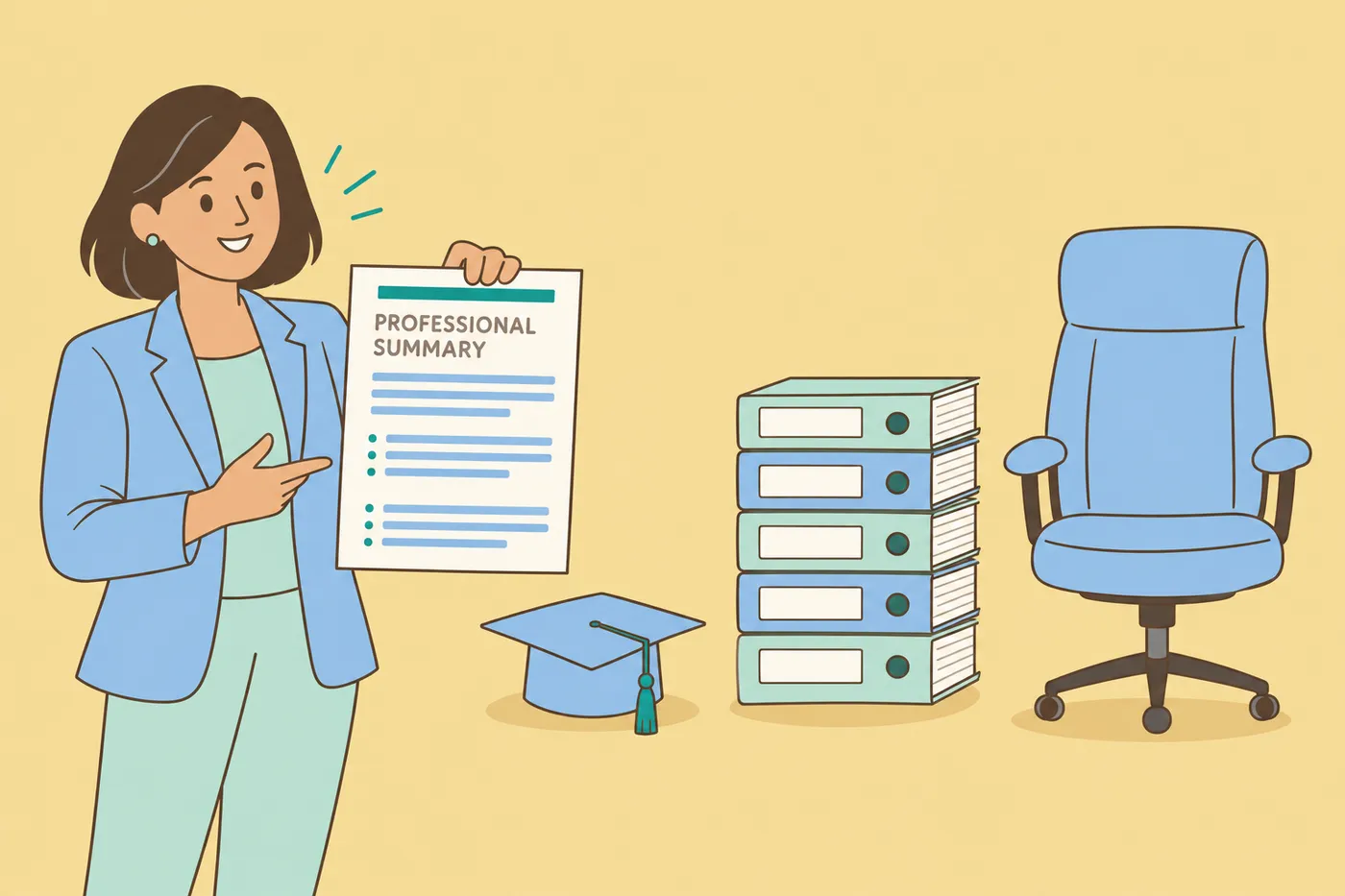
A professional summary is a short introduction near the top of a resume. Around three or four lines can be a useful drafting target, but the content and available space matter more than an exact word count. Explain your relevant background, specialization and supporting evidence.
A summary emphasizes what you bring. An objective emphasizes the role or direction you seek. Either can add context for a career change, and neither is mandatory. A graduate may prefer to lead with education and projects; an experienced candidate may prefer to move directly into relevant work.
Use the summary when it helps a reader connect information that is otherwise scattered across the page. Our section-order guide compares placement choices.
| Element | What it is | When to use it |
|---|---|---|
| Professional summary | 3–4 lines of positioning plus one proof point, aimed at a specific role | When a concise introduction adds relevant context |
| Objective statement | 1–2 lines about what you want from the employer | When the target or transition needs explanation; keep it tied to what you bring |
| Headline | A single line under your name, e.g. "Senior Product Manager · B2B SaaS" | When one accurate line provides enough orientation |
A practical structure for a resume summary
Build the summary from evidence already in your resume. Harvard's resume guidance emphasizes specific, active and factual language. The structure below applies that writing principle; it is not a universal hiring formula.
- Relevant identity: name your professional background or training. Add years of experience only when accurate and helpful.
- Specialization: identify the type of work, customers or technical area relevant to this role.
- One supporting fact: a result, responsibility or scope you can substantiate. A number is useful when available, but not required.
- Relevant terminology: name tools or credentials from the posting only when you have the stated experience or qualification.
- Optional direction: a brief explanation of your target, particularly for a career change.
A fictional example: "Project manager with 6 years delivering software implementations for healthcare clients. Managed a $2.4M portfolio at a 94% on-time delivery rate. PMP certified, experienced in Jira and stakeholder coordination." This combines background, scope and relevant qualifications. Use only facts that are true of you and permitted to share.
Keep the summary easy to read in the document body. Inspect the final file for missing text or awkward line breaks, as you would with any other section.
Start with relevant experience or direction
"Backend engineer with 7 years" is a direct opening when it is accurate. For a graduate, a degree and relevant project may be more useful. Resume writing often uses implied first person, such as "managed" rather than "I managed," to keep sentences concise. This is a style convention, not a screening requirement.
Write It Last
Writing the summary after the experience section can make selection easier. Choose a fact that matters for the target role and is supported later in the resume. It may be a metric, the scope of a responsibility or a concrete project; do not force a number when one is unavailable.
The Swap Rule: Tailoring Your Summary for Every Application
Review the summary for each application, but keep it when it already fits. To change emphasis efficiently, keep a base version in your master resume and consider these three swaps.
- Specialization: if you genuinely worked in more than one relevant area, emphasize the one connected to this role. Do not turn an unrelated project into sector experience you did not have.
- Terminology: use the posting’s recognizable names for skills and tools where accurate. Do not assume all employers use exact-match searches or ignore synonyms.
- Supporting fact: choose a result or responsibility that demonstrates a stated requirement, without assuming every startup or enterprise values the same metric.
The facts stay consistent: dates, qualifications, responsibility and results must remain accurate across versions. A different professional headline can explain a target role, but it should not rewrite a historical job title. Our base-and-versions workflow helps keep track of those drafts.
Relevant resume keywords can clarify the connection with a posting. There is no universal evidence that a summary receives special ATS weight simply because it appears at the top.
16 Professional Summary Examples by Seniority
All 16 examples below are fictional illustrations, including their figures and credentials. Borrow the structure, not the achievements. Replace every detail with truthful, shareable evidence from your own work or education. The career-stage ranges are organizing labels, not hiring requirements.
Students, graduates and first professional roles
When professional experience is limited, use relevant coursework, projects, internships or volunteering. Explain the activity and your part in it; metrics are optional.
- Marketing graduate. "Marketing graduate with hands-on experience running paid social for two student organizations, growing combined Instagram reach 4x in one semester. Certified in Google Analytics. Seeking a junior role on a performance marketing team."
- Computer science student. "Computer science senior with three shipped side projects, including a React app with 500+ monthly active users. Completed a summer internship at a fintech startup, closing 30+ production bugs in a Node.js codebase. Targeting junior full-stack roles."
- Graduate with no internships. "Biology graduate with four semesters of lab coursework covering PCR, cell culture, and gel electrophoresis. Led a six-person capstone team whose findings were presented at a regional undergraduate conference. Seeking an entry-level lab technician position."
Early Career (1–3 Years)
- Customer support specialist. "Customer support specialist with 2 years at a B2B SaaS company, resolving 40+ tickets a day at a 96% CSAT. Built the team's internal macro library, cutting average handle time 18%. Working toward a technical support engineer role."
- Staff accountant. "Staff accountant with 3 years of month-end close experience across two manufacturing clients. Cut close from 10 days to 6 by automating reconciliations in NetSuite. CPA candidate with two exam sections passed."
Mid-Career (4–9 Years)
- Project manager. "Project manager with 6 years delivering software implementations for enterprise healthcare clients. Managed a $2.4M portfolio across 5 concurrent projects at a 94% on-time rate. PMP certified, fluent in Jira and MS Project."
- Backend engineer. "Backend engineer with 7 years building payment systems in Go and PostgreSQL. Redesigned a transaction pipeline to handle 3x volume with no added infrastructure spend. Own services end to end, from design review to on-call."
- Enterprise account executive. "Enterprise account executive with 8 years selling HR software into companies of 1,000+ employees. Closed $3.1M in new business last fiscal year at 128% of quota, with an $85K average deal size."
- Registered nurse. "Registered nurse with 5 years in a 30-bed ICU and CCRN certification. Precepted 12 new nurses over the past two years while carrying a full patient load. Known for handoffs and charting that charge nurses can act on without follow-up questions."
Senior and Lead Roles
- Engineering manager. "Engineering manager leading 9 engineers across two product areas at a Series C startup. Cut deploy failures 60% by introducing staged rollouts and grew the team from 4 to 9 with zero regretted attrition. 12 years in backend systems, 4 of them managing."
- Head of demand generation. "Head of demand generation with 10 years in B2B SaaS. Built a pipeline engine that sourced 61% of new ARR last year on a flat budget. Deep in HubSpot and paid search, and still hands-on enough to write the landing page when it matters."
- Finance director. "Finance director with 12 years across FP&A and controllership, currently owning a $40M operating budget for a 300-person division. Led an ERP migration to NetSuite that landed six weeks ahead of schedule."
Executive
- Operations executive. "Operations executive with 15 years scaling fulfillment for e-commerce companies from $20M to $150M in revenue. Most recently cut cost per order 22% while opening two new distribution centers."
- Technology executive. "Technology executive with 18 years building engineering organizations of up to 80 people. Took two products from first commit past $10M ARR. Comfortable presenting to the board in the morning and reading pull requests in the afternoon."
Career Changers
- Teacher moving into L&D. "Former high school teacher moving into corporate learning and development with 8 years of curriculum design for groups of 30+. Built a district onboarding program adopted by 40 teachers across 3 schools. Completing an instructional design certificate."
- Military to supply chain. "Army logistics officer transitioning to civilian supply chain management after 9 years coordinating equipment and personnel movement for a 600-person battalion. Managed $12M in inventory with zero audit findings. Lean Six Sigma Green Belt with an active security clearance."
Notice that both career-change examples name the destination in the first line and then translate the old experience into the new field's vocabulary. That translation is the whole job of a career-change summary, and it extends to the rest of the document too; our guide to writing a career change resume walks through it section by section.
How to Quantify Your Summary Without Sounding Arrogant
Describe the work precisely and give credit where it belongs. A concrete result is easier to assess than a superlative, but it does not need to be numerical. Select information that is relevant, accurate and permitted to share.
- Choose a focused proof point rather than crowding the introduction with every metric. Save supporting detail for the experience section.
- Use scope where it helps: a budget, caseload, project type or area of responsibility can explain the work.
- Check confidentiality before sharing any metric, including a percentage. Relative numbers can still disclose restricted information. Use approved scope or a qualitative description when necessary.
- Credit the team honestly. Explain whether you led the work, contributed a component or supported someone else’s responsibility.
| Vague or inflated phrasing | Fictional specific alternative | What becomes clearer |
|---|---|---|
| Best salesperson in company history | Ranked #1 of 24 reps in FY2024 | The ranking and comparison group, if supported by records |
| Single-handedly transformed operations | Led a 6-person team that cut backlog 70% in two quarters | Team contribution, measured change and timeframe |
| Massive revenue growth | Grew ARR from $2M to $5M in 18 months | Starting point, outcome and timeframe |
Summary Anti-Patterns: Clichés to Avoid
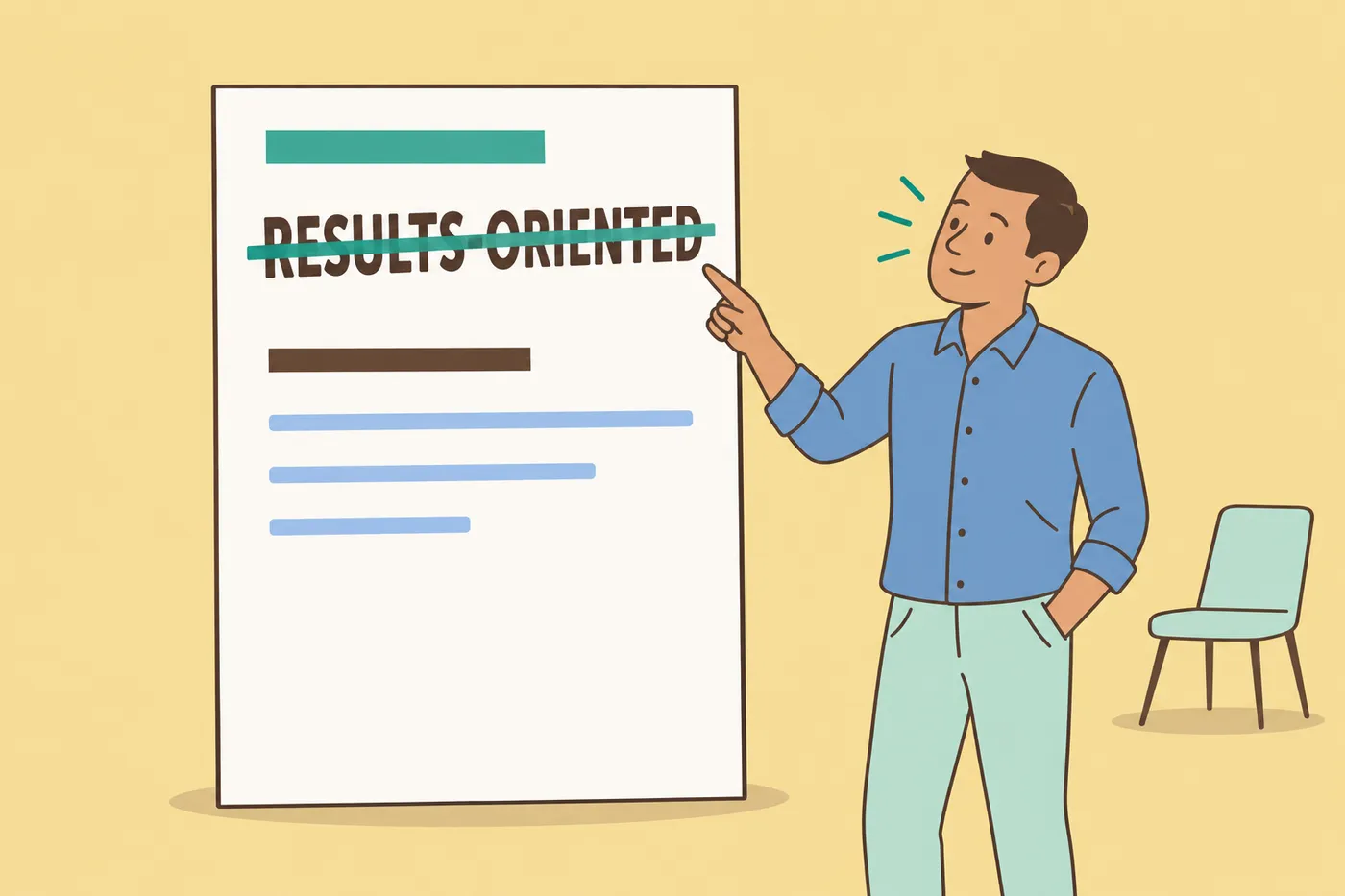
Review phrases that could describe almost anyone. A useful replacement names the work or evidence behind the claim. The examples below are illustrative and do not predict how an ATS or recruiter will assess you.
| Cliché | Why it fails | Write instead |
|---|---|---|
| "Results-driven professional" | Does not name a result | Name a specific relevant result or responsibility |
| "Proven track record" | Announces evidence without supplying it | "128% of quota last fiscal year" |
| "Excellent communication skills" | Needs a relevant example of communication | Show it, e.g. "presented monthly to the executive team" |
| "Seeking a challenging opportunity" | May leave your contribution unclear | Cut it and state your specialization |
| "Hard-working team player" | Does not explain the collaboration | Name a collaboration outcome, e.g. "partnered with design to cut handoff time 40%" |
| "Detail-oriented" | Needs an example of accuracy or careful work | Describe relevant checking, reconciliation or accuracy work |
Frequently asked questions
- What is a good example of a professional summary on a resume?
A useful summary names relevant experience and supporting evidence. A fictional example is: "Project manager with 6 years delivering healthcare software implementations. Managed a $2.4M portfolio at a 94% on-time rate. PMP certified, experienced in Jira." A qualitative project or responsibility can work when you do not have a shareable metric.
- How do I start off a professional summary?
Open with relevant experience, training or direction: "Backend engineer with 7 years" or "Biology graduate with laboratory project experience." Choose the description that is true of you. Avoid spending the opening on adjectives that do not explain your work.
- How do I write a summary about myself with no experience?
Use a relevant project, course, volunteer responsibility or other real experience rather than inventing employment. For example, describe what you built in a student project and which tools you used. A number can show scope, but a clear task is useful without one. You can also omit the summary and lead with education or projects.
- What is a short professional summary?
It is a concise introduction that adds relevant context. Roughly three or four lines is a practical starting point, not a rule. Cut repetition and leave enough space for the evidence in the rest of the resume.
- Should a resume summary be written in first person?
Write it in implied first person, meaning from your own perspective but with the pronouns dropped. "Managed a $2.4M portfolio" rather than "I managed a $2.4M portfolio." Third person ("John is an experienced manager") reads oddly formal on a resume and wastes words.
- Is a professional summary the same as an objective?
No. A summary emphasizes relevant background and evidence; an objective emphasizes the role or direction you seek. A short statement can combine both for a transition. Use whichever adds context, or omit the introduction when the rest of the page is already clear.



Ready to start your new resume?
Writing a resume takes time, and even a polished one can miss what a hiring manager is looking for. Roleframe helps you build a clear, ATS-safe resume in minutes and tailor it to the job you want.


