Project Director Resume Sample With Program-Level Scope
by Larbi SahliLast Updated
A project director resume sample built from an 18-year delivery career: nine programs, three titles at one employer, and the scope numbers PMOs screen for.
Users have landed jobs at
- 1Password
- OpenAI
- Notion
- justworks
On this page
Most project director resumes fail the same way: they read like a senior project manager resume that got longer. Fifteen projects, each with its own bullets, each closed "on time and on budget." A hiring committee reads that and sees a strong delivery lead, not a director. The title on the posting says director, so the resume has to argue portfolio, governance, and business outcomes, and it has to do it in the first third of page one.
The sample on this page is built from a single 18-year delivery career, because that is who actually searches for a project director resume sample. You have delivered many programs across several titles. Your problem is editorial, not biographical: deciding which of nine programs earns detailed bullets, which collapse into a one-line portfolio list, and how three titles at one employer become one entry that shows a promotion ladder instead of three short jobs.
This guide walks through each of those decisions, then shows you how to check the result against a real project director posting before you send it.
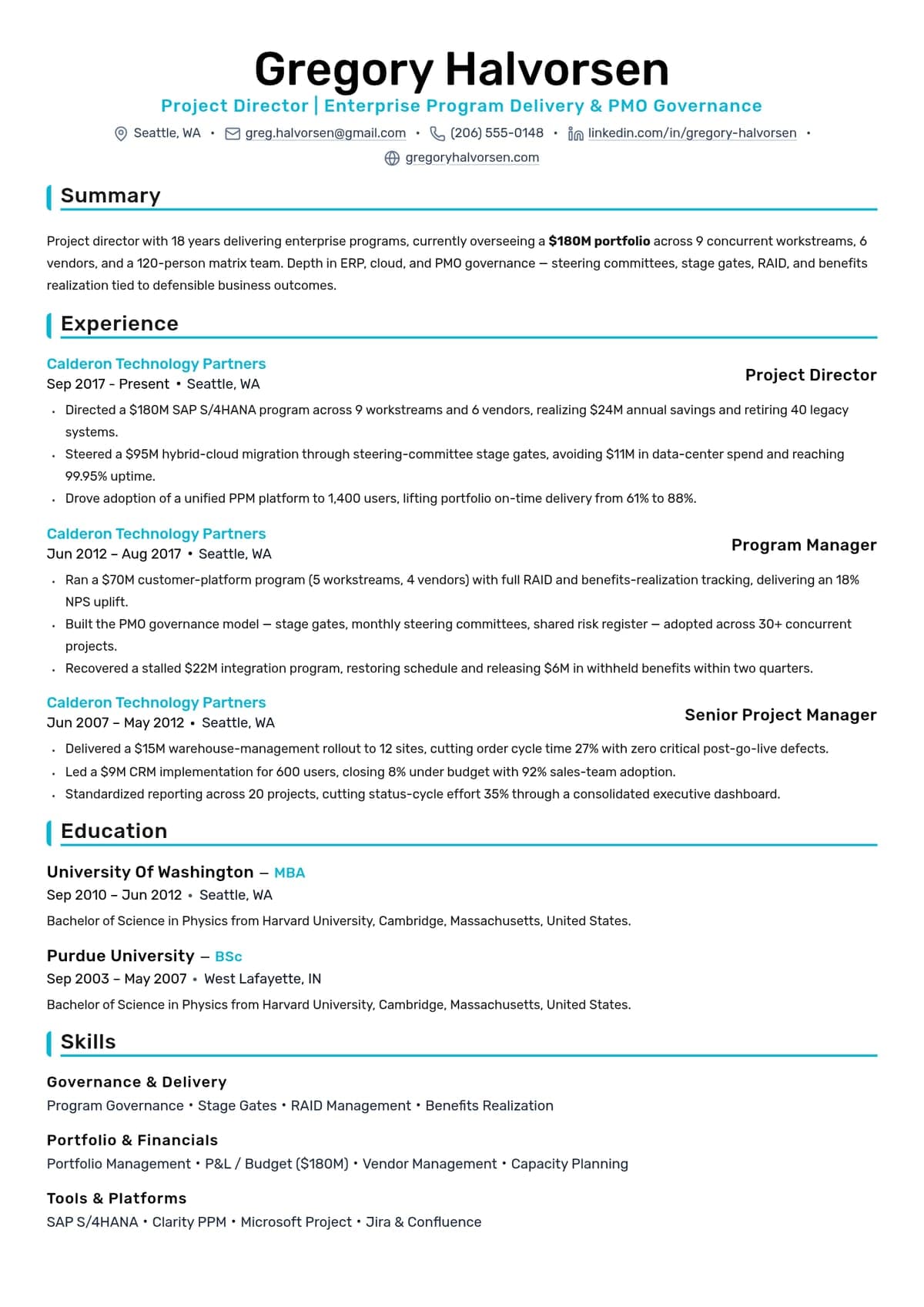
A project director resume sample built from one 18-year delivery career
The sample below makes four arguments at once. The summary quantifies the whole portfolio, not one project. The current employer is a single grouped entry carrying three titles and their dates, so the promotion ladder is visible in one glance. The three most consequential programs get full bullets with outcomes a sponsor would recognize. The remaining six appear as a portfolio list, one line each, with program value, workstream count, vendor count, and the result.
Read it as a set of decisions to copy, not text to copy. Your programs, values, and vendors will differ; the structure is what transfers.
What separates a project director resume from a senior project manager one
The difference is the unit of work. A project manager resume proves you can land a project: scope, schedule, budget, team. A project director resume proves you can run a portfolio of them through other people, decide which ones live and die, and answer to a steering committee for the business result. If your bullets still describe managing tasks and updating plans, you are describing the job you had two titles ago.
The practical test: count how many of your bullets start with delivery verbs (managed, coordinated, tracked) versus direction verbs (directed, governed, chartered, prioritized, escalated, negotiated). A director resume with a delivery-verb majority reads a level down, and hiring committees at this level are exactly the audience that notices.
| Dimension | Senior project manager resume | Project director resume |
|---|---|---|
| Unit of work | One project at a time, sequentially listed | A portfolio: concurrent programs with a combined value |
| Headline numbers | Project budget, team size, deadline met | Portfolio value, workstream count, vendor spend, matrix headcount |
| People story | Led a project team | Managed PMs and workstream leads; ran a matrix organization |
| Governance | Followed the methodology | Owned stage gates, steering committee reporting, RAID escalation |
| Outcome claim | On time, on budget, in scope | Benefits realized, adoption, cost avoided, risk retired |
| Audience | PMO manager, hiring manager | Sponsor, steering committee, executive hiring panel |
Senior PM to program manager to project director, inside one company
Three titles at one employer is the most common shape of a project director career, and the most commonly botched section of the resume. Written as three separate entries, it creates two problems. An applicant tracking system (ATS) and a skimming recruiter both read three stacked entries as three jobs, so a nine-year tenure looks like three short stints. And each entry repeats context (same company, same domain, same stakeholders), which burns space you need for outcomes.
Before, as three separate entries:
- Project Director, Meridian Health Systems, 2021 to present followed by four bullets
- Program Manager, Meridian Health Systems, 2017 to 2021 followed by four bullets
- Senior Project Manager, Meridian Health Systems, 2013 to 2017 followed by four bullets
After, as one grouped entry: the company name and full date range on one line, then the three titles stacked beneath it with their individual dates, then bullets. The current title gets the majority of the bullets and all the portfolio-level scope. Each earlier title gets one or two bullets that show what earned the promotion, written at the level that title held. The senior PM bullet can talk about a single project; that is what the role was, and the ladder above it is what proves growth.
The grouped format also fixes the parsing problem. One employer block with a continuous date range reads as one tenure to both software and humans, and the internal title lines make the promotions explicit rather than implied. If you built your resume in a rigid form builder that forces one title per entry, this alone is a reason to move to an editor that lets you structure the block yourself.
Which of nine programs earns bullets, and which goes in the portfolio list
Nine programs, all fully bulleted, is roughly 30 bullets of work history. Nobody reads 30 bullets. The editorial move that makes this resume work is a two-tier structure: full bullets for a small number of programs, one line each for the rest.
A program earns full bullets when it clears three bars:
- It maps to the target posting. If the posting is an IT project director role centered on ERP and infrastructure, the ERP consolidation gets bullets and the office relocation program does not, however proud you are of it.
- It has an outcome you can defend in an interview: a benefit realized, a cost avoided, a system adopted, a risk retired. "Completed successfully" is not an outcome, it is an absence of failure.
- It is recent enough to represent how you operate now. A program from 2009 rarely earns bullets even if it was the biggest of your career; it earns a portfolio line.
Everything else goes in the portfolio list: a compact block, usually titled something like "Selected program portfolio," with one line per program in a fixed pattern. The pattern that works carries four data points: what the program was, its value, its shape, and its result. Something like: Claims platform replacement | $22M | 5 workstreams, 3 vendors | retired 2 legacy systems, cut claim cycle time. One line, four facts, and a hiring committee can scan nine of them in fifteen seconds.
The portfolio list does two jobs the bullets cannot. It proves breadth without bloat, which is the whole tension of an 18-year resume. And it carries keywords. Program names, platforms, and domains (ERP, EHR, data center migration, regulatory remediation) all become searchable text that a recruiter's ATS keyword filter can hit, without you writing a paragraph about each one.
Scope that reads at director level: the four numbers that matter
Directors are hired on scope, and scope is numbers. Four of them belong in your summary and your current-role bullets, and most delivery careers can produce all four honestly with an evening of arithmetic.

- Portfolio value: the combined budget of the programs under your direction at peak, or annually. This is the single number a hiring panel uses to size you. "$60M portfolio" and "$6M portfolio" are different jobs with the same title.
- Concurrent workstreams: how many parallel tracks you governed at once. This is the number that proves you directed rather than delivered, because no one personally manages eleven workstreams.
- Vendor count and vendor spend: how many external partners you held to contract, and for how much. Vendor governance is a huge share of the actual director job, and most resumes at this level never mention it.
- Matrix headcount: the total people executing under your direction, including those who did not report to you. Say it that way: "directed a matrix organization of 85 across six workstreams." Direct reports alone undersells the role; claiming them all as reports oversells it.
Compute these conservatively and be ready to show the math. A director interview will probe the numbers, and a figure you cannot decompose into its programs is worse than no figure at all.
Governance wording a PMO recognizes
Project management office (PMO) screeners search for governance vocabulary because it is the fastest proxy for whether you have operated inside real structure. These terms are not buzzwords when they are attached to something you did; they are the shared language of the job. Wire them into bullets, not into a skills list where they prove nothing.
- Stage gates: "chartered and gated 9 programs through a 5-stage lifecycle" tells a PMO you ran a disciplined pipeline, not a spreadsheet of hopes.
- Steering committee: name the cadence and the audience. "Presented monthly to a steering committee of the CFO, CIO, and business unit VPs" places you in the room where decisions happen.
- RAID log: risks, assumptions, issues, dependencies. Owning the RAID at portfolio level, and escalating from it, is director work; maintaining one is PM work. Write the escalation, not the maintenance.
- Benefits realization: the discipline of tracking whether a program delivered the business case after go-live. If you ran benefits reviews, say so explicitly; it is the least common and most senior-sounding governance claim on this list.
- Change control: portfolio-level change boards and re-baselining decisions, especially ones where you killed or descoped a program. A resume that admits to stopping a failing program reads as more senior, not less.
One caution: governance language without outcomes is its own failure mode. "Established PMO governance framework" appears on thousands of resumes and means nothing by itself. Pair every governance claim with what it caught, saved, or decided. For the broader principle, see the list of resume buzzwords to cut.
Outcomes a sponsor cares about, instead of on time and on budget
"On time and on budget" is table stakes at director level. It describes the floor of the job, and every competing resume says it. A sponsor funded the program to change something in the business, so the resume outcome that lands is the change, with schedule and budget as supporting facts at most.
Rewrite the claim by asking what the business case promised. "Delivered the ERP consolidation on time and on budget" becomes "Consolidated 4 regional ERP instances onto one platform, retiring $2.1M in annual license and support cost." The second version answers the question the steering committee actually asked every month. Other outcome shapes that work: adoption ("3,800 clinicians live within 90 days of go-live"), cost avoided, revenue enabled, regulatory risk retired, cycle time cut.
Two rules keep this honest. Only claim a benefit you can trace to the program in front of an interviewer, and prefer the modest defensible number to the impressive fragile one. A director candidate who quietly says "we realized about 70 percent of the business case, and here is why" is more credible than one whose resume claims everything landed perfectly nine times in a row. Strong outcome verbs help here; there is a sorted list in our guide to action verbs by what they prove.
Certifications and tools screeners look for
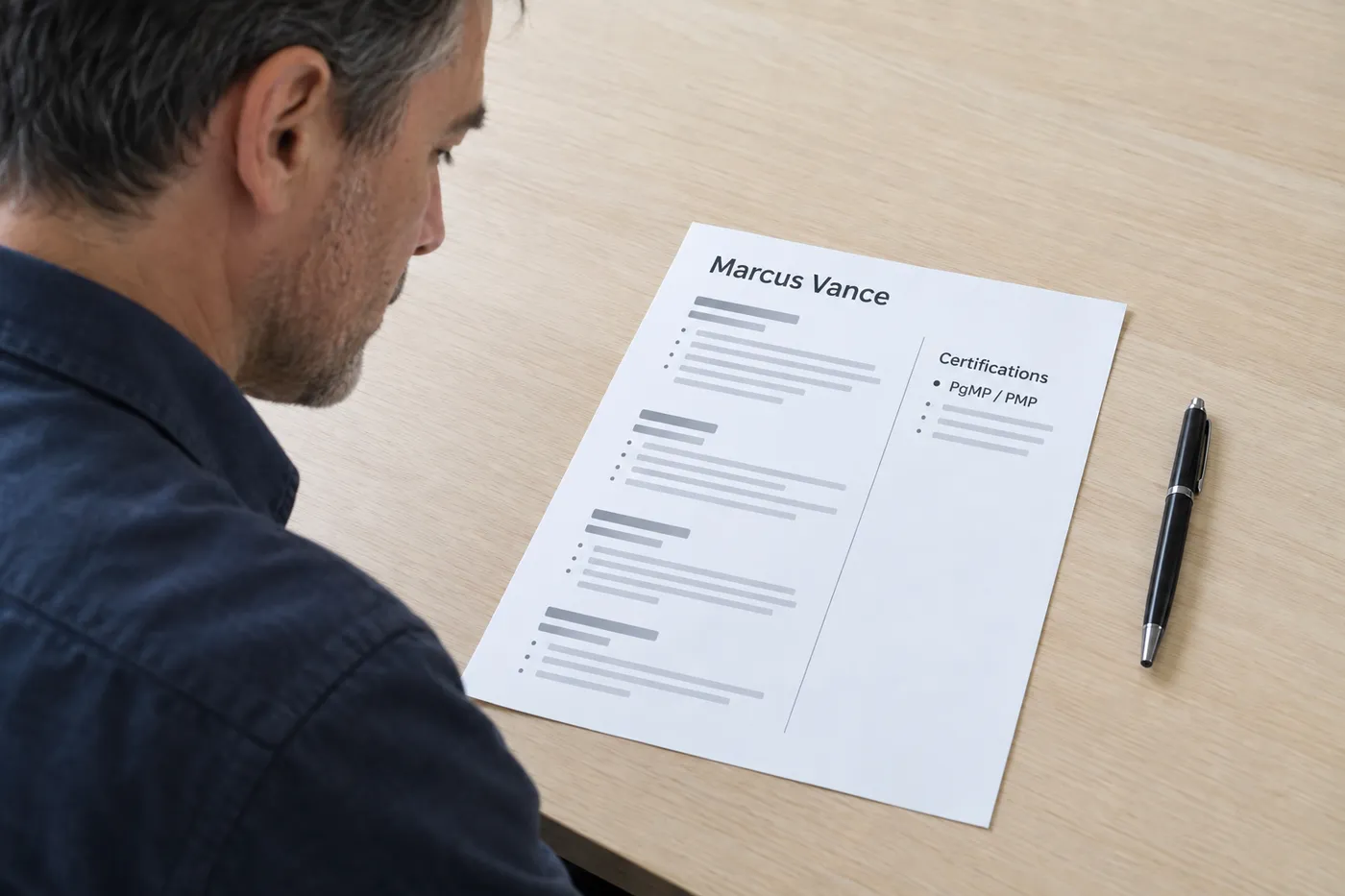
At this level, certifications work as filters more than as differentiators. Project Management Professional (PMP) is the default screen on most US project director postings, and its absence on an 18-year delivery resume raises a question you do not want asked. Program Management Professional (PgMP) is rarer and reads as a genuine director-level signal, since it certifies exactly the portfolio-and-governance work this resume claims. PRINCE2 and Managing Successful Programmes (MSP) matter for UK, European, and government-adjacent employers; list them if you have them and the employer's orbit suggests they care.
Tools deserve one honest line, not a paragraph. Primavera P6 signals construction, engineering, and capital programs; Microsoft Project and Jira signal IT and software portfolios; ServiceNow and Smartsheet turn up in enterprise PMO stacks. List the ones you have actually run programs in, in a skills section, and let the bullets carry the proof. Where the posting names a certification as required, it belongs near the top of the resume, not buried on page two; our guide on where to put certifications covers the placement logic.
Adapting the sample: IT, construction, and program director postings
IT project director
An IT project director resume sample earns its keep in the portfolio list: platform names and program types (ERP, CRM, data center migration, cloud, cybersecurity remediation) are what recruiter filters search. Keep the governance section intact and add the delivery methodology reality, which at director level usually means governing both agile and waterfall streams at once. Say that plainly if it is true; hybrid portfolio governance is a real differentiator.
Construction project director
A construction project director resume sample swaps the vocabulary, not the structure. Contract value replaces portfolio value as the headline number, subcontractor and trade management replaces vendor management, and safety record joins the outcome set. Primavera P6, contract forms, and permitting or regulatory milestones belong in the bullets. The nine-program portfolio list becomes a project schedule of builds with contract value and delivery outcome, and it works for exactly the same reason.
Program director and program manager postings
Program director postings overlap heavily with project director ones, and the same resume usually serves both once the summary mirrors the posting's own title. If the posting leans program, lead with program governance and benefits realization; the structure here already carries both. For a title one step down, the emphasis shifts toward hands-on program delivery, and our program manager resume examples show what that version looks like.
Compressing 18 years without losing the early wins
Two pages is the ceiling, and an 18-year career fills it fast. The compression logic runs top-down: the current grouped entry gets the most space, the portfolio list absorbs the middle years, and everything before roughly the 15-year mark compresses to a single line per employer, title and dates only, under a heading like "Earlier career." The general rule of thumb on lookback is covered in how far back a resume should go, and directors sit at the long end of it because career arc is part of the evidence.
The early wins survive in two ways. A genuinely defining early program can appear as a portfolio line even if the employer entry is one line. And the summary can carry the arc itself: "18 years in delivery, from IT project manager to a $60M program portfolio" preserves the origin story in twelve words. What must not survive is early-career bullet detail. A 2008 project bullet on a director resume signals that you could not tell what matters, which is the opposite of the judgment the title requires. If your professional summary does its job, the reader already knows the shape of the career before the entries confirm it.
Score it against a real posting before you send it
Every decision above gets sharper when it is made against a specific posting instead of in the abstract. Pull the actual language from a project director posting you want (the method is in how to pull resume keywords from a job description) and check which of its terms your resume already carries. Postings at this level are surprisingly literal: if the ad says "steering committee," "benefits realization," and "vendor management" and your resume says "leadership updates," "value tracking," and "partner oversight," a keyword filter scores you as a miss for work you have genuinely done.
Roleframe automates that check: paste the posting, and the fit report scores your resume against it, lists the exact keywords the posting uses that your resume is missing, and gives you a prioritized plan. Then Remi, the career copilot in the editor, helps you rewrite the specific bullets the report flags, with you approving every change, so the fixed resume is still in your words and defensible in the interview. Keep a tailored version per posting rather than overwriting one file; an IT project director application and a construction one should not share bullets.
Export and submit as PDF. It preserves the grouped-entry formatting and the portfolio list exactly as you built them, and it is what modern applicant tracking systems parse cleanly. Only send another format if a specific employer explicitly asks for it.
Frequently asked questions
- How do I write a strong resume for a director position?
Lead with scope, not duties. The summary should quantify what you directed: portfolio value, concurrent programs, vendor count, matrix headcount. Then prove judgment with outcomes a sponsor cares about (benefits realized, cost avoided, adoption) rather than delivery mechanics. Compress everything older than about 15 years to single lines, and mirror the posting's own governance vocabulary where it honestly matches your experience.
- What is the 7-second rule on a resume?
It is the shorthand for how briefly a recruiter skims a resume on the first pass before deciding whether to read properly. For a project director resume, it means the portfolio value, the current title, and one standout outcome must all sit in the top third of page one. If the first thing a skimmer meets is a paragraph of responsibilities, the seven seconds are spent before your best number appears.
- What does a project director actually do, and how should the resume reflect it?
A project director owns a portfolio of projects or programs: they charter and prioritize the work, govern it through stage gates and steering committees, manage the project managers and vendors executing it, and answer to sponsors for the business result. The resume should reflect that split: direction verbs (directed, governed, chartered, escalated) for the current role, delivery verbs reserved for the earlier titles in your ladder.
- What are the 5 P's of a resume?
It is an informal checklist that circulates in career advice: variations usually include preparation, purpose, presentation, proofreading, and personalization. The useful core for a director resume is the last one. A generic project director resume loses to a tailored one because postings at this level are literal about the governance terms and program types they want, and a resume checked against the specific posting covers them.
- Should a project director resume be one page or two?
Two pages is standard and expected for a director with 15-plus years of delivery. One page would force you to cut either the portfolio list or the promotion ladder, and both are core evidence. The discipline is staying at two: bullets for a few consequential programs, one line each for the rest, and single-line entries for early career. Three pages signals that you cannot prioritize, which is a poor trait to demonstrate in a portfolio-prioritization job.
- How do I show promotions from senior PM to project director on my resume?
Group them under one employer entry: company name and the full date range on the top line, then each title with its own dates stacked beneath. Give the current title most of the bullets and the portfolio-level scope; give each earlier title one or two bullets showing what earned the promotion. This reads as one long tenure with a visible ladder, where three separate entries read as three short jobs to both recruiters and ATS parsers.
- What is the difference between a program director and a project director resume?
Less than the titles suggest, and postings use them interchangeably in many industries. A program director posting typically leans harder on benefits realization, cross-program dependencies, and long-horizon governance, while a project director posting may weight delivery oversight and vendor management more. In practice, mirror the title and emphasis of the specific posting in your summary, and let the same portfolio evidence carry both.


Ready when you are
Send the tailored resume, not the generic one.
Paste a job posting and Roleframe scores your resume against it, then helps you close the gaps one approved edit at a time, so you apply while the role is still fresh.