Program Manager Resume Examples (And How to Beat the ATS)
by Larbi SahliLast Updated
A full program manager resume example, the ATS skills employers screen for, and how to show multi-program leadership recruiters can verify in seconds.
Users have landed jobs at
- 1Password
- OpenAI
- Notion
- justworks
On this page
Program manager resumes fail for a predictable reason: they read like project manager resumes with a bigger title. The candidate lists deliverables, timelines, and on-budget wins, and the recruiter has no way to tell whether this person ran one project well or steered a portfolio of interdependent workstreams toward a business outcome. Those are different jobs, and the resume has to prove the second one.
This guide shows you a complete program manager resume example, then breaks down why each section works: how to frame program-level scope in your summary, how to write bullets that show coordination across multiple projects and teams, which skills applicant tracking system (ATS) filters actually screen for, and how to check your resume against a specific posting before you hit submit.
Program Manager vs. Project Manager Resumes
Get this distinction right before you write a single bullet, because recruiters use it to sort candidates in seconds. A project manager delivers a defined scope on time and on budget. A program manager owns a group of related projects, resolves the conflicts between them, and is accountable for the business outcome the whole program exists to produce.
On a resume, that difference shows up in three places: the unit of work you describe, the people you influence, and the metric you claim. If every bullet ends in "delivered on time and under budget," you have written a project manager resume. That is fine if project management is the job you want. It undersells you badly if the posting says program.
| Dimension | Project manager resume | Program manager resume |
|---|---|---|
| Unit of work | One project with a defined scope and end date | A portfolio of interdependent projects and workstreams |
| Core claim | Delivered scope on time, on budget | Aligned multiple teams toward a business outcome |
| Stakeholders | Team members, a sponsor, a client | Executives, functional leads, vendors, cross-org partners |
| Key skill signal | Scheduling, risk logs, scope control | Dependency management, resource allocation across projects, governance |
| Success metric | Milestone and budget adherence | Revenue, cost savings, adoption, time-to-market for the program |
| Typical bullet verb | Delivered, scheduled, tracked | Orchestrated, prioritized, escalated, aligned |
One practical consequence: your bullets need a second layer of numbers. A project manager quantifies the project (budget, timeline, team size). A program manager quantifies the program: how many concurrent projects, how many teams, the combined budget, and the outcome the business got. The example below does exactly that.
Program Manager Resume Example
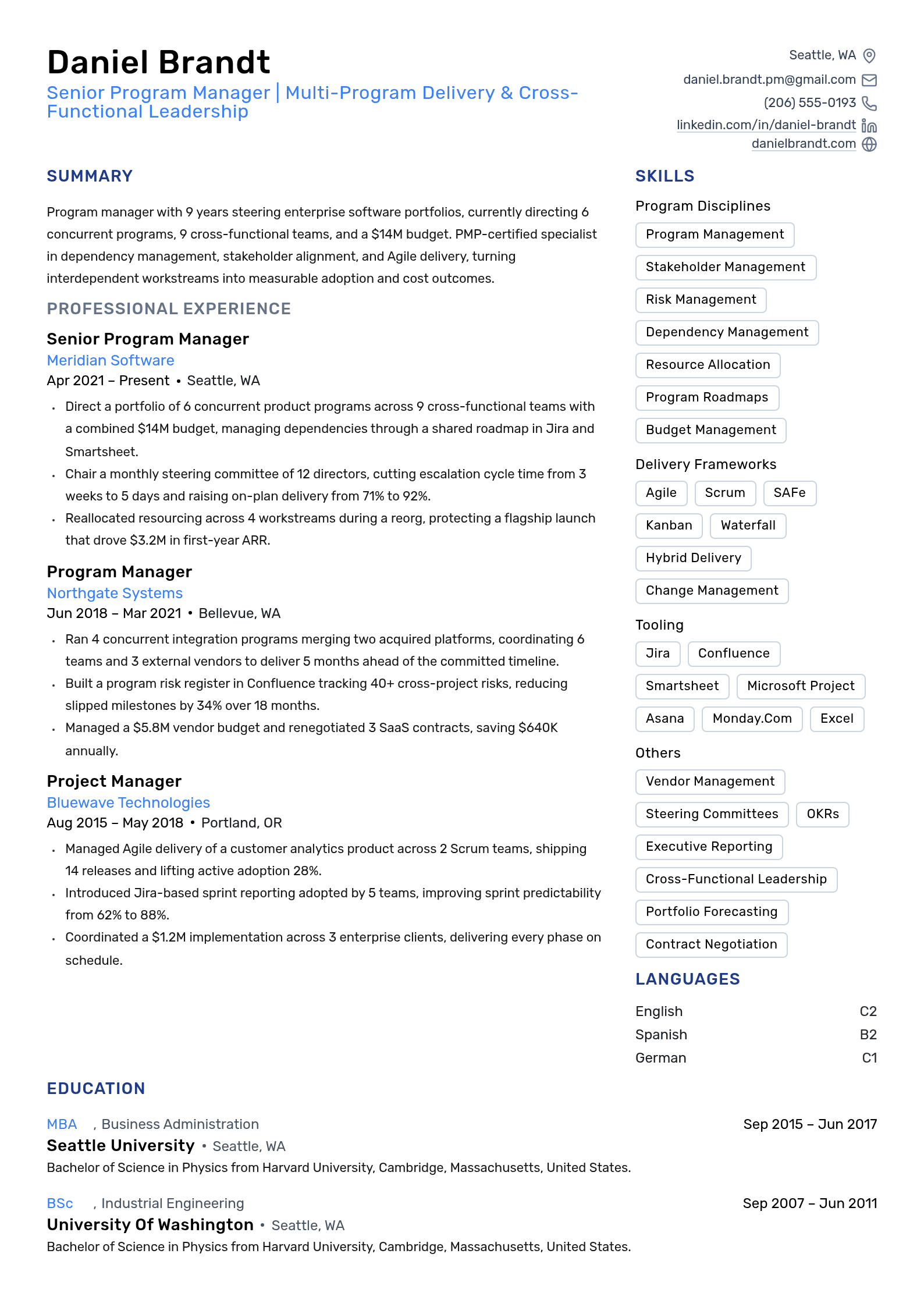
Here is a complete program manager resume you can use as a model. As you read it, watch three things: the summary states portfolio scope in the first sentence, every experience bullet names either the number of workstreams coordinated or the cross-functional teams involved, and the skills section mirrors the language of real program management postings rather than generic soft skills.
Why this resume works, section by section
The header is minimal. Name, city, phone, email, LinkedIn. A PMP after the name is one of the few title-line additions worth the space, because many recruiters filter on it before reading anything else.
The summary answers the scope question immediately. Concurrent projects, combined budget, teams coordinated, and one headline outcome. A recruiter skimming the top third of the page gets a program-level claim before their attention moves on.
The experience section quantifies coordination, not just delivery. Notice how bullets in the example name the number of workstreams, the functions involved, and the mechanism used to keep them aligned (steering committees, dependency reviews, escalation paths). That mechanism detail is what separates a candidate who ran a program from one who inflated a project title.
The career progression is visible. The example shows a project manager role earlier in the history. Do not hide that. Growth from project to program management is a credibility signal, and hiring managers look for it.
Key ATS Skills for Program Management
Before a human sees your resume, an ATS parses it and a recruiter runs keyword searches against it. Roleframe's job-analysis engine reads real program manager postings, and the same terms come up again and again across them. Missing the exact phrasing the posting uses is the most common reason a qualified program manager gets filtered out. "Managed stakeholders" and "stakeholder management" are the same competence, but only one of them matches a recruiter's search string.
The skills that appear most consistently in program manager postings fall into four groups:
- Core program disciplines: program management, stakeholder management, risk management, dependency management, resource allocation, program governance, budget management
- Delivery frameworks: Agile, Scrum, SAFe (Scaled Agile Framework), Waterfall, hybrid delivery
- Certifications: PMP (Project Management Professional), PgMP (Program Management Professional), Certified ScrumMaster (CSM), and increasingly SAFe certifications for tech programs
- Tooling: Jira, Confluence, Smartsheet, Microsoft Project, Asana or Monday.com, and Excel or Google Sheets for portfolio reporting
Two judgment calls worth making deliberately. First, list frameworks you have genuinely run programs under, not every methodology you have heard of; interviewers probe this, and a SAFe claim you cannot defend costs more than the keyword gains. Second, put certifications where the posting tells you to. If PMP is listed under requirements, it belongs in your header and a dedicated certifications section, not buried in a skills list. There is a fuller breakdown of that decision in where to put certifications on a resume.
Do not paste all of these into a skills section and call it done. Recruiters spot keyword walls instantly, and the stronger placement for most of these terms is inside experience bullets where they sit next to evidence. "Ran risk management across 6 workstreams, cutting escalations to the steering committee by half" beats "Risk management" in a list every time. For the mechanics of matching without stuffing, see ATS resume keywords: stop guessing and start matching.
Writing a Summary That Shows Cross-Functional Leadership
Your summary has one job: make a program-level claim in the first sentence that a recruiter can verify further down the page. Most program manager summaries fail by describing character instead of scope. "Results-driven leader with a passion for collaboration" tells a recruiter nothing they can check.
A working formula: title and years, then portfolio scope, then the functions you coordinate, then one outcome.
Weak: "Experienced program manager with strong communication skills and a proven track record of delivering complex initiatives in fast-paced environments."
Strong: "Program manager with 9 years leading enterprise software programs, currently directing 5 concurrent workstreams across engineering, design, and sales enablement with a combined $12M budget. Known for turning stalled cross-team initiatives into shipped outcomes, most recently a platform migration adopted by 40+ internal teams."
The strong version names the functions coordinated, which is the cross-functional leadership signal hiring managers scan for. Adjust the numbers to your reality, and never inflate them; every figure in your summary should be defensible in a screening call within ten seconds. If summaries are a weak spot for you generally, the worked examples in how to write a professional summary for a resume cover the pattern across seniority levels.

Detailing Multi-Project Coordination in Your Bullets
Multi-project coordination is the competence that defines the role, and it is the hardest thing to prove on paper. "Coordinated multiple projects" is a claim. A bullet proves it when it shows three things: the scale of the portfolio, the mechanism you used to manage it, and what changed because you did.
- Scale: how many projects or workstreams, how many teams, what combined budget. "Directed 4 concurrent product launches across 6 teams in 3 time zones."
- Mechanism: the actual coordination work. Dependency mapping, weekly cross-team syncs, a shared program roadmap, an escalation path, resource reallocation between projects. This is what interviewers dig into.
- Outcome: the program-level result. Launched on a coordinated date, cut cross-team blockers, freed engineering capacity, hit an adoption or revenue target.
Before: "Managed multiple projects simultaneously and communicated with stakeholders to ensure alignment."
After: "Orchestrated 5 interdependent workstreams for a CRM replacement program, running biweekly dependency reviews across engineering, data, and support; resolved 30+ cross-team blockers and delivered the cutover in a single weekend with zero customer-facing downtime."
The after version is longer, and that is fine. Program manager bullets earn their length when every clause carries a fact. What they cannot afford is a third layer of subordinate detail; if a bullet needs a second sentence, it is two bullets. Keep three to five per role for recent positions, fewer for older ones. The reasoning behind those counts is in how many bullet points per job on a resume.
One more pattern worth stealing: dedicate at least one bullet per recent role to a conflict you resolved between projects. Competing resource demands, a dependency that slipped, two teams building incompatible things. Resolving that tension is the core of the job, and almost nobody puts it on their resume, which makes it memorable when you do.
Using Remi to Sharpen Your Experience Section
Rewriting bullets is where most people stall. You know the bullet is weak, you stare at it, and forty minutes later it says the same thing with a fancier verb. This is the one place where AI help is genuinely useful, provided the AI does not take the pen from you.
In Roleframe's editor, Remi, your career copilot, works on the bullet you are looking at, in place. Select a vague line like "managed multiple projects," ask Remi to sharpen it, and it proposes a rewrite grounded in your resume's own analysis report, showing a word-by-word diff of what it would remove and add. Nothing changes until you accept it. On a version tailored to a specific posting, the rewrite also draws on that job's missing keywords, so closing a gap the report named takes one approved edit rather than a guessing session.
The approval step matters more for program managers than for most roles. Your interviews will drill into the specifics: how many workstreams, what governance cadence, which stakeholders pushed back. A machine-written resume full of plausible-sounding coordination claims collapses under that questioning. Because you approve every word Remi proposes, every line stays something you can defend. That is the whole point of assistance over ghostwriting, and it is why Roleframe deliberately does not write resumes for people.
How to Handle Employment Gaps or Career Transitions
Program management absorbs career changers well, because the core skills transfer: engineers, product managers, operations leads, consultants, and military officers all arrive with real coordination experience. The resume challenge is naming it in program management language.
For career changers, reframe rather than retitle. If you were an engineering lead who coordinated three teams through a migration, the honest bullet describes the coordination: the dependency management, the stakeholder alignment, the outcome. Do not change your old title to "program manager" (background checks surface this), but do make the program-shaped work impossible to miss. Consider a skills-forward section order so your transferable competencies appear before the unfamiliar titles; the full playbook is in how to write a career change resume.
For employment gaps, the rule is simple: a short gap needs no explanation, and a longer one gets one plain line, not an apology. "Career break for family care, 2023-2024" as its own entry reads as confident. Trying to disguise a gap with fuzzy date formatting reads as evasive, and recruiters check dates first. If you kept skills warm during the gap (a PMP renewal, volunteer program coordination, contract work), one bullet under the gap entry does more than any explanation.
If you are targeting more than one role type, say program manager and technical program manager, or program and senior project roles, do not stretch one resume across both. The summary that wins a TPM screen (technical depth, engineering fluency) is different from the one that wins a business program role (P&L outcomes, executive stakeholders). Keep a master resume per target and tailor from there; how to manage multiple resumes for different career paths walks through the system, and Roleframe's role workspaces exist for exactly this: one base resume per target role, with each application spinning off its own tailored version while the master stays untouched.

Analyze Your Resume Against a Program Manager Job Posting
A resume that matches the role in general still loses to one that matches the posting in particular. Program manager postings vary widely: one emphasizes SAFe and quarterly planning, the next wants vendor management and budget governance, a third is a TPM role in disguise that expects you to read architecture docs. Sending the same resume to all three means being a partial match for each.
The fix takes minutes, not hours. In Roleframe, duplicate your base resume for the job and paste the posting; you get a fit report: an ATS score against that specific posting, the exact keywords the recruiter will filter on and which ones your resume is missing, and a prioritized plan of what to rewrite and reorder for this role. Then you make the edits yourself, with Remi helping bullet by bullet. The report tells you, for instance, that this posting says "program governance" where your resume says "oversight," or that it asks for SAFe and you never mention it despite having run PI planning for two years.
That gap between what you did and what your resume says is where most program manager applications die. A per-job check closes it before the ATS ever sees you. If you want the underlying strategy, why you need a base resume and tailored versions makes the full case.
Download Your Resume as a Clean, Free PDF
Submit your resume as a PDF unless a posting explicitly demands otherwise. PDF preserves your formatting on every machine, and modern ATS platforms parse well-structured PDFs cleanly. What breaks parsing is not the file type; it is layout tricks like text boxes, tables used for positioning, and graphics-heavy templates. If you want the technical detail, see how to make your resume ATS-friendly.
You can build your version of the example above in Roleframe's free resume builder: the full document-grade editor with every template, drag-and-drop section reordering, and a free PDF download with no watermark, no trial, and no account required. If you already have a resume, upload the PDF and it comes back as editable blocks with an analysis already run, so you start from a scored document instead of a blank page. What you see in the editor is exactly what the exported PDF is, which matters when a two-column layout or a tight one-page format is doing work for you.
Frequently asked questions
- What do good program manager resumes look like?
One to two pages, reverse-chronological, with a summary that states portfolio scope (concurrent projects, combined budget, functions coordinated) in the first sentence. Experience bullets quantify coordination across projects, not just delivery of individual ones, and the skills section mirrors real posting language: stakeholder management, dependency management, program governance, plus the frameworks and tools you have actually used. Visible growth from project to program roles is a strength, so show the progression rather than hiding earlier titles.
- What are the top 3 skills of a program manager?
Stakeholder management, cross-project dependency management, and strategic prioritization. Stakeholder management appears in program manager postings more consistently than any technical skill, because the job is largely keeping executives, functional leads, and vendors aligned. Dependency management is what distinguishes program from project work. Prioritization, especially reallocating people and budget between competing projects, is what hiring managers probe hardest in interviews, so back all three with concrete bullets rather than listing them bare.
- What is the 7-second rule in resumes?
It is the common shorthand for how briefly a recruiter scans a resume on the first pass: a handful of seconds, not minutes. The practical consequence for program managers is that your program-level claim must sit in the top third of page one. If a skim of your summary and first two bullets reads like a project manager's resume, the scan ends there. Lead with portfolio scope and one headline outcome.
- What are the core responsibilities of a program manager?
Defining and owning a program roadmap that ties multiple projects to a business outcome, managing dependencies and conflicts between those projects, allocating resources and budget across the portfolio, running governance (steering committees, status reporting, escalations), and managing stakeholders from executives to vendors. Your resume should map bullets to these responsibilities explicitly, because recruiters check for them in roughly that order.
- Should a program manager resume be one page or two?
Two pages is normal and expected for anyone with more than a few years of program experience; the role's scope claims need room for evidence. Keep it tight, though: three to five bullets for recent roles, one or two for older ones, and cut anything from more than about fifteen years back. The full breakdown by experience level is in should a resume be one page or two.
- Do I need a PMP to get a program manager job?
No, but it helps at the screening stage. Many recruiters filter searches on PMP, and some enterprise and government postings list it as a hard requirement, so having it (or PgMP for senior program roles) gets you past filters that experience alone cannot. If a posting requires it and you have it, put it in your header and a certifications section. If you lack it, compensate with unmistakable scope evidence in your summary and bullets, and consider whether the certification is worth pursuing for your target market.
- How is a technical program manager (TPM) resume different?
A TPM resume adds technical fluency to the program skeleton: the systems involved (migrations, platforms, APIs, infrastructure), evidence you can read design docs and challenge engineering estimates, and delivery metrics engineers respect. The coordination story stays the same, but the stakeholders shift toward engineering leadership. If you target both TPM and general program roles, keep a separate base resume for each, because the summaries that win them are different.


Ready when you are
Send the tailored resume, not the generic one.
Paste a job posting and Roleframe scores your resume against it, then helps you close the gaps one approved edit at a time, so you apply while the role is still fresh.