
Mechanical Engineer Resume Examples (With the ATS Keywords That Actually Get Screened)
by Larbi SahliLast Updated
See a mechanical engineer resume example that passes ATS filters, plus the CAD and analysis keywords employers screen for: SolidWorks, GD&T, and FEA.

On this page
A mechanical engineer resume gets filtered on exact tool names before a human ever reads it. Traditional engineering firms, and especially aerospace, defense, and automotive suppliers, run some of the strictest applicant tracking system (ATS) keyword filters in any industry. If the posting says SolidWorks and your resume says "3D CAD software," the filter does not connect the two. You are out before the seven-second recruiter skim even happens.
This page gives you a complete mechanical engineer resume example, then works through the parts that decide the outcome: which CAD and analysis keywords employers actually filter on, how to write bullets around tolerances and cost savings, where your EIT or PE belongs, and how the same experience gets reframed for an R&D role versus a manufacturing role.
Why mechanical engineering resumes fail ATS screening
Most rejected mechanical engineering resumes fail for one of three mechanical reasons, none of which have anything to do with the candidate's ability.
Exact-match keyword misses. Recruiters at engineering firms search their ATS the way you search a parts catalog: by exact string. "SolidWorks" and "CAD modeling" are different search results. "GD&T" and "geometric dimensioning and tolerancing" are different search results. "FEA" and "finite element analysis" are different search results. The fix is simple and slightly inelegant: write the spelled-out term and the acronym together on first use, "geometric dimensioning and tolerancing (GD&T)," so both strings exist in the document. Do the same for FEA, CFD, DFM, and FMEA.
Formatting that shreds in the parser. Engineers love dense, two-column Word templates with text boxes, skill-rating bars, and tables. ATS parsers hate all of it. A text box can vanish entirely from the parsed output, taking your entire skills section with it. Keep the layout clean and machine-readable, and submit as a PDF, which locks your formatting in place. If you want the full checklist, see how to make your resume ATS-friendly without ugly design.
Generic titles and buried skills. "Engineer II" means nothing to a keyword filter. If your internal title was Engineer II but the job was mechanical design, write "Mechanical Design Engineer (Engineer II)" so the searchable phrase is present and you are still honest. And never bury your tools in prose only. A recruiter scanning for ANSYS should find it in a skills section in under a second, then see it proven in a bullet.
Mechanical engineer resume example: senior level
Here is what a strong senior mechanical engineer resume looks like in practice. Notice three things as you read it. The summary leads with a quantified outcome, a real one, in dollars or percentages. Every tool named in the skills section also appears inside an experience bullet, attached to a project result, which is what separates a keyword match from a credible keyword match. And the license is visible twice: after the name and in a dedicated section.
What to lift from this example, section by section:
- Header: name, "PE" after the name if licensed, phone, email, city and state, LinkedIn. No street address, no photo.
- Summary: three lines maximum. Title, years, domain, two tools the target job asks for, one quantified win. More on this below.
- Experience: reverse chronological, 3 to 5 bullets per role, each one an outcome with a tool or method embedded in it.
- Skills: grouped by category (CAD, analysis, manufacturing) rather than one alphabet-soup line. Groups help the human reader; the exact strings help the ATS.
- Certifications and licenses: a dedicated section, even if it holds only one line, because recruiters search for "PE" as a field.
Entry-level mechanical engineer resume: what changes when you have little experience
A recent grad's resume follows the same rules with the sections reordered. You lead with what is strongest, and for you that is education and project work, in that order.
- Education moves to the top, with your degree, school, and graduation date. Include your GPA if it is strong; leave it off if it is not, and be ready for the question either way.
- Your senior design or capstone project becomes an experience-style entry with its own bullets: what you designed, in which tool, to what spec, with what result. "Designed a 4-bar linkage gripper in SolidWorks, validated peak stress in ANSYS, and delivered a prototype that met the 2 kg payload spec" is a real engineering bullet, and it beats any coursework list. Here is exactly how to list a capstone project on your resume.
- Internships, co-ops, FSAE, Baja SAE, and machine-shop jobs all count. A season on a Formula SAE suspension team involves more real GD&T and DFM than most classroom hours. Write it like a job.
- EIT goes in your certifications section the day you pass the FE exam. It is one of the few credentials that reliably separates otherwise identical new-grad resumes, because it signals you are on the PE track.
- Skip the old-style objective statement. "Seeking a challenging position" tells the reader nothing. Write a two-line summary instead: degree, one or two tools, one project result.
One page. No exceptions at this stage. A new grad with a two-page resume is padding, and every reviewer knows it.
Top hard skills: SolidWorks, GD&T, and FEA keyword patterns
Roleframe's job-analysis engine reads real mechanical engineering postings to build per-job fit reports, and the pattern across them is consistent enough to plan around. SolidWorks is the CAD name that dominates product design and manufacturing postings. AutoCAD still appears, but it clusters in facilities, HVAC, and plant engineering roles rather than product development. CATIA and NX show up where you would expect them: aerospace and automotive OEMs and their suppliers. ANSYS and FEA concentrate in R&D, simulation, and analysis-heavy roles. And GD&T is the methodology that cuts across nearly everything with a manufacturing component, which makes it one of the highest-value strings a mechanical engineer can legitimately claim.
The practical takeaway: name the specific tool, never the category. "Proficient in CAD software" matches nothing. "SolidWorks (8 years), including sheet metal, weldments, and PDM" matches the filter and tells a design manager something real.
| Category | Exact keywords to use | Where they matter most |
|---|---|---|
| CAD | SolidWorks, AutoCAD, CATIA, NX, Creo, Inventor | SolidWorks for product design and manufacturing; AutoCAD for facilities and HVAC; CATIA/NX for aerospace and automotive |
| Simulation & analysis | ANSYS, finite element analysis (FEA), computational fluid dynamics (CFD), MATLAB, tolerance stack-up analysis | R&D, test, and analysis-heavy design roles |
| Drawing & tolerancing | geometric dimensioning and tolerancing (GD&T), ASME Y14.5, engineering drawings, first article inspection (FAI) | Nearly universal in roles that release parts to manufacturing |
| Manufacturing methods | design for manufacturability (DFM), CNC machining, injection molding, sheet metal, welding, casting | Manufacturing, sustaining, and process engineering roles |
| Quality & process | FMEA, root cause analysis, Six Sigma, lean manufacturing, PPAP, control plans | Automotive, medical device, and high-volume manufacturing |
| Data & PLM | Windchill, Teamcenter, SAP, engineering change orders (ECO), bill of materials (BOM) | Larger firms with formal release and change processes |
Two rules govern how you use this table. First, only claim tools you can operate under interview pressure; "exposure to ANSYS" that turns out to mean one lab session will surface in the first technical screen. Second, mirror the posting's exact wording. If the job says "ASME Y14.5," put "ASME Y14.5" on the page, even though you would normally just write GD&T. The filter is literal, so you should be too.
Writing an engineering summary that isn't fluff
Most engineering summaries are adjectives in a trench coat: "results-driven, detail-oriented mechanical engineer with a passion for innovation." Delete all of it. A summary earns its space only if it does the recruiter's matching work for them in three lines.
The formula: title + years + domain + two tools from the posting + one quantified win.
- Senior: "Mechanical design engineer with 9 years in high-volume consumer products. Own designs from SolidWorks concept through injection-mold tooling release; led a DFM program that cut unit cost 14% across three product lines. PE licensed."
- Entry-level: "Mechanical engineering graduate (BSME, EIT) with hands-on SolidWorks and ANSYS experience from a two-semester capstone: designed and prototyped a test fixture that passed first-article inspection on the first run."
Every phrase in those examples is either searchable or verifiable. Nothing is a personality claim. If you want more patterns to work from, this guide to writing a professional summary has sixteen worked examples across seniority levels.
How to quantify cost savings and tolerances in your bullets
Mechanical engineering is the easiest discipline in the world to quantify, and most mechanical engineers still write bullets like job descriptions. "Responsible for designing sheet metal components" describes a duty. Hiring managers pay for outcomes.
The rewrite pattern is always the same: action, tool or method, measured result.
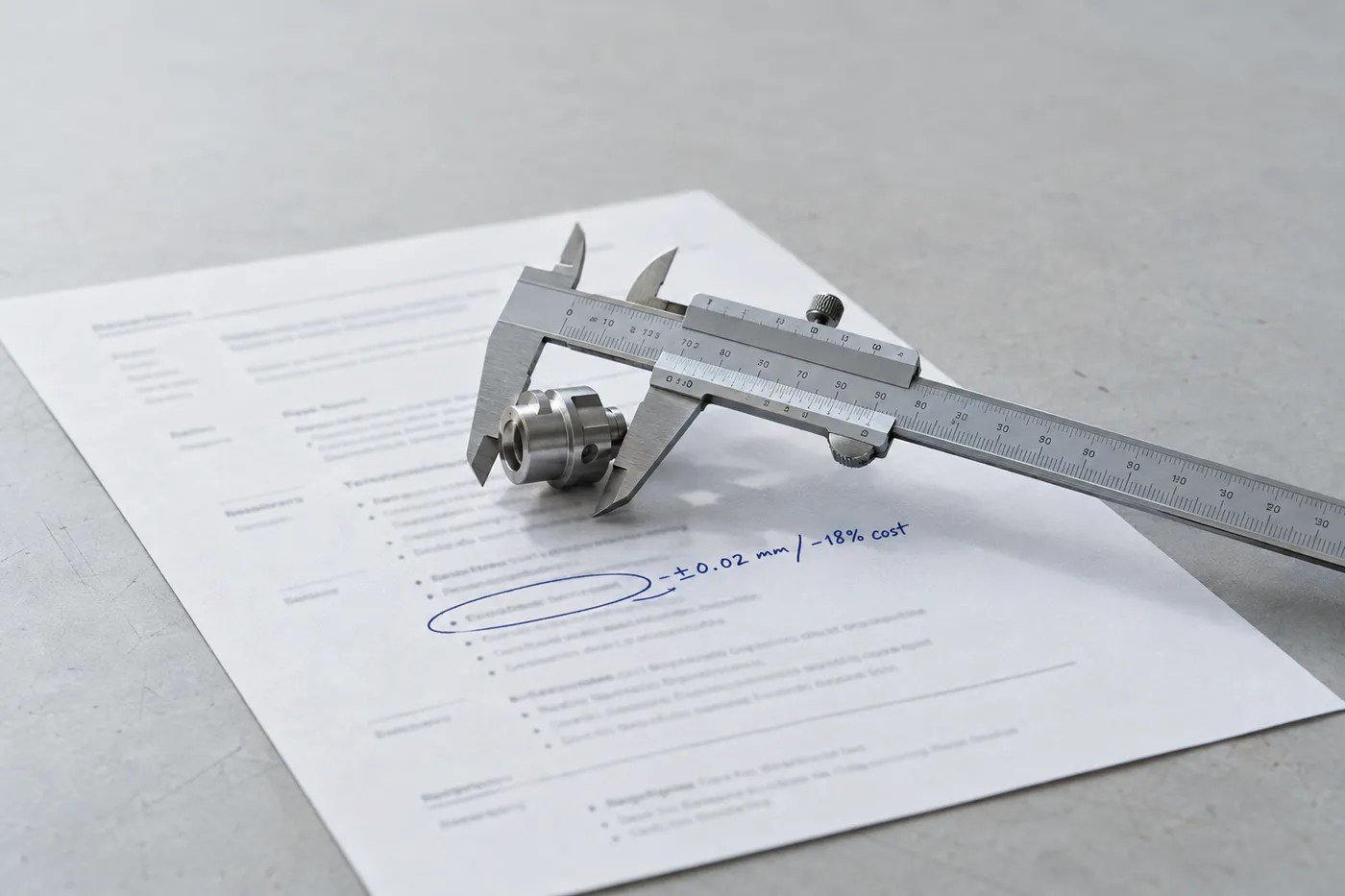
- Weak: "Designed enclosures in SolidWorks." Strong: "Redesigned a sheet-metal enclosure in SolidWorks, cutting part count from 14 to 6 and reducing unit cost by $11 across a 40,000-unit annual run."
- Weak: "Performed tolerance analysis on assemblies." Strong: "Ran tolerance stack-up analysis on a gearbox assembly, tightened the critical stack from ±0.5 mm to ±0.15 mm, and eliminated a recurring rework step on the line."
- Weak: "Used ANSYS for structural analysis." Strong: "Validated a bracket redesign in ANSYS ahead of physical testing, cutting prototype iterations from four to two and saving six weeks of schedule."
If you do not own a dollar figure, you still own numbers. Count what you touched: part count reduced, scrap rate lowered, cycle time cut, tolerance tightened, test hours saved, engineering change orders closed, first-pass yield improved. Tooling cost avoided is a favorite of manufacturing hiring managers because it is money they personally fight for in budget meetings.
One warning: never put a number on the page you cannot defend line by line in an interview. An estimated figure is fine ("roughly $200K in annual scrap reduction"). An invented one will end the interview the moment someone asks how you measured it.
Certifications: where EIT and PE belong on the page
The Professional Engineer (PE) license is the rare credential that belongs in two places. Put "PE" directly after your name in the header, because recruiters searching a database scan names first, and list the full license, with state and license number, in a dedicated Certifications and Licenses section. If the role involves anything with public-safety stamp authority, HVAC, structural, plant engineering, the PE is often a hard filter, and you want it impossible to miss.
The Engineer in Training (EIT) designation, sometimes listed as EI, goes in the certifications section only, not after your name. It signals commitment to the PE track, which matters most in your first five years, and it is worth listing the moment you pass the FE exam. Other credentials worth a line if you hold them: Six Sigma belts, GD&T certification (per ASME Y14.5), Certified SolidWorks Professional (CSWP), and PMP if you are moving toward project leadership.
Placement follows one rule: if the posting names the credential as required, it appears near the top of your resume; if it is nice-to-have, the section can sit lower. The full logic is in where to put certifications on a resume.
Tailoring your resume for R&D vs. manufacturing roles
The same eight years of experience reads differently depending on which bullets lead. An R&D hiring manager and a manufacturing hiring manager are looking for opposite instincts: one wants novel design validated by analysis and test data, the other wants cost, yield, and process discipline. Sending both the same resume means impressing neither.
| What to emphasize | R&D / design roles | Manufacturing / sustaining roles |
|---|---|---|
| Lead skills | FEA, ANSYS, CFD, prototyping, design of experiments (DOE), test planning | GD&T, DFM, tolerance stack-up, CNC machining, injection molding, lean |
| Bullet framing | Novel designs, analysis-backed decisions, prototype iterations cut, test results | Cost per unit, scrap and yield, cycle time, tooling savings, ECOs closed |
| Tools to surface | ANSYS, MATLAB, CATIA/NX, Creo | SolidWorks, AutoCAD, PLM systems (Windchill, Teamcenter), SAP |
| Summary angle | "Own designs from concept through validation" | "Take designs from release through stable high-volume production" |
The efficient way to do this is one base resume per target (one for design roles, one for manufacturing roles) and a tailored copy per application. Paste the posting into Roleframe and its fit report shows your ATS score against that specific job, the exact keywords the posting asks for that your resume is missing, and a prioritized plan of what to rewrite. You make the edits yourself, with Remi, Roleframe's career copilot, proposing rewrites bullet by bullet and you approving each change. The base-resume-plus-variants system is the workflow that makes this sustainable past your fifth application.
Build it in an editor that lets you drag sections where they belong
Section order is an argument, and it changes with your situation: a new grad leads with education and projects, a senior engineer leads with experience, a PE-required role wants the license visible immediately. Most resume builders lock you into their order or make you retype a section to move it. Roleframe's free editor does not: grab any section and drag it above another, into a column, or onto the next page, and it keeps its content and formatting. The editor needs no account, includes every template, and exports a clean, unwatermarked PDF, which is the format you should be submitting anyway, since it parses reliably and looks identical on every reviewer's screen.
Frequently asked questions
- How do I write a good mechanical engineering resume?
Lead with a three-line summary built from your title, years, domain, two tools the posting names, and one quantified result. Write experience bullets as outcomes with tools embedded ("redesigned X in SolidWorks, cutting unit cost by Y"), group your skills by category with exact tool names, and mirror the posting's wording since ATS filters match literal strings. Submit as a PDF with a clean, single-column-friendly layout.
- What skills should a mechanical engineer include on a resume?
Name specific tools, never categories: SolidWorks, AutoCAD, CATIA, or NX for CAD; ANSYS and finite element analysis (FEA) for simulation; geometric dimensioning and tolerancing (GD&T), design for manufacturability (DFM), and tolerance stack-up for methodology; CNC machining, injection molding, and FMEA where relevant. Write both the acronym and the spelled-out term on first use so either search string matches. Only list tools you can discuss under technical interview questioning.
- What should my resume summary say as a mechanical engineer?
State your title, years of experience, and domain, then name one or two tools from the target posting and one measurable win, such as a cost reduction, a tolerance improvement, or prototype iterations cut. Skip personality adjectives entirely; "detail-oriented" is a claim, while "cut unit cost 14% through a DFM redesign" is evidence. New grads should mention their degree, EIT if held, and a capstone result instead of years.
- How should an engineer's resume look?
Clean and machine-readable: standard section headings, no text boxes, no skill-rating graphics, no photo, and a common font at a readable size. Reverse-chronological experience with 3 to 5 bullets per role, skills grouped by category, and certifications in their own section. Export and submit as a PDF so the formatting holds on every screen and parses cleanly in an ATS.
- Should a mechanical engineer resume be one page or two?
One page through roughly your first five years, including internships and capstone work. Senior engineers with a decade of projects, patents, or a PE license can justify two pages if every line earns its place. The one page vs. two decision comes down to experience level, and padding is always more damaging than brevity.
- Should I list AutoCAD if the job asks for SolidWorks?
List both if you genuinely know both; CAD breadth is a plus, and AutoCAD still appears in facilities and plant-engineering postings. What you cannot do is let AutoCAD stand in for SolidWorks, because the ATS matches exact strings and the hiring manager will test the specific tool. If your SolidWorks experience is academic or personal, say so honestly ("SolidWorks: capstone and personal projects") rather than implying professional depth.
- Is a mechanical engineer CV different from a resume?
In the US, a mechanical engineer CV usually just means the resume, and everything on this page applies. A true academic CV, with publications, research, and teaching history, is only expected for research and faculty positions. For industry roles in the US, keep it to a focused one-to-two page resume; in the UK, Europe, and much of Asia, "CV" is the standard word for the same industry document.


Ready when you are
Send the tailored resume, not the generic one.
Paste a job posting and Roleframe scores your resume against it, then helps you close the gaps one approved edit at a time, so you apply while the role is still fresh.