HR Director Resume Example With Promotion History
by Larbi SahliLast Updated
An HR director resume that turns six HR roles into three employer blocks with nested promotions, plus the scope numbers and date syntax that pass an ATS.
Users have landed jobs at
- 1Password
- OpenAI
- Notion
- justworks
On this page
By the time you apply for an HR director role, your career is rarely a clean three-job story. It is usually a climb: HR generalist, then senior generalist, then HR business partner (HRBP), then HR manager, then senior manager, then director. Written as six separate entries, that history runs four pages and skims like job hopping. Written as three employer blocks with nested promotion lines, the same twelve years fit two pages and read as exactly what they are, a company promoting the same person over and over.
That formatting decision is the difference between the two versions of this resume, and it is the thing most HR director candidates get wrong. This page shows the two-page version done right, then walks through the mechanics: how to stack titles under one employer without confusing an applicant tracking system (ATS), which of your six roles deserves four bullets, the headcount and payroll scope numbers a director-level resume cannot skip, and where SHRM-SCP or SPHR belongs so a recruiter actually sees it.
The problem this resume has to solve
An HR director resume gets read by two audiences with opposite instincts. The recruiter or CHRO skims for scope: how many employees you supported, how big the payroll, how many sites, whether you have run a team and owned employee relations at volume. The ATS parses for structure: titles, employers, dates, and the keywords the posting filters on, from Workday to SPHR to collective bargaining.
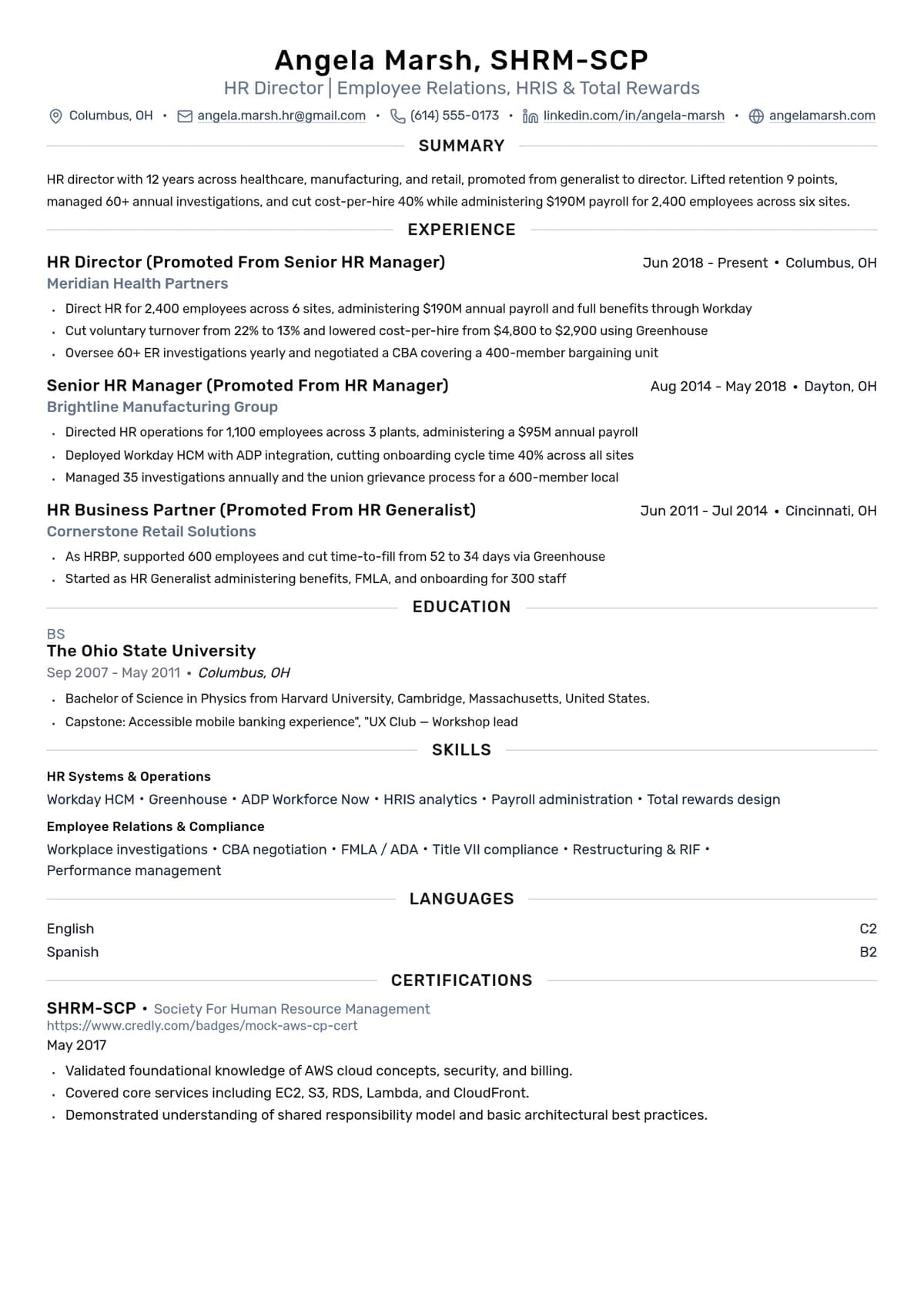
A flat, six-entry chronology fails both. The human sees six job changes before noticing four of them were promotions, and the repetition (every HR role involves onboarding, policy, and compliance) buries the growth. The parser does fine with six entries, which is the trap: candidates assume flat is safer for the ATS and pay for it with the human reader. The nested format below serves both, if you get the date syntax right. Here is the finished document.
What the example gets right: six roles, three blocks, two pages
Notice what the example does with structure before you read a single bullet. Three employer headers, each carrying the full tenure at that company. Under each header, the titles held there, newest first, each with its own dates. The promotions are visible in a two-second skim, which is precisely the window you get on a first pass.
Here is what changes when the same career is written both ways.
| Six flat entries | Three employer blocks, nested titles | |
|---|---|---|
| Length | Three to four pages | Two pages |
| First-pass impression | Six job changes in twelve years | Three employers, promoted at each one |
| Repetition | Onboarding, policy, and compliance bullets repeat six times | Duties stated once per employer, at the level you last held |
| What the ATS extracts | Six positions with clean dates | Six positions with clean dates, if each title line has its own date range |
| Where the reader's eye lands | The oldest, weakest roles get equal billing | The director role dominates page one |
The flat version is not wrong in any technical sense. It is wrong strategically: it spends your two most valuable inches of page-one real estate proving you were once a generalist, when the posting is asking whether you can run HR for 1,500 people.
How to stack generalist, HRBP, and manager titles under one employer
The rule: group by employer when the promotions happened at the same company, and keep every title visible with its own dates. You are making two claims at once, that you stayed (retention cuts both ways, and HR leaders who model it read better), and that you were promoted repeatedly. Collapsing to only your final title throws away the second claim; a director who "was always a director" at three companies is a less interesting story than one who earned the title.
The structure that works, top to bottom within each block:
- Employer line: company name, city and state, and the full tenure range for your whole time there.
- One optional context line under the employer: industry, revenue or employee count, so the reader can size the company without googling it.
- Each title on its own line, newest first, with its own month-and-year date range on the same line as the title.
- Bullets under the titles where they belong. Your director bullets sit under the director title, not pooled under the company.
The date syntax that keeps each promotion parseable
This is where nested formats go wrong in an ATS. Most parsers walk the document looking for title-plus-date pairs. If your titles have no dates because you put a single range on the employer line only, the parser either assigns the full company range to your last title or drops the earlier titles entirely. Either way, your promotion history disappears from the recruiter's database view, and some recruiters screen from that view rather than from your PDF. If you want the mechanics, here is how an ATS actually processes a resume.
The syntax that survives parsing:
- Every title line carries its own range: "HR Director | Mar 2021 – Present" on one line, title and dates together.
- Use month and year, not year alone, for anything in the last decade. "2019 – 2021" can read as a two-month or a two-year stint to a human and parses ambiguously.
- Keep one date format everywhere. If it is "Mar 2021" on one line, it is not "03/2021" on another.
- Make ranges contiguous within a block. The end month of one title should be the start month of the next; a gap between your own promotions looks like an error.
- Never put the title-and-date structure in a text box, a table, or a two-column split where dates live in a separate column from titles. Columns are fine for skills; they are risky for the experience section.
- When the ATS application form asks you to enter positions individually, enter all six as separate positions with their real dates. The form feeds the database; the resume tells the story. They do not need to match in structure, only in facts.
Which of six roles gets four bullets, and which gets one line
Bullet count follows relevance to the job you want, never tenure length. You may have spent four years as a generalist and eighteen months as a director; the director role still gets triple the space, because it is the only role doing the work of proving you can do the next one.
A distribution that works for a twelve-year, six-role climb targeting a director or senior director opening:
- Current HR director role: five to six bullets. Scope, team, and the three or four outcomes that map to the posting.
- Prior HR manager or senior manager role: three to four bullets, weighted toward whatever the director posting emphasizes (ER volume, HRIS migration, a site opening).
- HRBP role: two to three bullets. This is where business-partnering credibility lives, so keep the bullet where you sat with a P&L owner and changed a decision.
- Senior generalist: one to two bullets, only for things the later roles cannot show, a union environment, a restructuring, a system implementation.
- Early generalist roles: a single line each, or a combined "earlier roles" line with no bullets at all.
The honest way to decide which bullets survive is to read the posting, not your memory. If the job description mentions labor relations three times and talent acquisition once, your bullet budget should follow the same ratio. This is the judgment call a Roleframe fit report makes concrete: paste the posting, and it shows which requirements your current bullets already cover and which of your six roles holds the evidence for the gaps, so you cut and expand with the posting in front of you instead of guessing.
The scope numbers an HR director resume cannot skip
At director level, scope is the qualification. A hiring CHRO reading "responsible for all HR functions" learns nothing; the same sentence is on every HR resume from coordinator up. What they are trying to establish, and what your resume should hand them in the first ten seconds, is whether your scale matches theirs. Supporting 200 employees at one site and supporting 2,000 across nine states are different jobs with the same title.
Put these numbers on the page, in the summary and in the top bullets of your director and manager roles:

- Headcount supported, and whether it is salaried, hourly, or mixed. "HR leader for 1,400 employees, 70% hourly" tells a manufacturing CHRO more than a paragraph could.
- Annual payroll dollars administered, or benefits spend you managed. Payroll scope is the fastest proxy for organizational scale, and almost no HR resume includes it.
- Number of sites, states, or countries. Multi-site HR is a distinct skill; say so with a number.
- Bargaining units and which unions, if any. "Two bargaining units, ~400 represented employees" is a keyword and a qualification in one line.
- Size of the HR team you led, and its shape: generalists, recruiters, an HRIS analyst.
- Volume metrics for the work itself: requisitions filled per year, ER cases handled, open-enrollment population.
If you do not know your payroll number exactly, a defensible approximation ("~$85M annual payroll") beats omission. You will be asked about every number in the interview, so use figures you can stand behind, rounded rather than invented.
Open the summary with outcomes, not a duty list
Most HR director summaries are a duty inventory: "seasoned HR professional with 15+ years of progressive experience across talent acquisition, employee relations, benefits, and compliance." Every competing candidate can write that sentence, so it filters nobody in and nobody out. The summary that works leads with the three results a director gets hired to repeat: keeping people (retention), handling the hard cases (employee relations exposure), and controlling the cost of the machine (cost per hire, benefits spend).
A working pattern, three to four sentences: first sentence is scope (headcount, sites, payroll, industry). Second is your best retention or turnover result with the baseline and the timeframe. Third is ER credibility, stated as volume and outcome. Fourth, if the posting warrants it, a systems or cost result, a Workday migration, a cost-per-hire reduction, an in-housing of recruiting. Then your certification. The example above follows exactly this shape; compare its opening lines with whatever your current summary says. For the general craft of the section, see how to write a professional summary, but at this level the short version is: numbers first, adjectives never.
Which HR systems to name, and where they belong
System names are ATS keywords and credibility signals at the same time. A posting that runs on Workday will often filter for the word; a CHRO mid-migration wants to know you have lived through one. Name the systems you have genuinely administered or implemented, and be specific about your relationship to each: "administered" and "implemented" are different claims, and "selected and implemented" is a third, stronger one.
| System | What naming it signals | Where it belongs |
|---|---|---|
| Workday (HCM) | Enterprise-scale HRIS ownership; large-company credibility | Skills section, plus an experience bullet if you led an implementation or module rollout |
| UKG Pro / UKG Ready | Hourly, multi-site, timekeeping-heavy workforce experience (retail, manufacturing, healthcare) | Skills section; a bullet if you owned the rollout or the timekeeping compliance work |
| ADP Workforce Now | Mid-market payroll and HR operations; hands-on payroll scope | Skills section, next to your payroll-dollars bullet so the two reinforce each other |
| Greenhouse (or another ATS) | You have owned recruiting operations, not just overseen a recruiter | Skills section; a bullet with hiring volume or time-to-fill if talent acquisition is in the posting |
Two placement rules. First, systems live in a compact skills or systems line near the top of page one, where a keyword scan and a skimming recruiter both find them; do not scatter them only inside old bullets. Second, an implementation gets promoted from the skills line into a bullet, because "led Workday implementation for 1,400 employees, on time, replacing three legacy systems" is an accomplishment, while "Workday" in a list is a checkbox. Both belong on the page.
Employee relations bullets that stay specific without breaching confidentiality
ER is where HR director resumes go vague, for an understandable reason: the work is confidential. But "handled sensitive employee relations matters with discretion" proves nothing, and discretion is assumed at your level. The fix is to write in aggregates and process outcomes. Case counts, cycle times, and structural results are yours to share; names, departments, and case facts are not.
The pattern: volume, your role, the process improvement, the measurable outcome. Bullets built this way stay concrete and breach nothing:

- State caseload as a rate: how many investigations or ER cases per year, across how many sites, and whether you conducted, directed, or reviewed them.
- Report cycle time, not case detail: what average time-to-closure was when you arrived and what it was after you changed the intake or triage process.
- Claim structural outcomes: a grievance rate that fell, an EEOC or agency charge history with zero adverse findings during your tenure, a manager-training program that cut escalations.
- Name the frameworks, not the cases: investigation protocols you built, documentation standards you introduced, the ADA interactive-process workflow you formalized.
One caution: never claim an outcome that implies a specific person's case ("terminated a senior executive following my investigation"). Even anonymized, it reads as a confidentiality risk to the person deciding whether to hand you their hardest cases. Aggregate numbers make the same point safely.
SHRM-SCP, SPHR, and the certification block most directors bury
SHRM-SCP (SHRM Senior Certified Professional) and SPHR (Senior Professional in Human Resources) are among the few resume keywords that appear in HR postings as literal requirements, which means recruiters search and filter on the exact strings. Burying them at the bottom of page two, under education, in a section the first-pass skim never reaches, is the most common self-inflicted wound on senior HR resumes.
Put the credential in two places. After your name in the header ("Dana Whitfield, SHRM-SCP"), where it is the first thing both the recruiter and the parser encounter. And in a short certifications section on page one, near the skills line, with the granting body and year, where the full string "SHRM Senior Certified Professional (SHRM-SCP)" gives keyword filters both the acronym and the spelled-out form to match. If you hold both SPHR and SHRM-SCP, list both; different employers standardize on different bodies. The general placement logic is covered in where to put certifications on a resume, but for HR director roles the answer is always: page one, header plus section, never page two.
Cutting twenty years to two pages without losing the union and restructuring work
Two pages is the right length for an HR director resume; the evidence and the exceptions are in our one-page-versus-two breakdown. The hard part at twenty-plus years is not the cutting, it is choosing which early material earns its way back in. Most candidates cut chronologically, deleting the oldest roles wholesale, and in doing so delete the two things early HR careers often contain that later ones do not: union exposure and restructuring experience.
Cut by relevance instead. The mechanics:
- Detail the last ten to twelve years fully, in the nested-block format above. Guidance on the cutoff is in how far back a resume should go.
- Compress everything older into a two-to-three-line "Earlier career" strip at the end of the experience section: employer, title, years. No bullets.
- Then rescue the keywords. If your only union work was a plant generalist role in 2006, the earlier-career line for it names the union: "HR Generalist, Apex Manufacturing (2004–2007), supporting a 600-employee UAW-represented plant." One clause, and "union" and "UAW" are back on the page for the filter and the reader.
- Do the same for restructuring: "led HR workstream for a plant consolidation affecting 300 roles" can live inside an earlier-career line without bullets.
- Drop months for roles older than about fifteen years; years alone are fine there and save space.
- Delete the objective statement, the references line, and any duty bullet a coordinator could also write. That usually recovers half a page on its own.
The result is a document where page one is entirely your last two employers and your summary, and page two carries the third employer, the earlier-career strip, education, and certifications (which, again, also appear on page one). A CHRO can stop reading after page one and still have everything needed to shortlist you.
Before you send it
Save and submit as PDF. It preserves your nested title-and-date structure exactly, and modern ATS platforms parse PDFs cleanly; a Word file reflows on other machines and can shift dates off their title lines. Then reread the document asking one question per bullet: does this line contain a number a coordinator could not honestly claim? Every bullet that fails gets a scope figure or gets cut.
Frequently asked questions
- What does an HR director actually do, and what should the resume reflect?
An HR director owns the HR function for a business unit, region, or mid-sized company: workforce planning, employee relations, talent acquisition strategy, compensation and benefits administration, compliance, and leading an HR team, usually reporting to a VP of HR or CHRO. The resume should reflect ownership rather than participation: headcount and payroll scope, team size, and outcomes like retention gains and ER caseload handled, not a list of HR functions you touched.
- How do I show promotions on my resume without looking like a job hopper?
Group roles by employer. One employer header with the full tenure range, then each title nested beneath it with its own month-and-year date range on the same line as the title. The dates on every title line matter: without them, an ATS may collapse your history into a single role and the promotion story vanishes from the recruiter's database view.
- What is the 7 second rule for resumes?
It is a widely repeated rule of thumb that a recruiter's first pass over a resume lasts only a few seconds before they decide to keep reading or move on. Whatever the true number, the design implication is real: your title progression, scope numbers, and certification need to be visible in a skim of page one. The nested-promotion format exists precisely to survive that first pass.
- What are the top skills for an HR director resume?
The ones postings filter on: employee relations and investigations, labor and union relations where relevant, HRIS administration with the system named (Workday, UKG, ADP Workforce Now), talent acquisition strategy, compensation and benefits, and compliance (FMLA, ADA, EEO). Pair each with evidence in a bullet. A skills list without a matching accomplishment reads as a keyword dump at this level.
- Should an HR director resume be one page or two?
Two. With ten or more years and multiple promotions, one page forces you to cut the scope numbers and ER detail that get directors hired, while three pages signals you cannot prioritize, which is itself a director-level skill. Two pages, with the most recent two employers filling page one, is the standard senior format.
- Should I send my HR director resume as a PDF or a Word document?
PDF, as the default. It locks your layout so nested titles and dates render identically everywhere, and it parses cleanly in modern ATS platforms. Use a Word file only when a specific employer or recruiter explicitly asks for one, which occasionally happens with executive search firms that reformat candidate documents, and even then confirm the request before switching.
- How far back should an HR director resume go?
Detail the last ten to twelve years fully and compress everything older into a brief earlier-career line with no bullets. The exception is early experience the posting values, union environments and restructurings most often, which earns a one-clause mention inside that line so the keyword stays on the page.


Ready when you are
Send the tailored resume, not the generic one.
Paste a job posting and Roleframe scores your resume against it, then helps you close the gaps one approved edit at a time, so you apply while the role is still fresh.