
Embedded Software Engineer Resume Example (And the Keywords Generic Builders Miss)
by Larbi SahliLast Updated
A full embedded software engineer resume example, plus the C/C++ and RTOS keyword strings ATS filters match on and how to quantify memory and power wins.

On this page
Embedded software resumes get screened by people who have never flashed a board. The recruiter running the first pass is matching strings against the posting, and the applicant tracking system (ATS) before them is doing the same thing with less judgment. If the posting says FreeRTOS and your resume says “experience with real-time systems,” you can lose that match on a technicality.
This page walks through a complete embedded software engineer resume example, then the two things generic resume builders get wrong for this field: which keyword strings recruiter filters actually match on, and how to turn a bench debugging war story into a bullet a hiring manager stops on.
Writing a Resume for Hardware-Software Integration
Embedded roles are screened by two readers with opposite needs. The recruiter wants matchable strings, often without knowing what a real-time operating system (RTOS) does. The hiring manager reading the survivors wants proof you have worked at the boundary where code meets silicon. A resume built in a generic tool tends to fail both, because generic builders suggest phrasing like “developed software solutions to improve system performance,” which contains no matchable string and no engineering signal.
The fix is specificity. Every strong embedded bullet names four things:
- The silicon. The microcontroller family or system-on-chip: an STM32, an nRF52, an ESP32, or a Cortex-M7 part.
- The layer. Bootloader, driver, middleware, or application logic.
- The constraint. A RAM budget, an interrupt-latency deadline, a battery target, or a safety standard.
- The outcome. A number when you have one, a shipped product when you don’t.
A backend engineer can get away with “built a service that handled peak traffic.” You cannot get away with “worked on firmware,” because every candidate in the pile worked on firmware. The manager is scanning for whether you wrote against a datasheet or against someone else’s abstraction, and your word choice tells them in seconds.
Embedded Software Engineer Resume Example
The example below shows what that specificity looks like across a full page. It is written for a mid-level engineer, the profile most postings under this title target, and every pattern in it scales down to a first job or up to a senior role.
The summary earns its three lines
The summary states seniority and domain in the first line, then the core stack in the posting’s own vocabulary. No “passionate,” no “results-driven.” A recruiter skimming twenty embedded resumes decides at the summary whether to keep reading, so the first technical noun should land within the first ten words. If yours reads like a personality statement, rewrite it using this guide to professional summaries.
The skills section is a keyword map, grouped for scanning
Skills sit in labeled rows: languages, platforms and RTOS, buses and protocols, tools. The grouping serves both readers at once. The parser finds its exact strings, and the human finds the answer to “has this person touched a CAN bus” without hunting. Only claims you can defend belong here, because the skills section is the first place an interviewer mines for questions.
Every experience bullet names its hardware and lands on a consequence
No bullet in the example says “responsible for.” Each one opens with a verb and names the part or bus it ran on, then ends with what changed because the work happened. Order is reverse-chronological, with the most recent role carrying the most bullets. A role that predates your embedded work gets compressed to a line or two; it earns its place by showing continuity, nothing more.
Projects pull real weight in embedded hiring
A personal project on real hardware with a real constraint says more than most certificates. A custom PCB, or a driver written register by register from a datasheet, signals hands-on time a badge cannot. Entry-level candidates should give projects the space a mid-level engineer gives a job, written in the same four-part bullet pattern.
Firmware Engineer Resume Example: What to Change
At many companies “firmware engineer” and “embedded software engineer” are the same job with different letterhead. Where the titles genuinely differ, firmware sits closer to the metal: more bare-metal and driver work, less application logic on top. If you are adapting the example above for a firmware posting, make these edits:
- Lead with the lowest-level work. Board bring-up, bootloaders, peripheral drivers, and memory-map decisions move to the top of each role.
- Swap in the vocabulary of the metal: register-level programming, linker scripts, memory-mapped I/O, and OTA/DFU update paths.
- Demote application-layer bullets. Cloud connectivity or UI-adjacent work goes last, or goes entirely on a one-page resume.
- Keep the RTOS strings. Firmware postings filter on FreeRTOS and Zephyr just as hard as embedded software postings do.
One practical note: apply under both titles. Companies post identical roles under either name, and you don’t want a title string to hide half the market from your search alerts.
The Keywords You Need: C/C++, RTOS, Microcontrollers, and Protocols
These are the strings recruiter filters and ATS scans match on for embedded roles. Two rules govern all of them. Include a keyword only when you can survive an interview question about it. And mirror the posting’s exact form, because the string “Zephyr” beats “modern RTOS experience” in every filter ever built.
| Category | Keywords worth including (when true) | Why it matters |
|---|---|---|
| Languages | C, C++ (listed separately), plus Python for test tooling | Filters match exact tokens. “C/C++” with a slash can parse as a single string that matches neither, so list C and C++ as separate skills. |
| RTOS | FreeRTOS, Zephyr, ThreadX, VxWorks, QNX, plus the umbrella string RTOS | Postings usually name a specific kernel. Include the one you know alongside the generic term. |
| Microcontrollers & architectures | ARM Cortex-M, STM32, ESP32, Nordic nRF52, MSP430, AVR | Hiring managers screen for family experience because toolchains, peripherals, and errata all differ by vendor. |
| Buses & protocols | SPI, I2C, UART, CAN, USB, BLE, MQTT, Modbus | The fastest relevance check on an embedded resume. Write I2C in plain characters, never I²C; superscripts can garble during parsing. |
| Debug & test | JTAG, SWD, GDB, logic analyzer, oscilloscope, unit testing, HIL testing | Separates candidates who touched hardware from those who only compiled for it. |
| Build & platform | CMake, Git, Yocto, Buildroot, embedded Linux, CI pipelines | Embedded Linux roles filter hard on Yocto or Buildroot by name. |
| Standards & domains | MISRA C, ISO 26262, AUTOSAR, IEC 62304, DO-178C | Safety-critical postings in automotive and medical devices filter on these before anything else. |
Two formatting details matter more here than in most fields. Spell out an acronym once with the abbreviation beside it, “real-time operating system (RTOS),” so both strings exist in the document. And keep the skills section as plain text rather than graphics or skill bars, because a parser reads text and nothing else. For the general mechanics of matching, see how ATS resume keywords actually work.
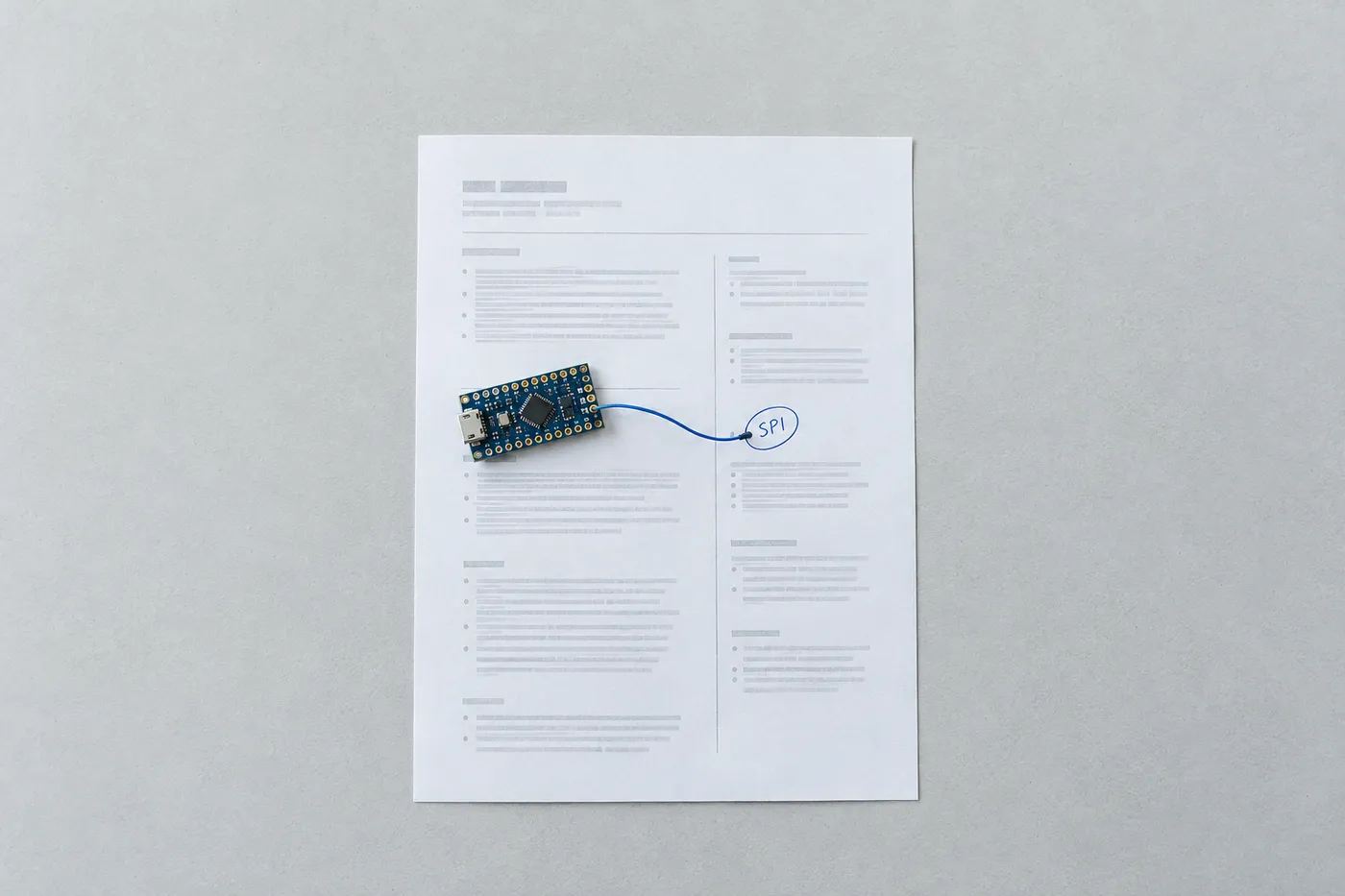
How to Describe Hardware Debugging and Protocols (SPI, I2C)
Hardware debugging is where embedded candidates undersell themselves most. “Debugged firmware issues” describes every embedded engineer alive. The version that gets an interview names the instrument and the root cause, because those two details prove the work happened on a bench rather than in a simulator.
A strong debugging bullet has this anatomy:
- The symptom, stated concretely: an intermittent bus lockup or a watchdog reset in the field.
- The instrument: logic analyzer, oscilloscope, SWD trace, protocol analyzer.
- The root cause, at the level you found it (a sensor holding SDA low, a race between an ISR and the main loop).
- The fix, in one clause.
- The consequence: a fault cleared or a release unblocked.
Weak: “Debugged and resolved I2C communication issues.”
Strong: “Traced an intermittent I2C bus lockup, captured on a logic analyzer, to a sensor holding SDA low after truncated transactions; added a bus-recovery routine that clocks SCL until the line releases, clearing a fault stress testing surfaced on roughly 1 in 200 units.”
Weak: “Worked with SPI peripherals.”
Strong: “Wrote a DMA-backed SPI driver for external NOR flash on an STM32L4, sustaining 8 Mbit/s transfers with CPU load under 10% during logging bursts.”
One caution: describe protocol work at the level you actually did it. Configuring a vendor HAL is real work, and so is writing a register-level driver from the datasheet, and they are different claims. Interviewers in this field probe exactly that line, so write the one you can hold.
Quantifying Memory Optimization and Power Efficiency
Embedded work is unusually measurable, and most of the numbers already exist in artifacts you have open every day. Before writing bullets, pull figures from these sources:
- The linker map file: flash and RAM footprint, before and after a change.
- A power profiler or bench meter: sleep current in microamps and average draw over a duty cycle.
- Timing captures: interrupt latency and worst-case boot time.
- Battery-life projections your team used for planning.
- Bus traffic and throughput figures from protocol analyzer captures.
Weak: “Optimized memory usage across the firmware.”
Strong: “Cut RAM footprint from 48 KB to 31 KB by replacing per-module static buffers with a shared pool and moving constant lookup tables to flash, creating headroom for an OTA update path on a 64 KB part.”
Weak: “Improved power efficiency of the device.”
Strong: “Reduced average sleep current from 180 µA to 9 µA by gating unused peripheral clocks and moving sensor polling to an RTC-driven wakeup, extending projected battery life from two months to over a year on a single cell.”
Two rules keep this honest. A percentage needs a base, because “cut RAM 34%” invites the question “from what,” so give absolute numbers when you have them. And never quote a figure you cannot explain measuring; “how did you measure that sleep current” is a standard screen question, and a stumble there costs more than the number gained.
Import Your PDF and Fix Formatting Instantly
Most embedded engineers already have a resume, often a LaTeX export or an aging file that fights back every time a bullet changes length. Retyping it into a builder is the reason people keep sending the old version.
Roleframe removes that step. Upload your existing resume as a PDF and it comes back as editable blocks, with roles and bullets already in the right places, plus an analysis that names the weak sections before you touch anything. The editor is free to use with no account. From there you can drag whole sections to reorder the page, which matters in this field: if your strongest signal is a dense, well-grouped skills section, you can move it above experience in one gesture instead of a retype.
When you export, the PDF matches the editor exactly. Submit PDF unless an employer explicitly asks otherwise; it is the format that survives every parser and every screen it crosses with your formatting intact.
Let Remi Help You Rewrite Highly Technical Bullets
The hardest part of an embedded resume is compression. An afternoon of logic analyzer captures becomes one line, and choosing which twenty words survive is genuinely difficult when you are close to the work.
A second pass helps, and this is what Roleframe’s per-job workflow does. You keep one base resume and duplicate it for each posting; the duplicate gets a fit report that scores it against that job, including your ATS score and the exact keywords the posting asks for that your resume is missing, say Zephyr where you only wrote RTOS. Remi, the career copilot in the editor, then proposes rewrites bullet by bullet, each shown as a word-by-word diff you accept or discard. Nothing changes without your approval, which matters more here than in most fields: every technical claim on the page is one an interviewer can drill into, so every word should be one you chose.
If you are applying to several embedded roles at once, the base-plus-variants structure is worth setting up properly; here is how base resumes and tailored versions work.
Frequently asked questions
- How long should an embedded software engineer resume be?
One page for roughly the first eight to ten years of experience. Senior engineers with patents, publications, or a long record of shipped products can justify two. The deciding factor is density of signal per line; see the one-page-or-two breakdown by experience level.
- Should I write “C/C++” or list C and C++ separately?
Both, in different places. In the skills section, list C and C++ as separate entries, because some parsers treat “C/C++” as a single token that matches neither filter. In prose bullets the slash form reads fine. If a posting uses the string “Embedded C,” mirror that too.
- How do I write an entry-level embedded software engineer resume with no experience?
Projects on real hardware carry the page. Give them the space a mid-level engineer gives a job, and write them in the same pattern: name the board, the layer you worked at, the constraint, and the outcome. A motor driver written register by register on an STM32 outranks a list of certificates. Here is how to list coding projects so they read as experience.
- Is a firmware engineer resume different from an embedded software engineer resume?
Mostly in emphasis. A firmware resume leads with bring-up, bootloader, and driver work and uses lower-level vocabulary like linker scripts and memory-mapped I/O, while an embedded software resume can carry more application and platform work. Many companies use the titles interchangeably, so apply under both.
- Should I put a GitHub link on an embedded resume?
Only if it shows embedded work. A driver written from a datasheet, with a clear README and a photo of the board it ran on, is a strong exhibit; a page of forks is noise. Put the link in your header next to your email so a curious manager finds it without scrolling.
- Do I need to list every microcontroller I have used?
No. A dozen part numbers reads as padding. List the families you could interview on today, with the posting’s family first: say ARM Cortex-M, then name the specific parts you know best. Families communicate competence faster than part numbers, because toolchain and peripheral knowledge transfers within a family.


Ready when you are
Send the tailored resume, not the generic one.
Paste a job posting and Roleframe scores your resume against it, then helps you close the gaps one approved edit at a time, so you apply while the role is still fresh.