
Civil Engineer Resume Examples (Built for ATS and Real Recruiters)
by Larbi SahliLast Updated
Civil engineer resume examples for licensed PEs and project engineers, plus how to handle Civil 3D, MicroStation, and PE keywords that ATS filters scan for.

On this page
A recruiter at a civil firm reads your resume in a specific order: license status first, software second, project scope third. If "PE" isn't visible in the top third of the page, or your Civil 3D experience is buried in a skills list at the bottom, you lose the seven-second scan even when your project history is stronger than every other candidate's.
This page shows you a complete civil engineer resume example, then breaks down why each section works: how to present a Professional Engineer (PE) license so both the applicant tracking system (ATS) and the human find it, how to write project bullets with budgets and scope instead of duty statements, and which software keywords employers actually filter on. If you're pre-license, there's a full section on adapting the same structure as a project engineer or engineer in training (EIT).
The anatomy of a top-tier civil engineering resume
Civil engineering resumes get screened on hard credentials before anyone reads a single bullet. That changes the structure. A marketing resume can open with a story; yours has to open with proof.
Here is the section order that works for most civil engineers, top to bottom:
- Header with your license status in your name line: "Jordan Reyes, PE" or "Jordan Reyes, EIT." This is the single highest-value edit most civil engineers never make.
- A 2-3 sentence summary that names your discipline (land development, transportation, water resources, structural), your years of experience, your license status, and your primary design software.
- Licenses and certifications as its own section, placed above or immediately after the summary if you hold a PE. State of licensure included; license number optional.
- Experience in reverse chronological order, with bullets scoped by project: dollar value, acreage, linear feet, lane-miles, or unit count.
- Skills, split into design software, analysis tools, and standards/codes rather than one undifferentiated list.
- Education last once you have 3+ years of experience, with your ABET-accredited degree named as such.
Format matters less than civil engineers tend to think, but two rules are non-negotiable. Use a single-column, reverse chronological layout so ATS parsers read your work history in order. And submit as a PDF, always. A PDF locks your formatting; a Word file reflows on whatever machine opens it, which is how a clean resume arrives at the recruiter's desk with orphaned bullets and a broken header.
On length: one page is right up to roughly five years of experience. Past that, a licensed engineer with a real project list earns a second page, and cutting to one usually means cutting the scope details that get you hired. There's a fuller breakdown by experience level in should a resume be one page or two.
Civil engineer resume example: licensed PE
The example below is built for the most common mid-career situation: a licensed PE with several years across design and construction phases, applying to a consulting firm. Notice three things as you read it. The PE credential appears in the name line, the summary, and the licenses section, so no screening pass can miss it. Every project bullet carries a number that establishes scale. And the software section reads like a design team's actual toolbox, not a keyword dump.

Marcus Deldon, PE
Civil Engineer, PE | Land Development & Site/Civil Design
Summary
Licensed civil PE with 7 years in land development and site/civil design, delivering commercial, residential, and mixed-use sites in Civil 3D from grading through permitting. Skilled in stormwater management, ADA compliance, and NCDOT coordination across projects totaling more than $180M in construction value.
PROFESSIONAL EXPERIENCE
Project Engineer
Piedmont Site & Civil Group
Led site/civil design for a 62-acre mixed-use development ($48M construction value), producing grading, utility, and roadway plans in Civil 3D and stamping the final permit set as engineer of record.
Designed 9,400 LF of storm and sanitary utilities and detention modeled in HydroCAD, securing NPDES and local stormwater approvals on first submittal.
Coordinated 6 sub-consultants (survey, geotech, landscape, traffic), cutting review cycles by 30% across a $22M retail portfolio.
Civil Design Engineer
Cardinal Engineering Associates
Produced grading, drainage, and ADA-compliant site plans in Civil 3D for 20+ commercial sites ranging 3 to 40 acres.
Performed hydrologic and hydraulic analysis in StormCAD and HydroCAD for 5,200 LF of roadway drainage meeting NCDOT standards.
Progressed from design support to leading deliverables on a $14M distribution center, managing QA/QC on the 80-sheet plan set.
EDUCATION
BSc
North Carolina State University
Bachelor of Science in Physics from Harvard University, Cambridge, Massachusetts, United States.
LANGUAGES
SKILLS
CERTIFICATIONS
Professional Engineer (PE), Civil
Validated foundational knowledge of AWS cloud concepts, security, and billing.
Covered core services including EC2, S3, RDS, Lambda, and CloudFront.
Demonstrated understanding of shared responsibility model and basic architectural best practices.
PROJECTS
Northgate Commons Mixed-Use Site
Project Engineer / Engineer of Record
Delivered full site/civil package for a 62-acre development: grading, 9,400 LF of utilities, two detention basins, and NCDOT driveway permits, on a $48M budget.
AWARDS
Young Engineer of the Year
ACEC North Carolina
What to lift from this example, even if your discipline differs: the bullets are project-shaped, not task-shaped. "Designed grading and drainage for a $14M, 42-acre mixed-use site" tells a hiring manager your level of responsibility in one line. "Responsible for grading and drainage design" tells them nothing they can't get from your job title. Scope numbers are the fastest credibility signal in this field because every reviewer has managed a budget and knows exactly what a $14M site involves.
What to change: the discipline-specific nouns. A transportation engineer swaps site grading for corridor design, signal warrants, and MUTCD compliance. A water resources engineer leads with hydraulic modeling, NPDES permitting, and floodplain analysis. The skeleton stays; the vocabulary is yours.
Civil engineer resume example: project engineer (pre-PE)
If you're a project engineer or EIT without a license yet, don't copy the PE resume and hope nobody notices the gap. Own the timeline instead. The adaptation is four moves:
- Put "EIT" in your name line and state your FE exam pass in the licenses section, with the state and year. An EIT designation tells the firm you're on the PE track, which is what they're actually screening for at this level.
- If you're within striking distance of licensure, say so explicitly: "PE eligible May 2026" in the summary. Firms hire pre-PE engineers partly on that date, because a soon-to-be PE can stamp work and bill at a higher rate within the year.
- Shift the bullet emphasis from sealing and leading to producing and coordinating: plans produced, submittals reviewed, RFIs answered, field observation reports, quantity takeoffs, cost estimates. Quantify volume: "processed 120+ RFIs across three concurrent projects" is a real claim at this level.
- Move education up. With under five years of experience, your ABET-accredited BS in Civil Engineering, relevant coursework, and any senior design or capstone project still carry weight. Past five years, they don't.
One trap to avoid: inflating field roles into design roles. If your two years were mostly construction administration, say that with pride and precision. Firms need engineers who have watched their designs get built, and "resolved 40+ field conflicts between design drawings and existing utilities" is a stronger bullet than a vague claim to design work you supported from a distance.
Keyword data: Civil 3D, MicroStation, and scheduling tools
Civil engineering is one of the most software-gated disciplines in the ATS. Recruiters at consulting firms routinely filter candidate pools on named tools before a human reads anything, and the tools they filter on are predictable. Civil 3D dominates private-sector and land development postings. MicroStation and OpenRoads show up heavily in DOT and public infrastructure work, because most state transportation departments standardized on Bentley products years ago. Scheduling tools, Primavera P6 above all, appear constantly in construction management and heavy civil postings.
The practical consequence: which tools you name, and where, should follow the job you're applying to, not the full list of everything you've ever opened. A land development posting that names Civil 3D three times wants Civil 3D in your summary and your bullets, not just your skills list. A DOT-adjacent posting wants MicroStation and the relevant state design manual named explicitly.
| Category | Tools and terms employers filter on | Where to place them |
|---|---|---|
| Design/CAD | AutoCAD Civil 3D, MicroStation, OpenRoads Designer, AutoCAD | Summary + inside experience bullets, tied to a deliverable |
| Analysis and modeling | HEC-RAS, HEC-HMS, StormCAD, WaterCAD, SAP2000, STAAD.Pro | Experience bullets, attached to the study or design they supported |
| Scheduling and PM | Primavera P6, Microsoft Project, Procore, Bluebeam | Bullets for CM/CA roles; skills section otherwise |
| Standards and compliance | AASHTO, MUTCD, ADA, NPDES, ASCE 7, state DOT design manuals | Bullets, phrased as the standard you designed or permitted to |
| Credentials | PE, EIT/FE, PMP, LEED AP, OSHA 30 | Name line + dedicated licenses section |
A tool in your skills list is a claim; a tool inside a bullet is evidence. "Produced grading plans and utility profiles in Civil 3D for a 200-lot subdivision" survives both the keyword filter and the human read. A bare "Civil 3D" in a skills box only survives the first.
The honest way to know which keywords a specific posting filters on is to check that posting, not a generic list. Paste the job into Roleframe and the fit report shows the exact keywords the posting asks for, which ones your resume already covers, and which are missing, along with an ATS score for that specific job. For the general method behind keyword matching, see ATS resume keywords: stop guessing and start matching.
How to highlight project budgets, scope, and compliance
Civil engineering hands you quantification for free. Every project you've touched has a construction value, a size, a schedule, and a regulatory framework. The engineers who struggle to quantify their resumes aren't missing numbers; they're leaving them in the project files instead of the bullets.
A reliable bullet formula for this field: action verb + deliverable + scope number + standard or outcome. Work through your project list and pull one number per project. The categories that land hardest:
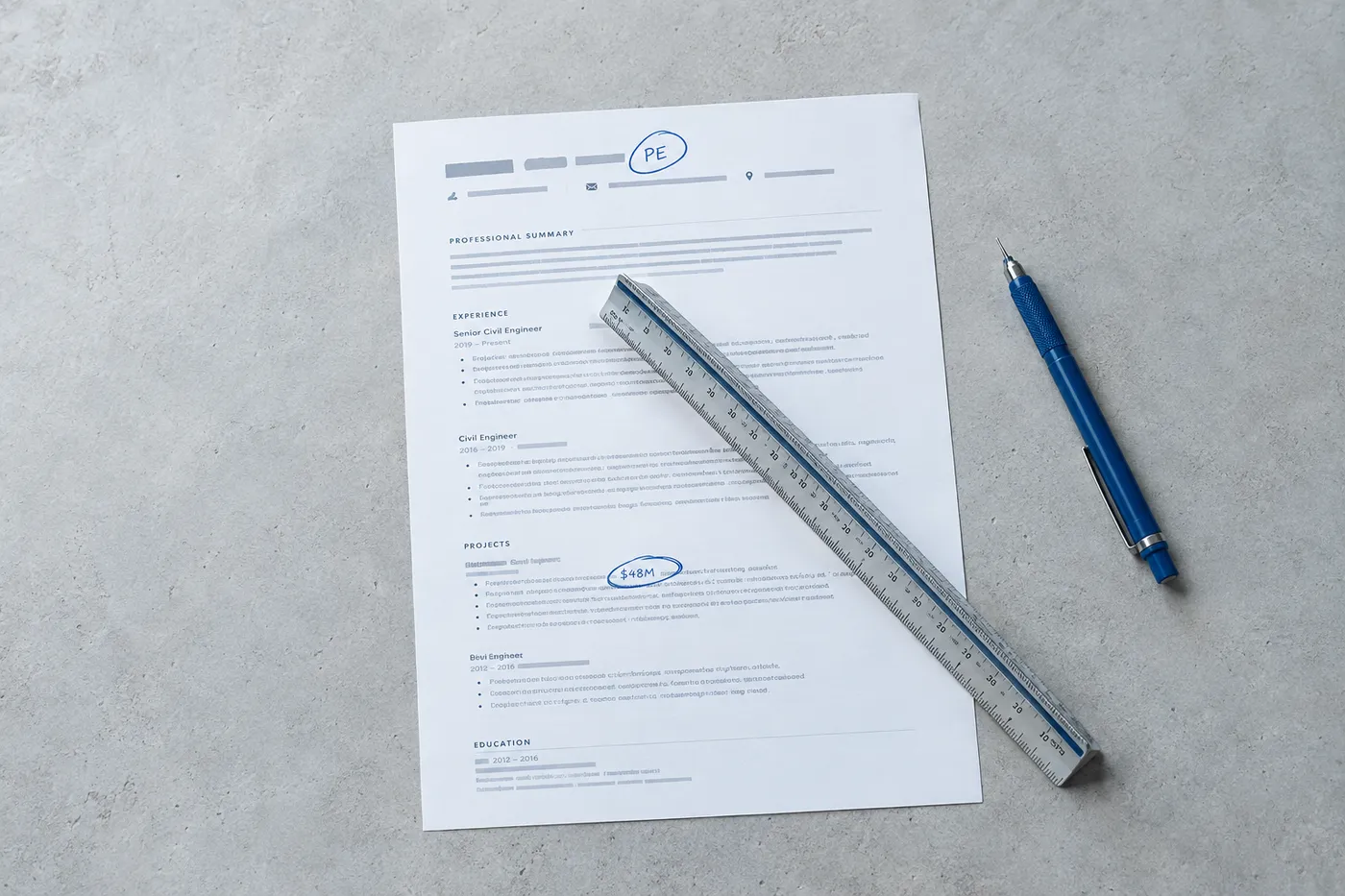
- Construction value: "$14M roadway reconstruction," "$3.2M pump station." Even a design-phase engineer can cite the estimated construction cost of what they designed.
- Physical scope: acres, linear feet of pipe or roadway, lane-miles, number of lots or units, square footage, span length.
- Schedule and delivery: "delivered 90% plans two weeks ahead of the letting date," "managed submittal review across a 14-month construction phase."
- Compliance and permitting: name the framework. "Secured NPDES construction permit," "designed to ADA and PROWAG requirements," "prepared SWPPP for a 60-acre site." Compliance vocabulary doubles as ATS keywords.
- Cost and conflict outcomes: value engineering savings, change orders avoided, utility conflicts resolved before construction.
Estimates are fine when exact figures are confidential or lost to time. "Approximately $10M" and "40+ acres" are honest and specific. What you must be able to do is defend every number in an interview, because a civil hiring manager will ask about the project behind the bullet, and they'll know if the answer doesn't match.
Education and licensure: the EIT/PE advantage
Licensure is the axis the entire civil career ladder rotates around, so treat it as a first-class resume section, never a footnote. A PE can stamp drawings, which changes what a firm can bill for your time; that's why postings so often require or prefer it, and why recruiters look for it before anything else.
How to present each stage:
- Licensed PE: credential in the name line, plus a "Licenses & Certifications" section listing state, year, and optionally license number. Multiple states are worth listing individually; multistate licensure is a genuine asset for regional firms.
- EIT/FE passed: "EIT" in the name line, the FE pass with state and year in the licenses section, and your expected PE eligibility date if it's within about a year.
- Recent graduate, FE not yet taken: a scheduled FE exam date is worth stating. It signals you're on the track even before the result exists.
- Degree: write "ABET-accredited" explicitly if your program qualifies, because ABET accreditation is a licensure prerequisite reviewers check. An MS in Civil or Structural Engineering earns its own line; GPA is optional past your first job.
Where the licenses section physically sits depends on the posting. If the job requires a PE, the section belongs in the top third of page one. If licensure is preferred rather than required and your project experience is the stronger card, the section can sit after experience. The placement logic is covered in more depth in where to put certifications on a resume.
Secondary credentials, PMP, LEED AP, OSHA 30, Envision SP, belong in the same section, below the engineering license. They matter most when the posting names them; otherwise they're supporting cast.
Using Remi to tighten your engineering bullet points
Engineers tend to write resumes the way they write technical memos: complete, accurate, and passive. "Was responsible for the design of stormwater management facilities in accordance with local requirements" is a true sentence that says almost nothing a reviewer can grade you on. The fix is usually surgical: a stronger verb, a scope number pulled forward, a named standard.
This is the kind of edit Remi, the career copilot inside Roleframe's editor, is built for. It reads the fit report for the job you attached, sees which keywords and findings apply to the bullet you're on, and proposes a rewrite as a word-by-word diff. You see exactly what would change, and nothing touches the document until you accept it. Remi doesn't write your resume for you, on purpose: a bullet claiming a $14M project you can't discuss is worse than a weak bullet, and every civil interview digs into the projects. You approve each change, so every line stays something you can defend when the hiring manager asks about the pump station.
The workflow that works: duplicate your base resume for the specific posting, read the fit report's keyword gaps, then work through the flagged bullets one at a time with Remi suggesting and you deciding. It's the fast version of tailoring without the generic-AI failure mode. The base-plus-variants system itself is worth understanding; see why you need a base resume and tailored versions.
Import your old PDF and update it instantly
Most civil engineers have a resume that's structurally fine and two years stale. The barrier to fixing it is retyping, and that barrier is gone. Upload your existing resume as a PDF to Roleframe and it comes back as editable blocks, roles and dates and bullets in place, inside a real drag-and-drop editor. The import runs a resume analysis automatically, so the first thing you see is your current document scored, with its weak sections named.
From there the updates are mechanical: add your newest projects with scope numbers, move your licenses section to match what your target postings require, drag sections into the order that argues your case, and export a clean PDF that matches the editor exactly. A free account includes an import, and the editor itself is free to use without an account.
Frequently asked questions
- What should I include in my resume as a civil engineer?
Six things: a name line with your license status (PE or EIT), a short summary naming your discipline and primary software, a dedicated licenses and certifications section, project-scoped experience bullets with construction values and physical scope, a skills section split by software and standards, and your ABET-accredited degree. The differentiator is the project bullets: every one should carry a number a hiring manager can grade you on.
- What are the most important skills for a civil engineer resume?
Three categories carry the screening: design software (Civil 3D for most private-sector work, MicroStation and OpenRoads for DOT work), regulatory fluency (the standards you've designed to, such as AASHTO, ADA, NPDES, or your state DOT manual), and project management fundamentals (budgets, schedules, submittals, and coordination). Analytical tools like HEC-RAS or STAAD.Pro matter within their disciplines. Soft skills like communication belong inside bullets as evidence, such as leading a utility coordination effort, never as a standalone list of adjectives.
- How should an engineer's resume look?
Single column, reverse chronological, a standard readable font, and no graphics, skill bars, or photos, all of which parse badly in an ATS and read as filler to engineering managers. One page under roughly five years of experience, two pages once your project list justifies it. Submit as a PDF so the layout arrives exactly as you built it.
- Should I put my PE license number on my resume?
The credential is mandatory; the number is optional. Always show "PE" in your name line and list the state and year of licensure in a certifications section. Including the license number is a mild convenience for firms that verify licensure, which most do, and there's no real downside since PE licenses are public record. List each state separately if you hold more than one.
- How do I write a civil engineer resume with no PE yet?
Lead with your EIT designation in the name line and your FE pass in the licenses section, and state your expected PE eligibility date if it's within about a year. Shift bullets toward what pre-PE engineers actually own: plan production, submittal and RFI processing, quantity takeoffs, field observation, and estimates, all quantified by volume and project scope. Firms hiring at this level are screening for the licensure track, not the stamp itself.
- Is a civil engineer resume the same as a civil engineer CV?
In the US, "resume" and "CV" are used interchangeably for industry applications, and everything on this page applies to both. A true academic CV, the multi-page document with publications and research history, is only expected for university or research positions. For consulting firms, contractors, and public agencies, send the one-to-two page resume format shown in the example above.


Ready when you are
Send the tailored resume, not the generic one.
Paste a job posting and Roleframe scores your resume against it, then helps you close the gaps one approved edit at a time, so you apply while the role is still fresh.