Chief Financial Officer Resume Example With Real Numbers
by Larbi SahliLast Updated
A complete chief financial officer resume example with scope figures filled in, a stacked promotion block, and the keywords CFO postings repeat most.

Users have landed jobs at
- 1Password
- OpenAI
- Notion
- justworks
On this page
A CFO resume fails in a specific, predictable way: three finance titles at one employer written as three separate jobs, a controller decade nobody compressed, and a summary that never says how big the company was. The reader, usually a retained search consultant or a PE operating partner, wants four facts inside ten seconds: revenue, stage, reporting line, and the events you owned. Close. Audit. Refinance. Exit.
Most chief financial officer resume samples online dodge the hard part. They show a tidy single-title career and leave every scope figure as a placeholder, which is exactly the opposite of what a real CFO resume needs. This page does it properly: a full example with every number filled in, a Controller to VP Finance to CFO promotion block written the way it should be written, and a pass through the terms CFO postings repeat most, from ASC 606 and SOX 404 to close cycle and NetSuite.
The full CFO resume example
The example below is an 18-year finance career compressed onto two pages. Notice three things before you read the section-by-section breakdown. The summary states company size, stage, and reporting line in two lines. The three titles at one employer sit under a single company header with one shared scope line. And every bullet that matters carries a number: revenue, headcount, days to close, dollars refinanced, multiple at exit.
The summary: company size, stage, and reporting line in two lines
An executive recruiter reads a CFO summary to answer one question: is this candidate the right size and shape for the mandate? A $2B public company audit chair and a Series C founder are looking for different animals, and a summary that hides the scale wastes everyone's time.
So a senior CFO resume summary has a fixed job. Two lines, four facts:
- Scale: the revenue band you have operated at, stated as a number, not "high-growth environment"
- Stage and ownership: public, PE-backed, venture-backed, or founder-owned, because each changes what the job is
- Reporting line: who you reported to (CEO, board, audit committee) and who reported to you
- The signature event: the one thing a reference call would confirm first, an exit, a refinance, an IPO readiness project, a turnaround
A shape that works: "CFO of a PE-backed $180M B2B software company, reporting to the CEO and board with a 32-person finance, accounting, and FP&A organization. Led the finance workstream through a $95M refinance and a sale process that closed at a premium to plan." Two sentences, and the reader already knows whether to keep going.
What kills a CFO summary is adjectives doing the work numbers should do. "Seasoned finance executive with a proven track record of driving results" contains zero facts and reads as evasive at this level. If your instinct is to reach for that phrasing, the fix is mechanical: replace each adjective with the figure it is gesturing at. More on the general technique in our guide to writing a professional summary, but at CFO level the rule is simpler: no sentence without a fact.
Controller to VP Finance to CFO at one employer: write it as one block
The multi-title problem is where most CFO resumes go wrong, and it matters because internal promotion is the most common path to the seat. Written badly, three titles at one company look like three short jobs, and a skim-reader sees a job hopper instead of the actual story: one employer trusted you enough to promote you twice.
The fix is one company block, one shared scope line, three stacked titles with dates, and bullets weighted toward the top. Structurally:
- Company name and a one-line company descriptor with the scope facts that apply across your tenure: "B2B software, grew from $60M to $180M revenue during tenure, PE-backed from 2019"
- Chief Financial Officer, 2021 to present, followed by your fullest bullet set
- VP Finance, 2018 to 2021, three or four bullets on what you built, not what you maintained
- Controller, 2015 to 2018, two bullets at most, and only the ones that set up the promotion
The shared company line is the trick most people miss. It lets you state the growth arc once ("$60M to $180M") instead of repeating fragments of it under each title, and it makes the promotions read as a single ascending story. It also solves a parsing problem: applicant tracking systems and resume-parsing tools handle stacked titles under one employer cleanly as long as each title has its own date range on its own line.
One more rule: no duplicate accomplishments across titles. If you built the FP&A function as VP Finance, that bullet lives under VP Finance, even though you still own FP&A as CFO. The CFO bullets should be things only a CFO does: board and audit committee work, capital structure, the exit.
How much space each role deserves at 18 years in
Two pages is the right length for a CFO resume. One page forces you to cut scope lines, which are the most valuable content on the document, and three pages signals you cannot prioritize, which is a bad look for someone whose job is allocation. The one-page-or-two question has a clear answer at this seniority.
Within those two pages, space is an argument about relevance. A working allocation for an 18-year career:
| Career segment | Space | What survives the cut |
|---|---|---|
| Current CFO role | 6 to 8 bullets plus a scope line | Every defining event: close, audit, refinance, exit, board work |
| VP Finance years | 3 to 4 bullets plus a scope line | What you built: FP&A function, systems, the team |
| Controller years (same employer) | 2 bullets | The audit record and the close, the things that earned the promotion |
| Earlier controller or senior accountant decade | 2 to 4 lines total | Company names, titles, dates, one line of scope. No bullets. |
| Education, credentials, board work | 4 to 6 lines | CPA, MBA, audit committee and board seats |
The earlier controller decade is where people agonize, and the answer is more brutal than most guides admit: compress it to almost nothing. A recruiter filling a CFO seat does not need bullets about a close you ran fifteen years ago. Titles, employers, and dates prove the foundation exists; the recent decade proves you can do the job. Our guidance on how far back a resume should go applies with extra force here, because the early years compete for space with the scope lines that actually win interviews.
If you did the early years at a Big Four firm or a marquee public company, keep the name visible even in compressed form. "Audit Senior, Deloitte" earns its line at any compression level.
Scope lines: revenue, entities, headcount, close cycle, cash
A scope line is one line under the title, before the bullets, that states the size of the job. It is the single highest-value line on a finance leader's resume because it answers the sizing question before the reader has to infer it from bullets.
Five figures belong in a CFO scope line, in roughly this order of importance:

- Revenue: the band you operated at, and the arc if you grew it ("$60M to $180M")
- Entities and geography: "9 legal entities across 4 countries" tells the reader you have done consolidation, transfer pricing, and multi-currency close
- Team headcount: total finance organization and direct reports, stated separately if they differ meaningfully
- Close cycle: current days to close, because it is the most legible proxy for the quality of the accounting operation you run
- Cash and debt under management: cash position, credit facilities, anything you actively manage
A finished scope line reads: "Own finance, accounting, FP&A, and tax for a $180M, 9-entity international group. 32-person org, 5 direct reports. 5-day close. $40M cash, $95M term facility." One line, five facts, and the reader can now size every bullet that follows against it.
Write a scope line for each title in the stacked block, not just the CFO role. The contrast between them is the promotion story told in numbers: the Controller line says "$60M, 1 entity, 8-day close" and the CFO line says "$180M, 9 entities, 5-day close." No prose about "progressive responsibility" makes that argument as well as the two lines sitting near each other.
Bullets for the events that define a CFO
CFO bullets are not a list of responsibilities. Every reader already knows what a CFO is responsible for. The bullets exist to prove you handled the four or five events that separate a finance leader from a finance manager, with numbers attached. Strong action verbs help, but at this level the number carries the bullet, not the verb.
The close
State before and after, and say what changed. "Cut the monthly close from 12 business days to 5 by moving revenue recognition into NetSuite ARM and killing 40+ manual reconciliations" is a complete story in one line. A close bullet without a day count is a wasted bullet; days to close is the one metric every finance reader can calibrate instantly.
The audit
The number that matters here is zero. "Four consecutive clean audits with zero material weaknesses; stood up SOX 404 readiness ahead of a planned exit, remediating all control gaps within two quarters" tells the audit committee reader exactly what they want to know. If you cleaned up someone else's material weakness, say so; a remediation is a stronger story than a streak you inherited.
The refinance
Size, structure, and outcome. "Refinanced a $95M term loan, extending maturity three years and reducing the rate by 175 bps, saving roughly $1.7M annually in interest" proves capital markets competence in a single line. Name the covenant work if it was the hard part. Lenders and sponsors read these bullets closely, and vagueness here reads as inexperience.
The exit
If you have taken a company through a sale, an IPO, or a sponsor-to-sponsor trade, that bullet leads the role. Own your specific workstream honestly: "Led the finance workstream through a sale to a strategic acquirer, owning the data room, quality of earnings support, and management presentations; deal closed at 6.5x revenue." Do not claim the multiple as your personal achievement; claim the workstream, and let the multiple date the deal's quality.
One caution on all of these: every number on the page is a number you will be asked about, by people who can check it against a data room. Round honestly, attribute team wins to the team, and never write a figure you cannot defend in a partner meeting. An inflated resume claim at this level is not embarrassing, it is disqualifying.
The keyword pass: what CFO postings repeat
Yes, CFO searches involve keywords. Retained searches less so, but a large share of CFO and VP-level finance roles are posted publicly and screened through an applicant tracking system (ATS) or a recruiter's keyword search before a human reads the document properly. The terms that recur across CFO postings are specific and technical, and generic executive resumes miss them because they were written for a human skim only.
The recurring vocabulary clusters into standards, processes, and systems:
| Cluster | Terms to name explicitly | Where they belong |
|---|---|---|
| Accounting standards | ASC 606 (revenue recognition), ASC 842 (leases), US GAAP, technical accounting | Inside bullets that show you applied them, not in a skills list |
| Controls and compliance | SOX 404, internal controls, material weakness remediation, audit committee | Audit bullets and the board/credentials section |
| Planning and analysis | FP&A, budgeting and forecasting, board reporting, 13-week cash flow, scenario modeling | Scope lines and VP Finance bullets |
| Operations | Close cycle / monthly close, consolidation, multi-entity, treasury, working capital | Scope lines, where the numbers live |
| Transactions | M&A, due diligence, quality of earnings, refinance, capital raise, integration | The event bullets |
| Systems | NetSuite, SAP, Adaptive Planning, Workday, Salesforce (for rev ops adjacency) | Named inside the bullet describing what you did with them |
The placement rule matters as much as the terms. "ASC 606" in a skills list is a claim; "led ASC 606 adoption across 9 entities, restating deferred revenue with no audit adjustments" is evidence. Fold the standard into the bullet that proves it and you satisfy both the keyword filter and the human who reads past it. The same logic applies to systems: name NetSuite or SAP inside the migration or close bullet, because "implemented" beats "familiar with" every time.
Before you send any version, pull the keywords from the specific posting and check your coverage. CFO postings vary more than people expect: a PE-backed posting leans on "13-week cash flow" and "lender reporting," a public company posting on "SEC reporting" and "10-K/10-Q," and a resume tuned for one will read as off-target for the other.
CPA, MBA, board work, and where each one goes
Credentials at CFO level are table stakes to display and a mistake to showcase. The placement logic:
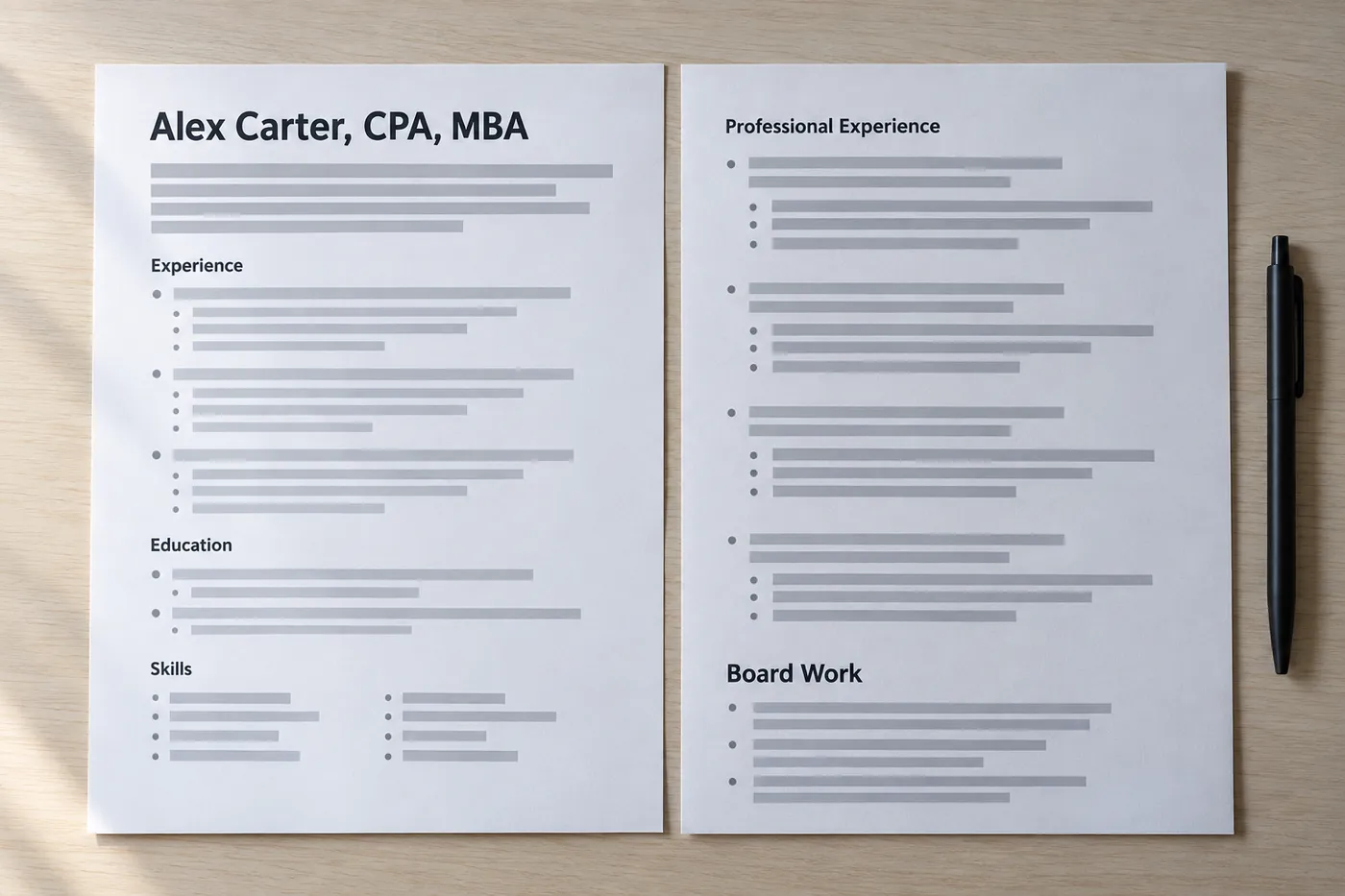
- CPA: after your name in the header ("Jordan Reyes, CPA") and again in the education section with the state. It is the one credential worth putting in the header, because many CFO searches filter on it.
- MBA: education section only, with the school. An MBA in the header reads as insecure at this level. If the school is a strong brand, the brand does the work from the education section.
- Audit committee experience: this is experience, not a credential. "Presented quarterly to the audit committee" belongs in a CFO bullet; a board observer or committee seat gets its own short "Board & Advisory" section.
- Board seats and advisory roles: a dedicated three-or-four-line section after experience. Even one advisory seat matters, because it signals you can operate on the other side of the table, which is precisely what a board hiring a CFO is buying.
Skip the certifications graveyard. An 18-year CFO listing a fifteen-year-old Six Sigma green belt dilutes the CPA sitting next to it. The general rules on where certifications go apply, with one executive addendum: fewer, stronger, and nothing that a controller would also list.
One base resume, three searches: public, PE-backed, venture-backed
The same career supports three materially different resumes, because the three ownership structures are hiring for different jobs. Sending your PE resume to a public company search does not fail loudly; it fails quietly, as "not quite the profile." Here is what changes when you rewrite one base resume for each:
| Element | Public company search | PE-backed search | Venture-backed search |
|---|---|---|---|
| Summary leads with | SEC reporting rigor, investor relations, controls at scale | Value creation, EBITDA growth, exit or refinance events | Runway, fundraising, building finance from scratch |
| Bullet emphasis | 10-K/10-Q, SOX 404, earnings calls, audit committee cadence | 13-week cash flow, lender reporting, add-on M&A integration, QoE | Series rounds supported, burn multiple, first audits, first controls |
| Metrics that matter most | Clean filings, control environment, market cap context | EBITDA margin expansion, debt paydown, exit multiple | ARR growth, months of runway extended, cost per dollar raised |
| Systems to foreground | SAP or Oracle, Workiva, SEC filing tooling | NetSuite, Adaptive Planning, data room tooling | NetSuite or earlier-stage stack, spreadsheet-to-system migrations |
| Riskiest signal to avoid | Anything that reads scrappy or improvised | Anything that reads slow or process-heavy | Anything that reads big-company and delegating |
The interim CFO variant deserves its own note, because the format inverts. An interim CFO resume example done well leads with engagements, not employers: each engagement gets a one-line mandate ("6-month interim mandate: stabilize the close and prepare the company for a lender-driven refinance"), the outcome, and the handoff. The fact that you left is the product, so make the completion explicit. Interim readers are buying speed to competence, and a resume organized around mandates proves it structurally.
Practically, this means maintaining one master document and tailoring per search, which gets unmanageable fast in a folder of files. This is the workflow Roleframe is built around: keep one base CFO resume, duplicate it per search, and run a fit report against the posting to see which of these exact terms, SOX 404, 13-week cash flow, ASC 606, the posting repeats and your version is missing. You make the edits yourself, with Remi, Roleframe's career copilot, proposing rewrites bullet by bullet that you approve or discard. At this level especially, every word on the document needs to be yours, because every word will be probed by people who do diligence for a living.
Formatting: two pages, plain structure, PDF
Executive resumes attract bad design decisions: two-column layouts, portrait photos, skill-rating bars. Resist all of it. The content of a CFO resume is dense with numbers, and numbers need a plain, single-column structure with clear title lines to be scannable. It also parses cleanly, which matters for the posted-role share of your search; the structure parsers read correctly is the same structure a board member skims comfortably on a phone.
Save and send as PDF, always. A PDF locks your layout and your numbers exactly as you set them; a Word file reflows on whatever machine opens it, and a scope line that wraps mid-figure is a small, avoidable indignity. If a search firm explicitly asks for another format, comply for that one request and keep PDF as your default everywhere else.
Frequently asked questions
- How long should a chief financial officer resume be?
Two pages. One page forces you to cut scope lines and event bullets, which are the highest-value content on the document, and three pages signals poor prioritization. At 18 or more years, compress the earliest decade to titles, employers, and dates rather than cutting the recent detail that wins interviews.
- How do I show Controller, VP Finance, and CFO at the same company?
One company block with a single shared scope line, then three stacked titles, each with its own date range on its own line. Weight the bullets toward the CFO role, give VP Finance three or four bullets about what you built, and give Controller two at most. Never repeat an accomplishment under two titles; assign each to the role where you did the work.
- Do CFO resumes really go through an ATS?
Often, yes. Retained searches rely more on the consultant's judgment, but a large share of CFO and VP finance roles are posted publicly and screened through an applicant tracking system or a recruiter's keyword search first. A plain, single-column structure and the posting's own vocabulary, ASC 606, SOX 404, FP&A, close cycle, cover you for both readers. See how an ATS actually works for the mechanics.
- What should a CFO resume summary include?
Four facts in two lines: the revenue band you operated at, the ownership stage (public, PE-backed, venture-backed), your reporting line and organization size, and your signature event, such as an exit, refinance, or IPO readiness project. No adjectives doing the work of numbers; "seasoned finance executive" tells the reader nothing they can size.
- How much should I compress my early controller years?
Aggressively. Beyond the most recent 10 to 12 years, list titles, employers, and dates with at most one line of scope, and no bullets. The early years prove the foundation exists; the recent decade proves you can do the CFO job. The one exception is a marquee name, like a Big Four audit background, which earns its line even fully compressed.
- How is an interim CFO resume different?
It is organized around engagements rather than employers. Each engagement gets a one-line mandate, the measurable outcome, and the handoff, because the completed departure is the product an interim client is buying. Make the fixed term explicit in the dates so short stints read as designed, not as turnover.
- Should the CPA go in the header or the education section?
Both. Put it after your name in the header, since many CFO searches filter on it, and list it again in education or credentials with the state of licensure. The MBA stays in the education section only; in the header it reads as trying too hard at this level.
- Can I use one CFO resume for public, PE-backed, and venture-backed searches?
You can, but you will read as slightly off-target for at least two of the three. A public company search weights SEC reporting and controls, a PE search weights cash discipline and exit events, and a venture search weights fundraising and building from scratch. Keep one master resume and tailor a version per search, changing the summary lead and the bullet emphasis rather than inventing new facts.


Ready when you are
Send the tailored resume, not the generic one.
Paste a job posting and Roleframe scores your resume against it, then helps you close the gaps one approved edit at a time, so you apply while the role is still fresh.