
Architect Resume Examples (With the ATS Keywords Firms Actually Filter For)
by Larbi SahliLast Updated
Architect resume examples for licensed and junior candidates, plus the Revit, licensure, and project keywords firms actually filter for in ATS screens.

On this page
Architecture hiring filters on keywords before it ever judges taste. Before a design director sees your portfolio, an applicant tracking system (ATS) and a recruiter who may not know a mullion from a muntin scan your resume for a short list of terms: Revit, licensure status, project phases, and project types. Miss those and the portfolio you spent weeks on never opens.
This guide shows you a complete architect resume example, breaks down why each section works, explains how a junior version differs, and gets specific about the software and licensure keywords firms screen for. It also covers the tension every architect feels: the resume has to parse cleanly in an ATS and still look like it was made by someone with design judgment.
What Makes a Winning Architect Resume Today
An architect resume has two audiences, and they want different things. The first pass belongs to software and a recruiter. They check for licensure (RA, or clear AXP progress if you are not licensed yet), the software the firm runs on, and whether you have taken projects through the phases the role covers, from schematic design (SD) through construction administration (CA). This pass is literal. It matches words.
The second pass belongs to a principal or design director. They read for judgment: what you built, at what scale, what you were trusted with, and whether your one page shows the restraint they would want on a drawing set. A cluttered resume from an architect reads as a red flag in a way it never would from an accountant.
The winning move is to satisfy both without compromising either. That means:
- Licensure status in the header, not buried on page two. "RA" or "AIA" after your name is the single fastest qualifier a recruiter checks.
- Software named exactly: "Revit," "AutoCAD," "Rhino." Not "BIM proficiency" or "CAD tools." ATS keyword matching is literal, and a filter set to "Revit" does not credit "BIM software."
- Project scale in numbers: square footage, construction budget, unit count. "Worked on a mixed-use development" tells a hiring manager nothing. "Led CDs for a 42,000 SF mixed-use project with an $18M construction budget" tells them your level in one line.
- Phases spelled out. Firms hire for phase coverage. If you carried a project through SD, DD, CD, and CA, say so in those words, with the acronyms expanded at least once.
- A clean, parseable layout that still shows typographic taste. More on that trade-off below.
One more thing before the example: your resume is not your portfolio. The resume's only job is to get the portfolio opened and the phone screen booked. Keep the elaborate graphic identity for the work samples.
Architect Resume Example: Licensed Architect
Here is a complete example for a licensed architect with several years of full-phase project experience. Notice how fast it answers the three questions every firm asks first: are you licensed, what software do you run, and what scale have you delivered?
Registered Architect, RA, NCARB | Commercial & Mixed-Use | Revit & BIM Coordination
Marcus Delgado

Summary
Licensed architect (RA, NCARB certified) with 8 years leading commercial and mixed-use projects from schematic design through construction administration. Delivered over 1.4M SF and $310M in construction value, managing Revit-based BIM coordination, multidisciplinary consultants, and IBC/ADA compliance across all phases.
Experience
Project Architect
Led a 240,000 SF mixed-use development ($82M construction budget) from SD through CA, coordinating civil, structural, and MEP consultants in a shared Revit model with weekly Navisworks clash detection.
Ran construction administration on three commercial projects, processing 640+ RFIs and 210 submittals in Bluebeam while resolving field conflicts within 48-hour turnarounds.
Enforced IBC and ADA compliance across permit sets, clearing plan review with zero code corrections on two of four submittals.
Architect
Produced construction documents for a $46M office and retail campus, authoring 180+ Revit sheets and enclosure details to LEED Gold standards.
Coordinated design intent across six consultant disciplines, cutting coordination errors 30% by standardizing shared parameters and BIM execution plans.
Managed permitting and DD-phase deliverables for four commercial tenants totaling 95,000 SF, keeping all milestones on schedule.
Architectural Designer
Modeled schematic and design-development packages in Revit and Rhino for hospitality and multifamily projects up to 60,000 SF.
Produced Enscape renderings and physical study models that supported three successful client design approvals.
Assembled code-analysis matrices for IBC occupancy and egress, accelerating early feasibility reviews by two weeks per project.
Education
University of Colorado Denver
MArch
Bachelor of Science in Physics from Harvard University, Cambridge, Massachusetts, United States.
University of Colorado Boulder
BS
Bachelor of Science in Physics from Harvard University, Cambridge, Massachusetts, United States.
Skills
Software & BIM
Technical Competencies
Sustainability & Delivery
Projects
Riverfront Commons Mixed-Use
Project Architect
marcusdelgado.design/riverfront-commons
Delivered a 240,000 SF retail-and-residential block, $82M budget, through full CA with LEED Silver certification and Revit-coordinated consultant sets.
Certifications
Registered Architect (RA)
Validated foundational knowledge of AWS cloud concepts, security, and billing.
NCARB Certificate
Validated foundational knowledge of AWS cloud concepts, security, and billing.
LEED AP BD+C
Validated foundational knowledge of AWS cloud concepts, security, and billing.
Awards
Merit Award, Mixed-Use Design
AIA Colorado
Recognized for building a cloud-native AI productivity tool.
Languages
Why This Example Works, Section by Section
The header does the qualifying. Name, then credentials (RA, plus AIA or NCARB if you hold them), then city, phone, email, and portfolio link. A recruiter running a licensure filter finds the answer in the first half-second. If your license is in one state and the role is in another, the licenses section below handles the detail; the header just signals "licensed."
The summary carries numbers, not adjectives. Three lines: years of experience, project types, scale delivered, and phase coverage. Skip "passionate" and "detail-oriented." A summary that says "Licensed architect with 8 years delivering commercial and mixed-use projects up to 60,000 SF through all phases" beats any string of personality claims, because a principal can price your level from it instantly.
Experience bullets pair the project with your role in it. The trap in architecture resumes is describing the project instead of your contribution. The building was impressive; what did you do? Each bullet in the example names the action (led, coordinated, produced, resolved), the deliverable (CD set, Revit model, submittal reviews), and the scale. That structure is what separates "was on the team" from "was trusted with the work."
Skills are grouped, not dumped. Software in one line, technical competencies (codes, documentation, LEED) in another. Grouping helps the human reader scan and gives the ATS every exact-match term in plain text. A long undifferentiated skill list reads as padding.
Junior Architect and Draftsman Resume: What Changes
If you are early in your career, the structure holds but the emphasis shifts. Four changes matter most.
- Watch your title. In the US, "architect" is a protected title in most states. If you are not licensed, use "Architectural Designer," "Design Professional," or "Drafter," and never claim RA. Firms notice, and licensing boards occasionally do too. This is not pedantry; it is a credibility check you can fail in your header.
- Show AXP progress explicitly. "NCARB record active, 70% of AXP hours logged, ARE testing in progress" tells a firm exactly where you are on the path to licensure. Firms hiring junior staff plan around this, and vague silence reads worse than honest partial progress.
- Go deep on software instead of broad on leadership. A junior candidate wins on production skill: Revit family creation, drafting speed, rendering pipelines (Enscape, Lumion, V-Ray), Grasshopper scripting if you have it. Name the specific things you can do in Revit, not just the word Revit.
- Education and academic work move up. A recent B.Arch or M.Arch graduate should place education above experience and can include a standout studio project, thesis, or competition entry, with the same quantified treatment: program, square footage, tools used. Once you have two or three years of firm experience, education drops back down. The right order by career stage is covered in more depth in our guide to resume section order.
Everything else, exact software names, quantified bullets, clean formatting, applies at every level. A draftsman resume that says "produced 100% CD sets for three multifamily projects in Revit, including all wall sections and details" competes above its experience level.
The Hard Skills That Actually Pass ATS (Revit vs. AutoCAD)
Roleframe's job-analysis engine reads real architecture postings every day, and the pattern is consistent: Revit is the software firms name first, and increasingly as a hard requirement rather than a preference. AutoCAD still appears constantly, but usually alongside Revit rather than instead of it. A resume that lists AutoCAD without Revit signals a 2D documentation workflow to a firm that has moved its production to BIM, and that alone can end a screen.
The second thing firms filter on is licensure language: "RA," "licensed architect," "registration," "NCARB," and for junior roles "AXP" and "ARE." These are binary filters. Either the term is on the page or the resume drops out of the search.
Here is how the keyword categories break down and how to handle each one:

| Keyword category | Terms firms filter on | How to list it |
|---|---|---|
| BIM / production software | Revit, AutoCAD, Navisworks, Bluebeam | Name each tool exactly. Add specifics in bullets: "built the central Revit model," "clash detection in Navisworks." |
| Design / visualization | Rhino, Grasshopper, SketchUp, Enscape, Lumion, Adobe Creative Suite | List in skills; prove in bullets only where it mattered to a deliverable. Design-forward firms weight Rhino and Grasshopper heavily. |
| Licensure & credentials | RA, Licensed Architect, NCARB, AXP, ARE, AIA | Credentials after your name in the header, plus a dedicated licenses section with state and license number. |
| Sustainability | LEED AP, LEED Green Associate, WELL, Passive House | Only if you hold the credential or delivered a certified project. Name the certification level of the project. |
| Codes & compliance | IBC, ADA, zoning, life safety, egress | Weave into experience bullets: "resolved ADA compliance issues during plan check." |
| Project phases | Schematic Design (SD), Design Development (DD), Construction Documents (CD), Construction Administration (CA) | Spell out and abbreviate at least once each. Recruiters search both forms. |
| Delivery & coordination | RFIs, submittals, consultant coordination, permit set, plan check | Use in CA bullets with volume where you have it: "reviewed 200+ submittals across two projects." |
Two rules make this table useful instead of a stuffing exercise. First, mirror the posting's exact wording. If the firm writes "Construction Documents," write "Construction Documents (CD)," not just "CDs." ATS matching rewards the literal string. Second, every skills-section keyword needs backup in a bullet. A recruiter who sees "Grasshopper" in your skills list will look for where you used it; if nothing supports it, the whole list loses credibility. For the general mechanics of matching a posting's language, see our guide to ATS resume keywords.
How to Quantify Project Scale and Budgets in Your Experience Section
Numbers are how a hiring manager prices your seniority without a phone call. Architecture gives you more quantifiable material than almost any other profession, and most architect resumes waste it.
Every project you list has at least four numbers attached to it. Use them:
- Size: square footage, floor count, unit count. "280-unit multifamily development" or "6-story, 85,000 SF office building."
- Budget: construction cost, rounded. "$18M construction budget" is fine; nobody expects the exact figure, and rounding protects any confidentiality concern.
- Volume: sheets in the set, RFIs answered, submittals reviewed, consultants coordinated. "Coordinated 8 consultant disciplines" says more about your role than any adjective.
- Time: deadlines met, phases delivered, concurrent projects. "Delivered permit set 3 weeks ahead of the entitlement deadline" is a story in one line.
Compare the difference. Weak: "Assisted with construction documents for a residential project." Strong: "Produced 60% of the CD set for a 120-unit multifamily project in Revit, including all unit plans and enlarged core drawings, delivered on a compressed 14-week schedule." Same work, but the second version has a level, a scope, and a pace.
If your firm treats budgets as confidential, use ranges ("$15-20M") or size alone. If a project is unbuilt or was shelved, you can still claim the phase work you did on it. What you cannot do is inflate your role: "led" means you were responsible for the outcome, and interviewers in this industry check, because the community is small.
Where to Put Your Portfolio Link and Licensure
Portfolio link: in the header, on every version of your resume. Write it as a short, readable URL (a personal domain or a clean Issuu or Behance link) and make it a live hyperlink in the PDF, because most reviewers read on screen and will click rather than retype. Test the link from the exported PDF before you send anything. A dead portfolio link on an architect's resume is the profession's most self-defeating mistake.
Do not attach the portfolio to the resume as one file unless the posting asks for it. A combined PDF balloons past upload limits, and some portals reject large files silently. Resume as one small PDF, portfolio linked or attached separately per the firm's instructions.
Licensure lives in two places. Credentials go after your name in the header ("Jane Rivera, RA, LEED AP") for the instant signal. The detail, state of registration, license number, NCARB certification, goes in a dedicated "Licenses & Certifications" section, placed high if the posting requires licensure and lower if it merely prefers it. Our guide on where to put certifications on a resume covers the placement logic for other credentials too.
If you are mid-path, a two-line entry does the work: "NCARB record active; ARE 5.0: 4 of 6 divisions passed." Firms hiring designers on the licensure track want exactly this level of precision.
Formatting for ATS vs. Human Design Sensibility
Architects face a formatting trap no other profession has: the resume is treated as a design sample, but the first reader is a parser that punishes design. The resolution is simpler than it feels. Restraint reads as taste to both audiences.
What breaks parsing, and what architects do more than anyone: resumes laid out in InDesign and exported with text converted to outlines, decorative multi-column grids where reading order becomes ambiguous, skills rendered as icon bars or rating dots, and text placed inside images. An ATS extracts text; if your text is outlines or pixels, the system sees an empty page. If a recruiter cannot select your text in the PDF, neither can the software.
What works for both audiences:
- One strong typeface, used well, with a clear size hierarchy. Typographic discipline signals design judgment better than ornament does.
- Standard section names: Experience, Education, Licenses, Skills. The parser maps these; "Professional Journey" it does not.
- Single column for the main content, or a layout where the reading order stays unambiguous.
- Real, selectable text throughout, exported as a PDF. PDF preserves your layout exactly and is what every portal accepts; only produce another format if a specific firm explicitly asks.
- One page for most careers, two if you are senior with a project list that earns it. The data on when two pages helps is in our breakdown of one page vs. two.
Senior candidates with long project histories can add a separate project list page: project name, type, size, budget, your role, phases. It is a format principals recognize and it keeps the resume itself tight. For the full set of layout rules that survive parsing, see how to make your resume ATS-friendly without ugly design.
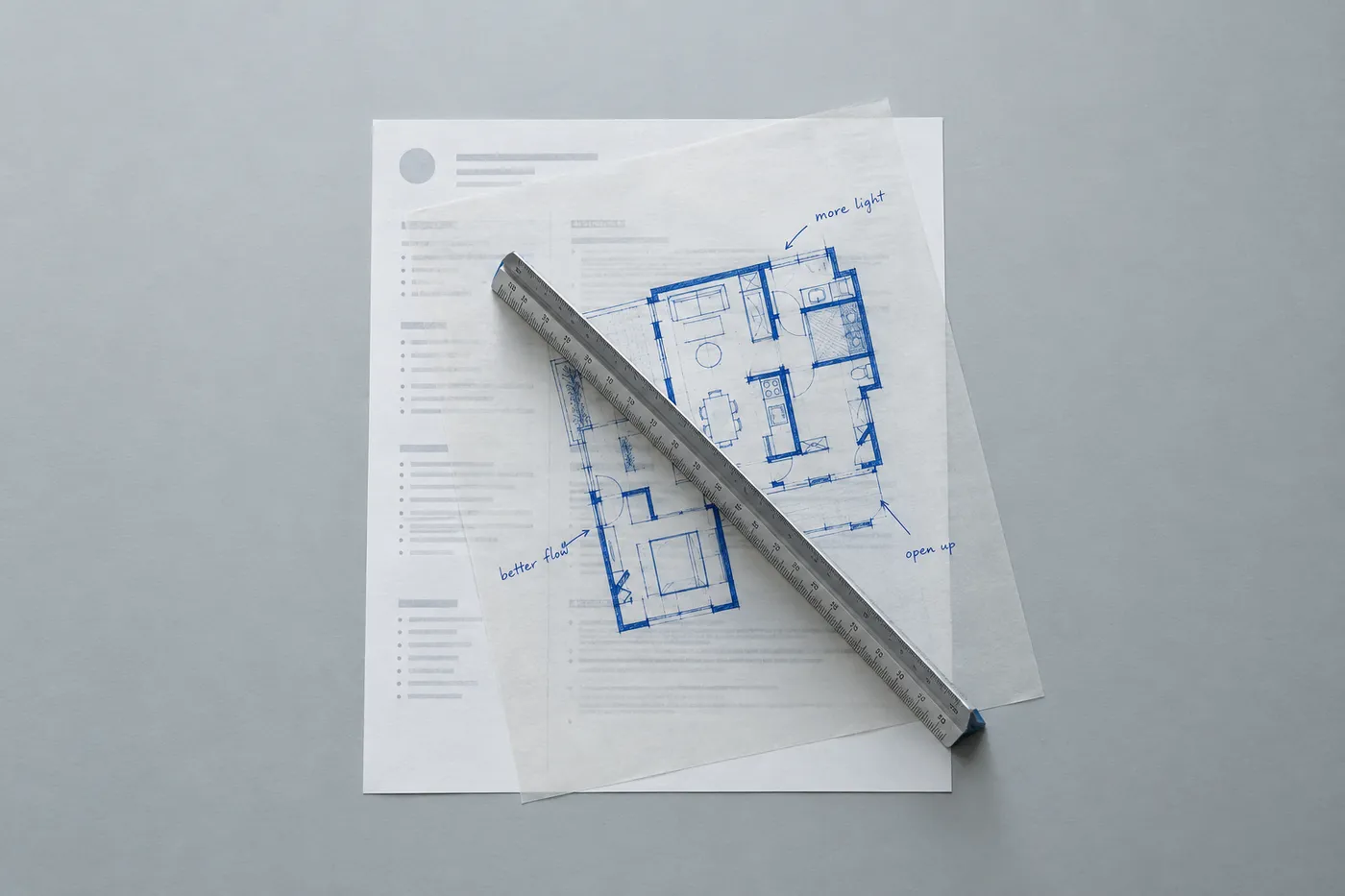
Tailoring Your Resume per Firm With a Fit Report
A corporate firm doing healthcare work, a boutique design studio, and a multifamily production shop are not looking for the same resume. One filters for "Revit, healthcare, FGI Guidelines," another for "Rhino, Grasshopper, competition experience," the third for "multifamily, CD production, consultant coordination." Sending all three the same document means being a partial match everywhere.
This is the specific problem Roleframe is built for. You keep one base architect resume, and for each posting you duplicate it and get a fit report: an ATS score against that posting, the exact keywords the firm's screen will look for and which ones your resume is missing, and a prioritized plan of what to rewrite and reorder. Then you make the edits yourself, with Remi, the career copilot, proposing rewrites bullet by bullet that you approve or discard. Roleframe never rewrites the resume for you, which matters in this industry more than most: every claim on an architect's resume gets probed in the interview, and you should be able to defend every line because you wrote it.
The base-plus-variants structure also means your master resume never gets mangled by tailoring. The reasoning behind that setup is laid out in why you need a base resume and tailored versions.
Import Your Existing Resume and Edit It Live
You do not have to rebuild from scratch. Upload your current resume as a PDF to Roleframe and it comes back as editable blocks, roles, dates, and bullets in place, with an analysis already run, so the first thing you see is a scored document with its weak sections named. From there you can drag sections into a stronger order (education up if you are a new graduate, licenses up if the posting requires an RA), fix the bullets the report flags, and export a PDF that matches the editor exactly.
The editor itself is free to use with no account and no watermark on the download, so you can rebuild your architect resume against the example above and judge the output before deciding on anything else.
Frequently asked questions
- How do I write a resume for an architect position?
Lead with licensure status in the header, then a three-line summary that quantifies your experience: years, project types, scale, and phase coverage. Write experience bullets that pair your specific action with the project's numbers (square footage, budget, sheet count), and group your skills into software and technical competencies with every tool named exactly. Keep the layout clean, single column, real selectable text, and export as a PDF.
- Can I call myself an architect on my resume if I'm not licensed?
In the US, no. "Architect" is a protected title in most states, and using it without a license can create problems with licensing boards and will read as a red flag to any firm. Use "Architectural Designer," "Design Professional," or "Drafter," and show your AXP hours and ARE progress explicitly. Firms hire on that trajectory all the time; honest partial progress reads far better than a title you cannot back up.
- How do I get a 90+ ATS score on my architect resume?
Match the posting's exact language: if it says "Construction Documents," write those words, not just "CDs." Name every required software tool literally (Revit, AutoCAD, Rhino), include licensure terms (RA, NCARB, AXP), and keep formatting parseable with standard section headings and no text-as-graphics. No tool can guarantee a score in a specific firm's system, but a resume that mirrors the posting's keywords in clean text consistently scores high. Roleframe's fit report shows you the exact keyword gaps for a specific posting before you apply.
- What are 5 good skills to put on an architect resume?
The five that appear most consistently in postings: Revit (with specifics, like model management or family creation), construction documentation, construction administration (RFIs and submittals), code compliance (IBC and ADA), and consultant coordination. Add Rhino and rendering tools if you target design-forward firms, and LEED if you hold the credential. Every skill you list should be provable by at least one experience bullet.
- What responsibilities of an architect should the resume show?
Show the responsibilities firms actually hire against: design development from concept through documentation, production of drawing sets, code and zoning compliance, consultant and client coordination, and construction administration. Frame each as something you did on a named project type with a number attached, rather than as a generic duty. "Coordinated structural, MEP, and civil consultants on a 6-story office building" beats "responsible for coordination."
- Should an architect resume be one page or two?
One page through roughly your first decade. Senior architects and project architects with long project histories can justify two, or better, a one-page resume plus a separate project list showing project name, type, size, budget, role, and phases. Principals recognize that format and it keeps the resume itself sharp.
- Should I send my resume and portfolio as one PDF?
Only if the posting asks for a combined file. Otherwise keep them separate: a combined PDF often exceeds portal upload limits and can be rejected silently. Send the resume as a small PDF with a live, tested portfolio link in the header, and attach or link the portfolio however the firm's instructions specify.


Ready when you are
Send the tailored resume, not the generic one.
Paste a job posting and Roleframe scores your resume against it, then helps you close the gaps one approved edit at a time, so you apply while the role is still fresh.