How to List Languages on a Resume (Levels & Formatting)
by Larbi SahliPublished
How to list languages on a resume with honest proficiency labels, CEFR and test results, clear formatting, and examples tied to relevant work.

On this page
List each language with an honest proficiency description, such as Spanish (conversational). Use a dedicated Languages section or include a short entry under skills. Give a required language more prominence, and describe relevant work you have done in it. Use text labels rather than relying on stars or bars.
Should You Include Languages on Your Resume?
Include a language when it helps demonstrate your fit for the role. Read the posting for required languages, proficiency levels, tests, and duties. The same industry can contain roles with very different language needs; the vacancy is more useful than a sector-wide rule.
If the language is central to the work, mention it in your summary and show a relevant example under experience. If it is an additional skill, a brief entry near the bottom is enough.
| Possible work context | What to check in the posting | How to present relevant ability |
|---|---|---|
| Patient-facing healthcare | Specific duties, assessed proficiency, and interpreting qualifications | State the language and verified duties; conversational ability alone should not imply clinical interpreting competence. |
| Customer support | Markets served and spoken or written support duties | Name the language and the channels you have supported. |
| Sales | Territories, customers, and negotiation requirements | Connect the language to relevant account work. |
| Education and social services | Communication duties and any required credentials | Describe relevant work and list requested credentials separately. |
| Government and public sector | Named proficiency framework or language assessment | Use the required framework and your actual assessed results. |
| Software, finance, and office roles | Client, team, or documentation needs | Highlight it when relevant; otherwise use a concise Languages entry. |
Keep the placement proportional to the job’s needs. Repeating the same label across several sections adds little unless each mention contributes useful evidence.
Choose a Clear Proficiency Description
There is no single five-level scale every resume must use. These plain-language descriptions are writing options, not an official assessment or a conversion between language frameworks.
| Description | What to make clear | Example entry |
|---|---|---|
| Basic | Limited vocabulary or simple exchanges | German — basic; currently studying |
| Conversational | Everyday conversations you can sustain | Spanish — conversational |
| Used at work | The tasks you can perform in the language | French — customer email support and routine calls |
| Advanced | Complex tasks you can carry out confidently | Portuguese — presentations and contract discussions |
| Native | Your language background; relevant skills can still differ | Mandarin — native speaker; specify writing ability if relevant |
Choose wording you can demonstrate. If reading is stronger than speaking, say so instead of compressing both into “fluent.” Use the employer’s requested assessment scale when one is specified.
What about CEFR levels (A1 to C2)?
The Council of Europe’s CEFR has six levels, A1 through C2, with descriptions of language activities. It groups them into Basic, Independent, and Proficient User bands. Use the official descriptors or your assessment result, and label self-assessment clearly.
Do not automatically translate CEFR codes into ILR levels or “native” ability. A useful resume entry can name the framework and explain a relevant skill separately.
| CEFR level | CEFR user band | Illustrative resume entry |
|---|---|---|
| A1 or A2 | Basic User | German — A2, self-assessed; currently studying |
| B1 | Independent User | French — B1, self-assessed |
| B2 | Independent User | Spanish — B2; include assessment name/date if tested |
| C1 | Proficient User | German — C1; identify the assessment or self-assessment |
| C2 | Proficient User | English — C2; identify the assessment or self-assessment |
Where to Place the Languages Section
For an additional skill, put Languages after your main experience and skills. When the job requires the language, make it easy to find near the top and support it with relevant experience.
With one extra language and limited space, an entry in your skills section works well. Name the language instead of writing only “bilingual.” Our resume section order guide explains how to prioritize other content.
Formatting Examples That Explain Your Ability
Use a recognizable heading such as Languages and write each language with its level or relevant use. A star rating or progress bar has no clear meaning without an explanation. Text labels also keep the information available without interpreting a graphic.
These examples are fictional formatting samples. Choose wording that matches your own ability.
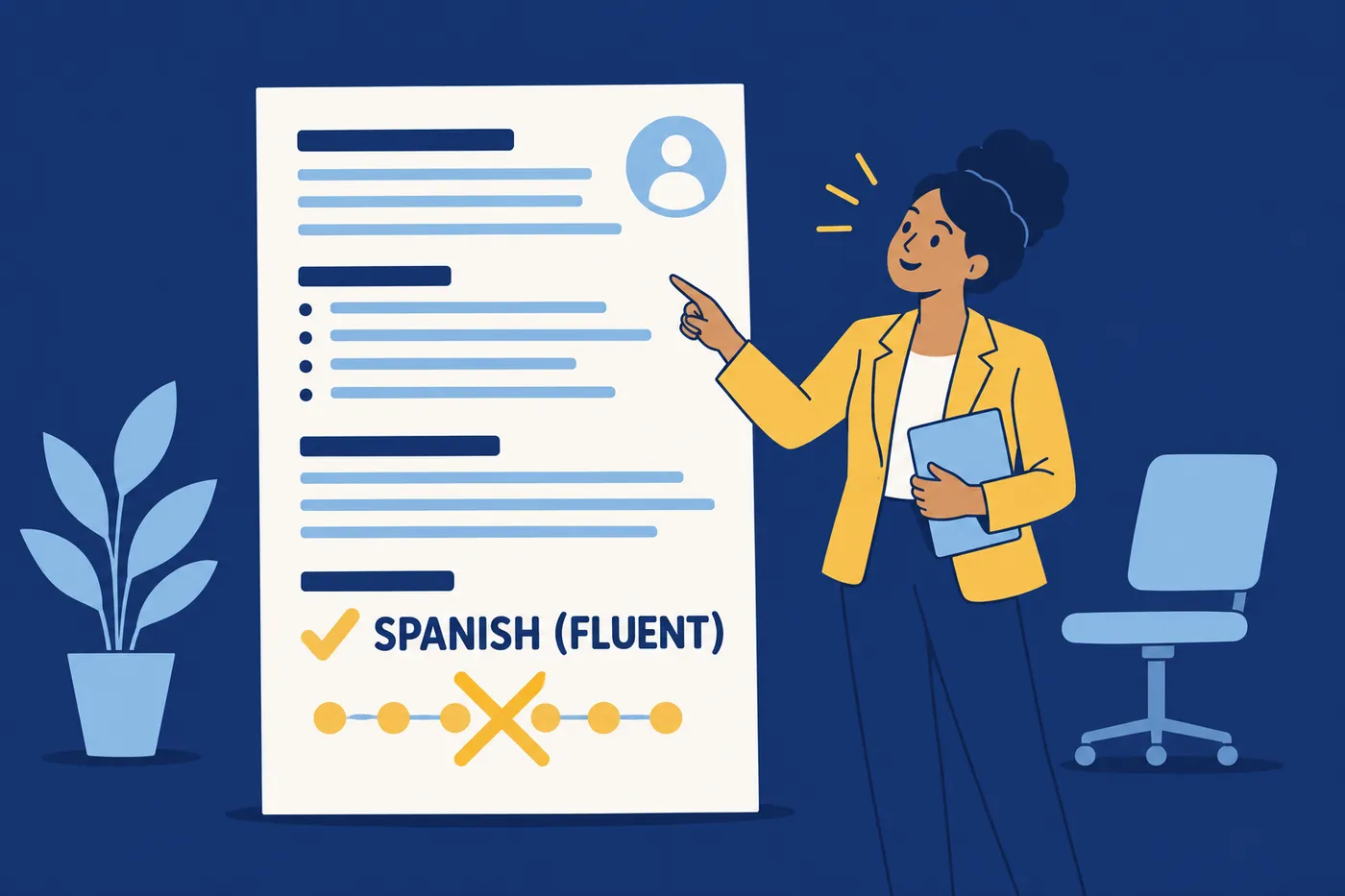
- Languages: Spanish (native); English (customer meetings and written reports)
- French — B2, self-assessed; reading stronger than speaking
- Mandarin — conversational
- Japanese — JLPT N2, passed July 2025; describe speaking ability separately
Use the posting’s terminology when accurate, including the specific languages in a bilingual requirement. Do not add a proficiency label simply to match a keyword. See our guide to ATS resume keywords for choosing relevant wording.
Follow the employer’s file instructions. For a PDF, check that you can select and copy its text in the intended order, then review any fields the application form imports. No format is guaranteed to parse correctly in every system. See the ATS resume format guide for more layout checks.
When to Leave a Language Off
Leave it off when it adds little to the application or you cannot describe your current ability accurately. Coursework or an app streak alone does not establish workplace proficiency.
A beginner level can still be relevant when the posting values basic communication or you want to show current study. Write German — A2, self-assessed; currently studying rather than implying you can already perform the job in German. Keep stronger, directly relevant evidence ahead of it.
How to Highlight Bilingual Skills in Your Summary
If language ability is important to the role, connect it to the work in your summary. These fictional examples illustrate the structure; do not copy credentials or results you have not earned.
- Customer support specialist providing email and phone support in English and Spanish.
- Customer success manager using English and Portuguese to support Latin American enterprise accounts.
- Inside sales representative conducting Spanish-language product demonstrations for regional customers.
Use the same approach in experience bullets: “Resolved Spanish-language customer inquiries by phone and email” explains the task more clearly than “bilingual” alone. Include volume or results only when you can support them. See how to write a professional summary for connecting skills to a role.
Frequently asked questions
- What language proficiency levels should I use?
Use clear descriptions, such as basic or conversational, or name the workplace tasks you can perform. If the employer specifies CEFR, ILR, or a test, use that framework and distinguish assessed results from self-assessment.
- Can I put Spanish on my resume if I am not fluent?
Yes, when relevant and accurately labeled. “Spanish — conversational” can be useful without claiming advanced ability. Check that your skills meet the actual duties; do not imply qualifications for specialized interpreting work.
- Should I list English on my resume?
List it when the employer requests a level or it helps explain your fit, especially for multilingual work. An English-language resume does not by itself demonstrate speaking or listening ability.
- How do I rank multiple languages on my resume?
Put the job’s required language first, followed by other relevant languages. Give each its own description; distinguish reading, writing, and speaking where the differences matter.
- Do language certificates like DELE, DELF, or JLPT belong on a resume?
Include relevant results with the exact test, level, and date. Do not infer skills beyond what the assessment covers. For example, the JLPT’s level descriptions describe reading and listening comprehension; N2 alone does not establish professional speaking ability. See where to put certifications on a resume for placement.
- Should I use CEFR levels on a US resume?
You can, especially when requested. Name the framework and the assessment or self-assessment basis, then add a short description of relevant tasks if the code alone is unclear. Avoid treating a CEFR level as an automatic equivalent to another scale.



Ready to start your new resume?
Writing a resume takes time, and even a polished one can miss what a hiring manager is looking for. Roleframe helps you build a clear, ATS-safe resume in minutes and tailor it to the job you want.


