Teacher Resume Template: Section Order and Fill-In Lines for Next School Year
Three fill-in teacher resume templates for experienced, first-year and career-change candidates, with certification lines, bullet rewrites and PDF rules.


On this page
Certification goes near the top. That is the main structural difference between a teacher resume and every other resume: a principal screening applicants for next school year needs to see within seconds that you hold, or will soon hold, the certificate the posting requires. Choose the remaining order for your career stage. Header, certification, a short summary, then teaching experience in reverse chronological order with grade level and subject named in every entry. Education follows, with professional development and skills at the bottom. Use one column. One page serves most candidates, and a second page is justified only when relevant teaching content genuinely fills it.
Below are three fill-in templates built on that order, covering an experienced teacher, a first-year teacher, and a career changer moving into teaching. They are templates, placeholder lines you replace, not finished examples. Copy the one that matches your situation, then use the bullet-writing and certification sections further down to fill the brackets with lines a hiring committee can act on. For completed fictional samples, see the teacher resume examples.
The section order, by career stage
Use certification status, education and relevant classroom experience to establish fit. Westfield State’s teacher resume guide includes these elements and recommends tailoring entries to the role. The order below is a practical starting point; adapt it to your career stage and the application instructions.
| Order | Experienced teacher | First-year teacher | Career changer into teaching |
|---|---|---|---|
| 1 | Header | Header | Header |
| 2 | Certification | Certification (pending shown honestly) | Certification (program and expected date) |
| 3 | Summary | Objective (optional, one line) | Summary that explains the move |
| 4 | Teaching experience | Education | Teaching and classroom-adjacent experience |
| 5 | Education | Student teaching / clinical experience | Prior career, rewritten for a school |
| 6 | Professional development | Other work experience | Education |
| 7 | Skills | Skills | Skills |
The logic is simple: lead with your strongest evidence. An experienced teacher's strongest evidence is the classroom record. A first-year teacher's is the degree and the student teaching placement. A career changer's is the certification progress plus whatever classroom work already exists, with the prior career reframed underneath it rather than hidden.
Template 1: Experienced teacher
Copy the lines and replace every bracket. The one-line guidance above each group tells you what the section has to prove.
Header. Name, city and state, phone and a professional email. No photo and no street address. Use a simple layout for the standard application and follow the district’s instructions.
- [Full name]
- [City, State] | [Phone] | [Email]
Certification. The exact title your state issued. Formats are in the certification section below.
- [State] [exact certificate title], [grade band and subject area], expires [month, year]
Summary. Two or three lines that say who you are and what you can show for it.
- [Grade/subject] teacher with [N] years in [district or school type]. [One strength a principal cares about, such as data-driven small groups or inclusion co-teaching.] [One result, such as class-level growth on a named assessment or a program you built.]
Teaching experience. Use reverse chronological order and select a few relevant bullets for each position. The next section covers what the bullets should say.
- [Job title with grade and subject], [School], [District], [City, State] | [Month Year]–[Present]
- Taught [subject] to [N] sections of [grade], [N] students per section [note co-taught or inclusion settings if true]
- [Result bullet on what you changed and the class-level growth on a named assessment]
- [Curriculum or assessment bullet, such as a unit you wrote or a data cycle you led]
- [Family communication or extra-duty bullet, such as translated newsletters or mentoring a student teacher]
Education. Degree, major, institution and year. Nothing from high school.
- [Degree], [Major], [University], [Year]
Professional development. Only entries the posting would care about, meaning endorsements and training tied to the district's curriculum or student population.
- [Endorsement or training], [Provider or state], [Year]
Skills. Classroom technology and instructional approaches, plus any languages you speak. Wording that holds up under interview questions is covered in teacher skills for your resume.
- [LMS and classroom tech] | [Instructional approaches] | [Languages spoken]
Elementary candidates can treat this same skeleton as the elementary teacher resume template. Write the grade and "self-contained, all core subjects" in the title line so the committee can place you instantly. Secondary candidates lead with the subject and course levels instead, such as honors or AP sections.
Template 2: First-year teacher
Certification comes first even when it is pending, then education, because the degree and the placement are your record. Student teaching is experience. Write it with the same bullet discipline as a paid position.
Certification.
- [Certificate title], expected [month, year] | [content exams passed, with dates] | program completion [month, year]
Objective (optional, one line). Use it only to name the band and the district.
- Seeking a [grade/subject] position at [district]; certification in [band] expected [month], with student teaching in [setting]
Education.
- [Degree], [Major], [University], [Year] | [GPA if strong and recent] | [relevant coursework only if it answers a posting requirement]
Student teaching / clinical experience.
- Student Teacher, [grade/subject], [School], [City, State] | [Semester, Year]
- Planned and taught [N] weeks of [subject] for [N] students, assuming full-class responsibility by week [N]
- [Assessment bullet, such as a unit test you wrote or small groups you regrouped from the data]
- [Management or family bullet, such as a routine you ran or conferences you joined]
Other experience. Work with children or teens counts, including camp jobs, tutoring and paraprofessional roles. One line, one bullet on scope.
- [Role], [Organization], [Dates] | [one bullet on how many students you worked with and what you ran]
Skills. Same format as Template 1.
Template 3: Career changer into teaching
The summary explains the move in one line, with no apology. Classroom-adjacent work leads the experience section, even if it is substitute days or tutoring hours, and the prior career follows, rewritten for the evidence a school cares about.
Certification.
- [Alternative certification program or certificate title], [state], expected [month, year] | [exams passed, with dates]
Summary.
- [Prior profession] moving into [grade/subject] teaching, certification expected [month, year]. [Classroom evidence, such as [N] substitute days across grades [range] or [N] tutoring hours.] [One transferable strength with a result.]
Teaching and classroom experience.
- [Substitute teacher / tutor / coach / instructor], [Organization or district], [Dates]
- [Bullet with grades and subjects covered, the number of days or students, and anything you ran rather than just covered]
Prior career. Keep the real titles and dates. Rewrite the bullets for a school audience.
- [Title], [Company], [Dates]
- [Bullet rewritten for a school, such as training you designed and delivered or materials you wrote for non-experts]
Education and skills. Same format as Template 1. Connect your actual experience to the posting’s subject and grade band without changing past job titles or overstating your qualifications.
What to write in each experience entry
Use these prompts to make each relevant experience entry informative. Include the details that fit your actual role:
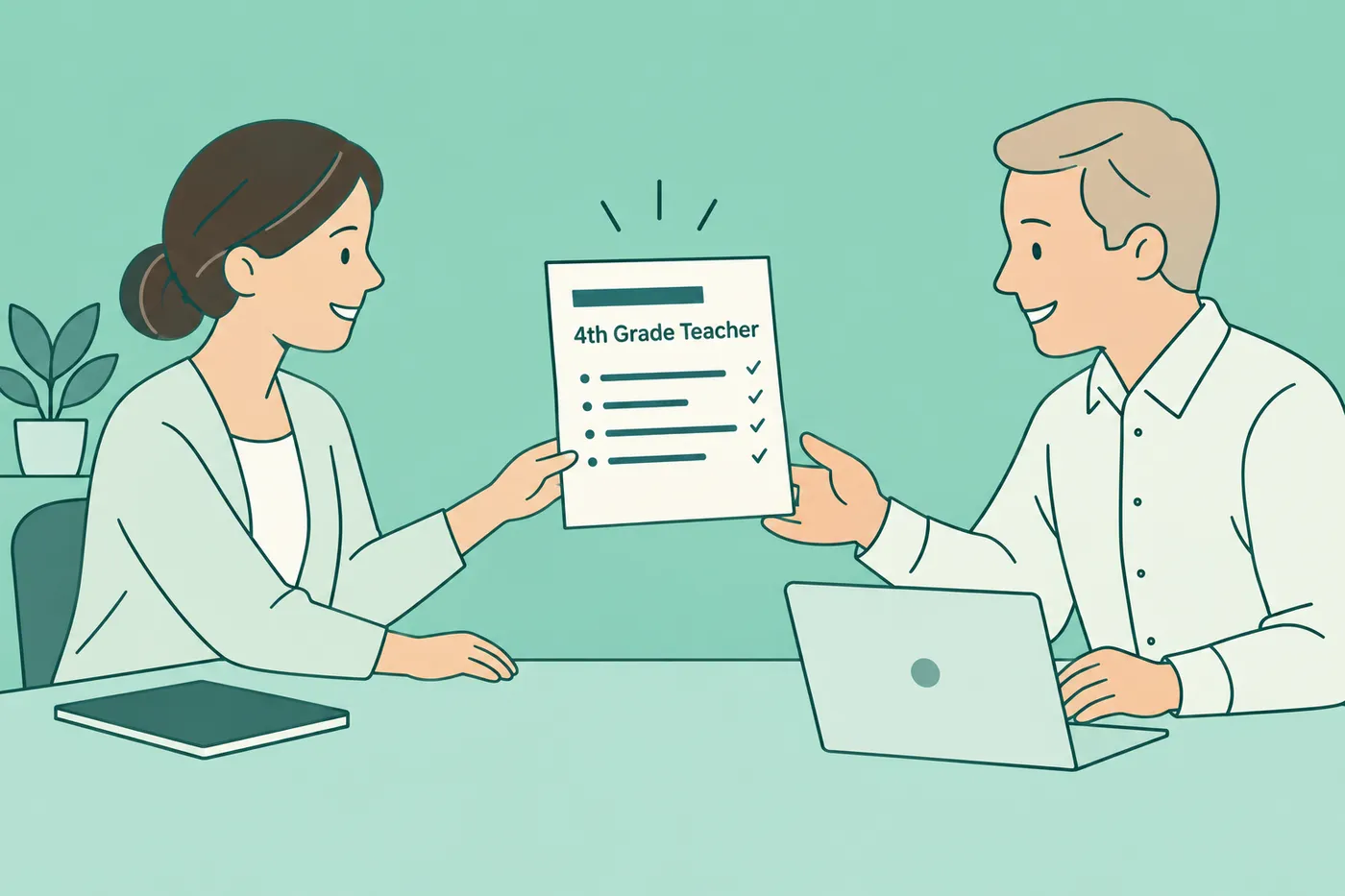
- Grade level and subject, always. "Teacher, Lincoln Elementary" tells a committee nothing; "4th grade, self-contained, all core subjects" places you immediately.
- Class size and load where it adds context: number of sections, combined grades, co-taught or inclusion settings.
- Curriculum and assessment work: units you wrote, assessments you designed, data meetings you led, a curriculum adoption you piloted.
- Results that respect student privacy: growth stated at the class or cohort level on a named type of assessment, or a program you started and what it reached. Never a student's name, and never detail specific enough to identify a small group.
- Family communication and extra duties: conference attendance, translated newsletters, clubs, coaching, committees, mentoring student teachers.
Quantify where you have reliable, appropriate evidence. Teaching load, materials developed or a program’s reach can be useful context. A number is optional; a specific description is better than an invented result.
Three bullet rewrites, from duty to evidence
These fictional rewrites demonstrate structure, not real classroom results. Replace them with your own verified facts. If you cannot support an outcome, describe the work and its purpose without implying an improvement you did not measure.
| Weak bullet | Stronger rewrite (illustrative) | What changed |
|---|---|---|
| Responsible for teaching 4th grade math. | Taught 4th grade math across two sections of 26 students; class median rose one proficiency band on the district benchmark between fall and spring. | Names the teaching load and states class-level growth on a named assessment. It uses class-level rather than named-student detail; still check disclosure rules. |
| Helped struggling readers. | Ran daily small-group reading rotations for below-benchmark readers; by spring, the group average on the school's universal screener met the grade-level target. | Replaces a vague duty with the structure (daily rotations), the population (below benchmark) and a cohort-level result. |
| Communicated with parents regularly. | Sent a weekly family update in English and Spanish and logged contact with every family each grading period; conference attendance reached 100% in both semesters. | Turns a duty into a system with an outcome measured at the classroom level, not the student level. |
Removing student names is not always enough to protect privacy. Small groups, unusual circumstances or combined details can still identify someone. Follow your school’s disclosure rules and use only information you are authorized to share. The Department of Education’s disclosure-avoidance guidance explains why aggregate data also needs care.
Certification lines: copy the state's wording
Use the exact credential title and current status recorded by the issuing authority. For an issued credential, a useful line is:
- [State] [exact certificate title], [grade band and subject], [current expiration date if applicable]
For an application in progress, identify what is actually completed and what is pending:
- [Program or application status], [state]; [exam actually passed and date]; expected completion [Month Year, if supported]
Do not imply that program enrollment or an expected date guarantees certification. If moving states, check the destination education agency’s requirements and describe a transfer application as submitted only after submitting it.
Formatting, file type and district portals
Use consistent headings, legible type and a layout that keeps the content in a clear reading order. One page may be enough for an early-career applicant; a second can be useful for substantial relevant experience. Follow any page limit in the announcement.
Use the requested file type. If PDF is accepted, check the exported file and upload preview. Complete required application fields accurately rather than relying on “see resume,” and make sure dates and job titles agree across the form and attachment.
Start it now, before the postings open
Prepare a base resume before you need it, then tailor it to each posting’s certification, subject and experience requirements. Start with a resume template or edit in the resume builder. Available checks can highlight possible issues while you remain responsible for the facts.
If a letter is requested, the teacher cover-letter example shows an annotated draft and a first-year adaptation.
Frequently asked questions
- Is there a free resume editor I can use for a teacher resume?
Yes. The fill-in structures here can be copied into a document editor. Roleframe also offers a free resume builder with PDF downloads; AI features have their own usage allowances.
- What is a good career objective for a teacher resume?
An optional objective can help a first-year teacher or career changer state a specific target. For example: “Seeking a [grade/subject] role at [district]; [accurate certification status] with student teaching in [setting].” Keep it brief and avoid claiming a credential that is still pending.
- Should a teacher resume be one page or two?
Use the length needed for relevant evidence within the application’s limit. One page often works for an early-career teacher; two may be appropriate for substantial relevant experience. Cut repeated duties before shrinking the font.
- Do I need a separate elementary teacher resume template?
No, the skeleton is the same. What changes is the content: an elementary resume names the grade and notes a self-contained classroom covering all core subjects, while a secondary resume leads with the subject and course levels such as honors or AP sections. Template 1 above covers both once you adjust the title line and the subject placeholders.


Ready to start your new resume?
Writing a resume takes time, and even a polished one can miss what a hiring manager is looking for. Roleframe helps you build a clear, ATS-safe resume in minutes and tailor it to the job you want.


