Resume Writing Guide 2026: Facts, Tailoring and File Checks
Build a reliable resume source record, tailor relevant evidence, check AI edits and inspect the final file. Includes scoped ATS guidance and truthful bullet examples.


On this page
A useful resume makes relevant experience easy to understand without changing the facts. This 2026 guide gives you a repeatable workflow: maintain a source record, choose evidence for the vacancy, write clear bullets and check the submitted file.
The ATS discussion uses specific provider documentation checked in October 2026. It does not claim that all employers use the same software, scoring system or hiring sequence. A careful application can improve clarity; no wording, layout or tool can guarantee that it will be reviewed first or lead to an interview.
Choose a structure for the application you are making
Follow the employer’s instructions before a general resume rule. A short conventional resume is useful for many applications; an academic CV, a government application or a requested supporting statement may need different detail.
A summary is optional. Use it when a brief introduction clarifies your experience or direction, especially for a transition. It can describe relevant work without a metric or an inflated target title. An objective can also be useful when it explains a specific direction that the history alone does not.
Select experience for relevance, but preserve accurate titles, dates and qualifications. A resume can be selective while an application form may request complete history; answer each according to its instructions.
- Content: emphasize evidence connected to the role rather than treating every past duty equally.
- Structure: choose headings and an order that make the relevant experience easy to find.
- Length: keep useful detail and remove repetition before reducing readability.
- Accuracy: distinguish your contribution from team results and qualifications in progress from those earned.
- Submission: follow the requested format, document requirements and deadline.
Separate resume parsing from application decisions
An applicant tracking system can store applications and support recruiting workflows, but features and employer configurations differ. Do not assume that every resume receives a universal keyword score.
In Greenhouse’s parsing documentation, parsing means extracting information into candidate fields. A failed parse can leave the file attached while fields need manual correction. The provider lists complex layouts, columns, images and contact details in headers, footers or text boxes among possible causes of incomplete extraction. This is a specific product example, not proof that a layout automatically causes rejection everywhere.
Separately, Greenhouse documents employer-configured auto-reject rules based on answers to application questions. A parsing issue, a qualification answer and a hiring decision are different things.
Use the posting’s terminology where it accurately describes your experience. Keep official job titles accurate; Product Owner and Product Manager are not interchangeable merely because one appears in a vacancy. You can clarify an unusual internal title without replacing it with a role you did not hold.
Do not add hidden text, copied duties or repeated skills to chase a score. The ATS format guide offers related checks.
Plan around deadlines without guessing the review order
Record the closing date and any stated review schedule. If an employer says it reviews on a rolling basis or may close early, take that into account. A submission date alone does not establish which application a recruiter will read first.
Keep a current source record so you can prepare efficiently when a suitable vacancy appears. Leave time for the required documents and a final review instead of rushing an inaccurate application to meet an invented first-day advantage. The job-search guide provides a wider planning workflow.
Keep a reliable source record
Maintain a private record of employment dates, actual titles, projects, qualifications and examples you can substantiate. It can be longer than a submitted resume. You may keep one master record with several role-specific versions; separate master files are optional.
For each example, note the task, your contribution, tools used, outcome if known and any sharing restriction. Keep the source of a metric in private notes rather than inserting unsupported precision into the final document.
Save a copy for each application and record what changed. The guides to managing versions and tailoring a resume provide related organization methods.
What to put in the source record
- Name and current contact details, plus relevant links you choose to share.
- Employer, accurate title, dates and the scope of each role.
- Projects and tasks, identifying what you did versus what the team did.
- Skills and tools with examples of actual use; distinguish training from work experience.
- Qualifications, issuing bodies and completion or current study status.
- Supported outcomes with definitions, dates and permission to disclose; omit confidential source material from applications.
Write bullets from known facts
A useful bullet identifies an action and enough context to understand it. Add the result when you know it and can support it. A well-described responsibility can still be relevant, particularly when it shows the exact work required by the vacancy.
The examples below are fictional. Each proposed bullet uses the supplied fact record; the last column identifies an outcome that the record does not establish. They demonstrate specificity without inventing an impressive number.
| Fictional source facts | Possible resume bullet | Do not add without evidence |
|---|---|---|
| Answered support requests, documented troubleshooting and escalated unresolved cases. | Handled customer support requests, recording troubleshooting steps and routing unresolved cases to the appropriate team. | A satisfaction score, daily ticket volume or resolution rate. |
| Checked redesigned website pages against agreed requirements and recorded defects. | Tested redesigned website pages against agreed requirements and documented defects for the developers. | Ownership of the redesign or an increase in signups. |
| Compared vendor invoices with approved orders and referred discrepancies to finance. | Reconciled vendor invoices with approved orders and raised discrepancies with finance. | Budget approval authority or procurement savings. |
| Arranged interview times, confirmed attendance and updated a candidate tracker. | Coordinated interview scheduling and maintained the candidate tracker for the hiring team. | Designing the selection process or cutting time to hire. |
If a number is approximate, there should still be a defensible method or record behind it, and the wording should make the approximation clear. Do not guess a percentage because a bullet seems weak without one. Describe the task or scope instead.
For a genuine improvement measure, identify the baseline, period and definition, and avoid taking sole credit for a team result. The resume mistakes guide includes related accuracy checks.
Use AI to edit language, then verify every claim
An AI tool can help organize notes, suggest clearer language or compare a draft with a vacancy. It can also invent details, change the scope of your role or turn a tentative observation into a definite achievement.
Provide non-confidential facts and ask for missing information to be identified rather than filled in. Compare the result with the source record. Keep the official title, dates, tools and outcomes accurate, and remove language you would not use or could not explain.
The same check applies when drafting with Roleframe. A resume input or match score does not guarantee faithful output. Before uploading personal information, review the service’s current privacy terms and avoid sharing confidential employer or client materials.
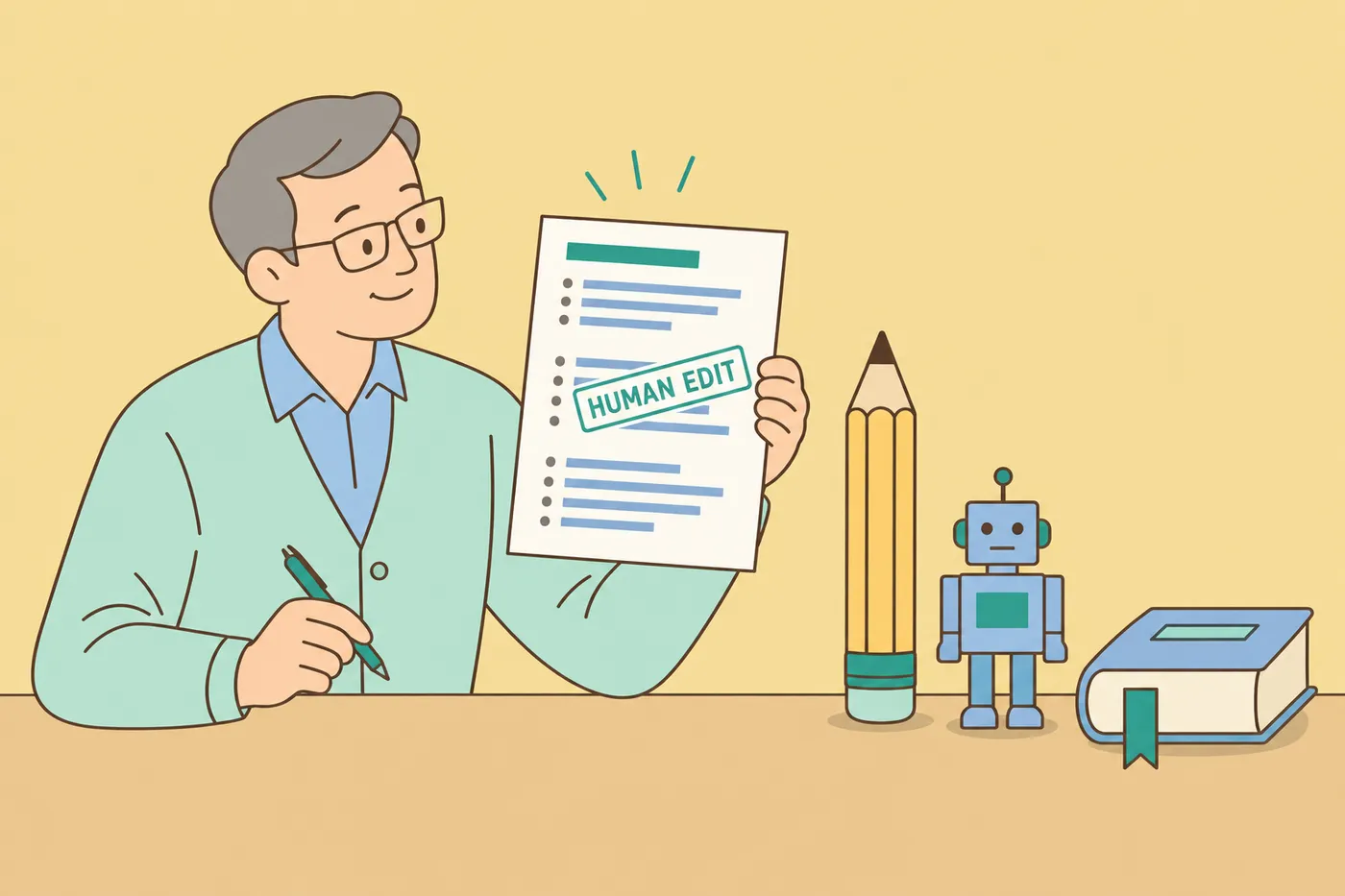
A quick AI checklist before you send
- Every role, date, qualification and skill matches your record.
- The draft does not turn assisting, observing or training into ownership or employment.
- Metrics have a source and a clear meaning; no figures were invented to fill a gap.
- Wording matches the vacancy only where the underlying experience matches.
- Examples are understandable, relevant and permitted to share.
- You have read the final text yourself and removed unsupported or unnatural phrasing.
Use a readable layout and inspect the reading order
A simple layout with clear headings and consistent dates is a practical starting point. Reverse chronological experience is useful when recent work is relevant; education or projects may deserve a higher position for another applicant.
A single column can make reading order easier to inspect. Whatever template you use, check that section headings, roles, dates and bullets remain associated in the exported file. Do not rely on a template’s “ATS-friendly” label as certification for every employer’s system.
Use an accepted file type and comply with the stated size limit. PDF and DOCX can both be appropriate depending on the application. Open the final file, inspect page breaks and links, and check whether its text can be selected and copied in a sensible order.
Copying text is a useful spot check, not a simulation of every ATS. Inspect the application’s autofilled fields or preview when available. No format or editor can promise identical rendering in every downstream system.
Keep public work samples and application facts consistent
If you choose to include a professional profile or portfolio, check relevant dates, titles, qualifications and links. Different documents can emphasize different work while preserving the same facts.
A portfolio is useful when it adds relevant, shareable evidence; it is not mandatory for every technical applicant. Do not publish employer code or client material without permission. The GitHub link guide and project guide discuss presentation choices.
Use a checklist without mistaking it for a standard
If memory aids help, use the five Ps in this guide: Purpose (which role), Proof (what supports each claim), Presentation (can it be read), Privacy (may it be shared) and Proofreading (is the final file correct).
Our three Cs are Clear, Concise and Consistent. These are editorial checklists for this workflow, not a standardized recruiter test, a scoring formula or evidence that one resume will outperform another.
A workflow for the next application
Use this sequence and allow the time the role requires. Its purpose is to reduce repeated work while preserving accuracy, not to promise every application can be completed in minutes.
- Read the vacancy and record requirements, documents, format and deadline.
- Check whether you meet required qualifications and identify any point needing clarification.
- Select relevant examples from your source record.
- Create an application copy and emphasize those examples without changing the facts.
- Add a summary only if it clarifies your experience or direction.
- Write concise bullets with a specific contribution and supported outcome where available.
- Review any AI edits against the source record.
- Export an accepted format and inspect the final file, links and reading order.
- Complete the application fields accurately and add other documents when requested.
- Save the submitted version and record the application date and vacancy.
After submitting, keep the source record current as you complete new work. For section-by-section writing guidance, see how to write a resume.
Frequently asked questions
- Is there a new mandatory resume format for 2026?
No universal format is established here. Follow the employer’s instructions and use a layout that makes your evidence easy to read. The year in this guide identifies the review edition, not a rule change affecting every employer.
- What makes a useful resume?
Relevant, accurate evidence presented clearly. Explain your contribution, preserve true titles and credentials, and check the final file. A metric can help when supported, but it is not required in every bullet.
- What are the five Ps in this guide?
Purpose, Proof, Presentation, Privacy and Proofreading. They are our memory aid for reviewing an application, not an industry certification or a hiring formula.
- What are the three Cs in this guide?
Clear, Concise and Consistent. Use them to check readability and facts across the application. Other guides may use different versions; none replaces the employer’s instructions.
- How long should my resume be?
Use the length needed to present relevant evidence within the application’s requirements. A conventional early-career resume may fit one page, while other histories or document types need more. Remove repetition before sacrificing readability.
- Can I use AI?
Use it according to the application’s instructions and check every output against your actual record. AI can invent or exaggerate details even when given a resume. No tool or score guarantees accuracy, an interview or a favourable hiring decision.



Ready to start your new resume?
Writing a resume takes time, and even a polished one can miss what a hiring manager is looking for. Roleframe helps you build a clear, ATS-safe resume in minutes and tailor it to the job you want.


