Nurse Residency Programs: How New Grads Apply, When Windows Open, and What to Send
What nurse residency programs are, who qualifies, when application windows open, and exactly what to send, with a packet checklist for new grad RNs.

On this page
A nurse residency supports the transition into registered nursing through supervised clinical experience and structured learning. Programs differ in their duration, employment status, pay or stipend, and admission requirements. Some hire residents as staff; others appoint paid trainees.
Plan around the actual programs you are eligible for. This guide gives you a target-list method, an application-packet checklist and questions to ask about dates, licensure and the offer’s terms.
What a nurse residency program actually is
Read the program description for its clinical supervision, education time, assessment process and support when a resident needs more practice. The label “residency” alone does not tell you how these work.
For example, VA Houston describes a one-year program, while Lovell Federal Health Care identifies its residents as paid clinical trainees rather than employees. Confirm which arrangement applies to your offer.
If accreditation matters to your choice, check the accreditor’s directory and current standards. CCNE’s entry-to-practice residency standards include revised 2026 standards taking effect January 1, 2027. Accreditation is one useful check, alongside the program’s actual supervision, learning time and contract terms.
Who is eligible, and why you must read every posting
Check degree type, graduation recency, prior RN experience and the date by which a license must be issued. These details differ even within one health system.
For example, VA Greater Los Angeles distinguishes its post-baccalaureate residency from the transition program to which ADN graduates may apply. Do not assume one program’s degree rule describes every residency.
Licensure timing also varies: VA Houston requires a current unrestricted license before the start, while the VA San Diego criteria specify 30 calendar days before the start. Recheck the current cohort posting and contact the coordinator if your expected licensing date is close.
Record any citizenship, screening, certification or specialty requirements separately. Do not assume admission includes placement in your preferred unit.
How to find programs
Build a target list using program and employer sources, then verify each opportunity against the current cohort posting:
- Search hospital and health-system careers pages for “nurse residency,” “new grad RN” and “transition to practice.” Follow links to the actual current vacancy.
- Ask clinical instructors or preceptors where to find official information about local programs. Treat informal timing information as a lead to verify.
- Ask your school’s career office for local contacts and resources, then confirm eligibility and dates with the program.
Choose a manageable set of programs that fit your qualifications and location constraints. Record the official URL, degree requirement, graduation cutoff, licensure deadline, application window and start date. Add a column for the date you last checked the information.
When application windows open and close
Application windows vary. Some programs recruit for scheduled cohorts, while others use a different hiring process. Record the published opening and closing dates, whether early closure is possible, and when a coordinator expects the next update.
Plan backward from the licensure deadline as well as the application deadline. Check your state board’s application steps, school processing times and exam eligibility process. A graduation date alone does not establish when a license will be issued.
A planning timeline for your final year
- Two semesters out: build the target list. Note each program's degree requirement, cohort start months and whether it defines a graduation cutoff. Set a weekly reminder to check the career pages, and set job alerts where the boards offer them.
- Start of the final semester: prepare the packet. Finish the resume, ask clinical instructors and preceptors for references, order transcripts, and draft a base cover letter you can adapt per unit.
- As windows open: apply early. Tailor the cover letter to the unit, attach the posting's exact requirements to your checklist, and submit in the first days of the window rather than at the deadline.
- Before graduation: learn the state board and NCLEX registration process, prepare required documents and schedule the exam when authorized and ready. Tell the program if your expected license date may miss its deadline.
What to send: the application packet
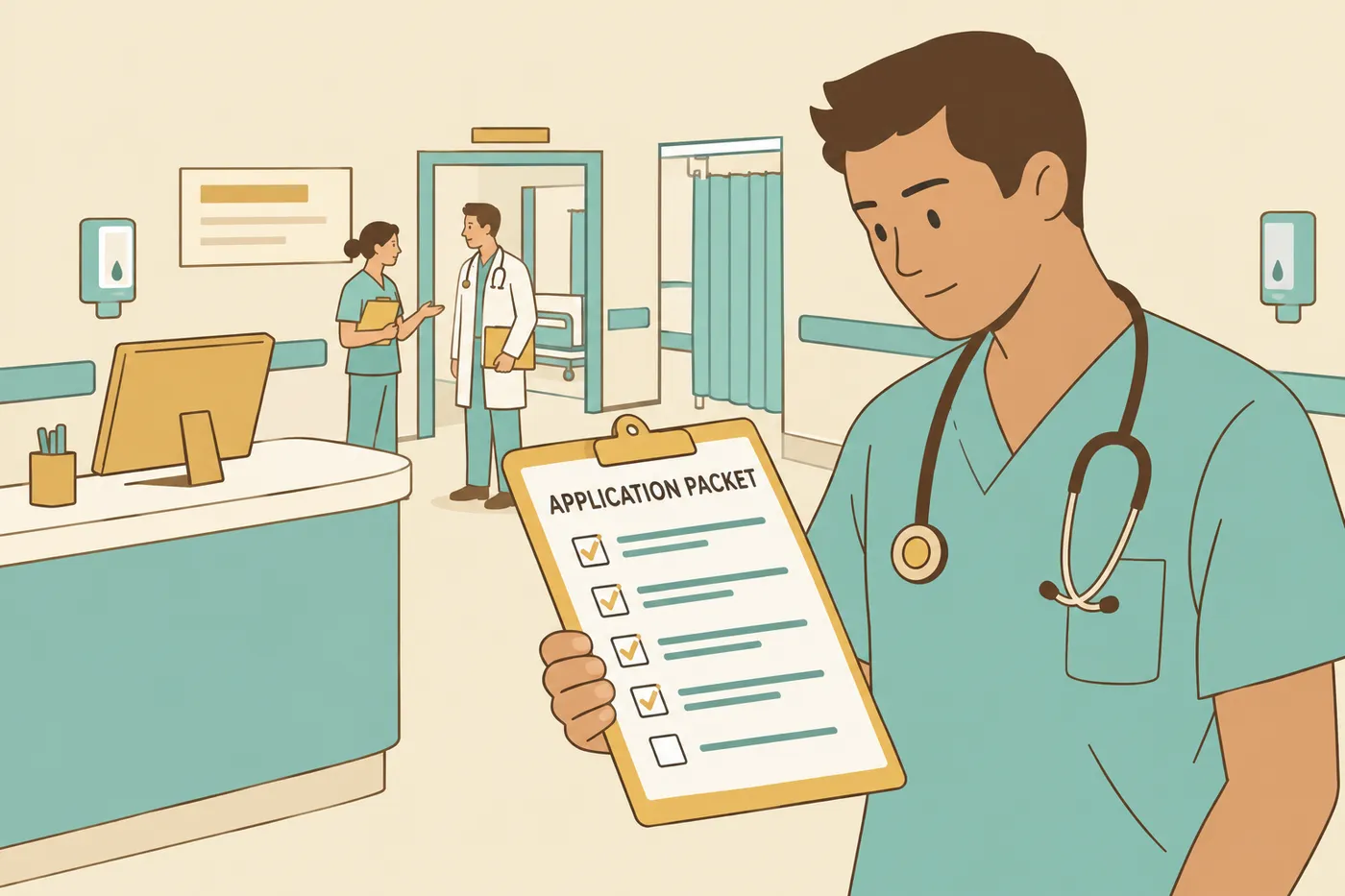
Use the current posting as your packet checklist. Required materials vary: one program may ask for a transcript and faculty recommendation, another for an essay or specific certification evidence. The table below is a planning aid, not a universal list of required documents.
| Item | What it should show | Tip |
|---|---|---|
| Resume | Relevant rotations, capstone and accurate work experience | Follow requested length and format; make your supervision level clear |
| Cover letter or essay | The requested prompt and your relevant experience | Include only if requested or appropriate; follow any authorship instructions |
| References | People who observed your work | Ask permission and follow the required number and submission method |
| Transcript | Degree progress or conferral | Check whether official or unofficial records are requested |
| Licensure | Accurate current status | Use the exact deadline in this cohort’s posting |
| Certifications | Credentials the program requires | Check issuer, accepted course type and expiration date |
The resume: clinicals are your experience section
Make clinical experience easy to assess. List the facility, rotation, dates and verified hours, then describe selected activities with your supervision level clear. Keep paid healthcare work separate from student placements.
See the registered nurse example and nursing skills guide for structure. Describe licensure accurately: use RN only when you hold the required license, and state an application or exam as pending or scheduled only when that is true. Keep patient-identifying information out of all examples.
The cover letter: name the unit
The letter has one job, which is to connect a specific rotation to a specific unit. "My preceptorship on a 32-bed med-surg unit is why I'm applying to your medical-surgical cohort" beats three paragraphs about your passion for nursing. Keep it under a page and follow the structure in how to write a cover letter, swapping the middle section for your clinical story.
The interview
Ask the coordinator what format to expect. Prepare examples of teamwork, escalation, prioritization and learning from feedback during clinicals. Explain what you did under supervision and how you followed the placement’s procedures.
Use anonymized situations without details that could identify a patient. The guide to nursing interview questions can help you organize responses; it does not predict an individual program’s assessment.
If you do not get in
If you are not selected, review your eligibility and materials before the next application. Ask whether feedback or a later cohort is available. A rejection alone does not tell you which part of the application determined the decision.
- Consider additional units or programs that fit your goals and qualifications, without assuming any specialty is automatically less competitive.
- Expand the location search where practical and verify each program’s current requirements.
- Consider relevant work you are qualified and authorized to perform while applying. Check whether gaining RN experience would change your eligibility for a new-graduate residency.
Get the packet ready before the window opens
Prepare accurate materials before a window opens so you have time to tailor and proofread them. Use a resume template or the resume builder, then check the final document against the program’s requirements. Editing suggestions can help you notice omissions, but the program decides eligibility.
Frequently asked questions
- Is it worth doing a nurse residency program?
It can be valuable when the program offers appropriate supervision, education and support for your first nursing role. Compare the actual unit placement, pay or stipend, benefits, schedule and any service or repayment agreement. A program label or aggregate retention figure cannot determine whether an individual offer is right for you.
- Do you get paid during an RN residency?
Many programs offer pay, but the arrangement varies. For example, Lovell’s program describes a stipend for clinical trainees rather than employee wages. Check the written offer for classification, pay, benefits and any service commitment.
- Can ADN graduates apply to nurse residency programs?
Some can; check the specific program. VA Greater Los Angeles, for example, separates post-baccalaureate residency eligibility from its transition-to-practice route for ADN applicants. Do not generalize one employer’s criteria to all programs.
- How long is a nurse residency program?
A year is a common design, including the VA examples linked above, but verify the duration and clinical arrangement for the particular program. A resident may be a staff employee or a trainee, depending on the program.


Ready to start your new resume?
Writing a resume takes time, and even a polished one can miss what a hiring manager is looking for. Roleframe helps you build a clear, ATS-safe resume in minutes and tailor it to the job you want.


