How to Explain a Layoff or Employment Gap on Your Resume
How to explain a gap in your resume: the exact line for a layoff, caregiving, health or study break, plus the cover letter sentence and interview answer.

On this page
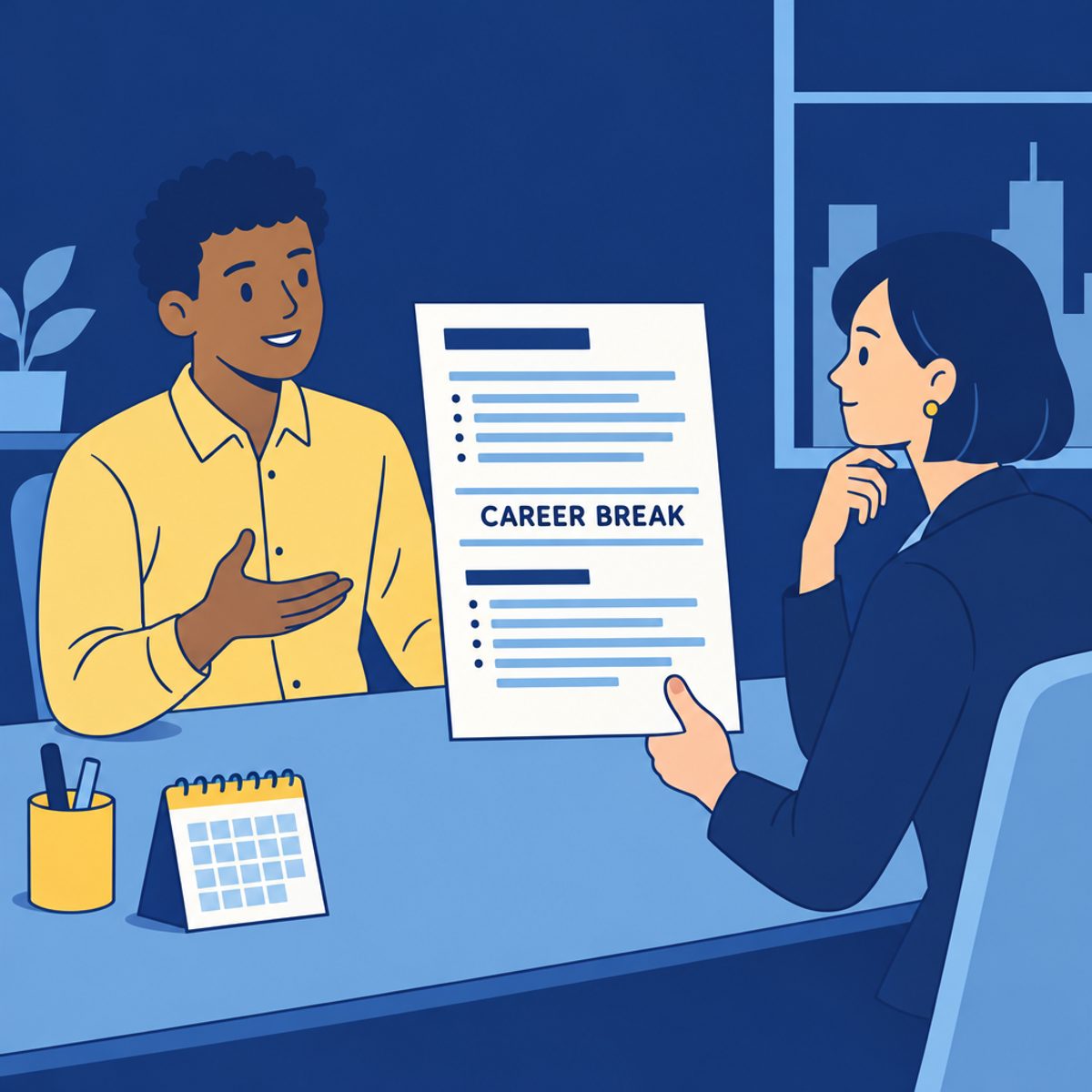
Keep employment dates accurate. If a recent or substantial break would otherwise leave the timeline unclear, you can add a short label such as “Career break” with the dates. The amount of context you share is a choice, except where a specific application requires a fuller history. You do not need to invent productive activities to justify time away.
This guide offers adaptable resume lines for layoffs, caregiving, health, study, and other breaks, then shows how to keep the explanation consistent in a cover letter or interview. The examples are fictional suggestions, not scripts guaranteed to satisfy every employer.
Does a gap actually hurt your chances?
There is no reliable answer for every employer or field. A gap can raise questions, but it is not proof that you lack the skills for a role. Focus on accurate dates, relevant experience, and what you can contribute now. If an application requires a complete history, supply it even when your shorter resume emphasizes selected roles.
Do not assume that every applicant tracking system rejects gaps or that none can screen on employment history. Products and employer configurations differ. Use clear dates and headings, check any automatically filled application fields, and answer eligibility questions truthfully.
In a licensed field, verify your current status directly with the licensing body before claiming a credential is active. If renewal or refresher training is needed, describe the actual status. Resume wording cannot substitute for a required license.
The exact resume line for each situation
A dated career-break entry is one option when it helps a reader follow a recent timeline. Another is to leave accurate dates on the surrounding jobs and prepare a brief explanation if asked. Use a consistent date format. Follow any application instructions that require month-and-year dates or a complete work history.
Every line below is illustrative. Replace the dates, employer names, activities, and circumstances with your own facts, and share only the context you choose to include.
Laid off in a restructuring
A past job can simply end with the correct date; a resume does not usually need to explain why every role ended. If you choose to give context, a brief parenthetical can work: “Operations Lead, Harlow Logistics (position eliminated in restructuring).” For a longer period away, you could use “Career break following a site closure (Mar 2026 – present).” Use this wording only when it accurately describes what happened.
Caregiving or parenting
One option is “Career break: family caregiving (Jun 2023 – Aug 2025).” A broader “Career break” label is also possible. If relevant coursework or volunteering happened during that time, list it accurately; caregiving does not need to be accompanied by a professional accomplishment to be real or worthwhile.
Health
You can use a neutral entry such as “Career break (Jan 2025 – Sep 2025)”. If you choose, “Career break for health reasons” adds limited context. Avoid calling the period medical leave unless that accurately describes it.
For US applications covered by the ADA, the EEOC explains that employers generally cannot ask disability-related questions before a conditional job offer, with limited exceptions concerning accommodations. This does not require you to put a diagnosis on a resume. Rules elsewhere differ; discuss accommodation needs through the appropriate process.
Study or retraining
A dated education entry can explain the period: “Full-time study: data analytics certificate program (Sep 2024 – Jun 2025).” Specify whether the qualification was completed or remains in progress. Add a relevant project if you have one, rather than implying that enrollment alone establishes professional experience.
Relocation
If useful and accurate, write “Career break: relocation and job search (Feb 2026 – present).” You can also state your current location or relocation availability in the contact area, without explaining the personal circumstances of the move.
A long job search
There is no fixed length at which you must add a job-search entry. If it would make the timeline clearer, try “Career break: job search (Oct 2025 – present).” Add “professional development” only when a real course, project, or other activity supports it. Do not describe a period of job searching as employment.
Freelance, contract or gig work
Actual freelance, contract, or gig work can appear as work experience: “Freelance Bookkeeper, self-employed (Apr 2024 – present).” Describe the work and dates accurately, including whether it was occasional or part-time if that context matters. Respect client confidentiality; you can explain an anonymized project instead of disclosing a protected client name.
Travel
"Career break: extended international travel (Jul 2024 – Mar 2025)." Add a bullet only if the travel produced something concrete, such as working proficiency in a language or volunteer work you can describe. Otherwise the dated label alone is enough.
Fill the gap only with what's real
Courses, freelance projects, family-business work, and volunteering can supply relevant evidence when they actually happened. Be specific about your contribution. “Completed a certificate and built a sales dashboard” is useful only if you completed both activities and were allowed to use the data.
You do not have to fill every month with an achievement. Do not invent consulting, courses, or projects to hide time away.
The three rewrites below are fictional illustrations. Replace every setting, activity, and figure with your own facts, not just the bracketed numbers.
| Situation | Weak line | Stronger line |
|---|---|---|
| Warehouse lead, laid off | Responsible for warehouse operations until layoff. | Led a 12-person receiving team; cut the mispick rate by [your %] in the year before the site closed in a company-wide consolidation. |
| Teacher returning after caregiving | Stayed home caring for a family member. | Career break: family caregiving. Kept teaching license current, completed [number] continuing-education hours in reading intervention, and volunteered weekly as a classroom aide. |
| Marketer who freelanced | Freelance marketing during employment gap. | Freelance Marketing Consultant, self-employed: ran paid social campaigns for [number] local clients, growing one client's monthly lead volume by [your %] in six months. |
Format and dates: don't rearrange your way out of a gap
A reverse chronological work history makes dates easy to find. A combination layout can put relevant skills near the top while keeping a dated experience section. Choose the structure that explains your background clearly rather than trying to make the gap invisible. Our format guide shows one option.
Never extend employment dates to cover a break or present coursework as paid work. Use a consistent level of date detail, and provide exact dates where an application asks for them. If you discover an error in an old resume, correct it before submitting the next one.

The cover letter: one sentence, then your offer
If an explanation helps connect your experience to this role, a short sentence may be enough: “After a career break for family caregiving, I am returning to accounting work and am interested in this role’s financial-reporting responsibilities.” You can keep the reason more general and spend the rest of the letter on relevant evidence.
For more examples, see explaining a gap in a cover letter and our letter after a layoff. Adapt the wording to your situation instead of treating an exact sentence count as a rule.
The interview: a three-part answer
If asked about the break, try a short answer with the context you want to share, any relevant activity that actually happened, and what you can contribute now. You can omit the activity section when it does not apply. Keep dates and facts consistent across your resume, letter, and interview.
These examples are fictional:
- Layoff: “My role ended when Harlow Logistics closed its Dayton site. I have since completed a safety-trainer certification, and I would like to bring that training and my receiving-team experience to this operation.”
- Caregiving: “I took a career break for family caregiving. I kept my teaching license current and am now looking for a classroom role. My previous experience includes adapting reading activities for mixed-ability groups.”
- Job search: “My contract ended last autumn. I have been looking for operations analyst roles and completed a SQL project that I can show you. This role’s reporting responsibilities are particularly relevant to that work.”
Replace every detail with your own experience, including your availability. You do not have to say that a health or caregiving situation is “resolved” to discuss how you could do the job.
If asked whether you were laid off or dismissed, describe the actual circumstances briefly. A dismissal can have different reasons; do not invent a restructuring explanation. Our guide to reasons for leaving a job offers wording to adapt.
There is no universal acceptable gap length. A longer break may call for more context about current skills, but it does not create an obligation to disclose private medical or family details.
Frequently asked questions
- Should I put "laid off" on my resume?
You can leave the job entry with its accurate end date. If brief context helps, you may add a truthful note such as “position eliminated in restructuring.” A separate career-break entry is optional unless the application requires a complete history.
- Do I have to explain a gap for health reasons?
You can use “Career break” with accurate dates without putting a diagnosis on the resume. Share only the context you choose, and handle any accommodation request through the appropriate process. See the EEOC guidance linked above for the US pre-offer rules and exceptions.
- How do I explain a gap as a stay-at-home parent?
A dated entry such as “Career break: parenting” is one option. Include relevant coursework, volunteering, or credentials only if they are real; none is required to justify the break. In an interview, you can discuss your relevant experience and availability without giving a family history.
- Is it OK to leave a short gap unexplained?
Often you can leave accurate dates on the surrounding jobs without a separate explanation. Follow the application’s instructions when it requests a complete history, and be prepared to answer a question briefly and truthfully.
- Do applicant tracking systems reject resumes with gaps?
There is no single rule across all ATS products and employer settings. A system may parse your dates, and an employer may configure screening questions or criteria. Use accurate dates, check the application fields, and avoid trying to conceal a break with false employment information.



Ready to start your new resume?
Writing a resume takes time, and even a polished one can miss what a hiring manager is looking for. Roleframe helps you build a clear, ATS-safe resume in minutes and tailor it to the job you want.


