How to Ask for a Letter of Recommendation, With Email Samples
How to ask for a letter of recommendation: who to ask for a job, grad school or scholarship, when to ask, four email samples and a packet checklist.


On this page
Start with the application's instructions, then choose a recommender who can describe relevant work they have personally observed. A prominent title is less useful than specific evidence if the person does not know you well.
Your request should explain the purpose, deadline and submission method, and give the person room to decline. This guide includes fictional email examples for a job, graduate program and scholarship, plus ways to handle short notice or a current employer who does not know about your search. Requirements differ between employers and programs, so use their instructions over a general template.
The six steps, in order
- Read the requirements and choose an eligible person who knows relevant work you have done.
- Ask several weeks ahead when possible, or earlier if the recommender or application requests more notice. Tell them the exact deadline and ask whether it is feasible.
- Make a clear request by email or in a conversation, with an easy way to decline.
- After they agree, send the purpose, submission details, your resume and a short evidence summary.
- Agree on a reminder and check the submission status using the application system, where available.
- Thank them for their time and share the outcome when you know it.
This page covers requesting a recommendation. If you are the authorized writer, our letter of recommendation templates show possible structures. If you are the applicant and are asked for a draft, first read the authorship guidance later on this page and the application’s rules.
Who to ask, by purpose
A former manager, teacher, research supervisor, colleague or client may be appropriate if the application permits that relationship. Common App's guidance, for example, distinguishes teacher and other recommenders and notes that colleges differ in what they accept. Do not assume the same rules apply to every opportunity.
| Purpose | Possible recommenders, if permitted | What to check |
|---|---|---|
| A job | A former manager, supervisor, coworker or client | Whether the employer wants a written letter or a person to contact, and which working relationships are acceptable. |
| Graduate school | A professor, research supervisor or professional supervisor, depending on the program | Whether the program requires academic references, professional references or a combination. |
| A scholarship | A teacher, coach, employer or community leader, depending on the award | The award criteria and any required recommender role. |
| A college application | The teachers, counselor or other recommenders the college specifies | Which letters are required or accepted and how to assign and submit them. |
Compare what each possible recommender can actually describe. Someone who supervised a project can explain your contribution and how you responded to feedback. Someone who met you once may have much less evidence, regardless of their title.
Ask whether the person feels able to write a positive, detailed recommendation and meet the deadline. A colleague may also need to follow their employer's reference policy. Give them an opportunity to decline rather than treating the letter as an obligation.
When to ask, and how late is too late
Ask when you know you will need the recommendation. A practical planning target is several weeks ahead, with more time during busy academic or work periods; this is a suggestion, not a universal minimum. Check whether the writer or program sets its own timetable.
If you are leaving a job or finishing a course, you can ask whether the person would be willing to recommend you in the future. Keep accurate, non-confidential notes on work you did together so you can refresh their memory when an application arrives.
For a late request, state the deadline plainly, acknowledge the short notice and provide complete information. Ask whether they can realistically meet it. If they cannot, thank them and check the application's options or approach another eligible recommender. Do not submit someone else's name without asking first.
Email samples for each kind of recommender
The examples below identify the relationship, opportunity, deadline and submission method, then give the person room to decline. All names, organizations, dates and experiences are fictional. Replace them with accurate details, including the deadline year and time zone when relevant.
Use the channel that suits your relationship. A conversation can be followed by an email with the logistics; a clear email request is also reasonable when you cannot meet.

To a professor, for graduate school
Subject: Recommendation request: MS in Data Science, due January 5
"Dear Professor Alvarez,
I was in your Applied Statistics course in spring 2025 and completed my senior project on hospital readmission modeling under your supervision. I'm applying to the MS in Data Science program at Harlow University, and one letter of recommendation is due January 5 through their online portal; you would receive an email link from the university.
Would you feel comfortable writing a strong letter based on that work? If so, I'll send my resume, the program description, and a one-page summary of the project right away. I completely understand if your schedule this semester doesn't allow it.
Thank you either way,
Priya Raman"
To a former manager, for a job
Subject: Would you write me a recommendation? (due March 10)
"Hi Dana,
I hope things are going well at Brightline. I'm in the final round for a project coordinator role at Northstar Logistics, and they've asked for a letter of recommendation by March 10, emailed directly to their HR contact.
You managed me through the warehouse-systems rollout, which is close to the work this role involves, so your perspective would carry real weight. Would you be comfortable writing a positive letter? I'll send the job description, my current resume, and a short list of the projects we worked on together so it's quick to write.
If the timing is bad, no problem at all. Just let me know.
Thanks,
Jordan Lee"
To a teacher, for a scholarship or college application
Subject: Letter of recommendation request: Merrow Scholarship, due November 1
"Dear Ms. Okafor,
I'm applying for the Merrow Community Scholarship, which requires one letter from a teacher, due November 1 through the scholarship's online form.
You taught me in AP Biology and sponsored the science club I led last year, so you've seen both my classwork and the peer tutoring program we started. Would you feel comfortable writing a strong letter? I can bring you the scholarship criteria, my activities list, and the submission instructions tomorrow.
If this fall is too busy, I completely understand, and thank you for considering it.
Sincerely,
Alex Tran"
To someone you have not spoken to in a while
Subject: Reconnecting, and a recommendation request
"Hi Marcus,
It's been a while since we worked together at Fieldstone, and I hope the new team is treating you well. I'm applying for a senior analyst role at Corvid Health, and they've asked for a recommendation letter by April 20.
You led the pricing-model project I worked on in 2023, and that's exactly the kind of work this role involves, which is why I thought of you first. I know this is out of the blue, so please don't hesitate to say no.
If you're open to it, I'll send a refresher packet: my resume, the job description, and my notes on the project, so you don't have to reconstruct anything from memory.
Either way, it would be great to catch up.
Best,
Sam Osei"
A refresher packet gives an older contact a way to check what they remember. It does not guarantee that they can write a useful letter. If they no longer feel able to assess your work, look for another eligible person.
How to ask your employer for a letter of recommendation
If your current employer does not know about your search, consider these options and the confidentiality limits of each:
- Ask a former manager if the application accepts that relationship. Explain any confidentiality concern, while recognizing that a request cannot guarantee secrecy.
- Consider a trusted colleague or client only if the application permits it and you are comfortable with the disclosure risk. Check any workplace reference policy.
- Ask the prospective employer whether current-employer contact can wait until a later stage, or whether another reference is acceptable. Obtain a clear agreement rather than assuming they will wait.
If your move is out in the open, an internal transfer, a program your company sponsors, a planned departure your manager knows about, ask your current manager directly and in person if you can. A short script:
"I've decided to apply for the regional operations role, and HR knows I'm applying. Would you be comfortable writing a letter about the two years I've run the Westgate location? The deadline is the 28th, and I'll put together everything you'd need, the posting, my resume, and the numbers from last year."
Notice the shape. The decision is stated as settled, the question is about their comfort, and the logistics are already handled. If you are leaving rather than transferring, keep the recommendation request separate from the resignation itself; our guide to a letter of resignation covers what belongs in that conversation.
A formal written request, for settings that expect one
If a formal written request is expected, use the same information as an email in a more formal format. Start with the opportunity and deadline. Explain your working relationship and ask whether the person can provide a positive, detailed recommendation. List the materials you can supply and the required submission method. End by making clear that they may decline.
If you are applying to several places, say how many submissions are involved and whether they have different questions or deadlines.
The packet: what to send once they say yes
Once the person agrees, send an organized packet promptly. Keep it specific to the opportunity and avoid sharing confidential work materials or unnecessary personal information. Include:
- A link to the opportunity and its recommendation requirements.
- The exact deadline, including time zone if relevant, and how to submit: portal, form, upload or email.
- The recipient or committee name, if specified.
- Your current resume in the format requested by the writer or application.
- A short list of projects or moments the writer personally observed, with accurate outcomes.
- The qualities the application asks the recommender to address.
- Optional factual reminders, clearly presented as background rather than instructions about what the person must say.
Confirm how the application delivers the request and whether the recommender must submit directly. Check that the invitation uses the correct email address and has arrived before relying on it.
Some U.S. college applications ask about a FERPA waiver. Common App explains that this concerns the right to review confidential recommendations after enrollment. Read the actual choice and discuss uncertainty with a counselor or the institution. It is a decision for the applicant; a general advice article should not make it for you.
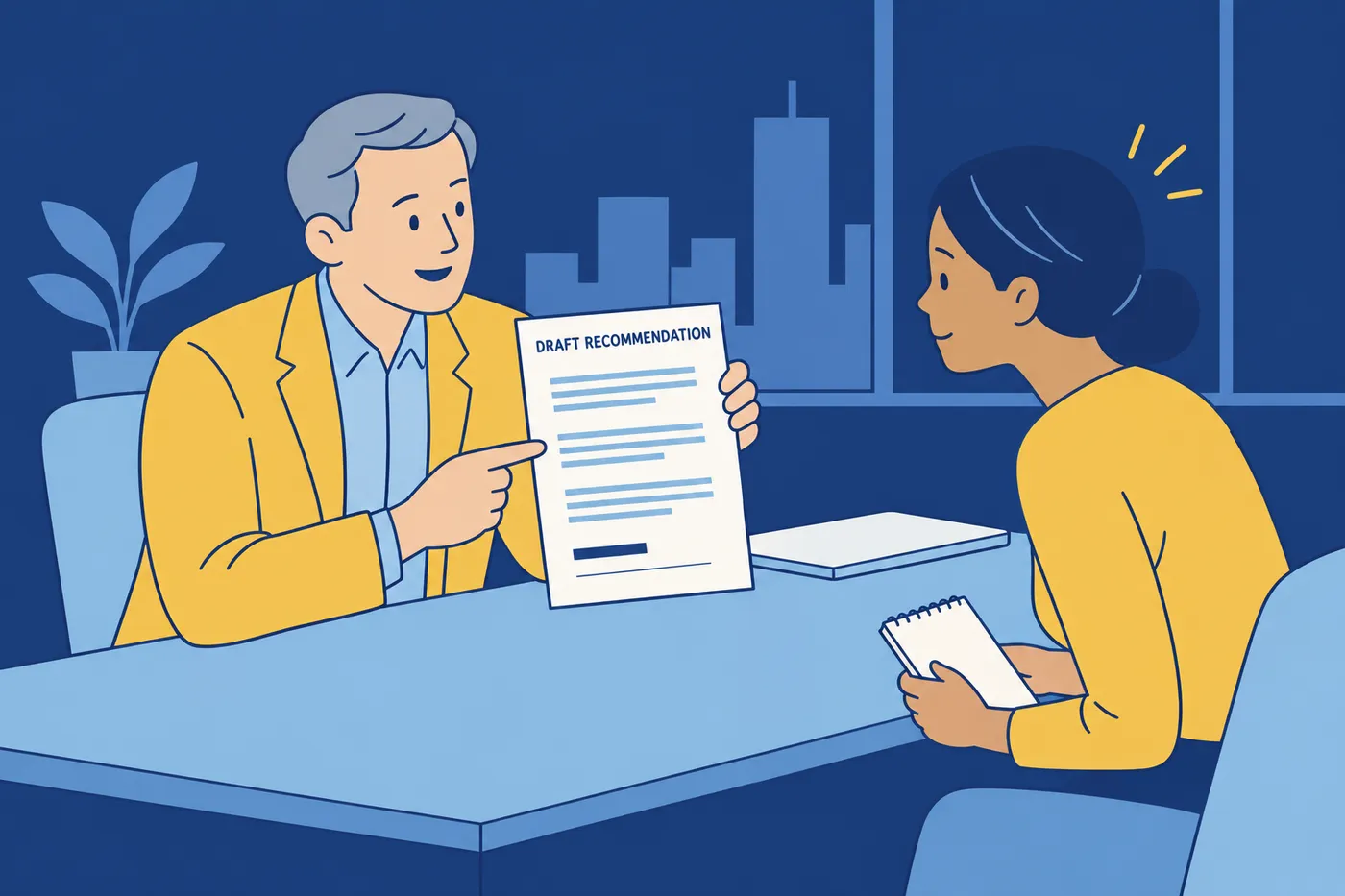
If the writer asks you to draft it yourself
Check the receiving institution's rules before agreeing to draft a recommendation. Some applications require recommendations to be completed independently by the recommender. Common App's key terms, for example, say evaluations cannot be completed or submitted by the applicant or another party on the recommender's behalf.
A factual background sheet is often a better starting point: list projects the writer observed, dates, responsibilities and evidence they can verify. For another application that expressly permits applicant draft material, make its origin clear to the writer and let them independently decide what to use, revise or reject. Do not sign, impersonate or submit as the recommender.
Our letter of recommendation templates show possible structure for an authorized writer. The application's authorship, format and submission requirements take precedence.
References and letters are not the same thing
A written recommendation and a contactable reference serve related but different purposes. One application may request a letter; another may ask for the name and contact details of someone it will approach. Confirm which is required before asking. Our guide to references on a resume covers how to organize reference information.
Ask permission before listing anyone, then explain who may contact them and when. A fictional follow-up after consent is: "Thank you for agreeing to be a reference for the analyst role at Corvid Health. If I reach the final round, their recruiter may email you over the next three weeks. Here is the job description for context."
After they agree, if they decline, and if they go quiet
After a yes, agree on a reminder if one would help. Before contacting the person again, check the application portal for a submission update. A brief message could read: "The Northstar recommendation is due Friday. The portal still shows it as pending; can I resend any materials? Thank you again." Allow for a delay in the portal updating.
If they decline, thank them without pressing for a reason. If they go quiet, ask whether the commitment is still feasible and investigate an alternative before the deadline. Contact the application office if needed to understand its process for changing recommenders or a missing letter. Silence is not proof of unwillingness, but you still need a plan for completing the application.
Set up the rest of the application
Prepare a resume and evidence summary that help the recommender understand this opportunity. You can work on the resume in Roleframe's resume builder. Check the finished file before sending it, and use the recipient's requested format.
A calendar, spreadsheet or Roleframe's contact tracker can help organize recommender details. Record consent, the deadline, invitation status and any reminder you agreed to send.
Frequently asked questions
- How late is too late to ask for a letter of recommendation?
There is no universal cutoff. Ask several weeks ahead when possible and follow any timetable the writer or application specifies. If time is short, state the actual deadline, provide the materials and make it easy to decline. Check for an alternative eligible recommender rather than assuming a rushed letter will be possible.
- How do I ask for a recommendation letter for a job?
First confirm that the employer wants a letter. Ask an eligible person who has observed relevant work, explain the role and ask whether they can write a positive, detailed recommendation by the deadline. After consent, send the posting, resume, factual reminders and submission instructions.
- What questions should I ask when asking for a letter of recommendation?
Ask whether they feel able to provide a positive, detailed recommendation, whether the deadline is feasible, what background they need and how they prefer to receive it. Confirm the application's required submission method rather than asking the writer to invent one.
- How long should a recommendation letter be?
Use the length and format specified by the application. If none is given, the writer can choose a concise format that explains the relationship and supports the recommendation with relevant examples. The applicant should supply context without dictating the endorsement.
- Should I waive my right to see the letter?
Read the specific waiver and make your own informed choice. Common App explains its FERPA waiver and notes that some recommenders may decline if rights are not waived. Discuss questions with your counselor or institution; requirements in other systems may differ.
- Can I use the same letter for several applications?
Only if the requirements and writer allow it. Explain all destinations and separate submission requests before they agree. A letter tailored to one role may need changes before it is suitable for another, and some systems require the writer to submit each recommendation directly.
- What do I do if my recommender goes quiet before the deadline?
Check the portal first, then send a brief reminder and ask whether the deadline is still feasible. If you cannot confirm it, contact the application office about your options and consider an alternative eligible recommender. Thank the original person for any work already done.



Ready to start your new resume?
Writing a resume takes time, and even a polished one can miss what a hiring manager is looking for. Roleframe helps you build a clear, ATS-safe resume in minutes and tailor it to the job you want.


