LinkedIn Headline Examples by Role and Situation
LinkedIn headline examples for job seekers, students, career changers and working professionals, with templates and before-and-after wording fixes.

On this page
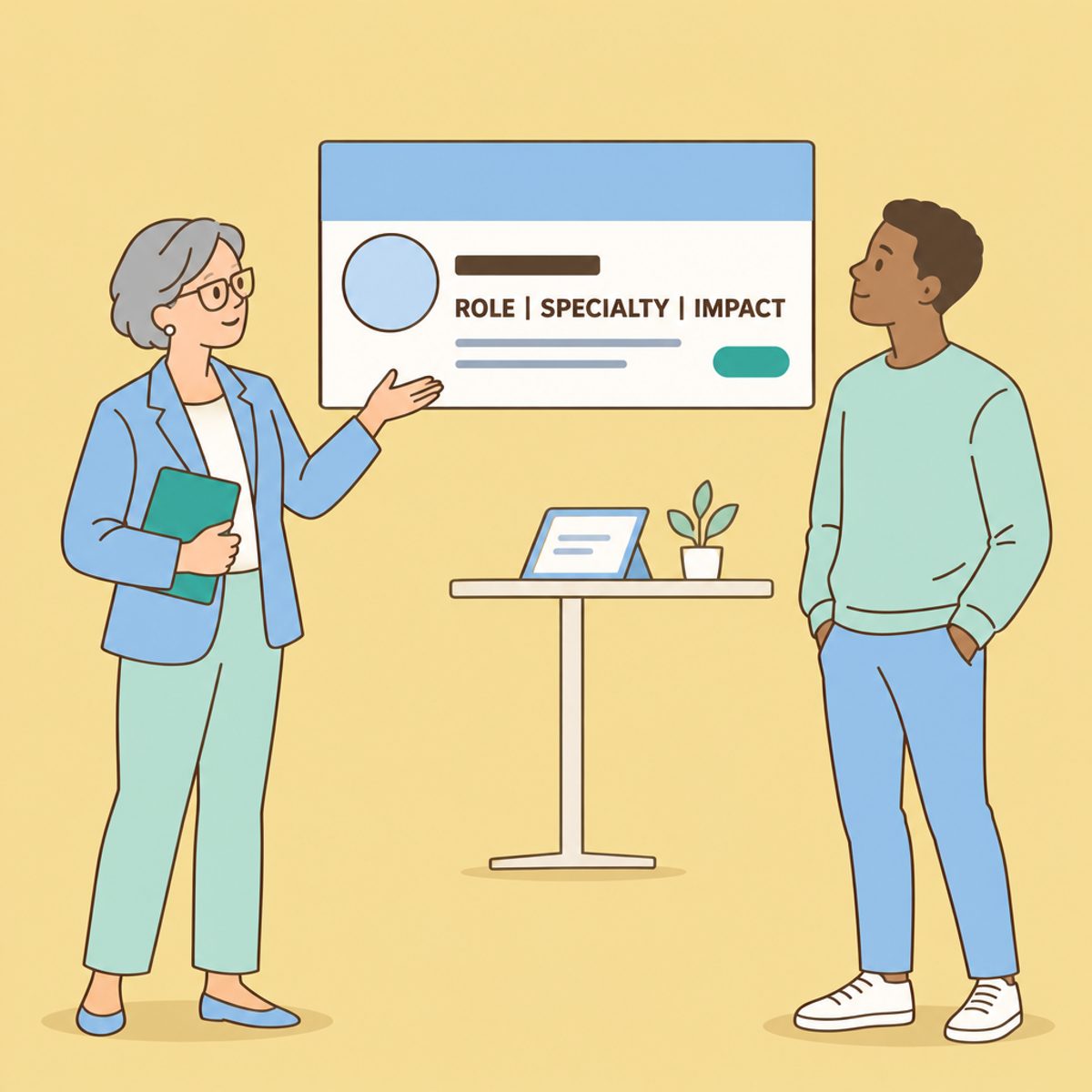
A useful LinkedIn headline tells a reader what work you do or are pursuing and adds a relevant specialty or skill. One possible structure is role | specialty | evidence or skills. It is an editorial template, not a LinkedIn ranking formula.
Every example in this article is fictional. Copy the structure, replace the details with your own and claim a professional credential only when you are entitled to use it:
- Data Analyst | SQL, Python and Tableau | Sales reporting and dashboards
- Registered Nurse, ICU | Critical care and precepting new graduates
- Customer Success Manager | SaaS onboarding and renewals | Open to remote roles
- Teacher Exploring Instructional Design | Curriculum design and e-learning projects
- Accounting Student | Seeking audit internships | Excel and bookkeeping
LinkedIn's headline help page confirms that the headline appears below your name and in search results, and can differ from your current-position title. Use that space to give accurate context. It cannot guarantee recruiter visibility or a particular search position.
The formula and its five variants
Use the structure that best explains your situation. Each variant below is a template with bracketed slots, followed by one filled example for a fictional person.
- Role, specialty and proof. Template: [Role] | [Specialty or industry] | [Proof point or two to three skills]. Example: "Financial Analyst | FP&A for multi-location retail | Forecasting in Excel, SQL and Power BI". An option for someone seeking similar work.
- Role and who you help. Template: [Role] | Helping [audience] [get outcome]. Example: "Enrollment Advisor | Helping adult learners finish the degree they started". Strong for client-facing work, where the audience is the specialty.
- Career changer. Template: [Current role] Moving Into [Target role] | [Transferable skills]. Example: "Paralegal Moving Into Compliance | Contract review and regulatory research". The word "Moving Into" names the target without claiming a title you have not held.
- Student or new graduate. Template: [Major] Student | [Skills, projects or coursework] | Seeking [role type]. Example: "Marketing Student | Google Analytics and campus event promotion | Seeking summer marketing internships".
- Open to work. Template: [Target role] | [Two to three skills] | Open to [location or remote]. Example: "Bookkeeper | QuickBooks and month-end close | Open to remote roles". Leading with the role helps a reader understand your direction before the availability detail. Change the order if another arrangement is clearer.
When a plain title-only headline is enough
A plain headline such as "Senior Accountant at [Firm]" may be enough if it describes your work accurately and supplies the context you want to share. A longer headline can explain a specialty, a career transition or a service you offer.
If your official title is unfamiliar outside the company, add a clear functional description without rewriting your employment history. For example, "Member of Technical Staff | Software engineering for distributed systems" preserves the official title while explaining the work. There is no evidence here that a particular title guarantees inclusion in a recruiter search.
LinkedIn headlines for job seekers
When job searching, name the work you are seeking and skills you can support. You may include availability or location if you want to make that information public. Employment status alone gives less context, but it is your choice whether to state it.
Six fictional examples:
- Operations Coordinator | Scheduling, vendor management and reporting | Open to roles in Denver
- Graphic Designer | Brand identity and packaging | Available for full-time roles
- Payroll Specialist | ADP and multi-state payroll | Open to remote roles
- Project Coordinator | Construction scheduling and budget tracking | Seeking roles in Austin
- Customer Support Specialist | Zendesk and SaaS help desks | Open to remote or hybrid roles
- Staff Accountant | Month-end close and reconciliations | Open to roles in the Twin Cities
If you use Open to Work, check its current visibility settings in LinkedIn Help. Decide separately whether the headline needs an availability phrase; neither choice guarantees more recruiter messages.
Students, new graduates and career changers
Explain a transition or early-career status clearly. Words such as "student," "graduate," "seeking" or "exploring" can distinguish your current background from your goal.
A credential and employment history are different: a qualified, appropriately licensed new nurse may accurately use their credential before holding a first nursing job. Conversely, graduation alone should not be presented as a license. Check the requirements that apply to the credential you name.
- Computer Science Student | Python and React projects | Seeking software internships
- Nursing Graduate | Clinical rotations in med-surg and pediatrics | Exploring graduate opportunities
- Recent Marketing Graduate | SEO coursework and two campus campaigns | Seeking entry-level marketing roles
- Retail Manager Exploring HR | Hiring, scheduling and team training
- Military Veteran Moving Into Logistics | Supply planning and team leadership
- Aspiring Data Analyst | Financial reporting and SQL projects
Choose transferable skills that match both your experience and the target work. The retail manager can emphasize hiring and training for an HR role, while keeping the actual retail-management position clear in the experience section.
LinkedIn headline ideas by role
These fictional headlines demonstrate role-specific wording. Replace bracketed numbers only with figures you can verify. If you have no reliable metric, remove that phrase and describe the scope or skill instead. Do not leave placeholders in a published profile.
Tech
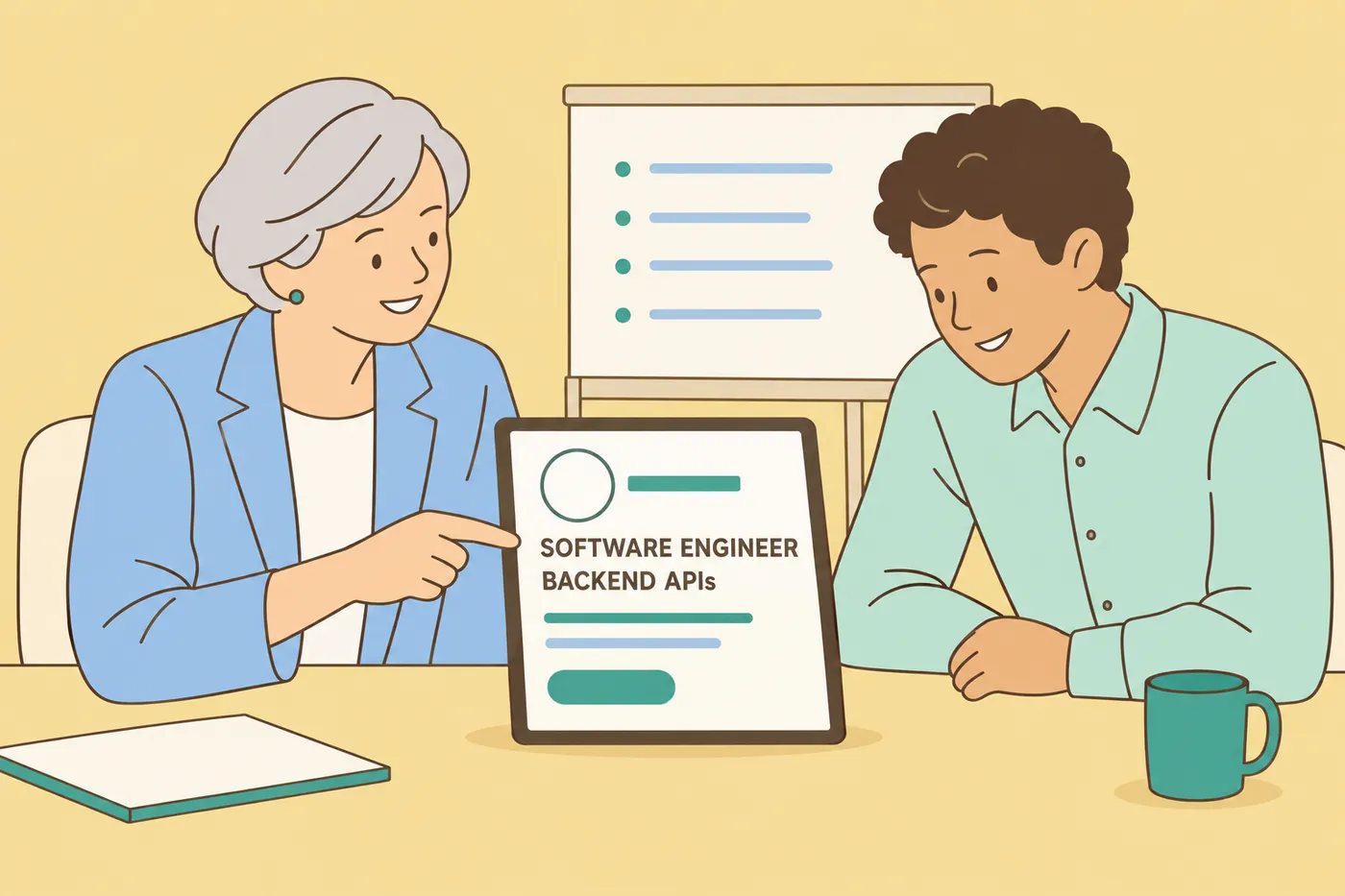
- Software Engineer | Backend APIs in Go and Postgres | Cut p95 latency [X]% on a checkout service
- Data Analyst | SQL, Python and Tableau | Dashboards that drive weekly pricing decisions
- Product Manager | B2B payments | Discovery to launch with engineering and design
- UX Designer | Mobile onboarding flows | Research, prototyping and usability testing
For technical roles, name tools you can use and discuss in an interview. "Backend APIs in Go and Postgres" explains a specialty more precisely than "technology professional." Search behavior varies, so use recognizable terminology without treating a keyword list as a visibility guarantee.
Business roles
- Account Executive | Mid-market SaaS | [X]% of quota across [Y] quarters
- Marketing Manager | SEO, paid social and email | Grew organic traffic [X]% year over year
- Senior Financial Analyst | FP&A and board reporting | Built the forecast model for a [X]-location chain
- HR Generalist | Benefits, onboarding and employee relations | Supporting [X] employees across two sites
- Operations Manager | Multi-site scheduling and vendor contracts | Cut fulfillment time [X]%
- Customer Success Manager | SaaS onboarding and renewals | [X]% gross retention on a [Y]-account book
Healthcare, education, admin and trades
- Registered Nurse, Med-Surg | Charge experience and new-nurse precepting
- Medical Assistant | Rooming, EHR charting and phlebotomy | Bilingual English and Spanish
- High School Math Teacher | Algebra through AP Calculus | Curriculum writing and tutoring programs
- Executive Assistant | Calendar, travel and board prep | [X] years supporting C-suite leaders
- Licensed Electrician | Residential service and panel upgrades | [State] journeyman license
Senior leaders, freelancers and founders
For leadership roles, consider describing the scope of your responsibility, such as the teams, sites or business stage you worked with. Include tools when they meaningfully explain the work; seniority alone does not make them irrelevant.
- VP of Operations | Multi-site logistics teams | Process improvement
- CFO | FP&A, fundraising and investor reporting | Series B software companies
- Freelance Copywriter for B2B Software | Case studies, landing pages and email
- Founder, [Company] | Building [product type] for [audience]
A freelancer can name the audience and deliverables. A founder can explain what the company makes. These are fictional formats to adapt, not claims about what every investor or recruiter prefers.
Common LinkedIn headline mistakes, with before-and-after fixes
These before-and-after examples show ways to make a headline clearer. Each rewrite is fictional; use only titles, skills and outcomes you can support.
| The mistake | Before | After |
|---|---|---|
| An unclear title | Chief Happiness Hero | Office Manager | Facilities, onboarding and events for a [X]-person office |
| Buzzwords instead of proof | Passionate marketing guru and growth ninja | Demand Generation Manager | Paid search and webinars | Pipeline reporting in HubSpot |
| A skill dump | Sales | Marketing | SEO | PPC | CRM | Excel | Leadership | Negotiation | Teamwork | Sales Development Representative | Outbound prospecting in SaaS | Salesforce and Outreach |
| Emoji overload | 🚀🔥 Growth 🔥🚀 | 💡 Ideas Person 💡 | Growth Marketer | A/B testing, landing pages and lifecycle email |
| Headline contradicts the resume | Headline says Product Manager; resume shows Business Analyst work only | Business Analyst Moving Into Product | Requirements, user stories and stakeholder demos |
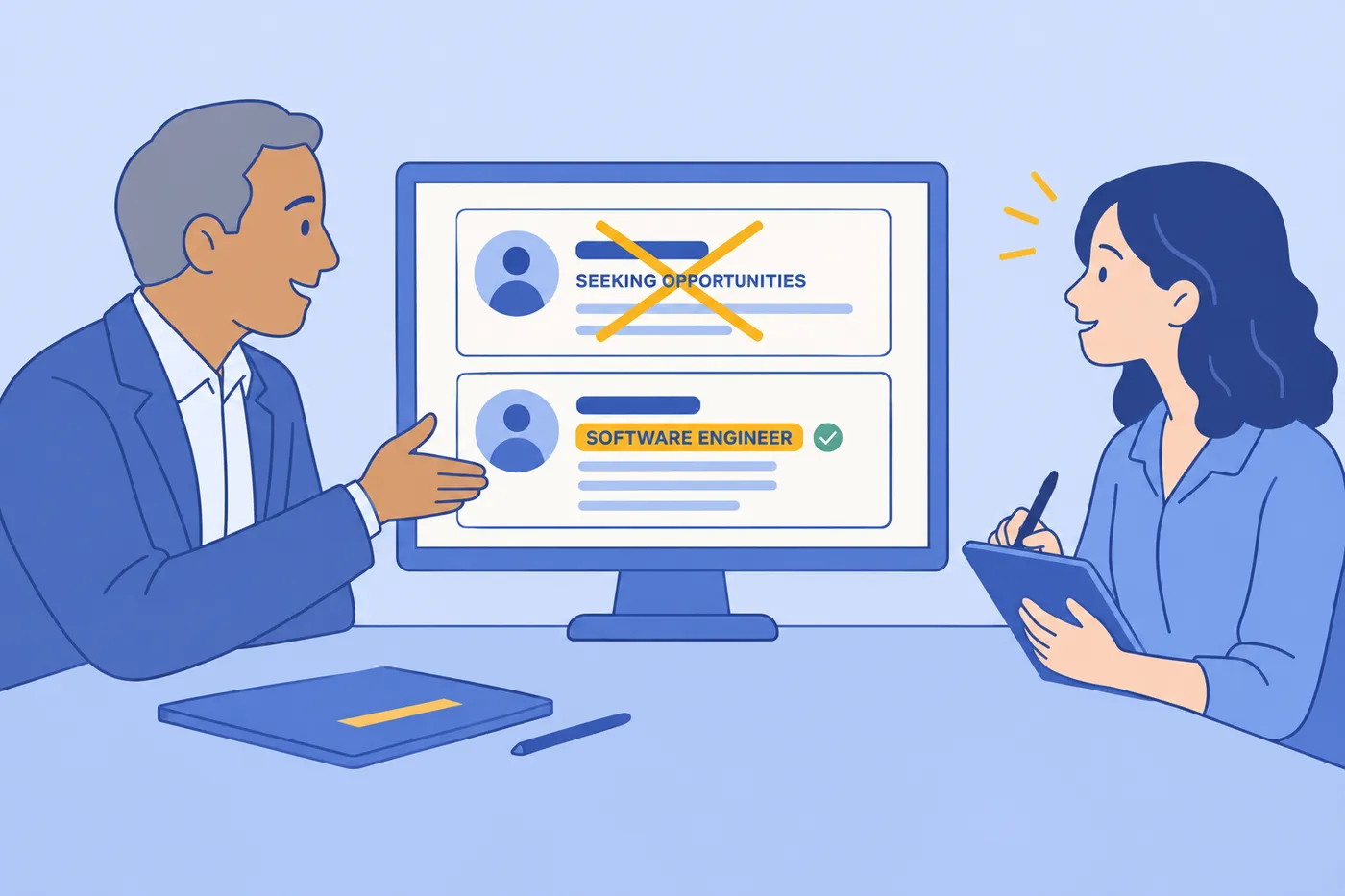
| A claim the profile can't back up | AI Expert, with no AI work anywhere on the profile | Data Analyst | Learning machine learning through [course or project] | SQL and Python |
A focused headline is easier to interpret than an unrelated list of skills. Choose the role and details that matter to the work you seek, then check them against the rest of your profile and resume. The documents do not need identical wording, but should tell a consistent story about your experience and goals.
For example, a business analyst pursuing product work can state that transition explicitly rather than imply they already hold a product-manager position. The same principle behind cutting resume buzzwords applies here: concrete responsibilities and substantiated results provide more context than a broad adjective.
Pick the closest example above, replace its details with your own and read it as a sentence a new contact needs to understand.
How to choose your words
Compare a few current job listings for the work you want. Note the titles and recurring skills, then choose terms that accurately describe your background. Listings are useful vocabulary examples; they do not reveal every search a recruiter runs. Our guide to reading keywords in job descriptions applies the same method to a resume.
Use the character limit shown in LinkedIn's current editor, and preview how your headline reads in the space available. You do not need to fill the field. Put the most useful information first and remove repeated or unexplained terms.
Update the headline when your experience or target changes. A resume summary can expand on the same direction with evidence, but does not need to repeat the headline word for word. See our guide to writing a professional summary for examples.
Make the resume say what the headline promises
Before using the new headline, check your resume for the same current dates, accurate titles and substantiated skills. A career goal should be clear in both, even when you use different wording.
You can prepare a resume in Roleframe's resume builder and browse examples by industry for structure. If networking conversations follow, Roleframe's contact tracker offers a place to organize contacts and notes. Review all generated or suggested wording yourself before sharing it.
Frequently asked questions
- What is a good headline for LinkedIn?
A useful headline explains your role or direction and a relevant specialty or skill. A fictional example is "Product Marketing Manager | SaaS positioning and customer research." It should be understandable and consistent with your experience; there is no wording that guarantees search placement or replies.
- What is an example of a profile headline?
One fictional example is "Software Engineer | Java and Spring Boot | Enterprise application development." A career changer might write "Financial Analyst Exploring Data Analytics | SQL and reporting projects." These are editorial examples, not quotations from LinkedIn or verified user profiles.
- What are headline examples?
They are sample lines that demonstrate ways to describe your work. For example, "Customer Success Manager | SaaS onboarding and renewals" names a role and specialty. Replace every detail with something true for you, and add an outcome only if you can substantiate it.
- How long can a LinkedIn headline be?
Follow the character limit displayed in the current LinkedIn headline editor. There is no need to use the entire allowance. A clear role and a relevant specialty may be enough; preview the result because different views may show different amounts of text.
- Should I write "Unemployed" or "Open to Work" in my LinkedIn headline?
You can state your employment status or availability if you want to. Adding the kind of work you seek makes the line more informative, for example "Operations Coordinator | Scheduling and reporting | Open to roles in Denver." Consider what you want public, and review the separate Open to Work settings before using them.
- What is the 4-1-1 rule on LinkedIn?
It is an informal content-sharing ratio, not a headline-writing requirement. It does not determine whether your profile is valid or guarantee engagement. For a headline, concentrate on an accurate description of your work and goals.
- Should my LinkedIn headline match my resume?
The facts should agree, including employment history, credentials and skills. The wording can differ. If you are changing careers, distinguish the target role from your current or previous position so the headline does not imply experience you do not have.


Ready to start your new resume?
Writing a resume takes time, and even a polished one can miss what a hiring manager is looking for. Roleframe helps you build a clear, ATS-safe resume in minutes and tailor it to the job you want.


