How Long Should a Cover Letter Be? The Honest Answer
How long should a cover letter be? Use a practical length guide and compare a full fictional draft with a shorter edit, with every cut explained.

On this page
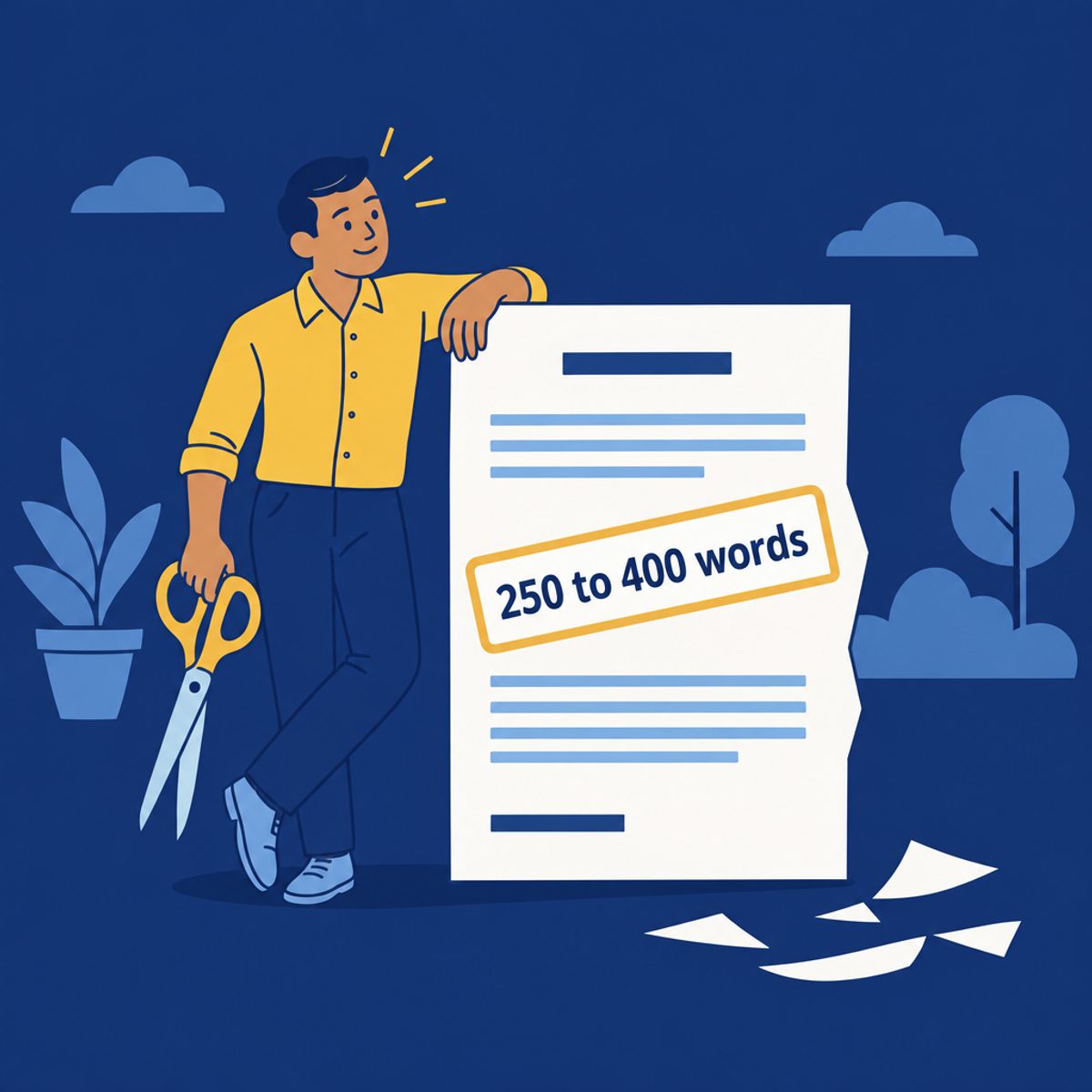
For most nonacademic applications, keep a cover letter to one page or less. Around 250 to 400 words is a useful drafting target, not a requirement. A shorter letter can work when it makes a clear case; the employer’s instructions take priority.
This guide shows how to shorten a fictional marketing cover letter while preserving relevant evidence. It includes the long draft, the edited version and an explanation of each cut.
The short answer, in words and in paragraphs
Start with three or four short paragraphs: explain which role you want, connect relevant experience to its requirements, then close with your interest in a conversation. Use fewer paragraphs when the case is simple, or separate two examples when each needs explanation.
Treat word counts as an editing aid. Keep a sentence when it supplies relevant evidence or explains your interest in this particular role. Cut it when it repeats the resume or adds only a generic claim.
Use the one-page guideline with judgment
Harvard’s cover-letter guide recommends concise, factual letters of no more than one page, tailored to the position with examples supporting your qualifications. That is a useful default for nonacademic applications. Research and faculty applications may have different expectations, so follow the posting and your field’s guidance.
| Situation | Useful starting point | What decides the final length |
|---|---|---|
| Most nonacademic applications | One page or less | Enough space for one or two relevant examples |
| Short email or simple introduction | A few concise paragraphs | The instructions and what context you need to add |
| Academic or research application | Check the announcement | The requested research, teaching or other statements |
Leave readable white space. Use a legible font and margins that do not crowd the page. Match the resume’s font and general style, and follow the employer’s file-format instructions. If you export a PDF, check that the formatting and text remain intact.
Make your evidence easy to find
Readers may skim before deciding what to examine closely. There is no universal reading order or reliable number of seconds that every hiring manager spends on a letter. Put relevant evidence early so it is easy to find.
A long introduction can push your strongest example down the page. Start by naming the role and a specific connection to it. Our guide to the opening line shows several ways to do that.
Four paragraphs, and what each one is for
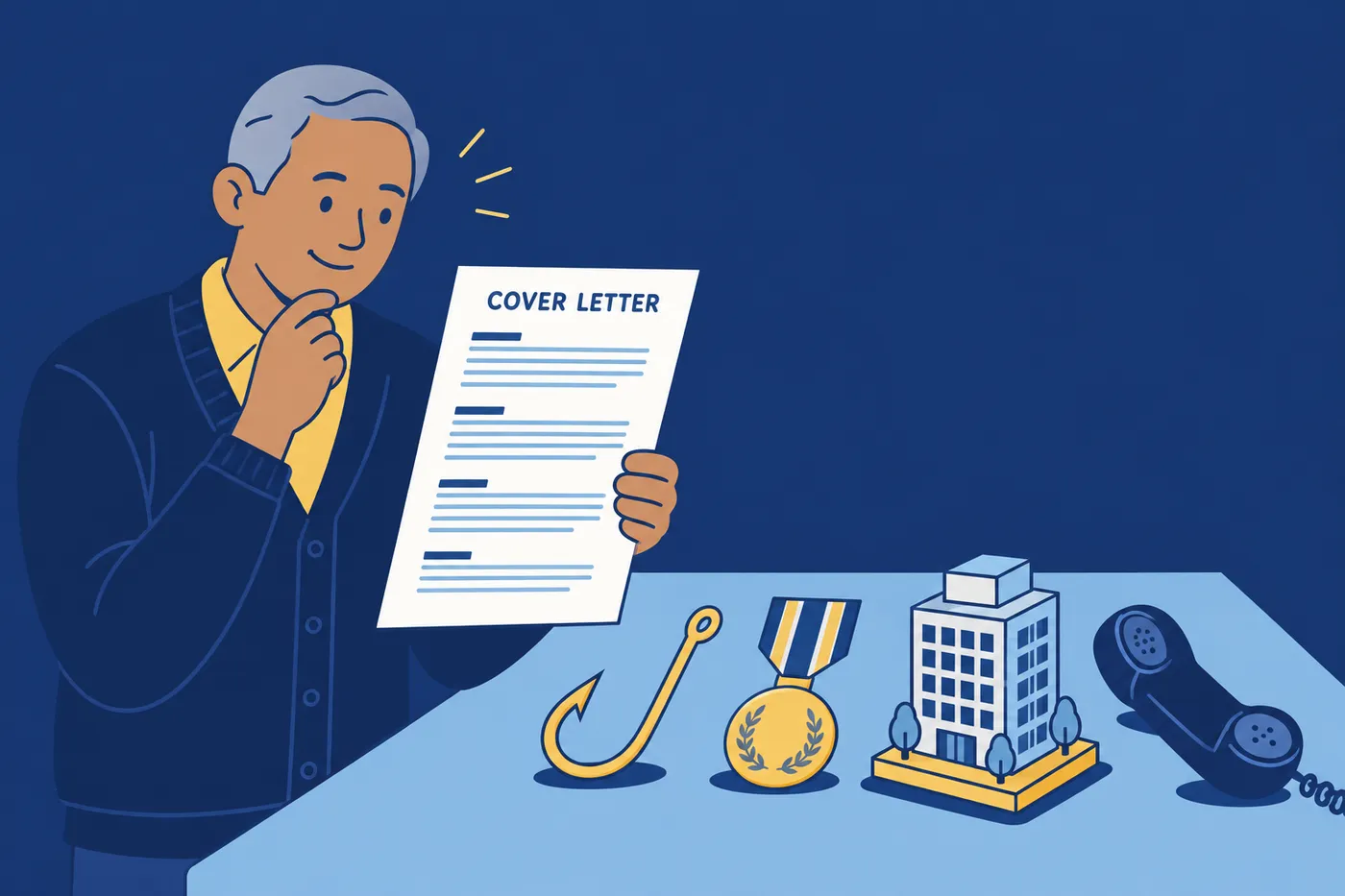
Use this optional four-paragraph plan to build a first draft. The ranges total 205 to 330 words; use them as prompts rather than quotas, and omit a paragraph if it adds nothing relevant.
| Paragraph | Its job | Word budget |
|---|---|---|
| 1. The role and the hook | Name the position and give one specific reason you fit it | 40 to 60 words |
| 2. Your strongest evidence | One result with a number, matched to the posting's top requirement | 80 to 120 words |
| 3. Why this company | A specific tie between their work and yours, plus a second proof point | 60 to 100 words |
| 4. The ask | Request the conversation, thank the reader, stop | 25 to 50 words |
The evidence paragraph expands on your most relevant qualification instead of restating the whole resume. Show what you did and why it matters to this role.
Close with a clear expression of interest and a brief thank-you. See closing-line examples and the full guide to writing a cover letter.
When a shorter letter is stronger
A letter under 250 words can be enough when it explains the fit with a concrete example. Consider a shorter letter in these situations, while following the application instructions:
- A referral already warmed the introduction, so the letter confirms fit rather than building it
- Your resume shows an exact title and industry match, and the letter only needs to add one number
- The letter rides in an email body, where anything long gets scrolled past
- Hourly, part-time and high-volume roles, where the screen is fast and the posting is short
- Internal applications, where the reader already knows your context
If that describes your situation, start from short cover letter examples under 200 words rather than trimming a long draft down.
Senior and executive letters are not longer
For most senior nonacademic roles, one page remains a useful default. A longer career creates more evidence to choose from; it does not require a chronological account of every position.
Select the decisions or achievements that match the role’s responsibilities. Explain the scope and outcome using facts you can substantiate, then let the resume carry the broader history. Use more space only where the employer or application format calls for it.
Cutting a long letter without losing the evidence
One test finds almost every cuttable sentence: could another applicant send it unchanged? “I am a detail-oriented team player who thrives in fast-paced environments” fits every applicant for every job, so it tells the reader nothing about you. Apply the test line by line and the cuts fall into six groups.
- The windup opener. “I am writing to express my sincere interest in…” The reader knows why you are writing. Open with the role and your strongest fact instead.
- The chronology. Degrees, first jobs, promotions in order. That is the resume's job, and the reader has the resume.
- The duty list. “Responsible for scheduling, drafting, coordinating…” Duties describe the role. The letter should describe what changed because you were in it.
- Unproven self-description. Organized, motivated, passionate, quick learner. Keep the evidence, cut the adjectives; a concrete result makes them redundant.
- Generic flattery. “I have long admired your commitment to excellence.” Keep one specific line about their actual work and cut the rest.
- Courtesy padding. “Thank you for taking the time… do not hesitate… at your convenience.” One thank-you and one ask close any letter.
What never gets cut: numbers you can defend, named projects, and any sentence that ties your work to the posting's stated requirements. Those sentences are the letter. Everything else is packaging.
If drafting from zero is what makes you pad, flip the order of work. Roleframe's cover letter builder drafts a job-specific letter from your resume and the posting for you to edit, so your effort goes into cutting and sharpening instead of filling a blank page.
A long letter and a shorter revision, with the cuts explained
Jordan and the employers below are fictional. All achievements, figures and campaign details are illustrative; use only your own accurate information in an application. The scenario is a marketing coordinator applying to an outdoor brand.
The long draft
Dear Hiring Manager,
I am writing to express my sincere interest in the Marketing Coordinator position at Brightline Outdoor, which I discovered on your careers page. Ever since my first marketing class in college, I have been passionate about the way great brands tell stories that connect with people. When I saw this opening, I knew immediately that it was exactly the kind of opportunity I have been looking for, and I believe my background and enthusiasm make me an excellent fit for your team.
I graduated from the University of Minnesota in 2021 with a degree in communications, where I served as social media chair for two student organizations and completed a semester-long internship at a local agency. After graduation, I joined Lakeview Gear as a marketing assistant, where I was responsible for a wide variety of tasks, including scheduling social media posts and drafting email newsletters, as well as coordinating with designers and supporting the broader team on seasonal campaigns. In 2023 I was promoted to marketing coordinator, a role in which I have continued to grow my skills and take on new responsibilities. During my time at Lakeview, I have also attended two industry conferences and completed a certification in email marketing, both of which have deepened my understanding of the field.
In my current role, I manage our email program end to end. Last year I rebuilt our welcome sequence, testing subject lines and send times over three months, and the new sequence lifted click-through rates by 34% and drove a measurable increase in first purchases. I also coordinate our seasonal campaign calendar across email and paid social as well as our blog, working with two freelance designers and an outside agency to keep twelve to fifteen assets moving each month. Our last two seasonal launches shipped on schedule and under budget.
I am a highly organized and detail-oriented team player with excellent communication skills, and colleagues often describe me as someone who can be counted on to follow through. Fast-paced environments bring out my best work, and juggling multiple priorities is something I am very comfortable doing. As a quick learner who is always eager to take on new challenges, I am also proficient in Mailchimp and Klaviyo as well as Asana and the Adobe Creative Suite.
I have long admired Brightline Outdoor's commitment to sustainability and the authentic voice of your brand. Your recent Trail Days campaign was a great example of the kind of community-driven marketing I find most exciting, and I would be thrilled to contribute to work like it.
Thank you for taking the time to review my application. I have attached my resume for your consideration, and I would welcome the opportunity to discuss how my skills and experience align with your needs. Please do not hesitate to contact me at your convenience. If there is any additional information I can provide, please let me know. I look forward to hearing from you soon.
Sincerely,
Jordan Lee
Six paragraphs, a page nearly full. The two sentences that could win an interview, the 34% lift and the on-budget launches, sit in the third paragraph, underneath roughly 200 words of biography the reader will skim past.
The seven cuts, marked
- The windup opener. “I am writing to express my sincere interest… an excellent fit for your team.” Any applicant for any job could send these three sentences. The rewrite opens with the role and a fact only this candidate owns.
- The college history. The degree, the student organizations, the internship. All of it is 2021 news, and all of it is on the resume.
- The job chronology. “Responsible for a wide variety of tasks, including…” is a duty list plus a promotion announcement. The resume carries both; the letter needs what changed because Jordan was there.
- The conferences-and-certification aside. If the certification matters to this posting, it belongs on the resume, where the screen will actually find it.
- The self-description paragraph. Organized, detail-oriented, fast-paced, quick learner: claims with zero evidence. The 34% lift in the kept paragraph does this work on its own, and only the two tools the posting names survive the cut.
- The generic flattery line. “Long admired your commitment to sustainability” is template filler. The Trail Days sentence stays because it refers to a specific campaign in this fictional scenario.
- The courtesy close. Five sentences of thank-yous, attachment notes and “do not hesitate” become one ask and one thank-you.
The edited letter
Dear Ms. Alvarez,
I'm applying for the Marketing Coordinator role at Brightline Outdoor. For the past two years I have run the email program at Lakeview Gear, an outdoor retailer about half your size, and the posting's emphasis on lifecycle email and campaign coordination describes my current job.
Last year I rebuilt our welcome sequence, testing subject lines and send times over three months. The new sequence lifted click-through rates by 34% and drove a measurable increase in first purchases. I also run our seasonal campaign calendar across email and paid social, plus the blog, keeping twelve to fifteen assets a month moving between two freelance designers and an outside agency. Our last two launches shipped on schedule and under budget.
Your Trail Days campaign is the kind of community-driven marketing I want to do more of. Brightline's channel mix matches the one I manage now, so I would be useful early. I hold the budget tracker for our launches, so reporting spend against plan is familiar work, and Klaviyo and Asana, the two tools the posting names, are what I work in daily.
I would welcome a conversation about how the welcome-sequence rebuild would translate to your list. Thank you for your time.
Sincerely,
Jordan Lee
The revision removes biography, repeated duties and generic claims, then uses the space for details relevant to the fictional posting. In your own letter, add a named contact, company comparison or job requirement only after verifying it. Never invent a detail to make an example sound stronger.
Read each sentence and ask what it adds to the case for this particular role. Keep the evidence and necessary context, then check whether the finished letter fits the application instructions.
Frequently asked questions
- What is the ideal length for a cover letter in 2026?
For most nonacademic applications, use one page or less. Roughly 250 to 400 words is a practical starting range, not an employer rule. Academic and research applications may need a different length; follow the announcement.
- Is a 150-word cover letter too short?
Not necessarily. If it names the role, gives relevant evidence and explains your interest clearly, 150 words may be enough. Add detail where the reader needs it, not just to reach a word count.
- How many paragraphs should a cover letter have?
Three or four short paragraphs are a useful starting structure. Give each paragraph a purpose and avoid repeating the resume. The application’s instructions matter more than a fixed count.
- What should a cover letter include?
Open with a specific greeting when you can find a name, and name the role you are applying for. Add a short explanation of why this organization and position interest you, then one or two paragraphs connecting your most relevant skills and results to the job's requirements. End with a clear ask and a professional sign-off. The letter should expand on the resume's most relevant points, never repeat them.
- Do you always need to send a cover letter?
Send one when the employer requests it. When optional, it can help explain a career change, an employment gap or another relevant connection that the resume does not make clear. Follow any instruction not to include one.
- What font, margins and file format should a cover letter use?
Use legible type, comfortable margins and spacing between paragraphs. Match the resume’s overall style. Submit the requested file format and check the uploaded result.
- What counts as a red flag on a resume or cover letter?
Errors, contradictory dates, invented achievements and disregard for application instructions can undermine trust. Check the facts, proofread and make the relevance to this role clear. Length alone does not determine quality.


Ready to write your cover letter?
Writing a cover letter takes time, and a generic one is easy to spot. Pick a letter template that matches your resume, or let Roleframe draft a first version from the job posting using only what your resume backs up.


