Resume Formats for 2027 Applications: Choose by Career Stage
Choose a resume format for your next application: compare chronological, hybrid and functional layouts with a decision table and fictional examples.

On this page
If you are preparing applications for 2027, start with a reverse-chronological resume that puts your most recent relevant role first. A hybrid format adds a short skills summary above that dated history and can help explain a career change or return to work.
This planning guide uses guidance available in October 2026. It does not predict new hiring rules for 2027. The U.S. Department of Labor’s Resume Essentials guide recommends chronological or combination layouts and warns that functional resumes can confuse some applicant tracking systems. Employer instructions always take priority.
Use the decision table below, then compare the same fictional candidate in three formats. The purpose is to make your relevant experience easy to find while keeping dates and qualifications accurate.
Pick your format by situation, not by year
Format determines which evidence the reader encounters first. The table below covers the seven most common situations. Find your row, note the format and the lead section, and ignore advice written for someone in a different row.
| Your situation | Format | Lead section | Why |
|---|---|---|---|
| Steady history in one field | Reverse chronological | Summary, then most recent role | Recruiters and parsers both look for dated roles first; your progression is your argument |
| New graduate or student | Reverse chronological, education on top | Education, with coursework or projects | Your degree and projects are your strongest evidence until work history catches up |
| Career changer | Hybrid (combination) | Skills summary aimed at the target role | Transferable skills need framing before the reader hits job titles from another field |
| Returning after a gap | Hybrid, with the gap addressed | Summary naming your current target | Keeps dated history visible, which both parsers and recruiters expect, while the top third leads with what you offer now |
| Senior or executive, long history | Reverse chronological, two pages | Executive summary with scope (team size, budget, remit) | You earned the length; detail the last 10 to 15 years and compress the rest |
| Federal job (USAJOBS) | Reverse chronological, built to the announcement | Experience with month/year dates and hours per week | Federal postings specify required content, and a two-page maximum now applies under the Merit Hiring Plan |
| Creative role with a portfolio | Reverse chronological plus a portfolio link | Summary with the portfolio URL | The resume has to parse cleanly; the portfolio is where the design work lives |
Two of these deserve a deeper read. The reverse chronological format guide walks through the full structure with examples, and the ATS resume format guide covers what parsing software does with your sections and dates. Federal applicants should start from a federal resume example, because USAJOBS requirements are stricter than anything in the private sector.
Current guidance to check before a 2027 application
Check federal resume requirements separately. USAJOBS currently limits resumes to two pages. Follow the USAJOBS resume instructions and the announcement for the position, including its required experience details and accepted documents. Do not reuse older advice recommending a lengthy federal resume without checking the current rules.
Keep skills attached to evidence. Use terms from the posting where they accurately describe your experience, then show how you used them in a role or project. A skills list is easier to assess when the work history supplies context.
Keep dated history visible. The Department of Labor guide favors chronological or combination formats for applications processed through an ATS. A short summary can explain your target without hiding when and where you worked.
These are current planning principles, not a forecast of every employer’s 2027 requirements. Check the instructions again when you apply.
Layout checks for your next application
These rules survive every yearly trend cycle because each one maps to how the document gets read, either by parsing software or by a recruiter's first skim.
- One column for the main content. The Department of Labor warns that columns, tables, and charts can create parsing problems, and a single column also matches how a recruiter's eye moves down the page.
- Standard section headings (Summary, Experience, Skills, Education). Familiar headings help readers and parsing software identify the sections.
- Dates in one consistent format, on one side. Month and year, same style on every role, so gaps and overlaps are legible at a glance.
- Contact details in the body, not a page header or footer. Important information in headers or footers can be dropped during parsing, per the Department of Labor.
- No text inside images or tables. Information stored only as an image can be missed during text extraction.
- Body text at 10 to 12 points with roughly one-inch margins, which is the Department of Labor's recommendation and also what stays readable when a recruiter opens your PDF on a phone.
- Spell out terms before abbreviating, such as "Search Engine Optimization (SEO)", so both the parser and a non-specialist screener match the keyword.
- One page for under about ten years of experience, two when the experience earns it. The Department of Labor's range is one to two pages; a half-empty second page reads as padding.
One candidate, three formats
Format changes what a recruiter sees first, even when the facts underneath are identical. Here is the top third of the same resume three ways. The candidate, Maya Chen, and her employers are fictional, built for illustration. She has five years in retail operations and is targeting operations analyst roles, which makes her a borderline career changer, the hardest case to format.
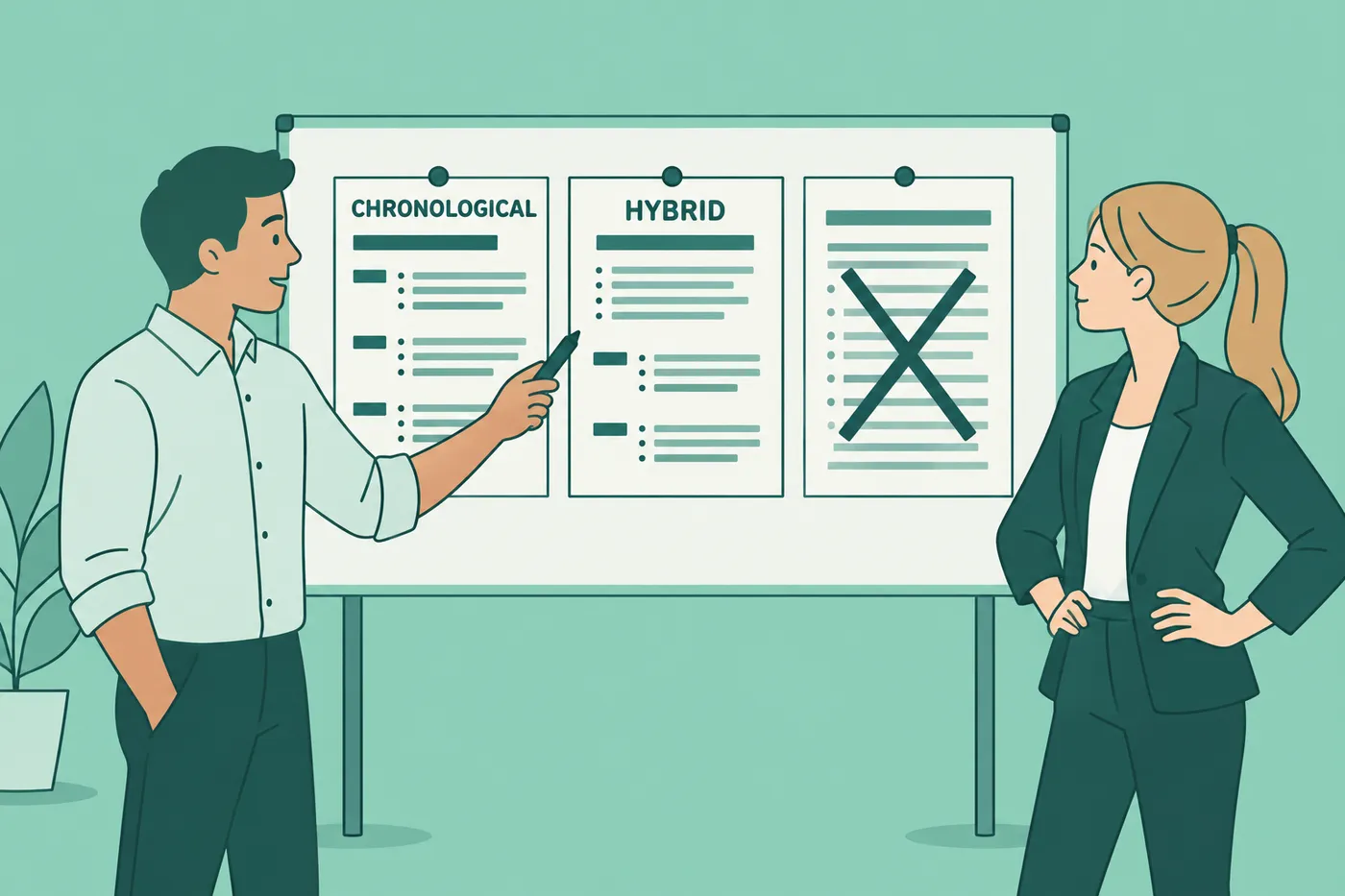
Reverse chronological: the role leads
- Maya Chen · Chicago, IL · maya.chen@example.com · (555) 014-2200
- Summary: Retail operations supervisor with five years running inventory, scheduling, and vendor processes for a 40-person store.
- Experience — Operations Supervisor, Brightlane Stores, Chicago, IL · Jun 2023 – Present
- "Rebuilt the weekly inventory count process, cutting shrink-related write-offs 18% in one year."
What a recruiter sees first: her current title, employer, and dates, then one quantified result. For an operations supervisor applying to operations supervisor roles, this presents a clear match. For an analyst role, the title does half the talking, and it says the wrong thing.
Hybrid: the skills frame the history
- Maya Chen · Chicago, IL · maya.chen@example.com · (555) 014-2200
- Summary: Operations supervisor moving into operations analysis; five years of inventory forecasting, process measurement, and Excel-based reporting.
- Core skills: Inventory analysis & demand forecasting · Process improvement (count cycle redesign, shrink reduction) · Reporting (Excel, SQL fundamentals, Power BI)
- Experience — Operations Supervisor, Brightlane Stores, Chicago, IL · Jun 2023 – Present (dated history continues below)
What a recruiter sees first: analyst-shaped capabilities, each tied to real work, before the retail title appears. The dated history is still there, one scroll down, so the parser and the skeptical reader both get what they need. This is why a hybrid can work well for a career change.
Functional: the context disappears
- Maya Chen · Chicago, IL · maya.chen@example.com · (555) 014-2200
- Process improvement: "Redesigned inventory counts, reducing write-offs 18%." "Cut schedule-build time from 4 hours to 90 minutes."
- Analysis & reporting: "Built weekly sales dashboards in Excel for three store leads."
- Work history: Brightlane Stores · Corvo Market (titles and employers only, no dates on the achievements)
What a recruiter sees first: claims with no anchor. Which job produced the 18%? How recent is the dashboard work? The reader cannot tell, and neither can the parser, which is exactly why the Department of Labor warns this format may confuse applicant tracking systems. The hybrid keeps the skills emphasis while giving the reader a dated work history.
File type, file name, and a 60-second test
Submit the file type requested by the employer. If PDF and Word are both accepted, a text-based PDF can preserve the layout, while a DOCX file may be useful where the employer requests editable content. Neither format guarantees correct parsing.
Name the file clearly, such as Maya-Chen-Operations-Analyst.pdf. Open it before sending and check every page. Copy the text into a plain text editor to catch missing or reordered content; a clean copy is a useful diagnostic, not proof that every ATS will interpret it correctly. If the application displays extracted fields, check those too.
For a worked layout, see the simple resume format sample.
Frequently asked questions
- What is the best resume format for 2027?
A reverse-chronological format is a practical starting point for most applications. Use a hybrid when a short skills summary helps explain a career change, while retaining dated work history. This recommendation is based on guidance available in October 2026; follow the employer’s instructions when you apply.
- Did resume format rules actually change for 2027?
This guide does not claim new rules have been announced for 2027. It applies current guidance to future applications. Check the employer’s instructions and, for federal roles, the current USAJOBS resume requirements before submitting.
- Is a functional resume ever the right choice?
A skills-led format can be useful in some contexts, but hiding dates makes work history harder to assess. For an application processed through an ATS, the Department of Labor guide recommends a chronological or combination resume. A hybrid gives skills prominence while keeping dates visible.
- Should my 2027 resume be a PDF or a Word file?
Follow the employer’s accepted file types. If either is allowed, use a text-based PDF or DOCX with a simple layout, then check the uploaded file and any fields extracted by the application system.
Your next step
Decide your row in the table, then build the top third first: the lead section that matches your situation, dated history underneath, one column throughout. If you want a head start on the layout, pick one of the free resume templates and replace the content with yours. Building it in Roleframe's resume builder adds live checks that flag what to fix in each block as you edit, so weak bullets and missing details surface while you write rather than after you apply, and you can check the exported PDF before submitting it.


Ready to start your new resume?
Writing a resume takes time, and even a polished one can miss what a hiring manager is looking for. Roleframe helps you build a clear, ATS-safe resume in minutes and tailor it to the job you want.


