Federal Resume Example: A Full USAJOBS-Ready Sample
by Larbi SahliLast Updated
A full-length federal resume example with hours per week, month-and-year dates, and specialized experience answered line by line for USAJOBS announcements.

Users have landed jobs at
- 1Password
- OpenAI
- Notion
- justworks
On this page
A federal resume is rated, not skimmed. When you apply through USAJOBS, a human resources specialist reads your resume against the announcement and decides one thing first: are you eligible. If the announcement requires one year of specialized experience and your resume does not state hours per week, the specialist cannot count that year. They are not allowed to assume you worked full time, call you to ask, or read between the lines. The application is rated ineligible and nobody with hiring authority ever sees it.
That is why the one-page resume that works everywhere else fails here. Most of the federal resume examples that rank on this query are career-center handouts showing a fragment: a template header, one job, a note that says "continue in this format." You cannot see from a fragment what a rateable document actually looks like at full length, or how the specialized-experience paragraph in the announcement maps onto the work history.
So this page shows the whole thing. Below is a complete federal resume written against a real-style GS-13 announcement, at the length HR actually expects, with every required field in place. After the example, we walk through each rule it follows: the mandatory fields, the specialized-experience mapping, grade and series, the questionnaire, and how to check your own draft against an announcement before the closing date.

Marcus D. Holloway
Management & Program Analyst (GS-0343-12) | Program Evaluation, Budget Formulation & Execution

Summary
U.S. citizen and current GS-0343-12 Management and Program Analyst with 10+ years in program evaluation, budget formulation and execution, and senior-leadership briefings. Began as a private-sector budget analyst; now manage a $340M Rural Development portfolio and an $18.6M operating budget.
Experience
Management and Program Analyst, GS-0343-12
40 hrs/wk; GS-0343-12, step 6 ($102,613/yr). Supervisor: Diane Kessler, (816) 555-0142, may contact. Lead program evaluation, budget formulation/execution, and senior-leadership briefings for a $340M portfolio.
Evaluated 14 loan and grant programs under OMB Circular A-11 and GAO methodology, reallocating $22M and cutting duplicate reporting 31%.
Executed an $18.6M operating budget in FMMI, closing FY24 at 99.4% execution with zero anti-deficiency findings; detailed to Acting Branch Chief, 06/2023–12/2023, supervising 7 analysts.
Briefed the State Director and executive staff biweekly using Tableau dashboards, informing decisions that redirected $6.5M to underserved counties.
Program Analyst, GS-0343-11
40 hrs/wk; GS-0343-11, step 5 ($76,721/yr). Supervisor: Raymond Ott, (816) 555-0198, may contact. Analyzed program performance and prepared budget justifications for a $210M grant portfolio.
Built recurring obligation and outlay reports in FMMI, reducing month-end close from 6 days to 2.
Coordinated the annual OMB Circular A-123 internal-control review across 9 programs, resolving 12 of 14 findings within the fiscal year.
Drafted decision memos and talking points for the State Director, adopted in 3 congressional response packages.
Budget Analyst
40 hrs/wk. Managed $12M in municipal and nonprofit client operating budgets with quarterly variance reporting.
Automated forecasting in Excel and Access, cutting report turnaround 40% across a book of 18 recurring accounts.
Education
University of Missouri
MPA
Bachelor of Science in Physics from Harvard University, Cambridge, Massachusetts, United States.
Skills
Program Analysis
Budget & Financial Systems
Data & Reporting
Federal Process & Leadership
Languages
Projects
Rural Development Program Evaluation Dashboard
Analyst Lead
https://github.com/oliviadavis/invoiceflow
Designed a Tableau dashboard consolidating 14 program metrics, cutting quarterly review preparation from 3 weeks to 4 days.
Budget Execution Automation Initiative
Project Analyst
https://oliviadavis.dev/telemetry
Scripted FMMI data pulls with Python, eliminating roughly 120 manual staff-hours per quarter across the division.
Certifications
Certified Government Financial Manager (CGFM)
Validated foundational knowledge of AWS cloud concepts, security, and billing.
Covered core services including EC2, S3, RDS, Lambda, and CloudFront.
Demonstrated understanding of shared responsibility model and basic architectural best practices.
Awards
Rural Development Administrator's Award
U.S. Department of Agriculture
Recognized for building a cloud-native AI productivity tool.
Why a federal resume runs four to six pages
The private-sector one-page rule exists because a recruiter gives your resume a few seconds and moves on. Federal hiring works in reverse. The HR specialist is required to read your resume in full and to find written evidence for every qualification you claim, both in the announcement's requirements and in your questionnaire answers. Detail is not padding here. Detail is the evidence.
For a mid-career candidate, that usually lands between four and six pages. Each significant position carries a paragraph of duties, several accomplishment lines, and the administrative fields HR needs to rate it: dates, hours, salary, supervisor. Cut those to squeeze onto one page and you have not made the resume tighter, you have made it unrateable.
Two caveats. First, long does not mean bloated. A ten-page resume that repeats the same duty paragraph for five positions reads worse than a five-page one where each entry earns its space. Second, a few agencies, mostly inside the Department of Defense, have started enforcing strict page caps and say so in the announcement or the agency's own application portal. The announcement always wins. Read the "How to Apply" and "Required Documents" sections before you write a word, because the same resume can be correct for one agency and rejected by another. For everything outside the federal system, the calculus is different, and we cover it in should a resume be one page or two.
The fields HR will rate you ineligible for missing
These are not style preferences. Office of Personnel Management guidance and the announcements themselves list the information a resume must contain for experience to be credited. Miss one on a position you are counting toward specialized experience and that position may not count at all.
| Field | Why HR needs it | How to write it |
|---|---|---|
| Hours per week | Part-time work is prorated. Without a number, a year of experience cannot be converted to full-time equivalent and may be credited as zero. | "Hours per week: 40" as its own line under every position, including old ones. |
| Start and end dates with month and year | "2019–2022" could be 14 months or 47. HR credits time from month to month, so years alone are ambiguous and get resolved against you. | "06/2019 – 08/2022". Include the month even for jobs from fifteen years ago. |
| Salary, or grade and step | Used as supporting evidence of the level you worked at, especially for federal positions. | "Salary: $78,400 per year" or, for federal jobs, "GS-0343-12, Step 4". |
| Supervisor name, phone, and contact permission | Reference checks and verification. The permission line lets you protect a current job. | "Supervisor: Jane Ortiz, (202) 555-0147. May contact: Yes" (or "Contact me first"). |
| Series and grade for federal positions | Establishes time-in-grade and whether your experience sits at the next lower grade. | Put the full series-grade string in the job title line: "Program Analyst, GS-0343-12". |
| Licenses and certifications with issuing authority and expiration | Some announcements make a license a screen-out requirement. An expired or unattributed credential cannot be verified. | "Project Management Professional (PMP), Project Management Institute, expires 03/2027". |
| Citizenship | Most competitive-service positions require U.S. citizenship, and HR verifies it from the resume and questionnaire. | One line near your contact details: "U.S. Citizen". |
The license and certification block deserves its own section header on the resume rather than a line buried in a job entry, because announcements that require a credential tell HR to look for it explicitly. Where that block belongs relative to the rest of the document is the same judgment call as any resume, and the logic in where to put certifications on a resume applies: required credential near the top, nice-to-have credential lower down.
Reading the specialized experience paragraph, then answering it sentence by sentence
Every announcement has a paragraph that begins something like "Specialized experience is defined as..." This paragraph is the exam. The HR specialist rates you against it clause by clause, and your job is to make each clause findable in your resume without interpretation.
The method is mechanical. Paste the announcement's specialized experience paragraph into a document and split it at every semicolon and every "and." Each fragment is a separate requirement. Then, for each fragment, write or edit a line in your most recent one or two positions that demonstrates it, using the announcement's own nouns.
Say the announcement reads: "Specialized experience includes analyzing program performance data to identify inefficiencies; developing budget estimates and tracking obligations; and preparing briefings and written recommendations for senior leadership." That is three requirements. A resume that answers it looks like this in the current position:
- "Analyzed quarterly program performance data across a 12-program grant portfolio, identifying process inefficiencies that reduced average award processing time by three weeks." (answers clause one, in its own vocabulary)
- "Developed annual budget estimates for a $9M program budget and tracked obligations monthly against spend plans, flagging variances above 5% to the branch chief." (answers clause two)
- "Prepared 20+ briefings and written decision memos per year for the deputy director and senior leadership, including recommendations adopted into the FY24 operating plan." (answers clause three)
Notice what the bullets do not do. They do not paraphrase "budget estimates" into "financial forecasting" or "briefings" into "stakeholder communication." Synonyms force the specialist to make a judgment call, and judgment calls made at speed across a certificate list of two hundred applicants do not break your way. Use the announcement's words, then prove them with your specifics: the portfolio size, the frequency, the outcome. Echoing language is legitimate; the fabrication line is claiming work you did not do, and that line is bright. The same extraction discipline works on any posting, federal or not, and pulling keywords from a job description covers the general technique.
Grade and series: what GS-13 actually requires
Two codes control everything: the series (the occupation, like 0343 for management and program analysis, 2210 for IT specialist, 0201 for HR specialist) and the grade (the level, GS-5 through GS-15 for most white-collar positions). The announcement states both, and your resume has to show you qualify for that grade in that line of work.
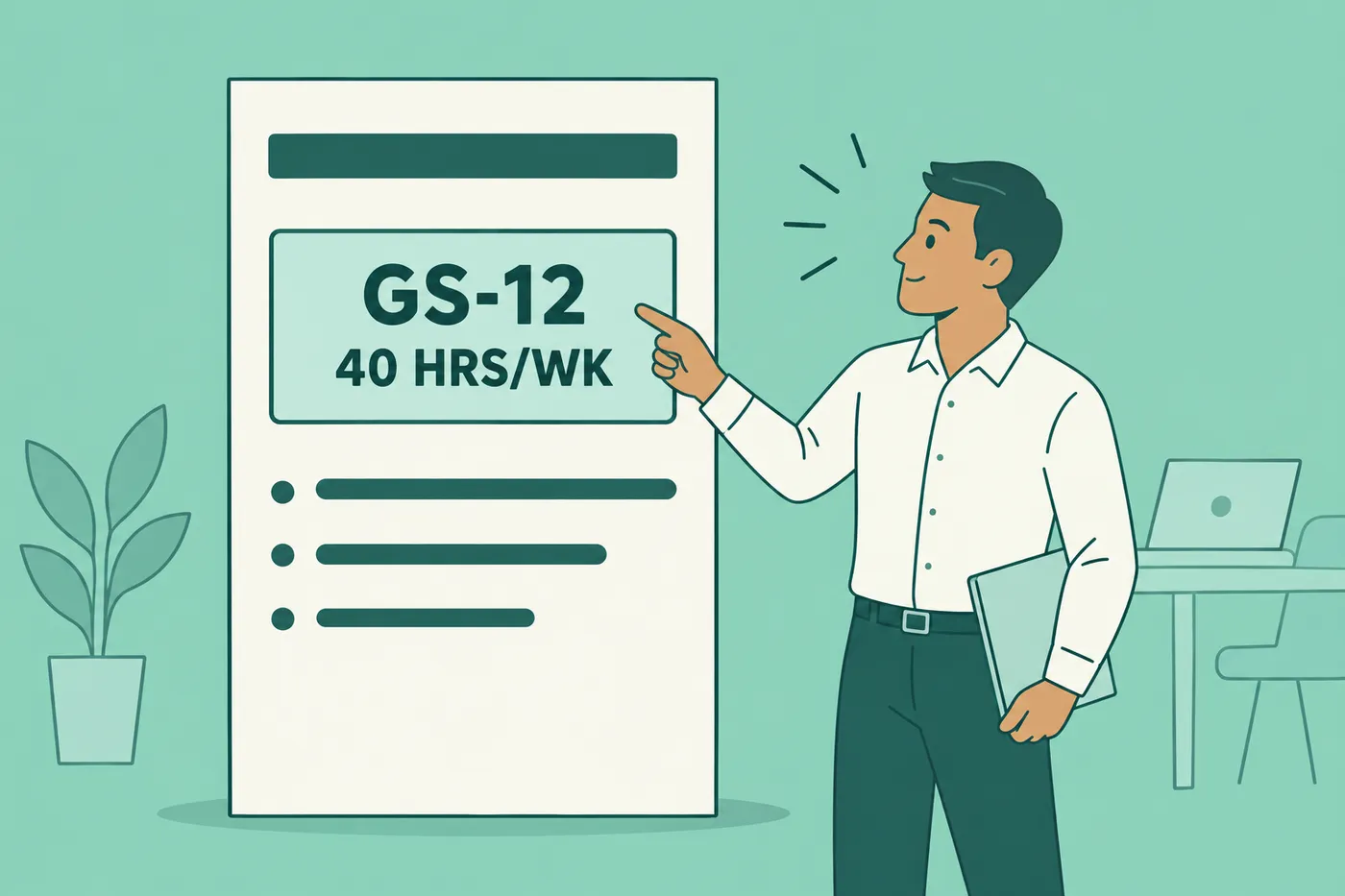
For most competitive announcements at GS-12 and above, qualifying means one full year of specialized experience equivalent to the next lower grade. Applying to a GS-13 position, you need a year of specialized experience at the GS-12 level or its private-sector equivalent. "Equivalent" is the word that trips up candidates coming from outside government. You do not need to have held a GS-12 job; you need your resume to show a year of work at that level of independence, complexity, and scope. That is why the salary field, the duty paragraphs, and the accomplishment bullets matter: together they let HR judge the level of your private-sector work.
Current federal employees face a second gate: time-in-grade. To be promoted within the competitive service, you generally need 52 weeks at the next lower grade. Your resume proves this through the series-grade strings and month-and-year dates on your federal positions, which is exactly why each grade you held should be its own entry rather than one blended block.
One resume rarely covers two grades well. A resume written to qualify for GS-13 leads with GS-12-level scope; the same document aimed at a GS-11 announcement buries the fact that you meet that bar comfortably and can even read as overqualified padding. Keep a master version with everything in it and cut a version per announcement. That is the base resume and tailored versions model, and federal hiring is the strongest case for it anywhere in the job market.
The occupational questionnaire: every rating needs a matching line
Most announcements include a self-assessment questionnaire where you rate your own experience on each competency, typically on a scale from "I have no experience" up to "I am an expert and others consult me." Your questionnaire score determines whether you land in the best-qualified category, so the temptation to rate yourself expert on everything is real.
Resist it selectively. HR specialists are instructed to compare your ratings against your resume, and they can and do lower a rating the resume does not support. Rate yourself expert on "developing budget estimates" with no budget work visible anywhere in your resume, and the specialist marks you down. Worse, a pattern of inflated answers can get the whole application removed from consideration.
The working rule: before you submit, read each questionnaire item you rated at the top two levels and put your finger on the resume line that backs it. No line, two options. Add the line, truthfully, because you probably do have the experience and just never wrote it down. Or lower the rating. Do this as a literal pass through the questionnaire, item by item, the day before the closing date. It takes twenty minutes and it is the highest-value twenty minutes in a federal application.
Several positions at one agency: promotions, details, and compressing the early years
Federal careers accumulate entries fast: a promotion from GS-9 to GS-11 to GS-12 in the same office is three positions, and a 120-day detail is a fourth. Blend them into one entry and you erase the evidence HR needs for time-in-grade and specialized experience. Give every entry full weight and the resume balloons past what anyone will read carefully.
The structure that works: one agency header, then a separate dated entry for each grade you held, with the fullest write-up reserved for the current or highest grade. Each entry keeps its own dates, hours, salary or grade-and-step, and supervisor line, because each is rated separately.
- Current grade: full duty paragraph plus four to six accomplishment bullets written against the target announcement's specialized experience.
- Previous grade at the same agency: shorter duty paragraph, two to three bullets, all required fields still present.
- Details and acting assignments: their own dated entry labeled honestly, e.g. "Detailed to Acting Branch Chief, 06/2023 – 01/2024 (temporary assignment, not a permanent promotion)," with hours per week and supervisor listed. A detail at the next grade can be strong evidence toward specialized experience, but only if it is visible as its own entry.
- Positions older than roughly ten years: compress to title, employer, dates, hours, and one line of scope. They establish progression, not qualification.
The compression judgment is the same one every long resume faces, with one federal twist: an old position you are counting toward a qualification requirement keeps its full field set no matter how old it is. For everything else, the reasoning in how far back should a resume go holds.
Veterans' preference, Schedule A, and clearances
Three claims change how your application is handled, and each has a documentation requirement the resume alone cannot satisfy.
Veterans' preference. Eligible veterans receive additional consideration in competitive hiring: 5-point preference for qualifying service, 10-point for preference categories tied to a service-connected disability or related criteria. Claiming it requires documents uploaded with the application: your DD-214 (the member copy that shows character of discharge) for 5-point preference, and additionally the SF-15 form plus the supporting VA letter for 10-point preference. State your preference claim on the resume too, near your contact details, but understand the documents are what HR adjudicates. A claimed preference with a missing DD-214 is a rejected claim, and announcements close on hard deadlines.
Schedule A. This is a non-competitive hiring authority for people with certain disabilities, and it can move your application through an entirely separate, faster path. It requires a Schedule A letter, and who signs it matters: a licensed medical professional, a licensed vocational rehabilitation specialist, or a federal or state agency that issues disability benefits. A letter from anyone else, including your manager or your HR department, does not qualify. The letter states that you are eligible under Schedule A; it does not need to name your disability.
Citizenship and clearance. Most competitive-service jobs require U.S. citizenship, so state it in one line. If you hold or held a security clearance, list it plainly: "Active Top Secret clearance" or "Secret clearance (inactive since 05/2023)." The level and status are useful to HR and the hiring manager; investigation details and polygraph specifics are not, and anything about the classified work itself stays off the document entirely.

USAJOBS resume builder vs. an uploaded document
USAJOBS gives you two ways to attach a resume: build it inside the site's resume builder, or upload your own document. The builder's virtue is that it makes the required fields structural. It asks for hours per week, dates, and supervisor information as form fields, so you cannot forget them. Its cost is formatting: you get limited control over how the output reads, and long duty descriptions become walls of text. Some announcements require the builder resume specifically, in which case that decision is made for you.
An uploaded document gives you control of structure and readability, which matters at four to six pages, and it is the right choice whenever the announcement allows it. Upload a PDF: it locks your formatting so the specialist sees exactly what you wrote, and it is what any modern editor exports cleanly. The tradeoff is that nothing forces you to include the required fields, so the checking burden is entirely on you.
That check is worth doing systematically, twice. First, the field audit: every position you are counting toward qualification has month-and-year dates, hours per week, salary or grade, and a supervisor line with contact permission. Second, the announcement audit: every clause of the specialized experience paragraph and every top-rated questionnaire item traces to a specific line. This is exactly what a resume-against-job-description check is for, and it is where Roleframe fits a federal application honestly: paste the announcement, duplicate your base resume for it, and the fit report shows which of the announcement's required language your resume covers and which clauses are still unanswered, with Remi helping you rewrite the weak entries one bullet at a time while you approve every change. Nobody should let software write a federal resume for them, because you certify its accuracy when you apply, and a fabricated line on a federal application is a federal problem. A gap report plus your own edits is the version of AI help that survives that standard.
Converting a private-sector resume to a federal one
If you already have a strong regular resume, the conversion is expansion, not rewriting. The order that works:
- Pick one target announcement first. A "general" federal resume is a myth; the specialized experience paragraph defines what yours needs to say.
- Add the administrative fields to every position: month-and-year dates, hours per week, salary, supervisor name and phone with contact permission.
- Expand your two or three most relevant positions from tight bullets into a duty paragraph plus accomplishment bullets, written against the announcement's specialized experience clauses in the announcement's vocabulary.
- Add the compliance blocks: citizenship, veterans' preference claim if any, clearance if any, and a license and certification section with issuing authority and expiration dates.
- Run the questionnaire pass: every top self-rating maps to a resume line, or the line gets added, or the rating comes down.
- Export as PDF (unless the announcement demands the USAJOBS builder) and submit well before the closing date, because announcements can close early when application caps are hit.
Frequently asked questions
- What is the difference between a federal resume and a regular resume?
A regular resume is a marketing document read in seconds; a federal resume is an eligibility document rated in full by an HR specialist against the announcement's requirements. Practically, that means a federal resume is far longer (typically four to six pages), includes administrative fields a regular resume omits (hours per week, month-and-year dates, salary, supervisor contact information and permission), and answers the announcement's specialized experience paragraph in its own language. Sending a regular resume to a USAJOBS announcement usually produces an "ineligible" rating regardless of how qualified you are.
- How long should a federal resume be?
Four to six pages is the normal range for a mid-career candidate, because each position needs a duty paragraph, accomplishment bullets, and the required administrative fields. Entry-level candidates land shorter; twenty-year federal careers can run longer. The exception is agencies that impose an explicit page cap in the announcement or their own portal, which some Department of Defense components now do. When a cap is stated, the cap wins; when nothing is stated, completeness beats brevity.
- Do I really have to put hours per week and salary on a federal resume?
Hours per week, yes, on every position you want credited: HR prorates part-time work, and without the number your experience may be counted as zero rather than assumed full-time. Salary (or grade and step for federal jobs) is expected by most announcements and helps HR judge whether private-sector work was equivalent to the target grade. Omitting salary is less fatal than omitting hours, but there is no upside to leaving either out; this document is read by an HR specialist rating eligibility, not a recruiter judging polish.
- What is the correct federal resume format in 2026?
Reverse chronological, with each position carrying its own dates (month and year), hours per week, salary or grade, and supervisor line, plus sections for education, licenses and certifications with issuing authority and expiration, citizenship, and any veterans' preference or clearance. There is no single mandated template; the requirements live in each announcement's "How to Apply" and "Required Documents" sections, and those override any general advice, including page-length norms. When the announcement permits an upload, submit a PDF so your formatting arrives intact.
- How do I write a GS-13 federal resume?
Show one full year of specialized experience at the GS-12 level or its equivalent, written directly against the announcement's specialized experience paragraph. Your most recent position should answer that paragraph almost clause by clause, with the announcement's own nouns and your quantified specifics. Current federal employees also need the resume to prove time-in-grade: 52 weeks at GS-12, visible through separate dated entries with full series-grade strings like "GS-0343-12." Candidates from outside government qualify on equivalence, so scope, independence, and complexity need to be explicit in the duty paragraphs.
- Does USAJOBS use an ATS that screens my resume by keywords?
Not in the private-sector sense. A human HR specialist rates your application; there is no algorithm auto-rejecting resumes before a person sees them. Keywords still decide outcomes, though, because that specialist is scanning for the announcement's specialized experience language across a large applicant list, fast. A resume that uses the announcement's exact terms gets credited; one that paraphrases them into synonyms forces a judgment call that often goes against you. Write for a rushed human checking boxes, which in practice looks a lot like writing for an ATS.
- Should I use the USAJOBS resume builder or upload my own PDF?
Upload your own PDF whenever the announcement allows it: you control structure and readability, which matters across four to six pages, and the PDF preserves your formatting exactly. Use the builder when the announcement requires it, and consider it if you tend to forget the required fields, since the builder collects hours per week, dates, and supervisor details as form fields. Either way, audit the final document against the announcement's specialized experience paragraph and required documents list before the closing date.


Build yours on the same template.
Every example here is built on a template you can open in the editor. Start from the same layout and write your own experience into it, then download the PDF free, with no watermark.


