Physician Assistant Resume Example With Rotations and Licenses
by Larbi SahliLast Updated
A full physician assistant resume example with a credential block formatted for verification, plus how rotations should change from new grad to year five.
Users have landed jobs at
- 1Password
- OpenAI
- Notion
- justworks
On this page
A physician assistant resume gets read twice, by two different people, looking for two different things. The credentialing coordinator checks that your NCCPA certification, state license, and DEA registration are current and verifiable. The hiring manager checks that you can handle the patient volume and the procedures the department actually runs. Most PA resumes are written for neither reader: the credentials are buried in a one-line "Certifications" footer and the clinical bullets say "provided patient care" without a single number.
This page fixes both. Below is a complete physician assistant resume example with the credential block laid out the way a credentialing office reads it, issuer first, dates and status visible, numbers withheld. Around it, the decisions that matter most at each career stage: what to do with clinical rotations as a new graduate, when those rotations collapse to a single line, and how to show patient volume and procedure scope so a manager can size you up in one pass.
The physician assistant resume example
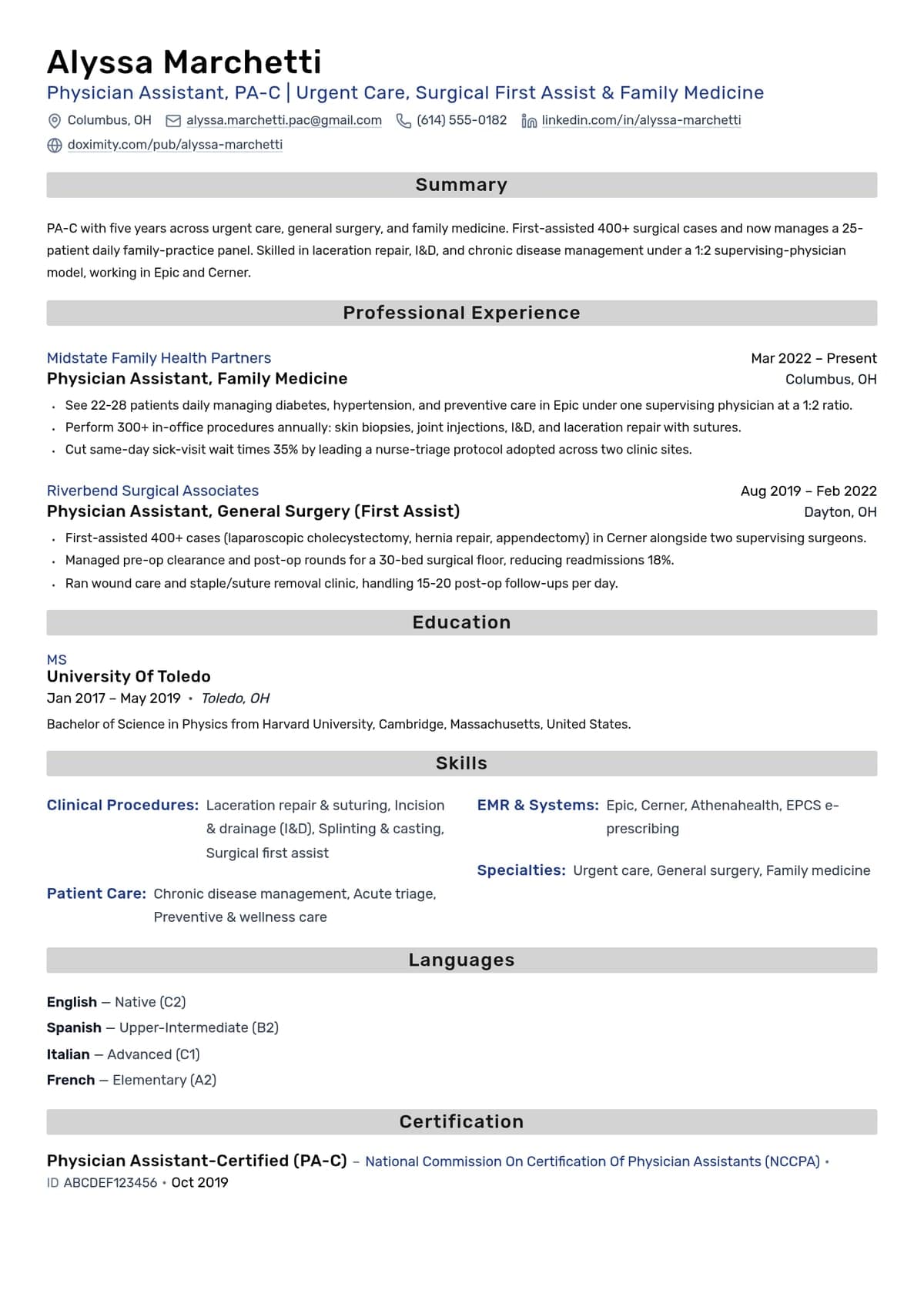
The example below shows a PA about five years out of school, with time in urgent care, general surgery, and family practice. Notice three things as you read it. The credential block sits directly under the header, before the summary, because it answers the first question anyone at a hospital or group practice asks. The rotations from PA school are gone, replaced by real employment with volume and procedure numbers. And every clinical bullet names either a patient population, a procedure count, or a scope of practice detail, because "experienced provider" is a claim and "22 to 28 patients per shift" is evidence.
If you are earlier in your career, the structure changes in one specific place, the rotation section, and I cover exactly how below. The credential block does not change at all. You need it on day one and you will still need it at year twenty.
What a credentialing office verifies before a hiring manager reads a word
At most hospitals and larger group practices, a PA application passes through credentialing or a recruiter running a credentialing checklist before a clinical manager ever sees it. That reviewer is not evaluating your bullets. They are confirming a short list of facts: that you hold current NCCPA certification (the PA-C), that you are licensed in the state of the job or eligible to be, that your DEA registration exists if the role involves prescribing controlled substances, and that your basic life support and advanced life support cards are current where the setting requires them.
Every one of those facts gets independently verified later through primary sources, the NCCPA portal, the state medical board, the DEA lookup. Your resume cannot substitute for that verification and should not try. What it can do is make the checklist trivially fast to run. A credential block that shows issuer, credential name, issue date, expiration date, and current status lets the reviewer tick every box in fifteen seconds. A resume that says only "PA-C, licensed in Texas" forces them to guess whether the license is active, expired, or pending, and a guess in credentialing defaults to a follow-up email or a pass.
The practical consequence: put the credential block above your summary, not at the bottom of page two. For a PA, credentials are not a supporting detail. They are the gate. Everything else on the resume is unreadable until the gate is open. The general rule of matching certification placement to how hard the job requires them applies here in its strongest form, because for a PA the certification is not preferred, it is the legal basis for practicing.
NCCPA certification, state license, and DEA, formatted to be checked
Here is the format the example uses, field by field. Each credential gets one line or one compact entry with five pieces of information.
| Field | What to write | Why the reviewer needs it |
|---|---|---|
| Credential name | PA-C (Physician Assistant-Certified) | Confirms the credential type at a glance |
| Issuer | NCCPA / state medical board / DEA | Tells them which primary source to verify against |
| Number | "Available for verification" | Never print license or DEA numbers on a document you email around |
| Issue date | Month and year | Establishes how long you have held it |
| Expiration | Month and year | The single most-checked field; an expiry inside the next 90 days triggers questions, so address it in your summary if it applies |
| Status | Active / active-unrestricted | Removes the ambiguity that forces a follow-up email |
Two of these fields deserve a closer look. First, the number. Do not print your license number, your NCCPA ID, or your DEA number on a resume. The resume travels: it sits in ATS databases, gets forwarded to panel interviewers, ends up in personal inboxes. Credentialing will collect the numbers through a secure application when they need them. "Number available for verification" signals that you understand the process, which is itself a small credibility marker.
Second, the status word. "Active" and "active-unrestricted" are not decoration. A reviewer who has processed applications from PAs with board actions reads the absence of a status as a maybe. If your license is unrestricted, say so. If you are licensed in a neighboring state and applying across the border, write "eligible for licensure by endorsement, application in progress" rather than leaving the reviewer to discover the mismatch. Compact licensure and endorsement timelines vary by state, and a candidate who names the situation honestly gets handled faster than one who lets credentialing find it.
Round out the block with the certifications the setting demands: BLS and ACLS for nearly everything, PALS for pediatrics and many emergency and urgent care roles, ATLS where trauma is in scope. Same format, issuer and expiry visible. Then stop. A PA resume does not need the CPR card from a college lifeguarding job.
Clinical rotations for a new graduate, and what replaces them at year five
Clinical rotations are the most misused section on PA resumes, in both directions. New graduates undersell them, listing rotation names with no content, and experienced PAs oversell them, keeping a half-page of 2019 rotations on a resume that has three real jobs above it. The rule is simple: rotations are your clinical experience until you have clinical employment, and then they are a credential line.
As a new graduate: rotations are your experience section
Fresh out of PA school, your rotations go in a dedicated "Clinical Rotations" section directly after your summary and credential block, above education. Each rotation gets its own entry: specialty, site, city, dates, and two or three bullets. The bullets follow the same evidence standard as an experienced PA's job bullets. Name the patient population, the volume you carried, and the procedures you performed or assisted on. "Emergency medicine rotation" tells a manager nothing. "Evaluated 8 to 12 patients per shift in a community ED, performed laceration repairs and splinting under supervision, presented all cases to the attending" tells them you have done the shape of the job they are hiring for.
Order matters too. If you are applying to an urgent care role, your emergency medicine and family practice rotations should sit at the top of the section even if they were not chronologically last. Rotations are the one section where relevance ordering beats reverse chronology, because they all happened within the same year and no reader cares which month.
Lead the resume with a short objective or summary naming your target setting, your program, and your strongest rotation exposure. New graduates are one of the few groups for whom a resume objective still earns its space, because the reader genuinely cannot infer your target from a work history you do not have yet.
At year five: one line, under education
Once you have two or more years of clinical employment, the rotation section dissolves. Your jobs now answer every question rotations used to answer, with better evidence. Keeping detailed rotations at that stage actively hurts you: it pushes real experience down the page and signals that you have not updated the document since graduation.
What survives is one line under your education entry: "Clinical rotations: emergency medicine, general surgery, family practice, internal medicine, pediatrics, women's health, behavioral health, orthopedics." That line exists for exactly one reason, specialty pivots. If a surgical group is reading a PA whose employment is all urgent care, the surgery rotation on that line is the thread they pull in the interview. It costs one line to keep the door open. It costs half a page to keep it open badly.
| Career stage | Where rotations live | Format |
|---|---|---|
| New graduate, pre-first job | Own section, above education | Each rotation: specialty, site, dates, 2-3 bullets with volume and procedures |
| 1-2 years employed | Own section, compressed | Rotation names and sites only, no bullets; employment section carries the bullets |
| 3+ years employed | One line under education | Comma-separated specialty list; expand a single rotation only when pivoting into that specialty |
Three settings in eight years: urgent care, surgery, family practice as one arc
PAs move between settings more than almost any other clinician, it is one of the profession's selling points. On a resume, though, three settings in eight years reads either as range or as drift, and the difference is entirely in how you frame the sequence. The example above handles it the way I recommend: each role's bullets emphasize what that setting added, so the sequence reads as accumulation rather than restlessness.
Urgent care first: high volume, broad acuity, independent disposition decisions. The bullets there carry the throughput numbers, patients per shift, door-to-provider ownership, the procedure mix of a walk-in setting. Surgery second: depth and technical skill. First-assist case counts, pre-op and post-op management, the specific case types. Family practice third: continuity and panel ownership. Chronic disease management, a defined patient panel, preventive care metrics if the practice tracked them.
Then the summary does the connective work in two sentences: a PA who can move fast, work with their hands, and manage patients over time. Written that way, a family practice hiring manager sees a provider whose urgent care years mean nothing in the walk-in schedule scares them, and whose surgical years mean confident procedure skills in an office setting. Written as three disconnected job descriptions, the same history reads as someone who could not settle. The facts are identical. The framing is the resume.
One structural note: keep the format strictly reverse chronological. Hiring managers and credentialing reviewers both reconstruct your timeline, and any format that obscures dates, functional layouts especially, reads as concealment in a field where gaps get asked about directly. If you are unsure how far back to carry pre-PA clinical work, the answer for most PAs is that it earns a line, not an entry, and the general guidance on how far back a resume should go applies with a healthcare-specific caveat: credentialing applications will require the full history anyway, but the resume is an argument, not an archive.

Which roles keep bullets and which become one line
PA careers accumulate clutter fast: per diem shifts, moonlighting, locum stretches, the EMT or medical assistant years before PA school. Each is legitimate experience, and each competes for space with the roles that will actually get you the interview. The sorting rule I use: a role keeps bullets if it is recent, relevant to the target job, and taught you something the roles above it did not. Everything else compresses.
- Keeps full bullets: your current role, your previous role, and any role in the same specialty as the job you are applying for, regardless of age.
- Keeps 1-2 bullets: an older role in a different specialty that demonstrates a transferable capability the target job names (procedures, a patient population, an EMR the posting requires).
- Becomes one line with dates: per diem and moonlighting work in settings similar to a main role, pre-PA clinical jobs (EMT, paramedic, MA, CNA), and locum assignments unless the target job is locum work.
- Comes off entirely: non-clinical jobs older than PA school, unless you are early-career and the page is thin.
Per diem work deserves a specific note because almost every PA has some. A per diem urgent care role held alongside a full-time surgery job is worth one line, "Per diem PA, [setting], 2022-present, 2-4 shifts monthly", because it explains your currency in a second setting without pretending to be a second career. Give it bullets only if you are applying into that setting and the per diem work is your most recent evidence there. The broader question of how many bullets each job deserves has a clean answer for PAs: spend them where the target job's requirements point, not where you spent the most years.
Patient volume, procedures performed, and supervision ratio: the three numbers that define scope
A PA hiring manager reading your experience section is trying to answer one question: can this person carry our load, in our setting, with our level of oversight. Three kinds of numbers answer it, and a bullet without at least one of them is usually a bullet worth rewriting.
Patient volume. Patients per shift or per day, and the shift length. "Managed a full urgent care schedule" is unfalsifiable. "Evaluated 22 to 28 patients per 12-hour shift across all ages and acuities" lets a manager compare you to their own board in one read. If your setting works in panels rather than shifts, give the panel: "managed a continuity panel of approximately 1,100 patients" says more than any adjective.
Procedures, with counts where you have them. Name the procedures the target setting runs: laceration repair, incision and drainage, splinting and casting, joint injections, skin biopsies, first-assist on specific case types. Counts beat lists. "Performed 200+ laceration repairs" outweighs a skills-section mention of "suturing" because it is evidence rather than a keyword. Keep a running procedure log if you do not already, credentialing committees ask for exactly this when privileging you, and the resume is where that log first pays off.
The supervision arrangement. This is the number most PA resumes omit and most hiring managers want. How many PAs and NPs per supervising or collaborating physician, whether the physician was on-site or available by phone, and what you dispositioned independently. "Practiced with off-site physician collaboration, independently managing disposition for all ESI 3-5 patients" tells an employer in a lean-staffed clinic that you will not need hand-holding. In states with optimal team practice or looser collaboration requirements, say what your actual autonomy looked like rather than quoting the statute. Autonomy is demonstrated, not asserted.
These numbers do not need to be precise to the digit. Honest ranges are fine and expected. What they must be is defensible, because a good interviewer will pick your biggest number and ask you to walk through a day that produced it.
Specialty pivots: showing transferable clinical work
The PA credential is generalist by design, you certify once and can practice across specialties, but hiring managers still discount candidates from other settings unless the resume does the translation for them. If you are pivoting, say urgent care into orthopedics, or family practice into dermatology, three moves close most of the gap.
First, mine your current work for the target specialty's content. An urgent care PA applying to ortho has splinted, reduced, injected joints, and read musculoskeletal films for years; those bullets exist, they are just scattered. Pull them forward and up within each role so the ortho content leads. Second, expand the relevant rotation. This is the one exception to the one-line rotation rule: a PA pivoting into surgery can restore two bullets under their general surgery rotation, even years later, because it is direct evidence of exposure. Third, use the summary to name the pivot plainly. "Urgent care PA with a high-volume MSK caseload, seeking orthopedic practice" beats letting the reader wonder whether you applied by accident.
What does not work is padding the skills section with the target specialty's vocabulary and hoping. A skills line saying "orthopedics" with no supporting bullet reads as keyword stuffing, and interviewers test it. The honest version of the same move, naming the transferable procedures you have actually performed, survives the interview. If the pivot is large enough that the resume alone cannot carry it, that is a cover letter's job, and the structure in this career change cover letter example adapts directly to specialty changes: name the move, map the overlap, close the gap you cannot map.

The keywords this role is screened on, and where each one goes
Healthcare recruiters and applicant tracking system (ATS) filters screen PA applications on a fairly stable vocabulary, and most of it is credentials and systems rather than soft skills. The table below covers the terms that show up again and again in PA postings, and, just as important, where each belongs on the page. A keyword in the wrong section either gets missed by a recruiter scanning a specific block or reads as filler.
| Keyword or phrase | Where it goes | Note |
|---|---|---|
| PA-C / NCCPA-certified | Credential block and header line | Put "PA-C" after your name in the header; the credential block carries the detail |
| State licensure (named state) | Credential block | Name the state explicitly; "licensed" alone fails a filter searching the state name |
| DEA registration | Credential block | With schedule scope if the posting mentions prescribing |
| BLS / ACLS / PALS / ATLS | Credential block | Issuer and expiry; postings frequently list these as hard requirements |
| EMR by name (Epic, Cerner, Athenahealth, eClinicalWorks) | Skills section, plus one bullet | Recruiters search the specific system; a bullet like "documented in Epic" confirms real use |
| Named procedures (suturing, I&D, splinting, joint injection, first assist) | Experience bullets | Counts beat lists; mirror the posting's exact procedure names |
| Patient population terms (all ages, pediatric, geriatric, acute, chronic) | Summary and bullets | Match the posting's population language |
| Supervising / collaborating physician | Experience bullets | Use the term your target state uses; postings quote their own statute's word |
| Setting terms (urgent care, ambulatory, inpatient, ED, perioperative) | Summary and job titles | A title line like "Physician Assistant, Urgent Care" outperforms a bare "Physician Assistant" in searches |
The reliable way to build this list for a specific application is to take it from the posting itself rather than from a generic sheet. Postings tell you their vocabulary: if the ad says "collaborating physician," a resume saying "supervising physician" is a near-miss a literal filter will not credit. The process in how to pull resume keywords from a job description works exactly the same for clinical roles as for any other, with one PA-specific addition: check the posting's credential list against your credential block line by line, because a missing ACLS line has sunk applications from PAs who held the card and simply never listed it.
Scan your draft against a real posting
Everything above is the general case. Your next application is a specific case: one posting, one setting, one credential list, one procedure mix. The last step before you send anything is to read your draft against that posting requirement by requirement and confirm each one is answered somewhere on the page, in the posting's own vocabulary.
You can do that with two printouts and a highlighter. If you are applying to more than a handful of roles, Roleframe does the same read systematically: paste the posting, and the fit report scores your resume against it, lists the exact keywords the posting screens on that your draft is missing, and gives you a prioritized plan. You then make the edits yourself, with Remi, the career copilot, proposing rewrites bullet by bullet for you to approve or discard. Nothing is rewritten for you, which matters more in medicine than anywhere else: a resume claim you cannot defend in a clinical interview is worse than a gap.
Whatever tool you use, submit as PDF. A PDF preserves your credential block's layout exactly, and every major ATS parses a well-structured PDF cleanly. Send an editable file only if a posting explicitly demands one.
Frequently asked questions
- Should a physician assistant resume be one page or two?
New graduates should fit one page: credential block, summary, rotations with bullets, education, skills. Experienced PAs routinely and legitimately run to two, because the credential block, multiple clinical roles with volume and procedure detail, and a rotation line take real space. Two full pages of substance beat one page of squeezed 9-point text. Do not confuse the resume with a CV: academic and research-heavy roles may want a full CV, but clinical employers want the two-page argument.
- Should I put my license number or NPI on my resume?
No. Write "available for verification" in the credential block instead. Credentialing will collect license numbers, your NPI, and your DEA number through a secure application, and they verify everything against primary sources regardless of what your resume says. A resume gets forwarded, stored in databases, and emailed around, and printed identifiers on it are pure downside.
- How do I list clinical rotations on a new graduate PA resume?
Give rotations their own section above education, with each rotation showing specialty, site, city, dates, and two or three bullets covering patient volume, procedures performed or assisted, and the level of supervision. Order them by relevance to the job you are applying for rather than by date. Once you have two or more years of clinical employment, compress the whole section to a single comma-separated line under your education entry.
- Do I list an expired or lapsed certification?
Not in the credential block, which should contain only current, verifiable credentials. If a lapsed certification is relevant to the target job, say a lapsed ATLS for a trauma-adjacent role, mention it in your summary as "ATLS previously held, recertification in progress" only if you are actually recertifying. Listing a lapsed card without a status invites the credentialing office to discover the lapse themselves, which is the worst version of the conversation.
- How do I show a gap on a PA resume, like parental leave or a break between contracts?
State it in one neutral line with dates: "Planned career break, family, 2023-2024." Healthcare employers reconstruct timelines during credentialing anyway, so an unexplained gap gets found and then questioned, while a named gap gets skimmed past. If the gap needs more context than one line, that context belongs in the cover letter, not the resume.
- Should pre-PA experience like EMT or medical assistant work stay on my resume?
As a new graduate, yes, with a bullet or two, because it is real patient contact and it differentiates you. After your first PA job, compress it to one line with title and dates, and after five years it can come off entirely unless it is directly relevant to the target setting, such as paramedic experience when applying to emergency medicine. Credentialing applications will capture the full history regardless.
- Is a physician assistant resume different from a CV?
Yes. A CV is a complete record: every rotation, publication, presentation, and appointment, and it grows for life. A resume is a two-page argument for one job. Clinical employers and recruiters want the resume; academic medical centers, fellowship programs, and research roles may ask for the CV. Maintain a full master document with everything in it, then cut a tailored resume from it for each application, which is exactly the master resume workflow.
- What skills should a physician assistant put in the skills section?
Concrete, searchable items: your EMR systems by name, procedure families you actually perform, and population or setting terms from the posting. Leave out generic traits like "compassionate" and "team player," which no recruiter searches and no interviewer believes from a list. The strongest version of every skill is a bullet with a number behind it; the skills section exists to make those bullets findable by a keyword filter.

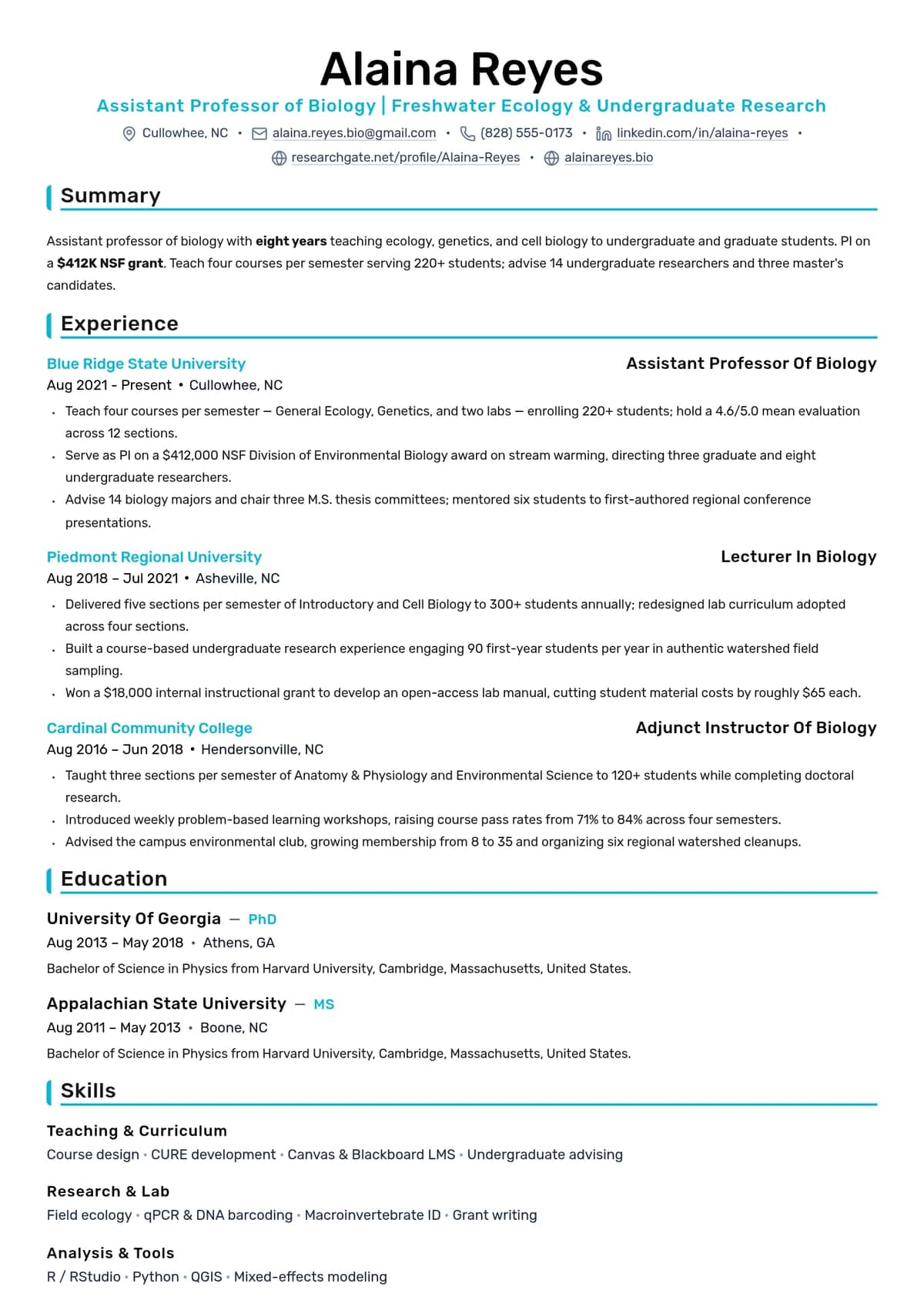
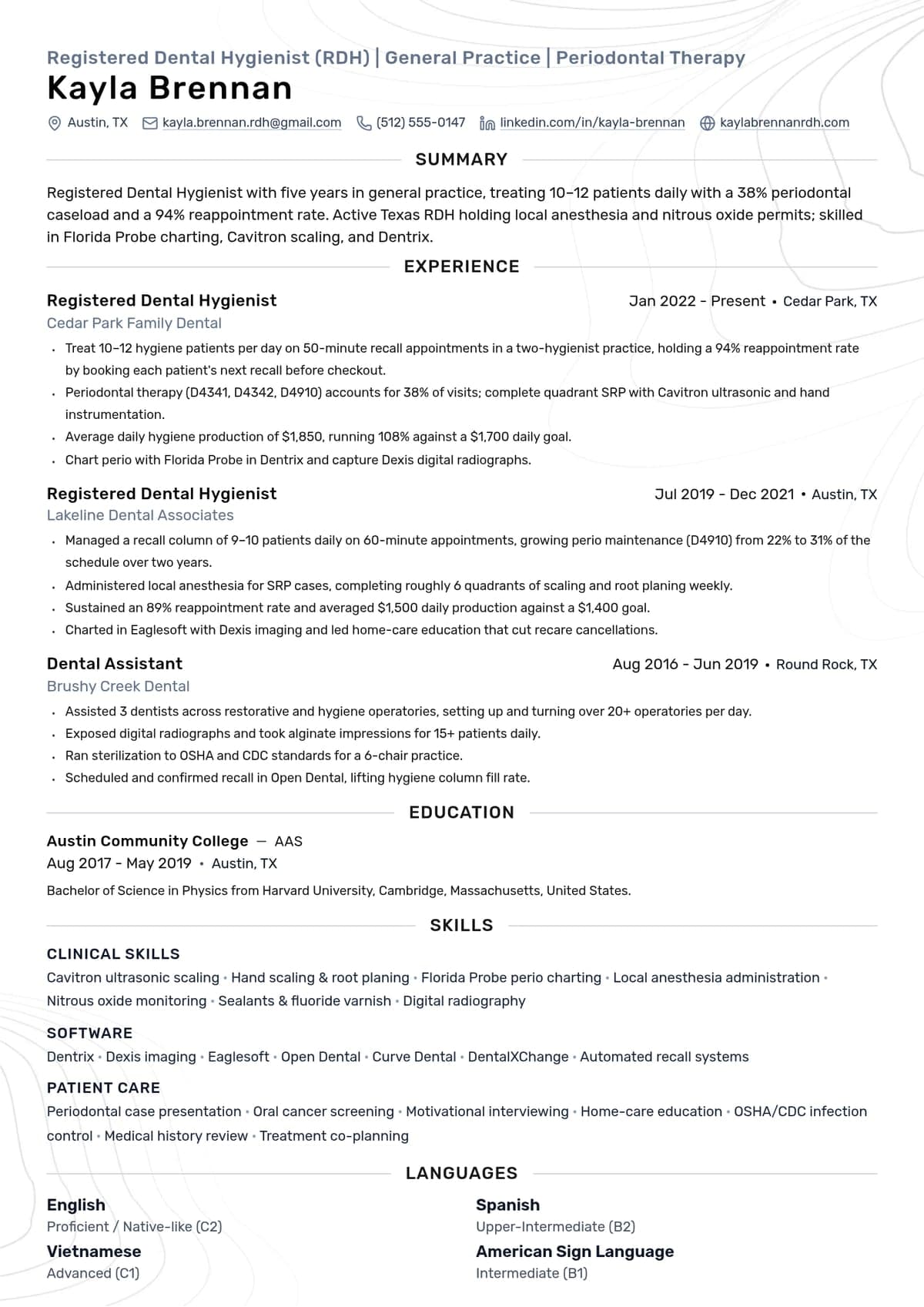
Build yours on the same template.
Every example here is built on a template you can open in the editor. Start from the same layout and write your own experience into it, then download the PDF free, with no watermark.


