Office Manager Resume Example (With the Leadership Keywords Employers Screen For)
by Larbi SahliLast Updated
A full office manager resume example, plus the budget, vendor, and HR keywords employers screen for and how to prove each one in your bullets.
Users have landed jobs at
- 1Password
- OpenAI
- Notion
- justworks
On this page
Proving Operational Efficiency on Your Resume
Almost every office manager resume says some version of "managed day-to-day office operations." Recruiters have read that line thousands of times, and it tells them nothing. The resumes that get interviews attach numbers to the operations: the size of the budget you owned, the headcount you supported, the vendor contract you renegotiated, the days you shaved off onboarding.
The office manager problem is a prioritization problem. You genuinely do wear many hats, which means you could fill two pages with duties and still leave the recruiter unsure what you're strong at. The fix is to write for what employers actually ask for. Read enough office manager postings and three demand clusters show up again and again: budget and financial operations, vendor and facilities management, and HR support such as onboarding and payroll coordination. Those three clusters are where the screening keywords live, and they should carry the weight of your resume.
This page gives you a complete office manager resume example built around that logic, a breakdown of the keywords worth targeting, and section-by-section guidance for the summary, the experience bullets, and the skills list. It also covers how to reorder your sections when your background doesn't fit the standard mold.
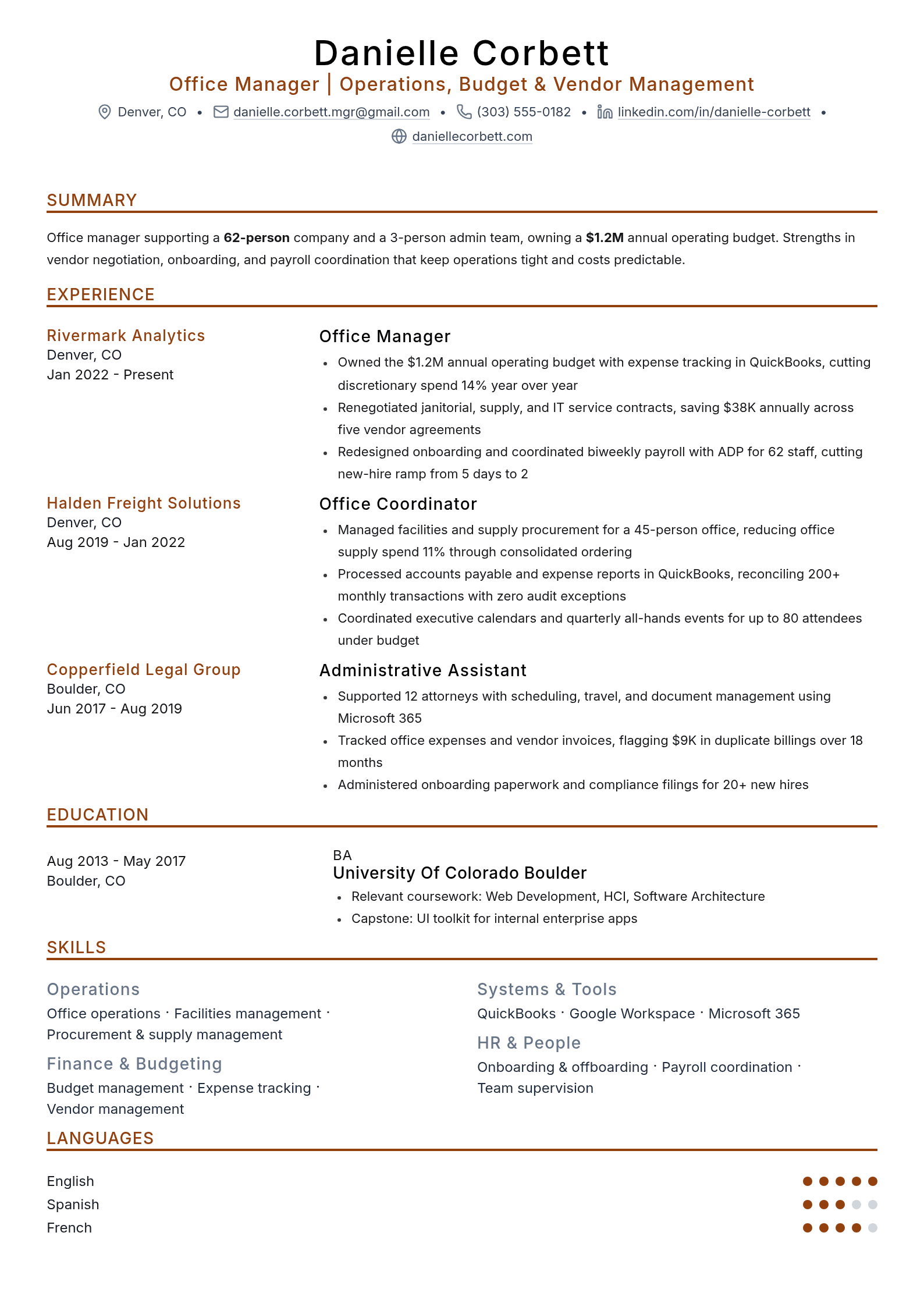
Office Manager Resume Example
Here is what a strong office manager resume looks like when it leads with scope and proof instead of a list of duties. Notice how fast you learn the size of the operation: how many people, how much budget, which systems.
Three things to lift from this example before you touch your own draft. First, the summary states scope in its opening line, because scope is how employers judge whether you can handle their office. A 12-person startup and a 200-person regional office are different jobs, and the recruiter wants to know which one you've done. Second, every experience bullet that touches money carries a number. Third, the HR work is named explicitly. Onboarding, offboarding, and payroll coordination are screening keywords, and a bullet that says "supported the team" gets no credit for any of them.
Top Leadership and Ops Keywords: What Postings Actually Ask For
Applicant tracking systems (ATS) don't reject resumes on their own, but recruiters do filter and search by keyword, and a resume missing the terms from the posting doesn't surface. For office manager roles, the pattern across postings is consistent enough that you can prioritize with confidence.
Budget-related language is close to universal. Postings ask for budget management, expense tracking, or cost control in some form at almost every company size, because the office manager is usually the person accountable for operational spend. Vendor management is the second constant, covering everything from supply procurement to negotiating the cleaning contract. The third cluster, HR support, is where postings vary most by company size: small companies expect their office manager to run onboarding and coordinate payroll, while larger ones carve that off to a dedicated HR team.
| Keyword | How often it appears in postings | How to prove it on your resume |
|---|---|---|
| Budget management / expense tracking | Near-universal | Name the budget size you owned and one decision that reduced spend |
| Vendor management / vendor relations | Near-universal | A negotiation or vendor switch with the savings or service improvement it produced |
| Office operations / office administration | Near-universal | State the headcount and locations you supported, then let the bullets carry the detail |
| Onboarding / offboarding | Very common, especially under ~100 employees | A bullet on the process you ran or improved, with time-to-productive or volume |
| Payroll coordination | Common at small and mid-size companies | Name the payroll provider or system and your role in the cycle |
| Facilities management | Common | An office move, a build-out, or ongoing maintenance coordination with scale |
| Calendar and scheduling / executive support | Common | Who you supported and at what level; link this to outcomes, not tasks |
| Procurement / supply management | Common | Spend you managed and a process change that cut cost or stockouts |
| Team supervision / staff management | Frequent differentiator for senior roles | How many direct reports, and one thing you developed or delegated |
| QuickBooks, Google Workspace, Microsoft 365 | Frequent, named explicitly | List the exact tools in your skills section; recruiters search these literally |
| Event planning / meeting coordination | Frequent | Scale (attendees, budget) and one measurable result |
| Compliance / policy administration | Occasional, heavier in legal and medical | Name the standard or policy area, not just the word "compliance" |
Two practical rules follow from this table. Use the exact phrasing the posting uses, because recruiter searches are literal: if the job says "vendor relations" and your resume says "supplier liaison," you may not match. And don't chase every keyword. Cover the near-universal cluster fully, then add the terms from the specific posting in front of you. For a deeper look at how keyword matching actually works in recruiter filters, see our guide to ATS resume keywords.
Crafting the Summary
Your summary has one job: establish scope and specialty in three lines, so the recruiter reads the rest of the page with the right frame. The formula that works for office managers is title plus years, then scope (headcount, budget, locations), then one proof point from whichever demand cluster the posting emphasizes.
Compare these two openings:
- Weak: "Detail-oriented office manager with strong organizational skills and a passion for supporting teams in fast-paced environments."
- Strong: "Office manager with 7 years running operations for 50-70 person companies. Own a six-figure operating budget, manage 15+ vendor relationships, and lead onboarding for all new hires. Cut office supply spend 22% by consolidating vendors in 2024."
The weak version could describe any of a hundred applicants, and "detail-oriented" is an adjective a recruiter has to take on faith. The strong version is checkable, specific, and maps directly to the three keyword clusters employers screen for. Note the strong version invents nothing generic to say: every clause is a fact the interviewer can ask about, which is exactly the standard you want. If you're unsure whether to write a summary or an objective at all, our professional summary guide covers the decision with 16 worked examples.
One adjustment for senior roles: if the posting is for a senior or executive office manager, put your people leadership in the summary's second line. "Lead a 3-person admin team" signals a different tier of candidate than pure individual-contributor operations work.
Experience: Budgets, Vendors, and Staff
The experience section is where most office manager resumes fall apart, because they list responsibilities instead of results. "Responsible for ordering office supplies" and "Cut supply costs 18% by moving to quarterly bulk procurement" describe the same work. Only one of them earns an interview.
Structure each bullet as action, scope, result. Then check your bullets against the three demand clusters and make sure each one has at least one strong entry.
Budget bullets
State the money. Recruiters hiring office managers want to know the largest budget you've owned, because it predicts what they can hand you without supervision.
- Weak: "Managed the office budget and tracked expenses."
- Strong: "Owned a $250K annual operating budget across supplies, facilities, and events; came in under budget three consecutive years by renegotiating recurring contracts."
If you don't know your budget figure precisely, a defensible range is fine. What you can't do is leave the number out, because a bullet with no figure reads as a bullet where the figure was small.
Vendor bullets
Vendor management bullets need a decision, not a relationship. "Maintained vendor relationships" says you answered emails. Show a negotiation, a consolidation, or a switch, and attach the outcome.
- Weak: "Served as point of contact for office vendors."
- Strong: "Consolidated 6 supply and service vendors to 3, cutting monthly spend 15% and reducing invoice processing time for the finance team."
HR and staff bullets
Name the HR processes explicitly, because these are searchable keywords: onboarding, offboarding, payroll coordination, benefits administration, and PTO tracking. If you supervised anyone, say how many and what you did for them beyond assigning tasks.
- Weak: "Assisted with HR tasks and helped new employees get set up."
- Strong: "Ran onboarding for 40+ new hires per year; rebuilt the checklist and equipment provisioning process, cutting first-day setup from 4 hours to 45 minutes."
- Strong: "Supervised 2 administrative assistants; introduced a shared ticketing inbox that cut average internal request response time by half."
If your role sits closer to executive support than operations, some of your strongest material may belong in a different framing entirely. Our executive assistant resume example shows how that version of the story reads.
Key Office Management Skills
Your skills section exists for two readers. The recruiter's keyword search hits it first, and the human skims it second. Both readers want nouns they recognize, which means named systems and named processes beat personality traits every time.

- Operations keywords: budget management, vendor management, facilities management, procurement, office operations
- HR keywords: onboarding, offboarding, payroll coordination, benefits administration
- Systems: QuickBooks, Google Workspace or Microsoft 365, Slack, a payroll platform (name the one you used), any booking or ticketing tools
- Scheduling and support: calendar management, travel coordination, event planning
- Leadership, only if true: team supervision, training, delegation
Leave "communication," "multitasking," and "attention to detail" out of the skills list. Nobody searches for them, and listing a trait is not evidence of it. Your bullets are where soft skills get proven: a bullet about training two admins proves leadership better than the word ever could. The reasoning behind that split is covered in our piece on hard skills vs. soft skills.
One more filter: match the tools to the posting. If the job runs on Microsoft 365 and your resume only says Google Workspace, add the Microsoft tools you've genuinely used. If you haven't used them, don't list them. An invented skill is the one lie that surfaces in week one of the job.
Rearranging Your Resume Sections
The standard order for an experienced office manager is summary, experience, skills, education. Your work history is your strongest evidence, so it goes first. Two situations justify breaking that order.
You're moving into office management from another role. If you were a receptionist, admin assistant, or coordinator and you're applying up, move skills directly under the summary. The recruiter's doubt is "has this person done budget and vendor work," and a skills section that answers it in the first screenful keeps them reading long enough to find the supporting bullets. Retitle nothing and inflate nothing; just change what they see first.
You have little or no direct experience. Lead with education or a strong related-experience section, and mine every past role for office-management evidence: any time you ordered anything, scheduled anyone, or handled a vendor counts. Our administrative assistant resume examples are the right starting template for this situation, since that's the role most no-experience candidates should actually target first.
Section order is one of the few resume decisions with a defensible right answer per situation, and it's worth getting deliberate about. The full logic, by experience level, is in our guide to resume section order.
Tailor for Specific Industries with Remi
Office manager postings look similar until you read them closely. A medical office wants scheduling systems and HIPAA awareness. A law firm wants confidentiality, billing coordination, and document management. A startup wants someone who can build processes from nothing and doesn't mind that "office manager" quietly includes IT support and event planning. One resume can't emphasize all of that at once, and sending the same version everywhere means each employer sees a resume optimized for someone else's posting.
The workflow that fixes this is a base resume plus a tailored version per application. In Roleframe, you keep one master office manager resume, duplicate it for each job, and paste in the posting. You get a fit report: an ATS score, the exact keywords from that posting your resume is missing, and a prioritized plan of what to change. Then Remi, the career copilot in the editor, helps you make the edits one bullet at a time. It proposes a rewrite grounded in the posting and your real history, shows you a word-by-word diff, and nothing changes until you approve it. Roleframe never rewrites the resume for you, on purpose: you should be able to defend every line in the interview, which means every line has to be yours.
Reordering is direct too. When a legal posting cares about compliance more than events, you drag the relevant section higher on the page and it keeps its content and formatting. When you're done, export the PDF; it matches the editor exactly, and PDF is the format you should be submitting anyway. The full base-plus-variants method is laid out in our guide to resume variants.
Frequently asked questions
- How do you describe an office manager on a resume?
Describe the scope, then the results. State how many people and locations you supported and what budget you owned, then prove the three clusters employers screen for: budget management, vendor relations, and HR support like onboarding and payroll coordination. "Office manager for a 60-person firm, owning a $200K operating budget and all vendor contracts" beats any list of adjectives.
- What is a professional way to say "office manager"?
Common equivalents include office administrator, operations coordinator, business operations manager, and administrative manager. On your resume, keep the title your employer actually gave you, and target the title the posting uses. If your official title was unusual, you can add a clarifier in parentheses, like "Team Coordinator (Office Manager)," as long as it honestly reflects the work.
- What are the basic duties of an office manager?
The core set is managing the office budget and expenses, handling vendors and procurement, keeping facilities running, supporting HR processes like onboarding and payroll coordination, and coordinating schedules, meetings, and events. At smaller companies the role often absorbs basic IT support and executive assistance too. On a resume, don't list all of these as duties; pick the ones the posting emphasizes and show a measurable result for each.
- What skills should an office manager have?
Lead with the searchable ones: budget management, vendor management, onboarding, payroll coordination, facilities management, and the named systems you've used, such as QuickBooks and Google Workspace or Microsoft 365. Soft skills like communication and organization matter, but prove them through bullets rather than listing them. A bullet about cutting onboarding setup time says "organized" more credibly than the word does.
- How do I write an office manager resume with no experience?
Mine your past roles for the same evidence at smaller scale. Ordering supplies, scheduling for a team, coordinating a vendor, or helping a new hire get set up all count, so write them as bullets with numbers. Lead with a skills section and consider targeting administrative assistant or office coordinator roles first, since those are the standard on-ramp and the strongest office manager resumes are built on a year or two of that work.
- Should an office manager resume be one page or two?
One page for under roughly ten years of experience, which covers most office manager candidates. Go to two only if your second page carries real weight, like multi-site operations or team leadership across several roles. The detailed breakdown by experience level is in our guide on whether a resume should be one page or two.
- Should I submit my office manager resume as a PDF or a Word file?
PDF, unless the posting explicitly demands otherwise. A PDF locks your formatting so the recruiter sees exactly what you built, and modern applicant tracking systems parse a cleanly structured PDF without trouble. A Word file can reflow on a different machine and arrive looking broken through no fault of yours.


Ready when you are
Send the tailored resume, not the generic one.
Paste a job posting and Roleframe scores your resume against it, then helps you close the gaps one approved edit at a time, so you apply while the role is still fresh.