Engineering Manager Resume Examples: Balancing Tech and Leadership
by Larbi SahliLast Updated
Engineering manager resume examples with the right balance of technical depth and people leadership, plus how to quantify team growth and delivery.
Users have landed jobs at
- 1Password
- OpenAI
- Notion
- justworks
On this page
An engineering manager resume fails in one of two predictable ways. Either it reads like a senior engineer's resume with "Manager" pasted into the title, all architecture and no people, or it reads like a generic leadership resume that could belong to a sales director, all "cross-functional stakeholders" and no evidence the person could review a pull request. Recruiters screening for engineering managers are checking for both halves at once, and a resume that only proves one gets filtered.
This page shows you what the balance looks like in practice. You'll find a complete engineering manager resume example, guidance on adapting it for startup versus enterprise contexts, a concrete rule for splitting technical keywords against people-management keywords, and the delivery metrics that make a hiring manager stop scrolling.
What an engineering manager resume has to prove
The person reading your resume, usually a director of engineering or a VP, is answering one question: can this candidate deliver outcomes through other people while still earning the technical respect of the team? Everything on the page should feed that answer.
Concretely, that means three kinds of evidence, in this order of importance:
- Delivery through a team. Shipped outcomes where your role was organizing, unblocking, and prioritizing, and where the size and shape of the team is stated. "Led 8 engineers across two squads to ship X" beats any list of technologies.
- People outcomes. Hiring, promotions, retention, performance management. Managers who grow people are rarer than managers who ship features, and hiring managers know it.
- Technical credibility. Enough architecture and stack context to show you can challenge a design review, without drowning the page in tool names. One line of stack per role is usually plenty.
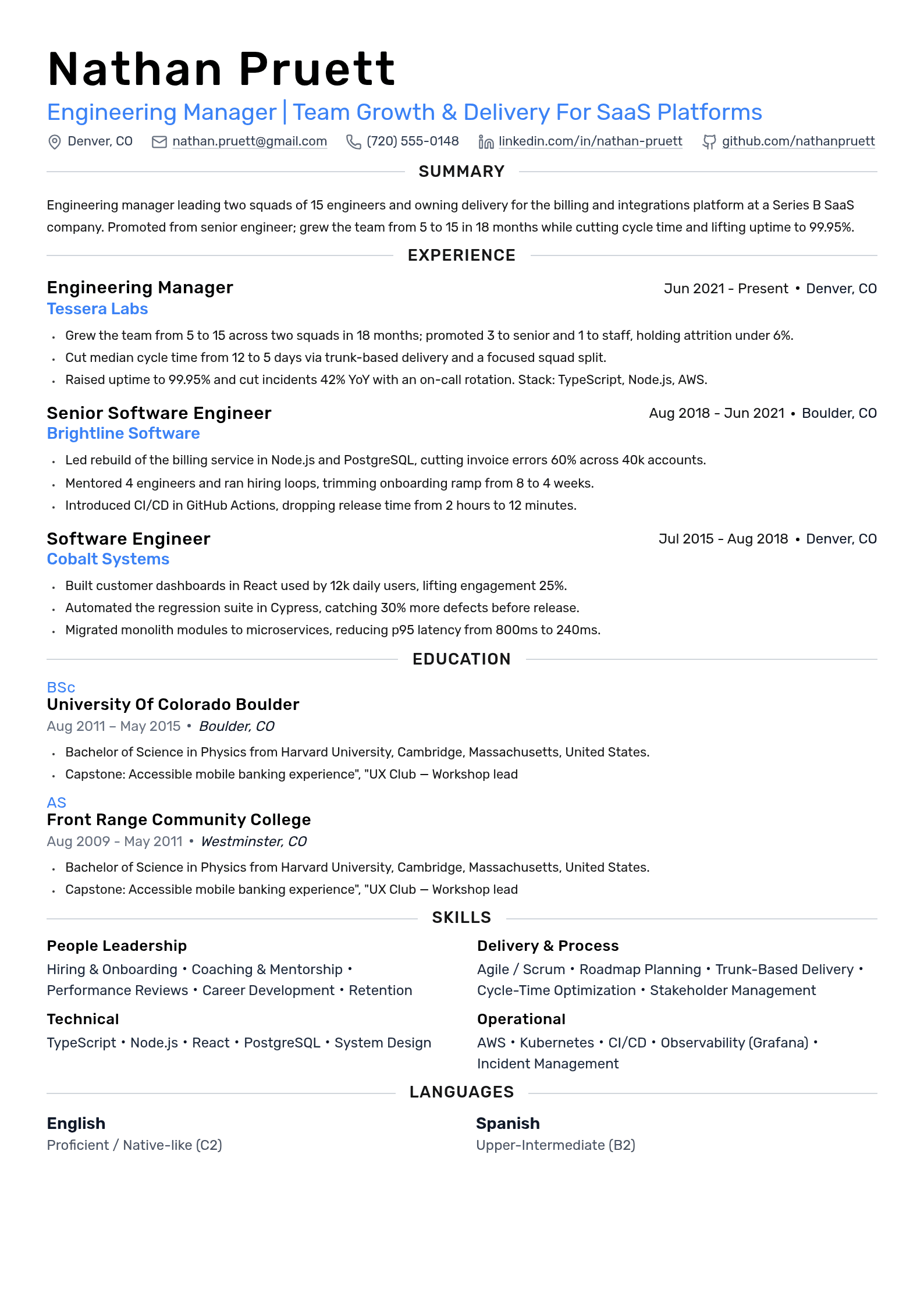
The mistake most engineers-turned-managers make is inverting that order. They lead with the Kubernetes migration and bury "grew the team from 5 to 14" in a fourth bullet. The example below gets the order right.
Engineering manager resume example: startup to scale-up
This example shows a common and highly employable profile: an engineer who became a manager at a startup and scaled with the company. Notice three things as you read it. The summary states team size and scope in the first sentence. The experience bullets alternate between delivery outcomes and people outcomes rather than clustering all the technical work together. And the skills section separates leadership competencies from the technical stack instead of mixing "mentoring" in between "PostgreSQL" and "AWS," which is where applicant tracking system (ATS) keyword matching goes to die.
What to lift from this example directly: the summary structure (scope first, then one delivery win, then one people win), the habit of naming team size in nearly every bullet, and the restrained stack line. What to change: every number. Your metrics have to be yours, because an engineering interview loop will pull on each one, and a figure you can't reconstruct in a debrief conversation is worse than no figure at all.
Adapting the example for an enterprise engineering manager role
The startup-to-scale-up resume above sells range: you did a bit of everything and the company grew around you. An enterprise engineering manager resume sells the opposite. It sells depth of process, scale of coordination, and the ability to operate inside constraints.
If you're targeting large-company roles, shift the emphasis in four places:
- Coordination scope over headcount. "Managed 10 engineers" matters less at enterprise scale than "coordinated delivery across 4 teams and 3 time zones with dependencies on platform and security orgs." Name the number of teams, partner functions, and stakeholders you aligned.
- Process fluency. Enterprise postings ask for things startups never mention: quarterly planning, OKRs, capacity planning, roadmap commitments to external customers, sometimes compliance regimes like SOC 2. If you've done any of it, say so in the posting's own vocabulary.
- Budget and vendor ownership. If you owned a cloud budget, ran a vendor evaluation, or managed contractor spend, that's a bullet. Startup resumes almost never include this, which makes it an easy differentiator.
- Longer time horizons. Enterprise hiring managers are wary of candidates who've only ever shipped in two-week bursts. A bullet about a multi-quarter migration or a year-long platform bet reads as maturity.
The bones of the resume stay the same. Same summary structure, same alternation of delivery and people bullets, same restrained stack line. You're re-weighting, and this is exactly why keeping a base resume and adjusting a copy per application beats rewriting from scratch. If you're applying to both startup and enterprise roles at once, treat them as two tailored versions of one base resume rather than one compromise document that undersells you for both.
Hard skills vs. soft skills: the balance that gets interviews
Read ten engineering manager job descriptions side by side and a pattern jumps out. The people-and-delivery language (coaching, hiring, performance management, agile delivery, stakeholder communication, roadmap ownership) consistently outweighs the deep technical language (system design, architecture reviews, specific stacks). Postings still list a stack, but they list it as context. The requirements that get their own bullet points are the leadership ones.
Your resume should mirror that weighting. My working rule after reading a lot of EM resumes on both sides of the table: aim for roughly a 60/40 split in favor of leadership and delivery content, measured across your bullets, not your skills list. Every technical bullet should carry a team or business outcome; a bullet that's purely "designed and implemented X in Y" belongs on a senior engineer resume, and on an EM resume it quietly signals you haven't let go of the IC (individual contributor) role.
| Category | Keywords postings actually use | Where they belong on your resume |
|---|---|---|
| People management | hiring, coaching, mentoring, performance management, 1:1s, career development, retention | Experience bullets with outcomes (promotions, retention, team growth); a short leadership skills group |
| Delivery & process | agile, sprint planning, roadmap, OKRs, cross-functional, stakeholder management, delivery | Summary and experience bullets; use the posting's exact terms, since ATS filters match strings, not synonyms |
| Technical architecture | system design, architecture, scalability, cloud (AWS/GCP/Azure), microservices, CI/CD | One stack line per role, a compact technical skills group, and technical bullets that end in a business outcome |
| Operational | incident management, on-call, reliability, SLAs, uptime, cost optimization | Experience bullets with numbers; these quantify well and few EM resumes use them |
Two cautions. First, the split is a starting point, and the posting in front of you is the tiebreaker. A platform EM role at an infrastructure company will weight architecture heavier than a delivery EM role at an agency, so count the terms in the actual posting before you decide. Second, don't dump all four categories into one undifferentiated skills list. Recruiters and ATS keyword filters both do better with grouped skills, and the grouping itself demonstrates the judgment the role requires. The deeper logic of balancing the two skill types is covered in our guide to hard skills vs. soft skills on a resume.
How to quantify team growth and delivery metrics
Engineering management is unusually quantifiable, and most EM resumes waste that advantage. "Responsible for team delivery and mentoring" says nothing. The same candidate almost always has real numbers available; they just haven't gone looking. Here's where to look, with the before-and-after pattern for each.

- Team growth: "Built and managed a team" becomes "Grew the team from 6 to 14 engineers over 18 months, including 3 senior hires, while keeping regretted attrition at zero."
- Promotions and development: "Mentored engineers" becomes "Promoted 4 engineers to senior and 1 to staff over two years through structured growth plans and quarterly calibration."
- Delivery cadence: "Improved delivery process" becomes "Cut median cycle time from 12 days to 5 by splitting one 10-person team into two squads with independent deploy pipelines."
- Reliability: "Improved system stability" becomes "Reduced production incidents 40% year over year by introducing an on-call rotation, blameless postmortems, and error budgets."
- Cost: "Managed cloud infrastructure" becomes "Cut cloud spend 25% by leading a right-sizing and reserved-capacity effort across 3 services."
- Hiring efficiency: "Involved in recruiting" becomes "Redesigned the interview loop, cutting time-to-offer from 6 weeks to 3 while raising the onsite pass rate."
Three rules keep these credible. Use ranges or approximations where your memory is honest but imprecise ("roughly halved," "from ~12 to ~5 days"). Attribute correctly: "led," "drove," and "introduced" for things you owned, "contributed to" for shared wins, because an interviewer will probe the boundary. And never invent a number to fill a template. A vague true bullet survives an interview; a precise false one ends it.
Keep each role to a tight set of your strongest bullets rather than an exhaustive log. If you're unsure where to draw the line, our guide on how many bullet points per job gives concrete counts by recency.
Where technical architecture belongs (and where people management does)
The balance question isn't only how much of each. It's where each one lives on the page, and getting the placement wrong is why competent managers get read as ICs.
Summary: both, in one breath. The first sentence should carry scope ("Engineering manager leading 12 engineers across two product squads") and the second should carry one technical anchor and one outcome ("Own architecture direction for a high-traffic payments platform; cut incident volume 40% while doubling release frequency"). A summary that's all leadership reads as fluff; all architecture reads as an IC. Our professional summary guide covers the mechanics.
Experience bullets: leadership verbs, technical nouns. The strongest EM bullets start with a management action and contain a technical object. "Led the migration to event-driven architecture across 3 teams, cutting integration failures by a third." You get the architecture keyword and the leadership signal in one line, which is exactly how the hiring manager thinks about the job.
Skills section: two labeled groups. One for leadership and delivery (people management, agile delivery, roadmap planning, stakeholder communication), one for technical (cloud platform, languages you can still credibly discuss, architecture patterns). Cut any language you couldn't whiteboard about today. A 2015-era PHP entry does nothing for an EM candidacy except invite a question you don't want.
What to leave out. Deep implementation detail ("wrote the caching layer in Redis with a custom eviction policy") belongs in your interview stories, not on the resume. On an EM resume it takes up a line that could have carried a team outcome, and it plants the seed that you're the person who still grabs the interesting tickets.
Using Remi to tighten your executive summary
The summary is where the tech-versus-leadership balance gets decided, and it's the section people rewrite worst on their own. The usual failure is stacking every scope claim into one 60-word sentence that a recruiter's seven-second scan can't parse.
This is a concrete place where Roleframe helps without taking the pen from you. Remi, its career copilot, works inside the editor on the actual document. It reads the analysis report already run on your resume, so when you ask it to tighten the summary it starts from graded findings, like a summary that claims leadership but never states team size, rather than guessing at what's wrong. It proposes a rewrite as a word-by-word diff, and nothing changes until you accept it. On a version tailored to a specific posting, its suggestions are grounded in that job's keywords and your fit report, so a rewrite closes a named gap, like the missing "stakeholder management" term the posting repeats three times, instead of producing generic manager-speak. You approve every word, which matters more for an EM than for most roles: your summary's claims are the first things a VP will pressure-test in the screen.
Moving from developer to manager: import your resume and reframe it
If you're a senior or staff engineer targeting your first EM role, your existing resume is the raw material, and most of the work is reframing rather than rewriting. You almost certainly have management evidence already: you've run an intern program, led a project with three other engineers, owned an on-call rotation, or driven a hiring loop. Right now those live as afterthoughts under technical bullets. The job is to surface them.
The practical workflow: export your current resume as a PDF and import it into Roleframe, where it comes back as editable blocks with roles, dates, and bullets in place, and with an analysis already run so you can see which sections read as pure IC. Then work role by role. Promote every leading, mentoring, and coordinating fragment into its own bullet with a team-size number. Demote implementation detail into the single stack line. Drag your sections into an order that leads with the experience that carries the leadership evidence. The judgment stays yours; the retyping disappears.
Two reframing rules from watching this transition succeed and fail. First, don't inflate: "tech lead for a squad of 4" is a legitimate and attractive stepping-stone claim, and "managed a team" when you had no reports is a claim that dies in the first reference check. Second, keep one flagship technical achievement per role even as you cut the rest, because a first-time EM's technical credibility is doing extra work that an experienced EM's track record would do instead. The broader mechanics of repositioning experience for a new role are covered in our career change resume guide.
Frequently asked questions
- What are the typical responsibilities of an engineering manager?
An engineering manager owns delivery and people for a team, usually 5 to 15 engineers. That covers hiring, 1:1s, performance management and promotions, sprint or roadmap planning, unblocking the team, and representing engineering to product and other stakeholders. Most EMs also keep a hand in technical direction through design reviews, though how much they code varies widely by company. Your resume should show evidence in all three areas: people, delivery, and technical judgment.
- What are the essential skills for an engineering manager resume?
Group them in two labeled sets. Leadership and delivery: people management, hiring, coaching, agile delivery, roadmap planning, stakeholder communication, incident management. Technical: your cloud platform, the languages and architecture patterns you can still credibly discuss, and CI/CD. Weight the page roughly 60/40 toward leadership and delivery, then adjust to the specific posting, since a platform EM role will ask for more architecture than a delivery-focused one.
- Is an engineering manager higher than a tech lead?
Usually yes in org-chart terms: an EM has direct reports and owns performance management, while a tech lead guides technical direction without formal people authority. At many companies they're peers on parallel tracks rather than a hierarchy, and a staff engineer can out-level an EM. On a resume, be precise about which you were. "Tech lead for a squad of 4" is a strong, honest claim for a first EM application; calling it management when you had no reports is a claim that collapses under reference checks.
- Should an engineering manager resume be one page or two?
Two pages is normal and expected once you have management experience, because you're documenting both delivery outcomes and people outcomes across multiple roles. One page starts cutting evidence you need. Keep older IC roles to two or three lines and spend the space on your management years. Our guide on one page vs. two breaks this down by experience level.
- Should I still list programming languages on an engineering manager resume?
Yes, but briefly and honestly. One compact technical group in your skills section and one stack line per role is enough to establish credibility. List only what you could discuss in a system design conversation today. A long language inventory reads as an IC resume and invites interview questions about tools you haven't touched in years.
- How far back should an engineering manager resume go?
Cover your management roles fully and compress everything before them. Your pre-management engineering years earn a short entry each, enough to show technical foundation and progression, and roles older than about 15 years can usually be summarized or dropped. See our guide on how far back a resume should go for the exceptions.
- Should I submit my engineering manager resume as a PDF or a Word document?
PDF, always, unless a specific employer explicitly demands otherwise. PDF preserves your formatting exactly across every ATS and every recruiter's screen, which matters when your layout separates leadership skills from technical skills on purpose. A well-structured PDF with standard section headings parses cleanly in modern ATS software.


Ready when you are
Send the tailored resume, not the generic one.
Paste a job posting and Roleframe scores your resume against it, then helps you close the gaps one approved edit at a time, so you apply while the role is still fresh.