Dental Hygienist Resume Example: Licensure, Clinical Work and Accurate Evidence
by Larbi SahliLast Updated
A fictional dental hygienist resume with guidance on license status, state-specific permissions, supervised training and responsible use of practice metrics.
Users have landed jobs at
- 1Password
- OpenAI
- Notion
- justworks
On this page
A dental hygienist resume should make your qualification status, clinical responsibilities and practice experience clear. Use accurate license and training details, then explain the work you performed within the relevant scope and supervision requirements.
This guide includes a fictional example, a credential checklist and ways to describe experience without treating production targets or treatment counts as proof of clinical quality.
Make eligibility and relevant experience easy to check
BLS states that all U.S. states require dental hygienists to be licensed, with requirements varying by state. Duties and supervision also depend on jurisdiction and setting. Check the applicable dental board rather than assuming a credential from another state automatically permits practice.
For the resume, identify the relevant license and verified status, any additional authorization you actually hold, and the practice work you can support. For a coverage role, accurate availability may also help. No universal rule says these are the only factors an employer considers or requires a particular section order.
A fictional general-practice hygienist resume
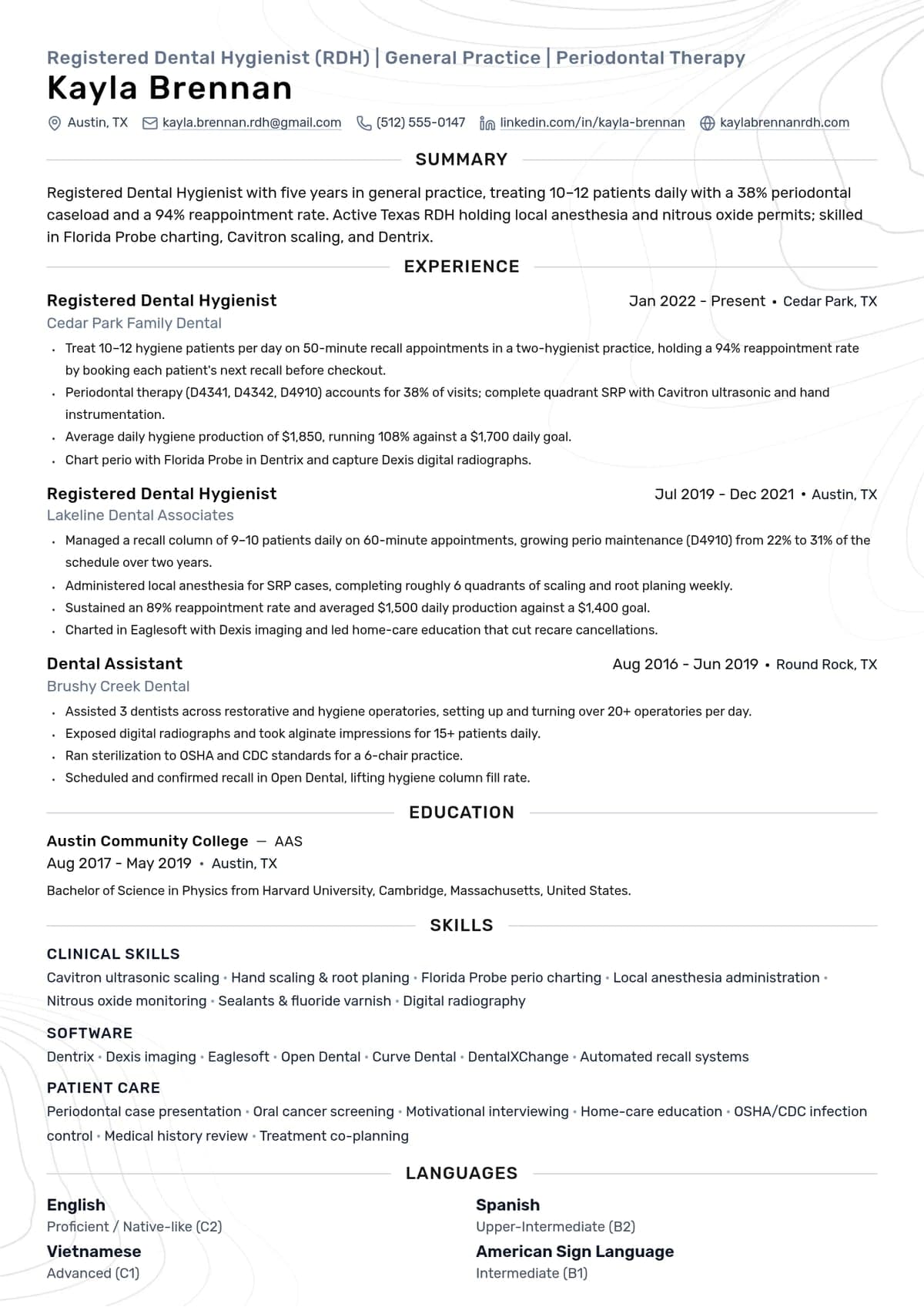
Kayla Brennan, her workplaces, school, projects and recognition below are fictional teaching details. The timeline shows a dental-assisting role before hygiene work beginning in 2019. The license entry is a placeholder to replace with verified information, not a real license or an attestation of eligibility.
The example describes documentation, assigned hygiene care and patient education without invented production, reappointment or treatment-acceptance figures. Replace all details before use. Visual skill ratings do not establish competence or authorization.

Dental Hygienist | General Practice and Patient Education
Kayla Brennan
Summary
Dental hygienist with experience since 2019 in general-practice settings. Documents assigned care, supports periodontal charting and explains home-care instructions within the applicable scope and supervision arrangements. Uses Dentrix and Eaglesoft workflows; verified license details must replace the placeholder below.
Experience
Registered Dental Hygienist
Provided assigned hygiene care within the practice’s authorized scope and supervision arrangements, recording care and follow-up in Dentrix.
Recorded periodontal measurements with the practice’s charting workflow and referred findings for the required clinical review.
Explained agreed home-care instructions and documented questions requiring follow-up from the treating clinician.
Coordinated appointment handoffs with the front desk without claiming that booking rates proved clinical quality.
Registered Dental Hygienist
Maintained hygiene records in Eaglesoft and checked that assigned documentation was complete before handoff.
Provided authorized hygiene care under the required supervision and documented changes needing clinician review.
Supported patient education and follow-up coordination, distinguishing observed behaviour from measured outcomes.
Dental Assistant
Prepared operatories and supplies for assigned procedures within the dental-assistant role.
Supported instrument-processing records and room-turnover checks under the practice’s approved procedures.
Assisted appointment confirmation and administrative handoffs in Open Dental.
Education
Riverbend College (fictional)
AAS
Fictional education example; no actual accreditation, board-exam result or license eligibility is asserted.
Skills
Clinical Skills
Software
Patient Care
Languages
Projects
Documentation handoff checklist
Process contributor
Created a checklist for missing chart entries and follow-up questions and reviewed it with colleagues. No treatment-acceptance increase or patient outcome is claimed.
Community oral-health education event (fictional)
Volunteer education support
Helped distribute approved oral-health education materials and directed attendee questions to the appropriate clinical staff. No treatment count or connection to a real charity is claimed.
LICENSE DETAILS TO COMPLETE
Your dental hygiene license — verify before use
Your actual state licensing boardReplace with your actual jurisdiction, license designation and verified current status. Provide the number through the application’s requested channel. This is a placeholder, not a valid license.
Awards
Internal documentation recognition
Cedar General Dental (fictional)
Illustrative recognition for clear handoffs; not a verified production or clinical-quality award.
A license block that separates status from training
Use current information from the issuing board and your own records. A useful pattern is “Dental hygiene license — [jurisdiction and issuing board]; [verified status]; [renewal or expiry information if applicable].” Provide a license number when the application requests it, using an appropriate channel. You do not need to place every identifying detail on a publicly shared resume.
List additional authorizations separately from courses. If an application is pending, say what is pending without implying approval or permission to practise. Exam completion and a submitted application are not the same as an issued license.
State the exact examination or course you completed when relevant. Do not use invented license numbers or dates from a sample. There is no universal requirement to list every historical exam or omit its year after a fixed number of years.
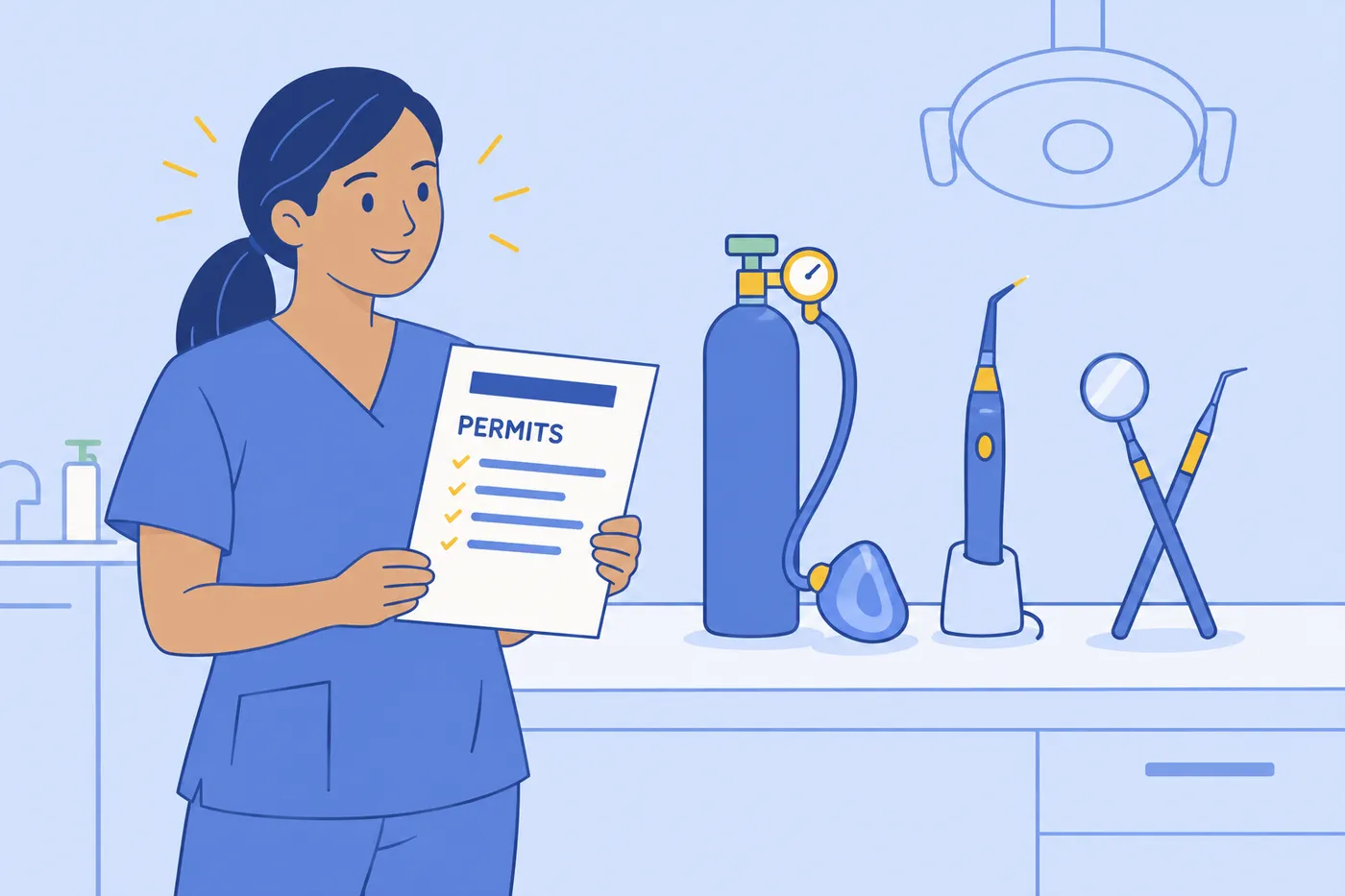
Check the exact state authorization and supervision rules
Use the regulator’s wording for any additional authorization. For example, the Texas dental board’s local infiltration anesthesia guidance requires a current certificate and direct supervision by a licensed dentist. It does not support a blanket claim that a hygienist can administer any anesthesia independently.
Check current requirements for the jurisdiction and task, including any supervision conditions. A course title or employer preference does not by itself establish permission. The following table is a verification checklist, not a national permit list.
| Area | Check before describing it | Resume wording |
|---|---|---|
| Local anesthesia | Exact authorized technique, current status and supervision requirements | Use the regulator’s actual designation; do not broaden it. |
| Nitrous-related work | Whether the task is administration, monitoring or assistance and what rules apply | State only the permitted task actually performed. |
| Expanded functions | Applicable jurisdiction, training and authorization | Keep duties and qualifications distinct. |
| Laser training | What was taught and what the regulator permits | A course certificate alone does not establish independent practice authority. |
Keep completed training and current authorization separate. Do not describe expired or pending status as active. For a qualification in another jurisdiction, identify that jurisdiction clearly and verify the steps needed for the intended role.
Use practice metrics only when they are appropriate evidence
Clinical experience does not need a production figure to be useful. Describe assessment or care tasks within your scope, documentation, education and coordination. Treatment volume or revenue alone cannot establish the appropriateness or quality of care.
If a permitted, relevant metric is available, use an authorized aggregate report and understand its definitions. Do not download or copy patient-level day sheets into a job application, public resume or AI tool.
- Workload: distinguish patients, visits and procedures, and state the period and your actual contribution.
- Case mix: describe relevant experience without treating a higher procedure-code share as proof of better diagnosis or care.
- Production: distinguish charges, collections and other accounting measures; check attribution and disclosure permission.
- Scheduling: define the population and time window for a booking measure. Rebooking is not proof of improved oral health or communication quality.
Fictional source facts: the hygienist documented care in Dentrix, explained agreed home-care instructions and routed outstanding questions to the clinician. A faithful bullet is “Documented assigned hygiene care in Dentrix and coordinated follow-up on patient questions.” These facts do not support a claim that treatment acceptance or production increased.
If a numerical result is supported, use the actual calculation and explain its limits. “Approximately,” a range or “above goal” still needs evidence and permission. An individual average can reveal confidential practice information; it is not automatically safe to share because it omits patient names.
Describe clinical and software experience accurately
Name the systems and equipment you actually used and the relevant task. Familiarity may reduce some learning needs, but it does not prove that a new practice can skip onboarding or competency checks.
- Practice-management software: explain the charting or scheduling workflow used.
- Imaging: describe tasks performed within your authorization, without implying independent interpretation beyond your scope.
- Periodontal charting: identify the workflow or equipment actually used and the required review process.
- Instrumentation: state relevant experience and training without claiming every device or technique in the vacancy.
Describe patient education and team communication through real work. A language level does not automatically establish qualification to provide clinical interpretation. Keep privacy and access requirements in mind when choosing examples.
The dental assistant guide covers a related but different role. Do not transfer a hygienist’s duties or qualifications to an assisting role without checking its own requirements.
Make part-time and temporary work easy to follow
Use accurate dates and label temporary or part-time assignments. You may group short assignments under an agency or use separate entries when that better explains the work. Avoid implying that sequential assignments were simultaneous or that every practice used the same systems.
A useful template is “Dental hygienist — temporary assignments through [actual agency], [dates],” followed by the settings and tasks you can support. For ongoing part-time roles, give the real employer and dates. State availability when requested or useful, and keep it accurate across applications.
Describe adaptation through concrete work, such as learning an office’s charting workflow and confirming handoff procedures. Do not claim “no onboarding needed” or comparative production without evidence. The tailoring guide explains how to keep consistent source facts.
For new graduates, label supervised clinical preparation
A new graduate can explain education, supervised clinical experience and verified licensing progress. You do not need to manufacture private-practice production figures or assume graduation has already granted a license.
- Licensing status: identify an issued license or precisely describe an application still pending; do not imply permission to practise from exam completion alone.
- Education: give the actual programme and graduation date. Verify any accreditation statement for the programme and relevant period.
- Clinical preparation: label student clinic work and rotations as supervised training, with hours or activities only when documented.
- Skills: distinguish observation, supervised practice and independent authorized work, including actual software used.
Use relevant learning and completed tasks as evidence. A programme clinic is not automatically paid employment, and recent graduation does not prove superior knowledge to an experienced clinician.
The graduate-summary guide can help frame preparation without overstating it. A short summary is optional; it does not need a production number.
Check qualification records and the final application
Compare your resume with current board and credential records. Resolve discrepancies through the appropriate application or verification process. Keep sensitive identity, medical and employment documents in the secure channels the employer actually requires rather than adding them to the public resume.
Confirm the role’s licensing, additional authorization and onboarding requirements directly. This guide does not establish that every practice uses the same background, insurance or health-document checks, or promise how quickly an application will clear.
Use a file format the employer accepts. Inspect text, dates, qualification status and any portal preview. Neither PDF nor a single-column layout guarantees successful parsing in every system.
Frequently asked questions
- What should a dental hygienist resume include?
Verified licensing information, relevant experience or supervised preparation, actual skills and education. Include additional authorizations only when held and correctly described. Production numbers and a fixed section order are not compulsory.
- How should I list my license?
State the actual jurisdiction, board, designation and verified status. Add renewal details where relevant and provide the number through the channel requested by the application. Do not use the sample’s placeholder as a real credential.
- How should I compare RDH and RN pay?
Compare current offers for the same location and hours, including guaranteed hours, benefits, paid leave and any variable pay. An hourly figure cannot by itself establish annual earnings or a long-term career ceiling. This guide does not rank the two occupations’ pay.
- How can I demonstrate professional qualities?
Describe actual documentation, patient education, collaboration and follow-up. A license, production target or rebooking rate alone does not prove every aspect of competence or communication.
- Should I include production figures?
Only when relevant, reliable and permitted to disclose. Personal averages and percentages can still be confidential. Revenue or procedure volume is not proof of appropriate care; clear non-numerical work examples are valid.
- How do I apply without employment experience?
Describe your actual education, supervised clinic work and licensing status. Label training accurately, include documented hours when useful and avoid claiming a license while an application is pending.
- Should I send PDF or Word?
Use an accepted format and inspect the export and portal fields. Neither guarantees identical rendering or correct parsing in every system.
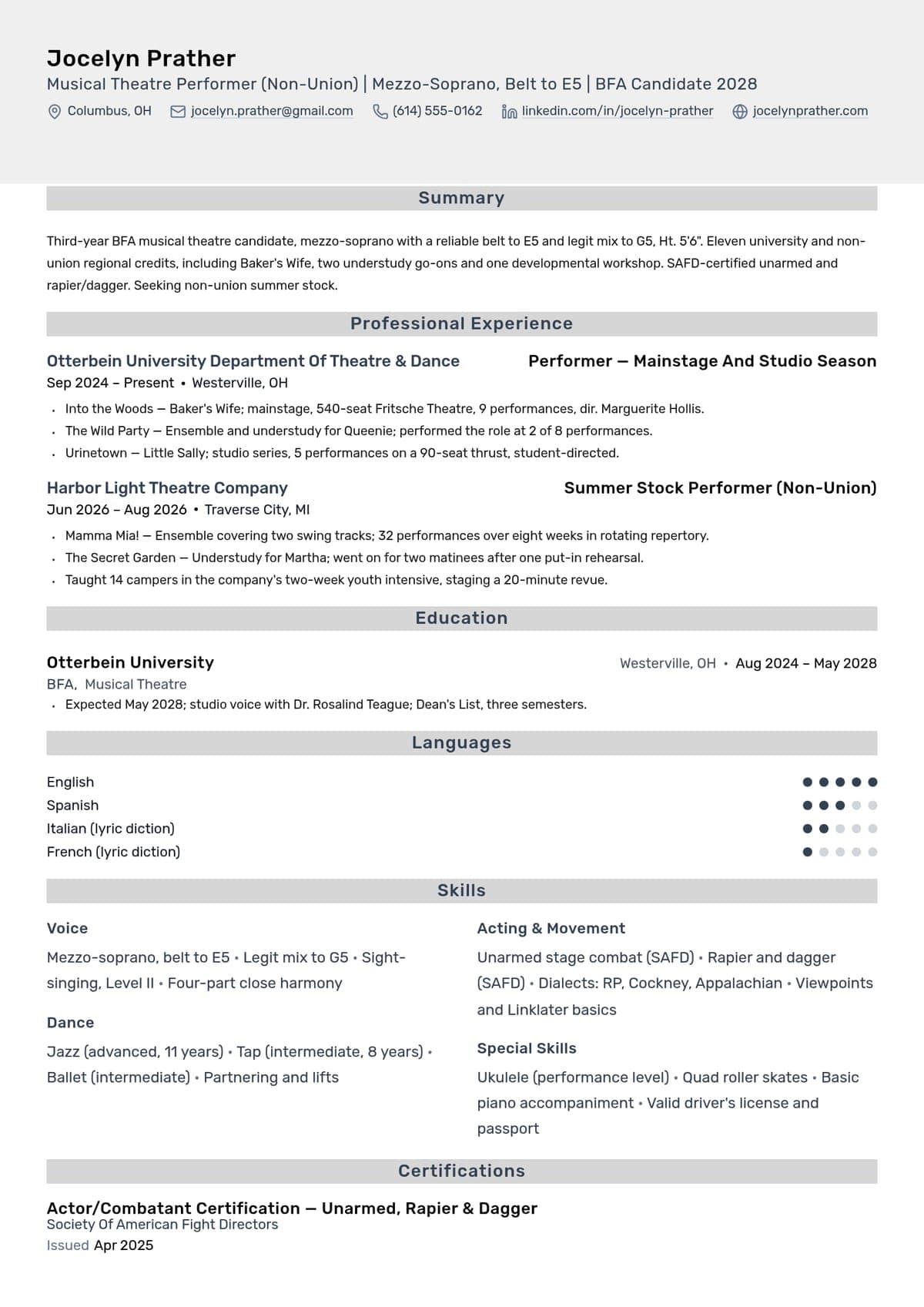

Build yours on the same template.
Every example here is built on a template you can open in the editor. Start from the same layout and write your own experience into it, then download the PDF free, as often as you like.


