Chief Information Officer Resume Example With Real Scope
by Larbi SahliLast Updated
A chief information officer resume example with budget, headcount, sites, and uptime in every bullet, plus how to compress five IT titles into two pages.
Users have landed jobs at
- 1Password
- OpenAI
- Notion
- justworks
On this page
A chief information officer is hired on scope. The CEO, the board, and the search firm want to know what you have actually run: how much money, how many people, how many sites, and what happened to risk and reliability while it was yours. Most CIO resumes answer with adjectives. "Visionary technology executive driving digital transformation" tells a search committee nothing it can verify, and search committees are in the verification business.
The example on this page takes the opposite approach. Every bullet carries a figure someone could check in a budget review: operating and capital budget owned, users supported, sites covered, vendor contracts held, availability delivered. That is the entire method, and it solves the problem that sinks most senior IT executive resumes, which is that they describe the office of the CIO rather than the record of one specific person.
There is a second problem specific to this title. A CIO usually arrives with four or five escalating IT titles behind them plus a decade of hands-on work at the start. Two pages cannot hold all of it at equal depth, so the hard editorial call is what gets full bullets, what gets one line, and what gets cut. This page walks through that call section by section, using the example below as the exhibit.
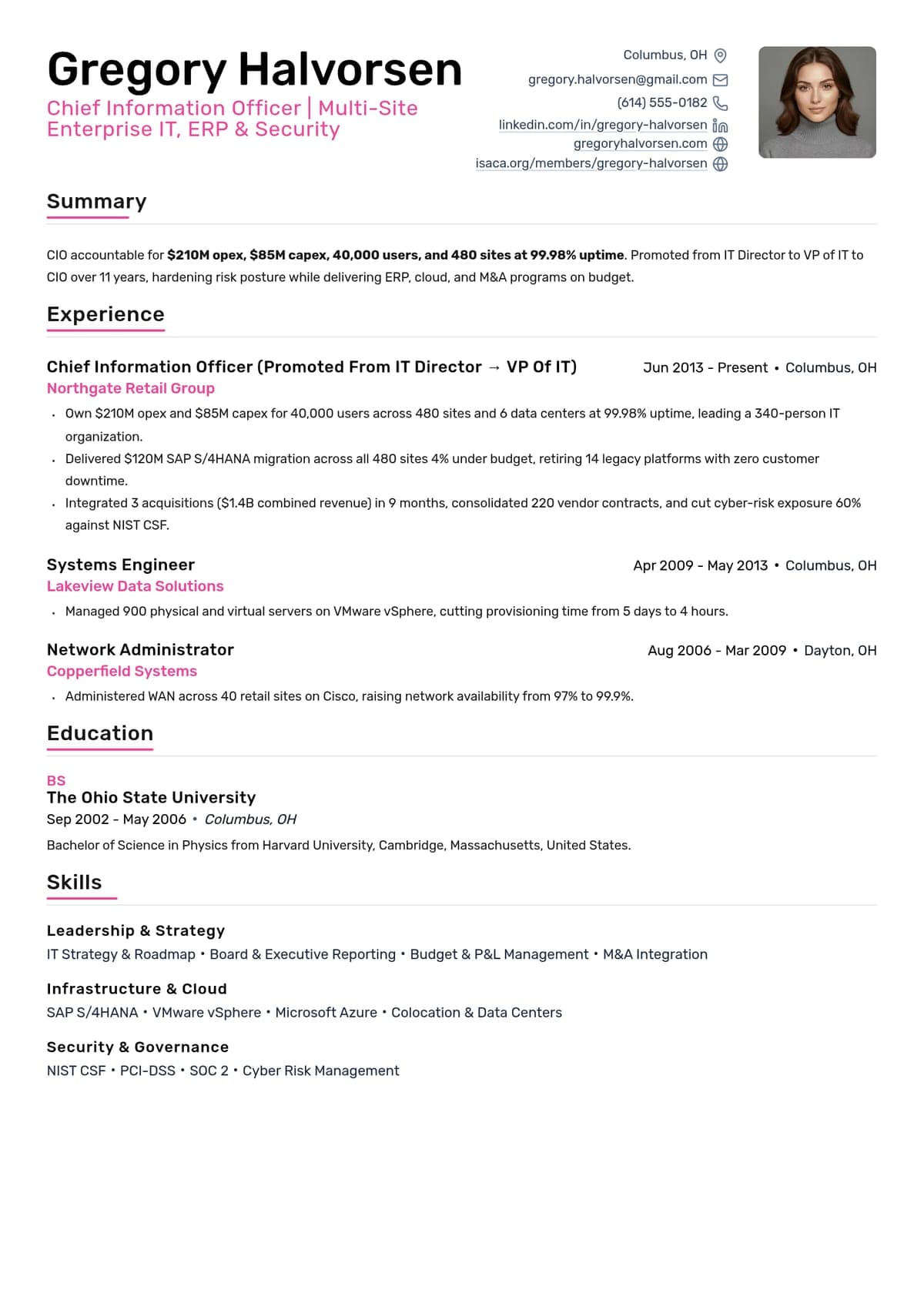
Gregory Halvorsen
Chief Information Officer | Multi-Site Enterprise IT, ERP & Security

Summary
CIO accountable for $210M opex, $85M capex, 40,000 users, and 480 sites at 99.98% uptime. Promoted from IT Director to VP of IT to CIO over 11 years, hardening risk posture while delivering ERP, cloud, and M&A programs on budget.
Experience
Chief Information Officer (promoted from IT Director → VP of IT)
Own $210M opex and $85M capex for 40,000 users across 480 sites and 6 data centers at 99.98% uptime, leading a 340-person IT organization.
Delivered $120M SAP S/4HANA migration across all 480 sites 4% under budget, retiring 14 legacy platforms with zero customer downtime.
Integrated 3 acquisitions ($1.4B combined revenue) in 9 months, consolidated 220 vendor contracts, and cut cyber-risk exposure 60% against NIST CSF.
Systems Engineer
Managed 900 physical and virtual servers on VMware vSphere, cutting provisioning time from 5 days to 4 hours.
Network Administrator
Administered WAN across 40 retail sites on Cisco, raising network availability from 97% to 99.9%.
Education
BS
The Ohio State University
Bachelor of Science in Physics from Harvard University, Cambridge, Massachusetts, United States.
Skills
Leadership & Strategy
Infrastructure & Cloud
Security & Governance
Projects
Cloud Repatriation Program
Executive Sponsor
https://github.com/username/project
Moved analytics and batch workloads from public cloud to a two-site colocation, cutting annual run cost $6.8M and improving batch completion times 35%.
Certifications
Certified Information Security Manager (CISM)
Validated foundational knowledge of AWS cloud concepts, security, and billing.
Certified in the Governance of Enterprise IT (CGEIT)
Validated foundational knowledge of AWS cloud concepts, security, and billing.
Project Management Professional (PMP)
Validated foundational knowledge of AWS cloud concepts, security, and billing.
Awards
CIO of the Year, Central Ohio
Columbus Technology Council
Recognized for building a cloud-native AI productivity tool.
Languages
CIO or CTO on the resume, and how that choice changes what you list first
Decide which chair you are applying for before you write a word, because the two resumes lead with different evidence. A chief information officer runs the technology the business operates on: enterprise systems, infrastructure, security, data, and the support organization. A chief technology officer builds the technology the business sells. Plenty of executives have done both jobs, and plenty of mid-market companies blur them, but the resume cannot blur them. It has to argue for one.
If the target is CIO, your first page leads with enterprise scope: budget, users, sites, the ERP estate, the security posture, and the vendor portfolio. Product engineering work you did earlier in your career becomes context, not headline. If the target is CTO, the order flips: product platform, engineering headcount, architecture decisions, and release velocity come first, and the internal IT scope shrinks to a line.
Do not hedge with "CIO/CTO" in your header or summary. It reads as uncertainty about your own level, and it forces the reader to do the positioning work you should have done. If you are running both scopes at a smaller company, pick the title the target job uses and let the bullets show the breadth. The same logic applies at the COO boundary; if your remit includes operations beyond technology, compare against a COO resume example before deciding which document to build.
An opening built on budget, users, sites, and risk posture
The summary is four lines, and each line should survive an audit. Here is the shape that fails, and you have read it a hundred times:
"Strategic, results-driven technology executive with 20+ years of experience leading digital transformation initiatives and building high-performing teams in dynamic environments."
Nothing in that sentence distinguishes its author from ten thousand other applicants, because nothing in it is checkable. Now the shape that works:
"CIO for a $2B manufacturer: $46M opex, $15M annual capex, 220-person organization supporting 40,000 users across 58 sites in 9 countries. Took the company through an 18-month ERP consolidation, an ISO 27001 certification with zero major nonconformities, and three acquisition integrations. Tier-1 system availability above 99.9% for four consecutive years."
Same length, completely different effect. A search partner reading the second version can size you in ten seconds: this person operates at the scale we need, in an environment as complex as ours, with a risk posture our audit committee will recognize. Adjectives ask for trust; figures earn it. If your current summary is closer to the first version, rebuild it using the structure in our guide to writing a professional summary, then strip every adjective that a number could replace.
One calibration note. Round your figures honestly and be ready to defend each one in the first interview, because a good search firm will probe them. "$46M opex" invites the question "what was in it," and you want to enjoy answering.
IT Director to VP of IT to CIO at one company, kept as a single entry
Internal promotion to CIO is common and it is an asset, so format it as one. Three separate employer entries for the same company make an applicant tracking system (ATS) and a skimming human both read you as a job hopper with short tenures. Stack the titles under a single employer header instead: company name and total date range once, then each title with its own dates and its own bullets beneath it.
This does two things. The parser and the recruiter both see one long tenure, which at the executive level signals that a board kept choosing you. And the promotion velocity becomes visible as a story: the reader watches your scope figures grow from title to title, from a $6M infrastructure budget as director to the full technology P&L as CIO. That growth curve is an argument no adjective can make.
Keep the scope figures distinct per title. If your CIO bullets and your VP of IT bullets claim the same budget and the same headcount, the promotion looks cosmetic. Show what changed: security and data moved under you, capex authority doubled, the board reporting line became direct. The delta is the point.
Which of your five IT roles to expand and which to cut to one line
A typical CIO career reads something like: helpdesk or sysadmin, systems engineer, IT manager, IT director, VP of IT, CIO. All six shaped you. At most three belong on the resume with bullets. Here is the allocation that works on two pages:

- Current CIO role: 6 to 8 bullets, every one carrying a scope figure. This is where the reader decides.
- VP of IT and director years: 3 to 4 bullets each, focused on the programs and the scope growth that justified the next promotion.
- IT manager and earlier, within roughly the last 15 years: one line each, title, company, dates, and a single clause of scope. "IT Manager, Meridian Logistics, 2009 to 2012. Ran infrastructure and support for 1,200 users across 6 distribution centers."
- Anything older than about 15 years, or purely hands-on roles: either a single "Earlier career" line naming the titles, or cut entirely.
The instinct to keep everything is the instinct that produces four-page executive resumes nobody reads. The general rules on how far back a resume should go and how many bullets each job deserves apply with extra force here, because your competition for a CIO seat is other people with equally long histories who made the cut cleanly. A tight two pages reads as an executive who knows what matters. A crowded four reads as someone who could not decide, and deciding is the job.
Scope lines: the six figures that belong on a CIO resume
Scope is the currency of an executive resume, and it comes in six denominations. The table below shows each one, how to write it, and what it tells the reader. Not every bullet needs all six, but every role header should establish the first three, and no bullet should be scope-free.
| Scope figure | How to write it | What it signals |
|---|---|---|
| Opex and capex owned | "Owned $46M opex and $15M annual capex" | You have sat in the P&L conversation as a peer of the CFO, not a cost center manager. |
| Headcount and structure | "Led a 220-person org through 6 directs: infrastructure, apps, security, data, support, PMO" | Organizational scale, span of control, and that you have built a leadership bench. |
| Users and sites | "Supported 40,000 users across 58 sites in 9 countries" | Complexity of the environment, which matters more than raw size. 58 sites is a harder job than one campus of the same headcount. |
| Vendor portfolio | "Managed a $28M vendor portfolio across 40+ contracts; renegotiated the top 10 for double-digit savings" | Commercial judgment. At CIO level, vendor management is a bigger lever than most technical decisions. |
| Availability and reliability | "Held tier-1 availability above 99.9% for four consecutive years" | The baseline job done. Boards forgive slow projects faster than they forgive outages. |
| Risk posture | "Took the company from no security framework to ISO 27001 certification, zero major nonconformities" | Security is governed and auditable under you, not improvised. |
Two cautions. First, precision beats inflation: "$46M" is stronger than "multi-million dollar" and safer than a rounded-up "$50M+" that a reference check contradicts. Second, if a figure is genuinely confidential, use a defensible range or a relative measure, "a nine-figure technology budget" or "cut infrastructure run-rate 22%", rather than omitting scope entirely. A resume with no numbers reads as a resume with nothing to count.
Program bullets that hold up: ERP migration, cloud exit, M&A integration
Every CIO resume claims an ERP program, a cloud move, and usually an acquisition or two. The claims all sound identical until you look at how they are written. The difference between a bullet that survives a search committee and one that dies there is whether it describes an activity or a scope. Here is the same ERP migration written both ways.
Before, the activity line:
"Led the enterprise ERP migration program, coordinating cross-functional stakeholders and managing vendor relationships to ensure a successful and on-time implementation."
After, the scope line:
"Migrated 9 plants and 40,000 users from three legacy ERPs to SAP S/4HANA in 20 months on an $18M capex budget, retiring 11 satellite systems and cutting month-end close from 9 days to 4."
Read the before line again and notice who could have written it: a project coordinator, a PMO analyst, a vendor account manager. It contains no evidence of executive ownership at all. The after line could only have been written by the person accountable for the whole program, because it names the four things only that person owns: the scale (9 plants, 40,000 users, three source systems), the money ($18M capex), the clock (20 months), and a business outcome the CFO cares about (close time cut nearly in half). That four-part pattern, scale plus money plus time plus one business outcome, is the template for every flagship bullet on the page.
The same pattern applied to the other two programs every CIO gets asked about:
- Cloud exit or repatriation: "Moved the analytics and batch workload from public cloud to a two-site colocation footprint over 11 months, cutting run-rate infrastructure cost 30% with no change to processing SLAs." Scale, time, money, and the outcome that matters, which is that nothing broke.
- M&A integration: "Integrated three acquisitions totaling 6,500 users onto corporate identity, network, and ERP within 120 days of each close, consolidating 4 duplicate application stacks." The 120-day figure is the whole bullet; integration speed is what an acquisitive board is buying.
- Cost or contract programs: "Renegotiated the telecom and software estate across 40 contracts, taking $4.2M out of annual run-rate while extending coverage to 12 new sites." Money out plus scope in, in one line.
One discipline while you write these: strip the verbs that describe involvement rather than ownership. "Supported," "participated in," "helped drive," and "was responsible for" all concede the bullet to whoever actually ran the program. Our list of action verbs sorted by what they prove is built for exactly this pass.
Security and compliance evidence a board can audit
Security is the topic a board interview will spend the most time on, so the resume needs auditable evidence rather than assurance. "Strengthened the security posture" is assurance. Evidence looks like this:

- Certifications achieved on your watch, with the standard named: SOC 2 Type II, ISO 27001, PCI DSS, alignment to the NIST Cybersecurity Framework. Name the framework exactly; the reader may be screening for the acronym.
- Audit results: "Closed 34 open audit findings in the first year, held zero repeat findings across the next three external audits." Findings closed, and how fast, is the single most credible security metric a CIO can put on paper.
- Program build-out: stood up a security operations capability, hired the first CISO, took the board through its first tabletop exercise, brought cyber insurance through renewal without exclusions.
- Measurable behavior change where you have it: phishing simulation failure rates trending down, patch latency on critical CVEs cut from weeks to days, MFA coverage taken to the full user base.
One thing to avoid: the claim of "zero breaches" across a career. It is unverifiable, it invites the interview question of how you would know, and to a sophisticated audit committee it reads as naive rather than impressive. Write what an auditor signed. That is the standard of proof the room you are trying to enter actually uses.
Keeping the hands-on years without reading as a systems administrator
Your decade in the server room is a genuine asset. It is why you can call a vendor's bluff, size a migration estimate, and know what a platform decision does to the on-call rotation. The mistake is presenting that asset the way a practitioner would, with a skills section full of tools. A CIO resume listing PowerShell, VMware, and Cisco IOS reads as a systems administrator resume with an inflated title, and search firms discount it accordingly.
Keep the hands-on years in three controlled ways. First, the one-line early roles from the allocation above; the titles themselves establish that you came up through the stack. Second, let technical fluency show inside executive bullets rather than beside them: "chose to consolidate on a single hypervisor estate, cutting licensing 18%" demonstrates the depth without a tool list. Third, keep the skills section at the governance altitude: IT strategy and operating models, ERP program leadership, security and risk governance, vendor and contract management, M&A technology integration, board and audit committee reporting. Frameworks like ITIL or TOGAF can appear if a posting asks; individual tools should not.
The test for any line on the page: could this sentence appear on the resume of someone two levels below you? If yes, either raise it to the decision you made and the outcome you owned, or cut it.
Format, length, and getting past the first screen
Two pages is the right length for a CIO resume, and the general evidence on one page versus two supports going to two at this level of experience. Executive search partners read long documents for a living; what they punish is not length but noise. Single column, standard section headers, no headshot, no charts, no skill bars. Save and send it as a PDF so the layout you approved is the layout that arrives.
Yes, ATS screening still applies to you. Corporate CIO postings run through the same applicant tracking systems as everything else, and retained search firms keep keyword-searchable candidate databases of their own, so the exact phrases matter: "ERP," the specific platform, "P&L," "ISO 27001," "M&A integration," "IT governance." Before you send a version, check the resume against the specific job description rather than guessing which terms the posting weighs. This is what Roleframe's fit report does: duplicate your base resume for the posting, and it returns an ATS score, the exact keywords the posting asks for that your document is missing, and a prioritized plan, after which you make each edit yourself with Remi, its career copilot, proposing rewrites you approve line by line. For an executive resume that discipline is not optional. Every figure on the page has to be yours, because every figure will be probed.
Frequently asked questions
- How long should a chief information officer resume be?
Two pages. One page cannot hold a credible executive record, and three or more signals that you could not prioritize. Get there by giving your CIO and VP years full bullets, your director years a few, and everything older one line each. Executive recruiters read two-page documents comfortably; what they skip is padding.
- Do I need different resumes for CIO and CTO postings?
Yes, if you are pursuing both. The evidence order is different: a CIO resume leads with budget, users, sites, and risk posture, while a CTO resume leads with product platform, engineering organization, and architecture decisions. Keep one base resume and spin a tailored version per target rather than maintaining a hedged hybrid, which serves neither search.
- What if my budget and headcount figures are confidential?
Use defensible ranges and relative measures rather than omitting scope. "An eight-figure technology budget," "cut infrastructure run-rate 22%," and "a 200+ person organization" all convey scale without publishing a number your employer would object to. A resume with no scope figures at all is a bigger problem than an approximate one, because the reader has nothing to size you with.
- Do executive recruiters use ATS software for CIO searches?
Corporate postings for CIO roles run through the company's applicant tracking system like any other requisition, and retained search firms maintain their own keyword-searchable candidate databases. Either way, the exact terms matter: the ERP platform by name, the frameworks (ISO 27001, NIST), "P&L," "M&A integration." Pull the phrasing from each posting rather than assuming a human reads you first.
- I'm a VP of IT applying for my first CIO role. How do I position the resume?
Prove you already run CIO scope without the title. Lead the summary with the enterprise figures a CIO would claim: budget owned, users and sites supported, the board or audit committee exposure you have had, the flagship program you delivered end to end. Where your CIO left strategy to you or you presented to the board directly, say so in a bullet. Search committees promote scope, not titles.
- Should a CIO resume include certifications or an MBA?
Include an MBA or an executive program in education; boards notice them. Certifications are situational: CISSP or CISM helps if the role has a heavy security remit, and ITIL or TOGAF can matter where a posting names them. Skip practitioner-level certificates from early in your career, since a vendor associate certification on a CIO resume works against the seniority you are arguing for.
- How much of my early hands-on IT experience should stay on the resume?
Keep the titles, cut the detail. Early sysadmin or engineer roles earn one line each within roughly the last 15 years, and a single "earlier career" line beyond that. The titles establish that you came up through the stack; the fluency itself should show in how your executive bullets handle technical decisions, not in a list of tools.


Ready when you are
Send the tailored resume, not the generic one.
Paste a job posting and Roleframe scores your resume against it, then helps you close the gaps one approved edit at a time, so you apply while the role is still fresh.