
Entry-Level Software Engineer Cover Letter Example (That Actually Works)
A complete entry-level software engineer cover letter example, plus how to pitch bootcamp projects, GitHub work, and no commercial experience with confidence.


On this page
The Entry-Level Dilemma: Proving You Can Code Without Professional Experience
You can code. You just can't point to a job title that proves it yet. That's the entire problem with an entry-level software engineer cover letter, and it's why generic "I'm passionate about technology" openers fall flat.
Here's what actually moves the needle. When you read enough entry-level job descriptions, a pattern shows up fast: employers ask for evidence you can ship working code, not a declaration that you love it. They list specific languages, frameworks, and outcomes. They want to see that you've built something real and can talk about what it did.
So the winning move is to treat your cover letter like a short case study. Lead with a concrete project result, name the exact stack from the posting, and connect one or two experiences that prove you can do the job. Passion is fine as seasoning. Proof is the meal.
Everything below follows that logic. You get a full example you can adapt, then the specific tactics for bootcamp projects, non-tech backgrounds, and the dreaded "no commercial experience" gap.
Entry-Level Software Engineer Cover Letter Example
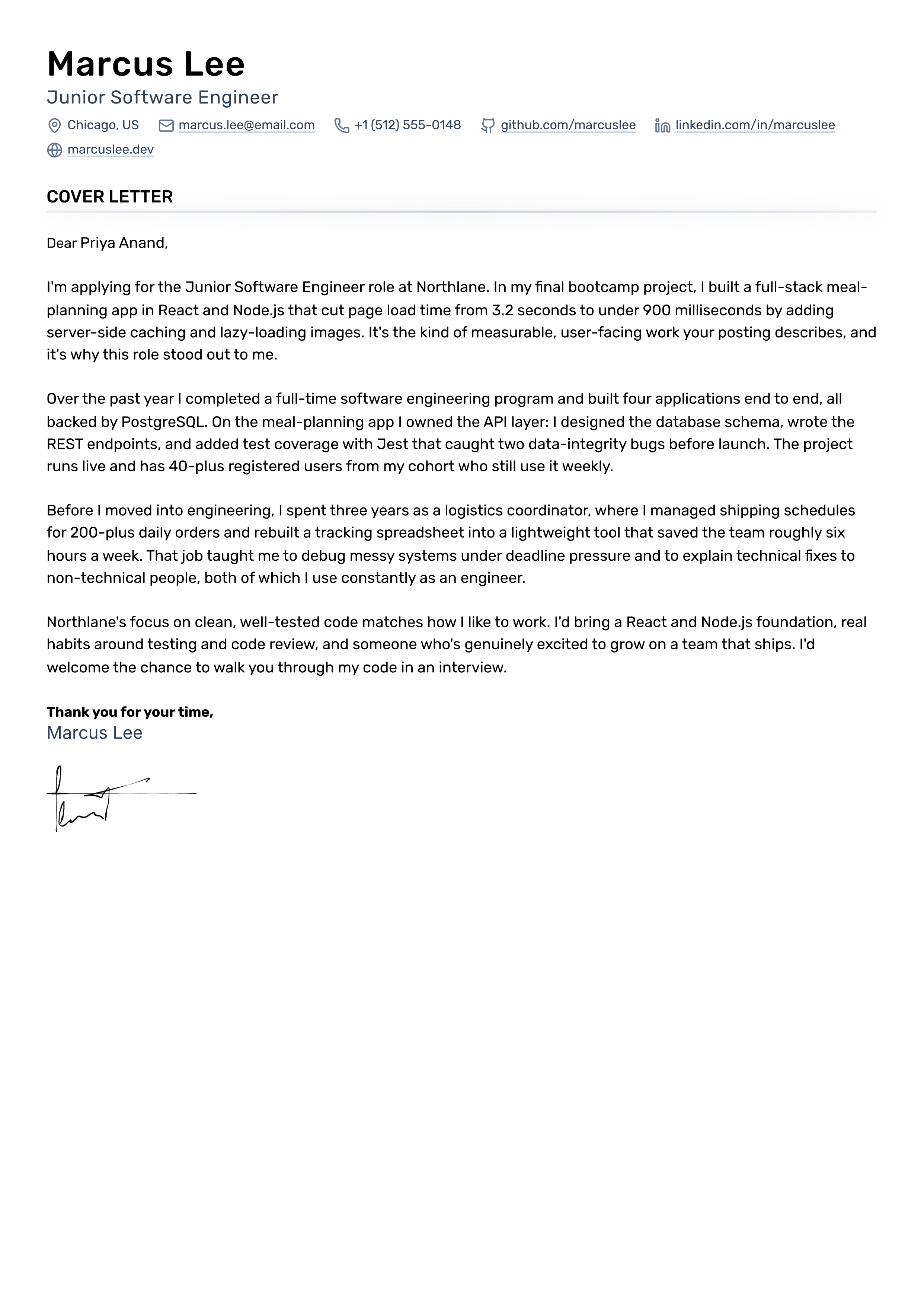
This is a complete example for a candidate applying to a junior full-stack role that lists React, Node.js, and PostgreSQL. Read it once, then I'll break down why each part works.
Why this example works
- The first two sentences name the role and lead with a measurable result. The reader knows exactly who this is and what they can do before line three.
- Every technology mentioned (React, Node.js, PostgreSQL, Jest) appears in the imagined job posting. Nothing is padding.
- The bootcamp project reads like a work story: what was built, what the candidate owned, and what it produced.
- The non-tech job is translated into engineering-relevant skills, not listed as unrelated history.
- It closes with a specific ask (walk through the code) instead of a vague "I look forward to hearing from you."
Notice what's missing: no life story, no "ever since I was a child," no five-paragraph windup. A strong entry-level cover letter is 250 to 350 words. Recruiters skim it in under a minute, so the first sentence has to earn the rest.
How to Highlight Bootcamp Projects and GitHub Contributions
Your projects are your experience. Treat them that way. A bootcamp grad software engineer cover letter should describe projects with the same structure a senior would use for a job: the problem, your specific role, the technology, and the outcome.
The mistake I see most often is listing projects like a menu. "I built a weather app, a to-do app, and an e-commerce clone." That tells the reader nothing about your ability. Pick one project, go deep, and quantify it.
Turn a project into a result
- Weak: "I built a full-stack web app using React."
- Strong: "I built a booking app in React that handles 50 concurrent users and reduced form-submission errors by validating input on both client and server."
- Weak: "I contributed to an open-source project."
- Strong: "I merged three pull requests into an open-source CLI tool, including a fix for a memory leak that had been open for two months."
Numbers don't have to be huge to matter. Load time, error rate, test coverage, number of users, hours saved, requests handled: any of these turns a claim into evidence. If you genuinely can't measure a project, describe the technical decision you made and why, which still signals judgment.
For GitHub, name what the reader will find before they click. "My GitHub includes the meal-planning app repo with commit history and a README that documents the architecture" is far more useful than a bare link. Put the link in your header or signature, and make sure the profile is presentable. For the details on placement and what a hiring manager actually checks, see our guide on including your GitHub link on a resume, and for framing projects across your whole application, how to list coding projects on a resume.
Translating Non-Tech Experience into Engineering Soft Skills
Your old job is an asset if you frame it right. Career changers and bootcamp grads worry their retail, teaching, or logistics background looks irrelevant. Engineering teams care a lot about the skills those jobs build: communication, debugging under pressure, ownership, and working with people who aren't technical.
The trick is to translate, not to list. Don't say you were a barista for two years. Say you handled a high-volume workflow with zero-defect expectations and trained four new hires on the process. That's operational rigor and mentorship, both of which map directly onto engineering work.
| Non-tech experience | Engineering skill it proves |
|---|---|
| Managed a support queue for 100+ tickets a week | Prioritization, debugging user-reported issues, staying calm under load |
| Taught or tutored students | Explaining complex ideas simply, mentoring, documentation |
| Ran shift scheduling or logistics | Systems thinking, handling edge cases, optimizing a process |
| Handled customer complaints | Requirements gathering, empathy for the end user, patience |
Use one short paragraph for this, not three. Pick the single most relevant prior role, translate one or two concrete achievements, and tie them to how you'll work as an engineer. The goal is to show your background makes you a better junior engineer, not to apologize for it.
Addressing the 'No Commercial Experience' Gap Head-On
Don't hide the gap, and don't dwell on it. A no experience software engineer cover letter works best when it acknowledges reality once, then immediately redirects to proof. Reframe the whole letter around what you have done rather than what you haven't.
Never write sentences like "Although I lack professional experience" or "Despite having no work history in tech." Those hand the reader a reason to doubt you before you've made your case. The projects, testing habits, and collaboration you demonstrate on real code are your experience, even if no one paid you for it yet.
Three ways to close the gap without begging
- Show team collaboration. If you built a project in a group, used Git for code review, or paired on debugging, say so. Commercial engineering is mostly teamwork, and this proves you can do it.
- Show you finish things. A deployed, live project beats ten half-built repos. "Runs in production with real users" is the phrase that eases the no-experience worry fastest.
- Show you learn fast. Mention a technology you picked up specifically for the role or a hard bug you solved by reading docs and source code. Ability to self-teach is exactly what juniors are hired for.
Freshers and new grads: your degree, internships, hackathons, and capstone projects all count here. Lead with the most impressive one. A sample cover letter for a software engineer fresher should read confident, not apologetic, because employers hiring at entry level already know you're early in your career. They're evaluating trajectory and evidence, not tenure.
Tailoring Your Cover Letter to the Specific Tech Stack
Match your language to the posting, literally. If the job says "TypeScript, React, and AWS," those exact words should appear in your letter where they're true. This is partly about the human reader recognizing a fit, and partly about applicant tracking systems (ATS), the software that scans and ranks applications before a person sees them.
A generic cover letter sent to 40 companies gets treated like spam, because it reads like spam. Tailoring is what separates a junior developer cover letter that gets a reply from one that gets ignored. The good news: tailoring the tech stack takes five minutes once your base version is solid.

How to tailor without rewriting from scratch
- Read the posting and pull out the named technologies, tools, and any repeated phrase (like "test-driven development" or "REST APIs").
- Match the ones you honestly have to a real project. Don't claim a tool you've never touched; a five-minute call will expose it.
- Swap the company name, the role title, and one sentence connecting your work to their focus. Keep the rest of your proven structure.
- Mention their product or engineering culture in a single specific line, so it's clear you read past the requirements list.
Keyword matching matters for the resume you attach even more than the letter, since the resume is what most ATS parses hardest. If you want to see which terms employers actually repeat for engineering roles, read ATS resume keywords and the walkthrough on building an ATS-friendly software engineer resume. Doing this by hand for every application is slow, which is where Roleframe helps: paste the job posting and it tailors your resume's keywords and bullets to that specific role in seconds, then generates a matching cover letter, so you apply while the posting is still fresh.
Is a Cover Letter Even Necessary for a Software Engineer?
Often optional, occasionally required, and almost always worth it at entry level. Many engineering applications mark the cover letter as optional. But when you're competing against candidates with internships and CS degrees, a sharp letter is the cheapest way to stand out.
At senior levels, a strong resume and GitHub sometimes speak for themselves. As a junior with no commercial track record, the cover letter is where you make your projects tell a story and address the experience question before the recruiter has to wonder about it. Skip it only when the application explicitly says not to include one.
Pair This With a Strong Entry-Level Resume
Your cover letter opens the door; your resume gets you the interview. They have to say the same thing. If your letter highlights a React project that cut load time, that project should be front and center on your resume too, with the same number.
Get the resume format right first. At entry level, put projects and skills high on the page, since your work history is thin. Our guide to resume section order by experience level covers exactly where projects, education, and skills belong when you're early-career. For a concrete model, the entry-level React developer resume example shows the whole thing assembled.
Save and send both as PDF unless an employer specifically asks for another format. A PDF keeps your layout intact so the resume the recruiter opens looks exactly like the one you built.
Frequently asked questions
What should an entry-level software engineer cover letter include?
Open with the role and one measurable project result. Then cover a project in depth (what you built, your role, the stack, the outcome), one relevant experience or transferable skill, and a specific closing line that invites a conversation. Name the exact technologies from the job posting where they're true. Keep it to 250 to 350 words.
How do I write a cover letter with no experience?
Reframe the letter around projects instead of jobs. Describe a real application you built, ideally one that's deployed with actual users, and quantify what it does. Mention team collaboration, testing, and any technology you taught yourself. Acknowledge the experience gap once at most, then redirect to proof. Bootcamp projects, capstones, and open-source contributions all count as evidence.
Is a cover letter necessary for a software engineer?
It's often optional, but at entry level it's usually worth writing. Without an internship or professional track record, the cover letter is where you turn your projects into a story and address the no-experience question directly. Skip it only when the application explicitly tells you not to include one.
How long should an entry-level software engineer cover letter be?
Around 250 to 350 words, or three to four short paragraphs. Recruiters skim it in under a minute, so a single page is already too long. Lead with your strongest result so the letter earns attention in the first two sentences.
How do I highlight bootcamp projects in a cover letter?
Treat one project like a work story rather than listing several. State the problem, what you specifically built or owned, the technologies used, and a measurable outcome like reduced load time, test coverage, or number of users. Point the reader to the repo and mention what they'll find there, such as a documented README and commit history.
Should I match my cover letter to the job's tech stack?
Yes. Use the exact language names, frameworks, and tools from the posting wherever they're genuinely true, both so the human reader sees a clear fit and so applicant tracking systems recognize the match. Never claim a technology you haven't used, because an interview will expose it quickly.

Larbi is a self-taught software engineer and the founder of Roleframe. He built it after getting tired of rewriting his resume for every single application. Having built ATS software himself, he knew exactly what those filters do to resumes on the other side. He writes about what actually gets you past ATS and in front of recruiters, based on thousands of real job descriptions, not recycled advice.



Ready when you are
Send the tailored resume, not the generic one.
Paste a job posting and Roleframe scores your resume against it, then helps you close the gaps one approved edit at a time, so you apply while the role is still fresh.