
Entry-Level React Developer Resume Example (No Experience)
A complete entry-level React developer resume example, plus the exact hooks, tools, and keywords junior job postings ask for and how to pass the ATS.


On this page
You can land your first React role without a professional job on your resume. Recruiters hiring junior developers expect that. What they screen for instead is proof you can build with React, read a codebase, and ship something that works. Your job is to show that with projects, a bootcamp or coursework, and the exact skills the posting names.
This page gives you a full entry-level React developer resume example you can copy the structure of, plus the specific keywords junior React postings ask for, how to turn personal and bootcamp projects into real experience bullets, and the mistakes that quietly get first-time applicants filtered out.
Landing your first React role without professional experience
Entry-level React postings are written for people who don't have a React job yet. When a listing says "0-2 years" or "junior," the hiring manager is really asking: can you build a component, wire up state, call an API, and use Git without hand-holding? None of that requires a paycheck to prove.
Two things decide whether your resume gets read. First, the applicant tracking system (ATS) that most companies use to filter resumes needs to see the right keywords, spelled the way the job posting spells them. Second, a human recruiter, often non-technical, needs to skim your resume in fifteen seconds and think "this person actually builds things."
So your whole resume points at one message: I write real React code, here's the proof, and here are the exact tools you asked for. Everything else is supporting detail.
Complete entry-level React developer resume example
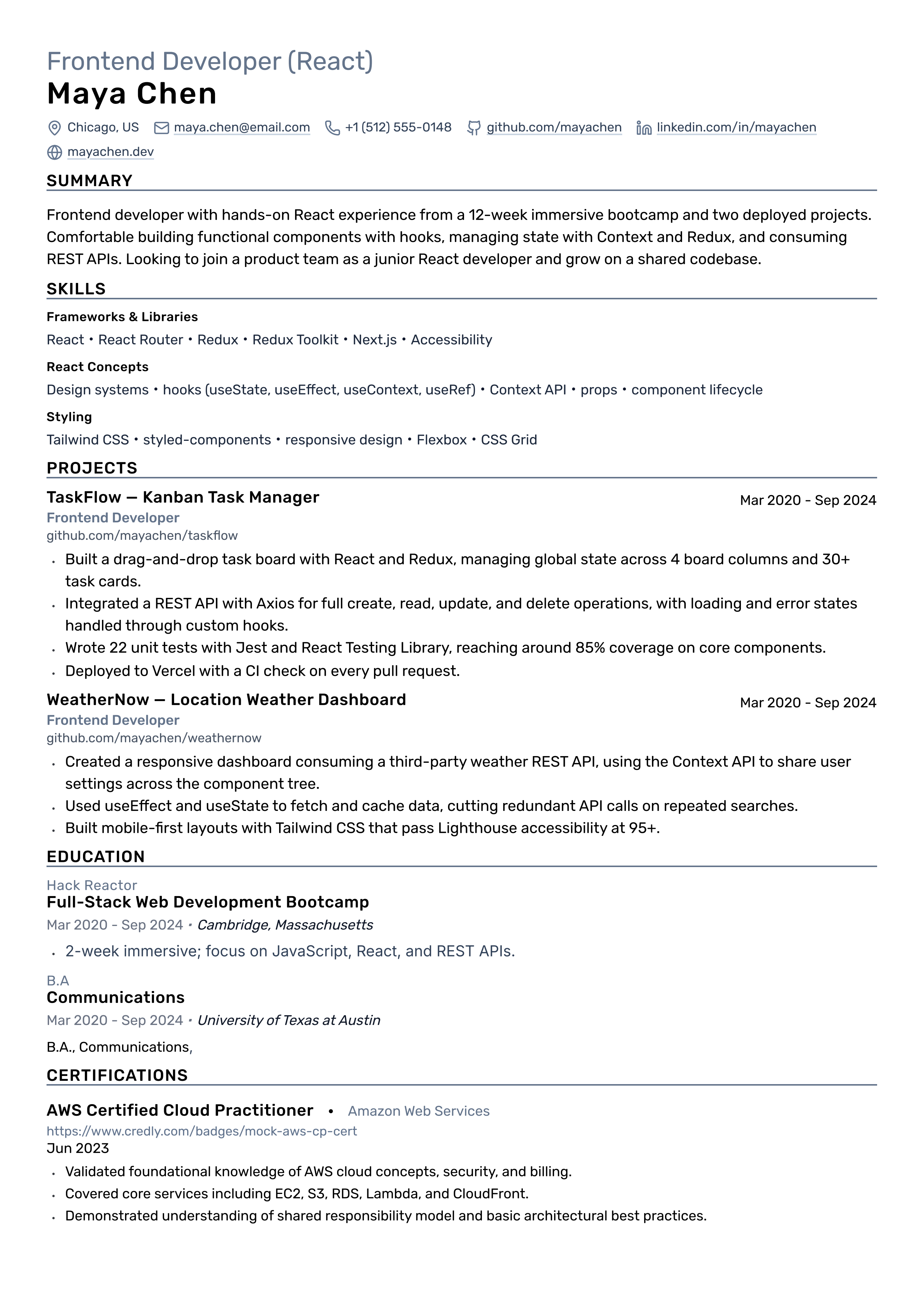
Here's a full worked example for a candidate with no paid experience, coming out of a bootcamp with two solid projects. Read it as a structure to copy, not text to paste. Your projects and numbers replace hers.
How to frame bootcamp and personal projects as experience
Projects are your experience section when you don't have a job yet. Treat them exactly like work history: a title, the stack you used, and bullets that describe what you built and what happened. A recruiter should not be able to tell the difference in effort between your project bullets and a senior dev's job bullets.
The mistake most freshers make is describing the app instead of their work. "A weather app made with React" tells me nothing. "Consumed a weather REST API and shared settings across the tree with Context" tells me you understand data flow. Write bullets about decisions and mechanics, not features.
Use the format: what you built, how, and the result
- Lead with an action verb and the technical work: "Built," "Integrated," "Implemented," "Refactored," "Tested."
- Name the React concept explicitly: hooks, Context, Redux, component structure, routing.
- Add a number wherever you honestly can: components, API endpoints, test count, coverage, Lighthouse score, load-time improvement.
- End with an outcome: deployed, passing tests, faster render, cleaner state.
Bootcamp projects count. So do course projects, hackathon builds, and things you made for fun. What matters is that the code is yours, it's on GitHub, and it's deployed somewhere a recruiter can click. Pick two or three strong projects over five thin ones. For a deeper walkthrough, read how to list coding projects on a software engineer resume.
Include a repo link for every project and make sure the README explains what the app does and how to run it. A clicked link that leads to a clean repo does more than another line of resume text.
Must-have React keywords for junior roles (hooks, Context, Redux)
Entry-level React postings share a core vocabulary, and the ATS matches against it. If a posting names React, JavaScript, hooks, and Git, and your resume never uses those exact words, you can get filtered before a human ever sees you. Read three or four target postings and mirror their wording.
From what shows up across junior React and frontend listings, these are the fundamentals that are close to non-negotiable:
- JavaScript (ES6+) — the language under React; expect it named separately.
- React — functional components, props, and rendering.
- Hooks — useState and useEffect at minimum; useContext and useRef are common.
- Context API and/or Redux — some form of state management beyond props.
- REST APIs — fetching data with fetch or Axios, handling loading and error states.
- Git and GitHub — version control is assumed, not optional.
- HTML5 and CSS3 — including responsive layout with Flexbox and Grid.
- TypeScript — increasingly listed even at junior level; add it if you know it.
- Testing — Jest and React Testing Library show up more than freshers expect.
- Build tools — Vite, npm, and sometimes Next.js for React frameworks.
Don't stuff every keyword in a blind list. Put the ones you genuinely know in your skills section, then prove the important ones in your project bullets. A recruiter trusts "managed state with Redux Toolkit across 4 columns" far more than the word "Redux" sitting alone in a skills row.
Match the exact spelling the posting uses. If it says "React.js," include that form somewhere; if it says "ReactJS" or "React," mirror it. This is the core of getting past the filter, covered in more depth in how to beat the ATS in 2026.
Writing project bullets that pass the ATS
The ATS reads plain text, so your bullets need to be readable as plain text and rich in the right terms. Skip tables, columns, text boxes, icons, and graphics for skill "levels." Those either scramble in parsing or get dropped. A clean single-column layout parses reliably and still looks sharp as a PDF.
Here's the difference between a bullet that gets skipped and one that lands:
| Weak bullet | Strong, ATS-ready bullet |
|---|---|
| Made a website with React | Built a responsive single-page app with React and React Router, structured into 15 reusable functional components |
| Used an API for data | Integrated a REST API with Axios for CRUD operations, handling loading and error states with custom hooks |
| Knows Redux | Managed global state with Redux Toolkit across a multi-step checkout flow, reducing prop drilling |
| Tested the app | Wrote 22 unit tests with Jest and React Testing Library, reaching ~85% coverage on core components |
Every strong bullet names a concrete tool, a specific React concept, and a number. That combination feeds the ATS its keywords and gives the recruiter a reason to believe you. For the formatting rules that keep your resume parseable, see how to make your resume ATS-friendly without ugly design.
Where to put your education and certifications
For a first React role, order your resume by what proves you can code. That usually means: header, short summary, skills, projects, then education and certifications. Projects sit above education because they carry more weight than a degree title for a junior dev.
Two exceptions. If you're a recent computer science graduate with relevant coursework and no strong projects yet, education can move up. And if a bootcamp is your main React training, list it clearly with the program name, focus, and year. Bootcamps are normal in junior hiring; there's no reason to hide one.

How to handle certifications
Certifications help when they map to the stack, like the Meta Front-End Developer certificate or freeCodeCamp's front-end libraries. List the issuer and keep it to one line each. They're supporting evidence, not the main event, so don't let them push your projects down the page.
You don't need a computer science degree to get hired as a junior React developer. Plenty of teams hire self-taught and bootcamp developers who ship clean code. What you do need is visible proof of work, which is exactly what your projects and GitHub provide.
Common mistakes junior developers make on resumes
Most rejections at the entry level come from avoidable mistakes, not weak skills. Here are the ones I see most often on first-time React resumes.
- Listing skills you can't defend. If "Redux" is on your resume, expect a Redux question in the interview. Only list what you can talk through.
- Describing apps instead of your work. "A to-do app" says nothing. Say what you built and which React concepts you used.
- No live links or broken ones. A dead GitHub link or a repo with no README kills trust. Test every link before you send.
- A generic resume sent to every job. The same file for 40 postings ignores the exact keywords each one asks for. Tailor per role.
- Fancy layouts that break the ATS. Columns, skill bars, and icons look nice and parse badly. Keep it clean single-column.
- Vague objective statements. "Seeking a challenging role to grow my skills" wastes the top of your resume. Lead with what you build.
- Zero numbers. Component counts, test coverage, and load times make your work concrete. Add them wherever they're true.
- Sending a Word file. Export a PDF so formatting and links stay intact on any screen.
For a broader list beyond React specifics, this is worth a read: 5 common resume mistakes that cost me interviews.
Start tailoring your React resume
One resume won't win a job hunt. Junior React postings vary a lot: one leans on Next.js and TypeScript, another wants Redux and testing, a third cares most about REST APIs and CSS. The candidates who get callbacks send a version that mirrors each posting's exact language, and they send it while the role is still fresh.
Keep one strong base resume for junior React roles, then spin off a tailored copy for each application: reorder skills, swap in the posting's keywords, and lead with the project that matches best. If you're targeting a few different tracks, like React and general frontend, managing multiple resumes for different career paths shows how to keep them straight. And on why speed matters, see why applying early beats a perfect generic resume.
Frequently asked questions
How do I write a React developer resume with no experience?
Treat your projects as your experience section. List two or three deployed React projects with a title, the stack you used, and bullets describing what you built and how. Name specific concepts like hooks, Context, and REST APIs, and add numbers wherever they're true. Add a short summary, a focused skills section, and your education or bootcamp below the projects.
What skills should be on an entry-level React resume?
Cover the fundamentals junior postings assume: JavaScript (ES6+), React with functional components, hooks like useState and useEffect, some state management with Context API or Redux, REST APIs, and Git. Add HTML5, CSS3, responsive layout, and TypeScript if you know it. Testing with Jest and React Testing Library is a strong bonus that many freshers skip.
Do I need a degree to become a junior React developer?
No. Many teams hire self-taught and bootcamp developers who can show working code. What matters is visible proof: deployed projects, a clean GitHub with readable repos, and skills you can defend in an interview. If you have a bootcamp or relevant certificate, list it clearly, but let your projects carry the resume.
Should I use React or React.js on my resume?
Match the exact wording of the job posting. If it says "React.js" or "ReactJS," include that form somewhere so the ATS matches it; if it says "React," use that. When you're unsure, "React" is the most common spelling and works for most listings. The point is that your resume and the posting use the same term.
How many projects should I put on an entry-level React resume?
Two or three strong projects beat five thin ones. Each should be deployed, backed by a clean GitHub repo with a README, and described with real technical bullets. Pick projects that show range: one with state management and an API, one that shows responsive styling and accessibility, for example.
Should I save my React resume as a PDF or Word file?
Save and send it as a PDF. A PDF keeps your layout, spacing, and clickable links intact on any screen, and it's what almost every ATS and recruiter expects. Only use a Word file if a specific employer explicitly asks for .docx, and even then a PDF is the safer default.
What's the difference between a junior and entry-level React developer resume?
They're the same target in practice. "Junior" and "entry-level" both mean roughly 0-2 years and a focus on learning the React ecosystem under supervision. Whichever term the posting uses, your resume should mirror it and prove you can build components, manage state, and consume APIs without much hand-holding.

Larbi is a self-taught software engineer and the founder of Roleframe. He built it after getting tired of rewriting his resume for every single application. Having built ATS software himself, he knew exactly what those filters do to resumes on the other side. He writes about what actually gets you past ATS and in front of recruiters, based on thousands of real job descriptions, not recycled advice.



Ready when you are
Send the tailored resume, not the generic one.
Paste a job posting and Roleframe scores your resume against it, then helps you close the gaps one approved edit at a time, so you apply while the role is still fresh.