
Overqualified for the Job? A Cover Letter Example That Proves Your Fit
A complete cover letter example for a job you're overqualified for, plus how to explain the step down and calm recruiter fears before they reject you.


On this page
When you apply for a job below your level, your cover letter has one job that no other cover letter has: it must answer the question the recruiter is already asking before they finish your first paragraph. That question is not "can this person do the work?" They know you can. The question is "why would they want to, and how long before they leave?"
Most applicants ignore that question and write a standard letter listing accomplishments. That makes things worse. Every impressive line deepens the recruiter's suspicion that you'll be gone in eight months. This page gives you a complete cover letter example for a step-down role, the reasoning behind every paragraph, and the resume adjustments that need to match it.
The recruiter's fear: why being overqualified is a red flag
Yes, employers can and do reject candidates for being overqualified. It is legal in most cases, it is common, and it usually happens silently. You never hear "you're too senior." You hear nothing, or you get the generic rejection email.
The rejection is rarely about your skills. It is about risk. When a hiring manager sees a former director applying for a manager role, or a fifteen-year engineer applying for a mid-level position, a specific set of fears kicks in:
- Flight risk. They assume you're applying because you need income now, and you'll leave the moment a role at your real level opens up. Replacing you in a year costs them another hiring cycle.
- Salary mismatch. They assume your expectations are anchored to your last title and that you'll be resentful, or gone, once the paycheck reality sets in.
- Boredom. They picture you disengaged by month three, doing the minimum, and quietly job hunting from your desk.
- Threat to the manager. This one nobody says out loud. A hiring manager with five years of experience interviewing someone with fifteen wonders whether you'll second-guess them, undermine them, or angle for their job.
- Coachability. They worry you'll resist direction because "you've done this before, at a bigger scale."
Your cover letter has to defuse these fears one by one, in plain language, without sounding defensive. That is the whole strategy. A letter that only proves competence fails, because competence was never in doubt.
Cover letter example for a step-down role
The scenario: Maya spent four years as Director of Operations at a mid-size logistics company, managing a team of 30 across three sites. She's applying for an Operations Manager role at a 60-person e-commerce company. On paper, it's a clear step down: smaller team, narrower scope, less strategy, more hands-on execution.
Here is the letter she should send.
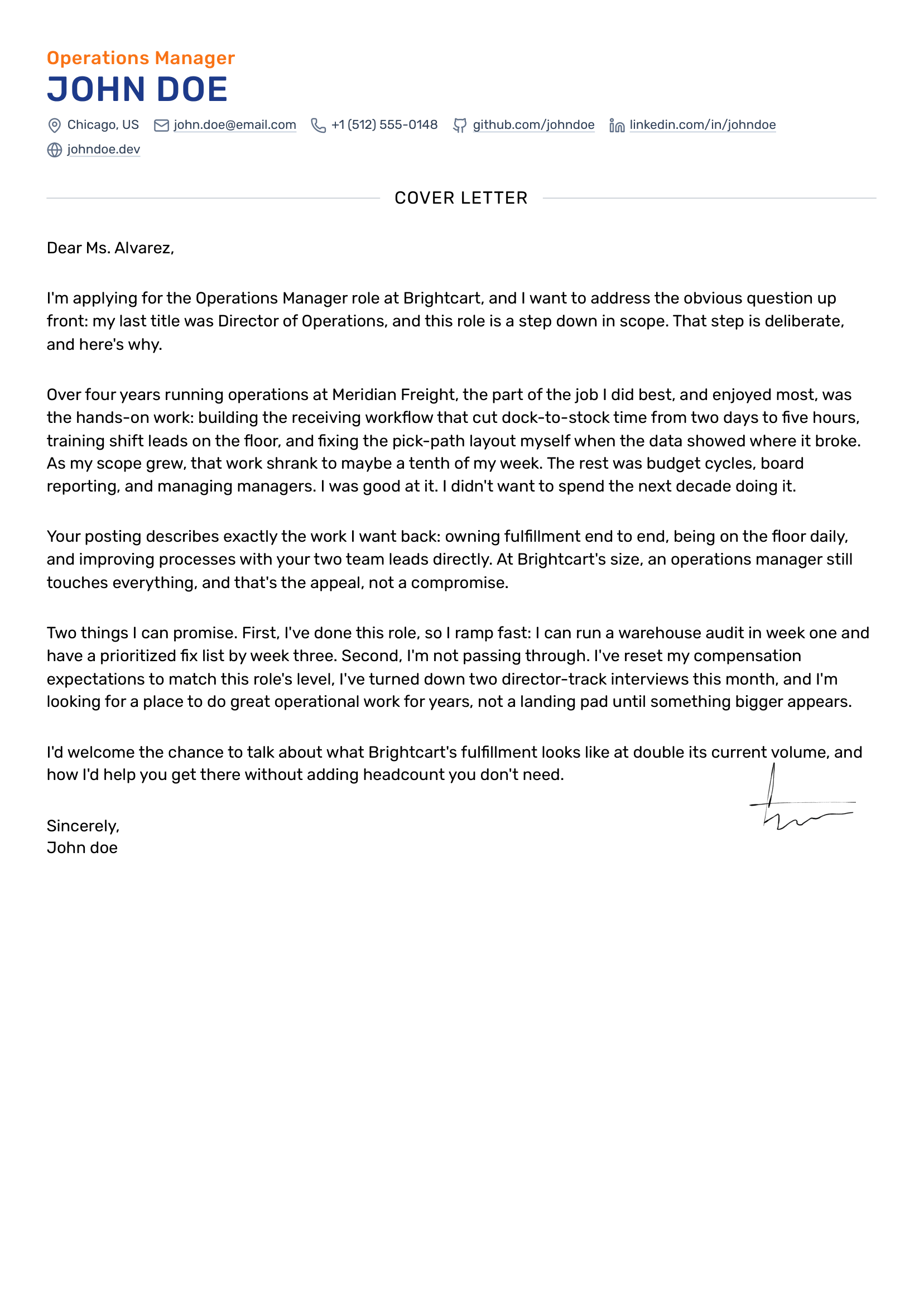
Notice what this letter does that a generic one doesn't:
- It names the elephant in the second sentence. Pretending the recruiter won't notice the step down insults their intelligence. Naming it first makes you the credible narrator of your own story.
- It gives a specific, believable 'why' rooted in the work itself, not vague talk about 'better work-life balance,' which recruiters read as 'I'm coasting.'
- It reframes seniority as ramp speed. 'I've done this before' becomes an asset (week-one audit, week-three fix list) instead of a threat.
- It kills the salary fear explicitly. 'I've reset my compensation expectations to match this role's level' is the single most important sentence for a step-down application.
- It signals commitment with evidence, not adjectives. Turning down director-track interviews is proof. 'I'm very committed' is noise.
- It ends by looking forward with the company, which quietly answers the boredom fear: she's already thinking about their next two years.
Addressing the 'why': burnout, pivot, or passion
Every step-down cover letter lives or dies on the "why" paragraph. The recruiter needs a reason that makes your application make sense. There are three honest reasons that work, and each needs careful framing.
If the real reason is burnout
Never write the word burnout. It tells the employer you arrive depleted. Reframe it as a move toward the work you want more of, not away from the work that drained you. "I want to spend my days building, not sitting in budget reviews" is the burnout story told as a preference. Same truth, opposite signal. Maya's letter does exactly this: the strategy-and-reporting grind clearly wore her down, but the letter frames it as pulling toward hands-on work.
If it's a career pivot
Stepping down to change industries or functions is one of the most legible reasons a recruiter can read, so say it plainly: "I'm moving from agency marketing into product marketing, and I'd rather learn the craft properly at this level than fake seniority in a function I'm new to." Humility about the new domain, confidence about the transferable skills. If a pivot is your situation, the framing overlaps heavily with a career change cover letter, and it's worth studying that structure too.
If it's genuine passion for this company or mission
This works only with specifics. "I've always admired your company" convinces no one. "I've used your product to run three fundraising campaigns and I know exactly which onboarding steps lose donors" convinces everyone. Passion claims need receipts, or they read as a cover story for one of the other two reasons.
One reason that does not work: "I just need a job." It may be true, and there's no shame in it, but it confirms the flight-risk fear outright. If financial need is your real driver, lead with the parts of the role you genuinely want, because there almost always are some, and let those carry the letter.
Focusing on mentorship and stability
Your seniority becomes an asset the moment you position it as something you give rather than something you expect deference for. Two angles do this well.
Mentorship, offered sideways. If the team has junior people, mention that you enjoy raising the level of people around you, informally. "At Meridian, two of my shift leads were promoted into salaried roles, and helping people get there is a part of any job I keep." This tells the hiring manager your experience will lift their team, not compete with them. Keep it light. "I could mentor your whole department" sounds like you're auditioning for the manager's job.
Stability, with proof. Recruiters trust patterns over promises. Point at your tenure history if it's good ("I've held two roles in eleven years, and I stay where the work is good"). Point at concrete commitments if it's not (the reset salary expectations, the declined interviews, a relocation, a family reason for wanting a role at this level). One evidenced sentence beats a paragraph of reassurance.
And address the hiring manager's unspoken fear directly through tone. A letter that says "your posting describes exactly the work I want" positions the manager as the person offering something valuable. A letter that says "I could bring strategic leadership to your team" positions you above them. The first gets interviews.

How to tone down seniority in your resume bullet points
A step-down cover letter attached to a director-level resume is a contradiction the recruiter will resolve against you. The resume has to tell the same story, which means rewriting bullets to emphasize execution over command.
The technique is simple: for each senior bullet, ask "what did I actually do with my hands?" and lead with that. Scale and leadership stay in the bullet, but they move from subject to context.
| Director-level bullet (works against you) | Rewritten for the target level |
|---|---|
| Directed operations strategy across 3 sites and a $12M budget, reporting to the CEO | Redesigned receiving workflow across 3 warehouses, cutting dock-to-stock time from 2 days to 5 hours |
| Led a 30-person org through a company-wide WMS migration | Ran the hands-on rollout of a new WMS: wrote the training program, ran floor sessions, and hit go-live with zero shipping delays |
| Owned P&L and presented quarterly performance to the board | Built the weekly ops dashboard the whole company still runs on, tracking pick accuracy, cost per order, and dock throughput |
| Managed and developed a team of 5 direct-report managers | Trained and coached 8 shift leads; 2 were promoted into salaried operations roles |
A few more adjustments that matter for step-down applications:
- Trim your history. Ten to fifteen years is plenty; ancient senior roles add seniority without adding fit. Our guide on how far back a resume should go covers the cutoff logic.
- Consider dropping or softening title inflation you can't explain. If your title was 'VP' at a 12-person startup where you did the work of a senior IC, describe the work, and note the company size so the title reads in context.
- Rewrite your summary line for the target level. 'Operations leader with 12 years of experience' becomes 'Operations manager with 12 years of hands-on fulfillment experience.' Same person, different signal.
- Match keyword register to the posting. If the job description says 'coordinate,' 'execute,' and 'support,' and your resume says 'direct,' 'oversee,' and 'own,' the mismatch is visible in a six-second scan.
That last point extends to structure. Which sections lead, how many bullets each role gets, and where skills sit should all reflect the level you're applying at. If you're reworking the whole document, the resume section order guide and the answer to how far back your resume should go are the two decisions to get right first.
Why generic AI tools fail at this, and how Roleframe handles seniority
Here is a problem specific to this situation: if you paste your resume into a general-purpose AI chatbot and ask it to write a cover letter or punch up your bullets, it will do the one thing you must not do. It will make you sound as impressive as possible. These tools are tuned to amplify: bigger verbs, broader scope, more leadership. For a step-down application, that tuning actively works against you, and you end up with a letter that reads like a director campaigning for a VP seat. We've written before about why AI resumes come out sounding generic and inflated, and step-down applications are where that failure costs the most.
Roleframe's tailoring pipeline handles this differently because the first step is not writing. It's reading. The deep job analysis agent reads the posting the way a senior recruiter would: it identifies the role archetype and, critically, the seniority level the employer is actually hiring for. When the posting is a level below your base resume, that changes the tailoring strategy that follows. Instead of amplifying leadership language, the rewrite emphasizes execution, hands-on skills, and reliability, reorders sections to lead with the work rather than the scope, and pulls keywords at the register the posting uses. You review and approve every change, so nothing shifts without your sign-off.
The practical setup: keep your full-strength base resume in a role workspace, untouched, for applications at your real level. When a step-down role is worth applying to, paste the posting and let the tailoring run against it. You get a level-matched resume and a paired cover letter in minutes, exported as a clean PDF, without permanently downgrading the resume you'll need for your next senior application.

Preparing for the inevitable interview question
If the cover letter works, you'll be asked the question live: "You seem overqualified for this. Why do you want it?" Sometimes it comes softer ("walk me through why this role") and sometimes blunter ("won't you be bored?"). Either way, it is the interview. Prepare it like one.
A strong answer has three beats, in order:
- Acknowledge without apologizing. "Fair question, and I expected it. On paper this is a step down from my last role." Agreeing with the premise disarms it; arguing that you're not overqualified starts a debate you lose either way.
- Give your specific 'why,' the same one from your letter, in one or two sentences. Consistency matters here. If the letter said 'I want the hands-on work back' and the interview answer becomes 'I need something less stressful,' you've just told them the letter was spin.
- Flip it to their benefit and close the risk. "What you get is someone who's seen this movie: I know where fulfillment breaks at 2x volume because I've fixed it at 3x. And I'm not passing through. My salary expectations are set for this level, and I'm looking for somewhere to stay."
Rehearse it out loud until the acknowledgment beat feels comfortable, because that's the beat people fumble. Candidates who get defensive at "you're overqualified" confirm the coachability fear on the spot. Candidates who say "you're right, here's why I'm here anyway" usually get the next round.
One more preparation note: expect the salary question early, sometimes in the recruiter screen. Have a number ready that genuinely matches the role's level. Naming your old compensation, even as context, reopens every fear the letter closed.
Tailor your application to the exact job level
The thread running through all of this: an overqualified application fails when it's pitched at your level instead of the job's level. The fix is level-matching everything the employer sees. The cover letter names the step down and explains it with a specific, forward-looking reason. The resume leads with execution and keeps scale as context. The interview answer repeats the same story without a wobble. When all three align, "overqualified" stops being a rejection reason and becomes what it should have been all along: a candidate who can do the job on day one and has a credible reason to stay.
Send the resume and letter as PDFs, apply while the posting is fresh, and keep your senior-level base resume intact for the roles at your real level. The step-down version is a tailored variant, not your new identity.
Frequently asked questions
How do you politely say you're overqualified for a job?
Acknowledge it factually, then pivot to your reason for applying: "On paper, this role is a step down from my last position, and that's a deliberate choice." Avoid the word "overqualified" itself where you can; it sounds like a boast even when it isn't. Describe the gap in neutral terms (scope, level, title) and spend your words on the why, which is the part the employer actually cares about.
Can employers reject you for being overqualified?
Yes, and they do it routinely. In most cases it's legal, since "overqualified" is a judgment about fit and retention risk rather than a protected characteristic. The rejection usually happens at the resume screen without explanation, which is exactly why the cover letter matters so much here: it's your only chance to answer the flight-risk and salary questions before someone decides silently.
How do you write a resume for a job you're overqualified for?
Rewrite bullets to lead with hands-on execution instead of scope and command, keep team size and budget as context rather than the headline, and match your verbs to the posting's register. Trim history to the last 10 to 15 years, adjust your summary line to the target level, and consider adding company-size context to titles that sound bigger than the work was. Keep your full-strength resume saved separately as a base version so you can still apply at your real level.
What should you say if an interviewer says you're overqualified?
Agree with the observation instead of arguing, give the same specific reason you used in your cover letter, then flip it to their benefit: fast ramp, proven judgment, and no learning curve on the fundamentals. Close the risk explicitly by confirming your salary expectations match the role and that you're looking to stay. Defensiveness is the failure mode; candidates who handle the question calmly tend to advance.
Should I use the word 'overqualified' in my cover letter?
Skip the word, but not the topic. "Overqualified" invites the employer to agree with the framing that you don't fit. Instead, name the facts: "my last role was a level above this one" or "this is a deliberate step down in scope." You get full credit for addressing the elephant without handing over a rejection-shaped label.
Should I mention salary in an overqualified cover letter?
Yes, one sentence, no numbers. Something like "I've reset my compensation expectations to match this role's level" preempts the single biggest silent objection to a step-down candidate. Save actual figures for the recruiter screen, and when asked, give a number anchored to this role's market rate, not your previous salary.
Is it bad to apply for a job you're overqualified for?
Not if the reason is real. People step down for saner scope, a pivot into a new field, a company they believe in, or more hands-on work, and employers hire them when the story is credible and consistent. It becomes a problem only when the application pretends the gap doesn't exist, or when the honest answer is "anything until something better appears," because recruiters can read that between the lines.

Larbi is a self-taught software engineer and the founder of Roleframe. He built it after getting tired of rewriting his resume for every single application. Having built ATS software himself, he knew exactly what those filters do to resumes on the other side. He writes about what actually gets you past ATS and in front of recruiters, based on thousands of real job descriptions, not recycled advice.



Ready when you are
Send the tailored resume, not the generic one.
Paste a job posting and Roleframe tailors your resume for it in about a minute, so you apply while the role is still fresh.