
Internal Promotion Cover Letter Sample: Put Your Company Knowledge to Work
A complete internal promotion cover letter sample, plus how to use insider knowledge, real metrics, and department jargon to win the role from the inside.


On this page
An internal cover letter fails in a specific way: the candidate assumes the company already knows their work, writes three casual lines, and loses to an external applicant who mapped every paragraph to the posting. Being an insider is an advantage only if you put the evidence on the page.
This guide gives you a full internal promotion cover letter sample, a short version for quick internal postings, an example for transferring to another department, and the exact techniques for turning institutional knowledge into an argument a hiring panel can't ignore.
The Advantage of Applying Internally (And How Not to Waste It)
Internal candidates start ahead. The hiring manager can verify your work with a ten-minute hallway conversation instead of a reference check. You already know the systems, the customers, and the unwritten rules. Promoting a known performer is less risky than betting on a stranger, and most managers know it.
Here is what internal applicants get wrong: they assume that edge applies automatically. At most mid-size and large companies, your internal application goes through the same applicant tracking system (ATS) and the same recruiter screen as every external one. The recruiter reading it first may have never worked with you. Your reputation does not travel with the application. The document does.
The second mistake is tone. Internal applicants send short, breezy notes along the lines of "you know my work, happy to chat," while external candidates submit tightly tailored letters that answer every requirement in the posting. Side by side in the same pipeline, the breezy note loses.
The fix is a letter that is external in rigor and internal in evidence. Same professional structure, same line-by-line tailoring to the posting, but every claim backed by things only an insider can say: named projects, internal metrics, systems you already run, and people who will vouch for you today.
Internal Promotion Cover Letter Sample
Here is a complete sample for a marketing coordinator applying for a marketing manager opening on a different team at the same company. Names and numbers are illustrative; swap in your own.
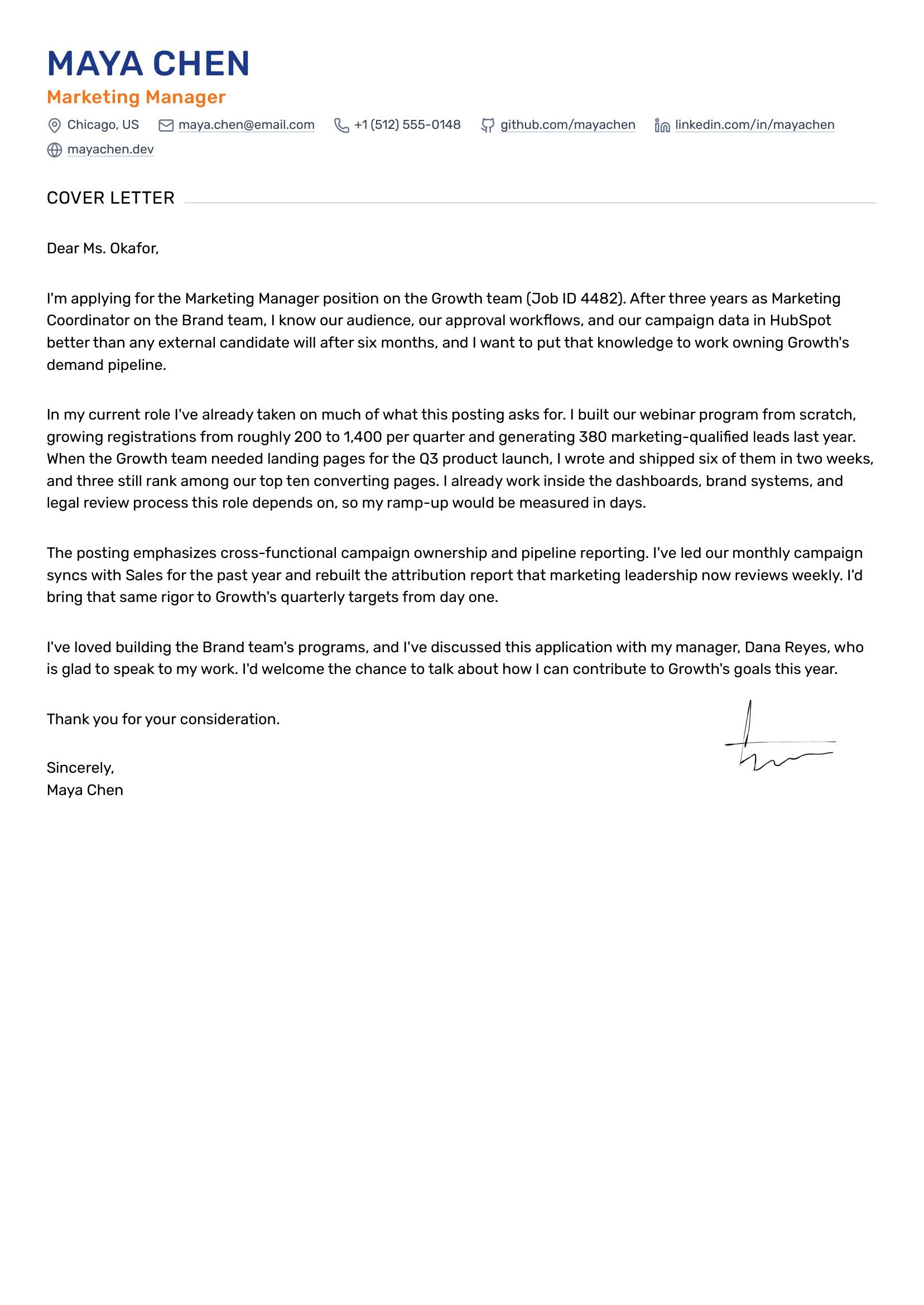
Why this letter works
- It names the job ID and team, which matters because internal postings often run through the same ATS intake as external ones.
- Every claim is verifiable inside the company: named projects, named systems, a named manager who supports the move.
- It answers the posting's stated requirements (cross-functional ownership, pipeline reporting) with insider evidence, not generic enthusiasm.
- It makes the ramp-time argument explicitly. "Days, not months" is the single strongest case an internal candidate can make.
- It signals transparency by mentioning the current manager, which removes the hiring manager's biggest worry about internal candidates: political fallout.
A short cover letter for an internal position
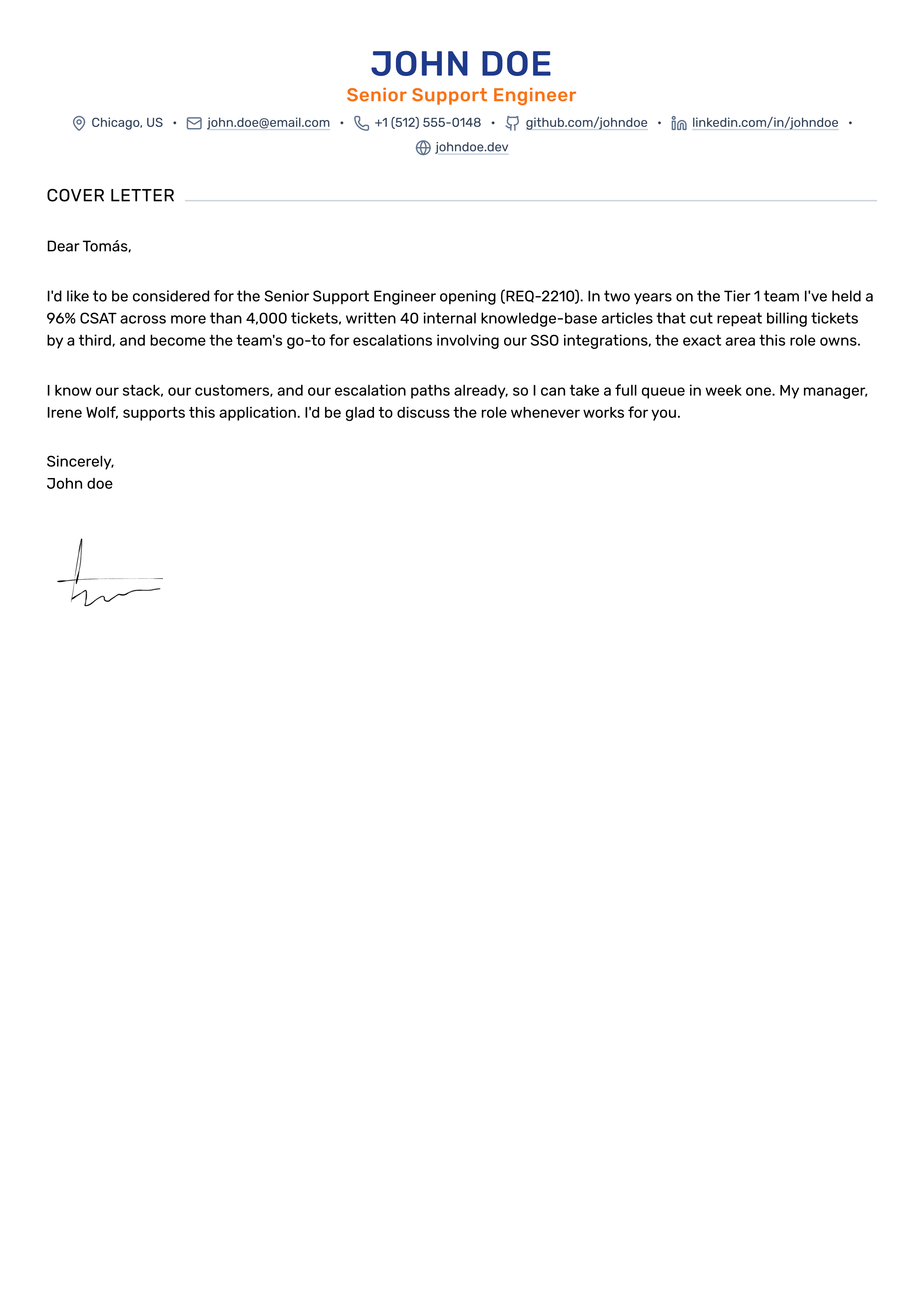
Some internal postings ask for a brief expression of interest rather than a full letter. Keep the same logic and compress it to three paragraphs, like this support engineer applying for a senior role on the same team:
Highlighting Your Institutional Knowledge Effectively
Institutional knowledge is your strongest card, and most internal candidates play it wrong. "I've been here five years" is tenure, and tenure by itself argues nothing. What the hiring manager actually buys is reduced ramp time, so frame everything as "here is what I can do on day one that an external hire can't do until month six."
Insider knowledge worth naming falls into three buckets:
- Systems knowledge: the specific tools, instances, and configurations the new role uses. Not "CRM experience" but "our Salesforce instance, including the custom lead-routing rules the Growth team relies on."
- Process and relationship knowledge: approval chains, legal review, the stakeholders in Finance who sign off on budget, the vendor contacts. New hires burn months mapping this. You already have the map.
- Historical context: what was tried before and why it failed. If the new team is about to rerun a playbook that flopped in 2023, you are the only candidate who knows that.
Compare the framing. Weak: "With five years at the company, I have deep institutional knowledge." Strong: "I onboarded three of the enterprise accounts this role would manage, and I know why two of them nearly churned last year." The second sentence could only be written by you, and it tells the manager exactly what problem you solve for them.
One caution: never spend insider knowledge on criticism. "I know everything that's broken in that department" reads as a threat to the people you'd be joining. Frame history as context you'll build on, not messes you'll clean up.
Mapping Your Current Metrics to the New Role's Goals
Your current job's metrics rarely match the new job's metrics word for word, and that gap is where promotions are won or lost on paper. The letter's job is translation: take a number you own today and state what it proves about the outcome the new role is measured on.
| Metric you own today | What the new role is measured on | How to frame it in the letter |
|---|---|---|
| Resolved 4,000+ tickets at 96% CSAT | Team-level customer retention | "I know exactly which product friction drives churn, because I've handled the tickets it generates." |
| Grew webinar registrations 200 to 1,400 per quarter | Pipeline and marketing-qualified leads | "That program produced 380 MQLs last year, the same pipeline motion this role owns at larger scale." |
| Trained 6 new team members on internal tooling | People management | "Onboarding I built cut new-hire ramp from eight weeks to five, which is the core of what a team lead does daily." |
| Rebuilt the attribution report leadership reviews weekly | Reporting to executives | "I already produce the report this role presents. The step up is owning the narrative, and I've been writing the first draft of it for a year." |
Pull the new role's success measures straight from the posting. If it says "own quarterly revenue targets," every metric you cite should end in a revenue-shaped conclusion. A precise number aimed at the wrong goal impresses no one.
How to Address the Hiring Manager (Even if You Know Them)
Use a professional greeting even when the hiring manager sits ten feet from your desk. "Dear Priya" is fine at a first-name company; "Dear Ms. Sharma" if your culture is formal. What you should never do is skip the greeting or open with an in-joke, because you usually don't control who reads the letter first. HR screeners, panel members from other teams, and sometimes a VP will see it, and it needs to stand on its own for all of them.
Your working relationship belongs in the body, stated as fact rather than familiarity. "We collaborated on the Q3 launch, where I delivered the landing pages two weeks ahead of schedule" works for every reader. "As you know, I always come through" works for none of them, because a panel member who doesn't know you now has an unverifiable claim in front of them.
Two edge cases. If the hiring manager is your current manager, the letter formalizes what they may already intend, so focus it on readiness for the next level, not on your existing rapport. If you can't identify the hiring manager, "Dear [Team name] Hiring Team" beats "To Whom It May Concern" every time, and internally you can almost always find the name with one Slack message.

Transitioning Between Departments: The Cross-Functional Angle
A cover letter for an internal transfer to another department is a different animal from a same-team promotion. You are part career changer, part insider, and the letter has to do both jobs: bridge the skill gap the way a career change cover letter does, while cashing in the company knowledge an external switcher doesn't have.
The trap is leaning entirely on the insider half. "I've been at the company four years and want a new challenge" tells the new department what you want, not what they get. Lead with the transferable skill, then use company knowledge as the accelerant. Here is how a support agent moving to product operations might open:
Dear Mr. Chen,
I'm applying for the Product Operations Analyst role (REQ-3104). For two years in Support I've been the unofficial data pipeline between customers and Product: I built the tagging taxonomy our team uses to categorize feature requests, and the monthly "top friction" report I compile now feeds directly into the roadmap review. This role would make official what I've been doing on the side, with the tools and mandate to do it properly.
Notice the structure. The transferable skills (data categorization, reporting, cross-team communication) carry the argument. The insider details (the taxonomy, the roadmap review) prove the skills are already operating inside this company. If your resume needs the same treatment, the approach in our career change resume guide applies almost unchanged to internal moves: reframe experience around the target role's language, not your current title's.
How Roleframe's Deep Job Analysis Reads Internal Postings
Internal postings carry a quirk most candidates miss: they're written in the hiring department's dialect, not yours. A posting drafted by Sales leadership says "pipeline hygiene" and "forecast accuracy." The Data team writes "data quality SLAs." Product writes "discovery" where you'd say "customer research." If your letter uses your current department's vocabulary for the same work, the recruiter screening it, who often knows neither team's jargon deeply, sees a mismatch where none exists.
This is exactly what Roleframe's deep job analysis is built for. Paste the internal posting and its keyword extraction agent pulls the exact competencies and phrasing the new department values, the same terms a recruiter's filter scans for, then checks them against your real experience and flags what's covered and what's a gap. The result is a cover letter and resume that bridge your current role to the promotion in the target team's own language, without you guessing which words matter. The same logic behind matching ATS resume keywords applies internally, because your application very likely runs through the same system.
Every change is shown before it saves, and nothing gets invented. The agents rewrite what you've actually done in the vocabulary the posting uses, which is precisely the translation work this whole article describes, done in seconds instead of an evening.
Tailor Your Internal Cover Letter in Seconds
Speed matters even internally. Internal postings often close fast, sometimes with a preferred candidate already in mind, so a polished application in the first day or two beats a perfect one in week three. Start from the sample above, swap in your own projects and numbers, and make sure every paragraph answers a line in the posting. Export as PDF so the formatting survives whatever system HR runs it through.
Frequently asked questions
Do I really need a cover letter for an internal position?
If the posting accepts one, yes. Your application often reaches a recruiter or panel member who has never worked with you, and the letter is your only chance to translate your reputation into evidence they can read. Skipping it while external candidates submit tailored letters puts you at a disadvantage in your own company.
Should I tell my boss before applying for an internal position?
In most companies, yes, and many require it. HR systems frequently notify the current manager anyway, and a manager who hears it from you first usually becomes an advocate instead of an obstacle. Mentioning in the letter that your manager supports the application, as the samples above do, also removes the hiring manager's biggest worry about internal hires.
How long should an internal promotion cover letter be?
Three to five paragraphs, under one page, same as an external letter. If the posting asks for a brief expression of interest, three tight paragraphs work: the role and one headline achievement, the ramp-time argument with a metric or two, and a close that names your manager's support.
How is an internal cover letter different from an external one?
Structure and length are identical. The difference is the evidence: internal letters cite named projects, internal metrics, specific systems, and colleagues who can vouch for you, and they make an explicit ramp-time argument no external candidate can match. They also need one extra sentence of transparency about your current manager knowing you've applied.
How do I write an expression of interest for an internal job that hasn't been formally posted?
Send a short, direct email to the hiring manager: name the role or team you're interested in, give two or three concrete results from your current position that map to their goals, and ask for a conversation. Keep it under 150 words and professional in tone, since it may be forwarded to HR. Loop in your own manager before or immediately after sending it.
What if I apply internally and don't get the role?
Ask the hiring manager for specific feedback and treat it as a roadmap, because internal rejections often come with unusually honest answers. A professional, well-argued application leaves a strong impression even when it loses, and internal candidates who handled a "no" gracefully are frequently first in line for the next opening on that team.
Should I submit my internal application as a PDF?
Yes. Even internal applications usually pass through the company's ATS, and a PDF keeps your formatting intact for every reader in the chain, from the HR screener to the panel. Only use another format if the internal posting explicitly asks for one.

Larbi is a self-taught software engineer and the founder of Roleframe. He built it after getting tired of rewriting his resume for every single application. Having built ATS software himself, he knew exactly what those filters do to resumes on the other side. He writes about what actually gets you past ATS and in front of recruiters, based on thousands of real job descriptions, not recycled advice.



Ready when you are
Send the tailored resume, not the generic one.
Paste a job posting and Roleframe tailors your resume for it in about a minute, so you apply while the role is still fresh.