How to Decline a Job Offer Politely (With Templates)
by Larbi SahliLast Updated
How to decline a job offer politely: reason-specific email templates, what the recruiter logs on their side, and the one line that keeps the door open.

On this page
Reply within a day or two of deciding, by email unless an agency recruiter has been calling you personally. Thank them for the offer, say plainly that you are declining, give one brief and honest reason, and close with a single line that keeps the door open. Skip long apologies and process critiques. Five sentences is enough, and the templates below cover the six most common reasons.
Decide before you write: three questions that set the wording
Most decline emails go wrong before the first word, because the sender has not decided what the message is for. Answer these three questions first and the wording almost writes itself.
- Is this a final no, or a negotiation in disguise? If a higher salary or a scope change would flip your answer, you are not declining yet. Say what would change your mind and let them respond. Never send a decline as a bluff; recruiters take you at your word, close the offer in their system, and move to the next candidate the same day.
- Do you want to work at this company later? If yes, your reason needs to be specific, because the reason is what gets logged. "Declined, compensation" is a searchable flag a recruiter can come back to when the pay band changes. "Decided to go another way" is not.
- Will you meet these people again? An agency recruiter, an internal recruiter who will change companies, a hiring manager in a small local market. If the answer is yes, the phone call before the email matters more than the email.
What a decline has to contain, and four things to leave out
A polite decline has exactly four parts: a one-sentence thank you that names something real, a clear decision using the word decline, a one-sentence reason, and a forward-looking close. That is the whole message. Anything past five or six sentences starts working against you.
Four things to leave out:
- The apology spiral. "I'm so sorry, I feel terrible about this" forces the recruiter to comfort you. One "thank you" outperforms three "sorry"s.
- A critique of the process or the people. "The interviews raised some concerns for me" is feedback nobody can act on now, and it is the sentence that gets remembered. If they send a candidate survey, put it there.
- The other company's name and numbers. You can say you accepted another offer without naming it. If the recruiter asks, you can share or politely decline that too; volunteering it reads like scorekeeping.
- A soft maybe. "I don't think I can accept at this time" reads as an invitation to counter. If you want a counter, ask for one. If you don't, use the word decline.
The message line by line
Subject. Reply in the existing offer thread whenever you can; the recruiter's inbox is organized by candidate and the thread keeps your history in one place. If you must start fresh: "Offer for [Role], [Your name]".
The thanks. One sentence, and make it specific. "Thank you for the offer and for the time you, Dana, and the analytics team spent with me" lands. "Thank you for this amazing opportunity" reads as a form letter.
The decision. Say it in the second or third sentence, not the last one. "After careful consideration, I've decided to decline the offer." Recruiters skim; a decline buried under two paragraphs of warmth gets misread as a stall.
The reason. One sentence, honest, no essay. The reason is the most useful part of the message for the employer, because it decides how you get logged in their system. More on that below.
The door. One sentence that says what a future conversation would look like. Each template below ends with a version of this line, and it is the sentence to keep if you may ever want back in.
Templates by reason, with what each one produces on the employer's side
These are not interchangeable. The reason you give determines the disposition code the recruiter selects when they close your offer, and that code determines whether you land in a talent pool or a generic "withdrew" bucket nobody ever searches. Pick the template that matches your real reason, then edit it until it sounds like you.
You accepted another offer
Hi [Name],
Thank you for the offer to join [Company] as [Title], and for the time you and the team invested over the past few weeks. After careful thought, I've decided to decline: I've accepted another role that is a closer match for the direction I want to take my work.
I genuinely enjoyed meeting [hiring manager] and hearing how the team approaches [specific thing you discussed]. I'd welcome being considered for future roles on this team, and I hope our paths cross again.
Best regards,
On the employer's side: this gets logged as "offer declined, accepted another offer." It is the most common and most neutral code, and it does you no harm. If your interviews went well, this decline is what puts you on the "silver medalist" list, the finalists recruiters call first when the role reopens or a similar one is created. The sentence to keep: "I'd welcome being considered for future roles on this team." It is the explicit permission a recruiter needs to add you to their talent pool rather than just closing the file.
The pay is too low
Only send this after the negotiation is genuinely over, or if you have decided not to negotiate at all. If a better number would change your answer, have the salary conversation instead of declining.
Hi [Name],
Thank you for the offer and for walking me through the full package last week. I've decided to decline: the compensation is below the range I need to make this move, and I understand it reflects the band for the role.
I was impressed by the team and I'd be glad to revisit the conversation if the range for this role, or a more senior version of it, changes in the future.
Best regards,
On the employer's side: logged as "offer declined, compensation." This is the single most useful code you can leave behind, because it is the one recruiters actually search. When a pay band gets rebuilt or a role is re-leveled, the first list a recruiter pulls is candidates who declined on comp. Naming money plainly is not rude; it is the reason recruiters find easiest to respect, because it is not about them. The sentence to keep: "I'd be glad to revisit the conversation if the range changes." It converts a dead offer into a standing callback.
The role changed after the interviews
Sometimes the offer letter describes a different job than the posting did: more maintenance and less building, a different manager, a scope that shrank between the final round and the paperwork. Decline on facts, not on grievance.
Hi [Name],
Thank you for the offer and for the conversations along the way. As I compared the offer against what we discussed in the interviews, the scope has moved toward [X] and away from the [Y] work that drew me to the role, so I've decided to decline.
I'd be interested in hearing about future roles that are centered on [Y], and I appreciate the team's openness throughout the process.
Best regards,
On the employer's side: usually logged as "declined, role fit" or "candidate withdrew." The factual framing matters here. "The scope moved toward X" is information a recruiter can pass to the hiring manager without anyone getting defensive. "This isn't what I was promised" gets summarized in the notes as "difficult," and notes travel. The sentence to keep: "I'd be interested in future roles centered on [Y]." It tells the recruiter exactly which req to call you about.
Relocation
Hi [Name],
Thank you for the offer to join [Company] as [Title]. After working through what the relocation would mean for my family, I've decided to decline; the move to [city] isn't workable for us right now.
I'd welcome a conversation if a role opens in [your city or region] or on a remote basis, and I appreciate everything you did to make the process smooth.
Best regards,
On the employer's side: logged as "declined, location" or "declined, relocation." Talent pools in most applicant tracking systems filter by location, so the geography you name is the geography you will be matched against. Be precise: "remote or the Denver metro" gets you found, "the move doesn't work" gets you filed and forgotten. The sentence to keep: the one naming where you would work.
The commute
Hi [Name],
Thank you for the offer, and for the flexibility you showed in scheduling my interviews. I've decided to decline: with the on-site expectations, the daily commute would be [duration or description], and I know from experience that isn't sustainable for me.
If the role's hybrid or remote arrangement changes, or if a position opens closer to [area], I'd be glad to talk again.
Best regards,
On the employer's side: logged under location or work arrangement, and here is the part candidates underestimate: on-site policies change. Companies loosen hybrid rules when a role sits unfilled, and when that happens the recruiter re-contacts everyone who declined over the commute. The sentence to keep: "If the hybrid or remote arrangement changes, I'd be glad to talk again." You are pre-registering for a policy change that may be months away.
Better fit elsewhere, or you would rather not say
Use this when the honest reason is personal, complicated, or unflattering to share. It is the vaguest template, which makes it the least useful for future consideration, so only reach for it when the specific ones don't fit.
Hi [Name],
Thank you for the offer and for the care the team took through every stage of the process. After weighing it carefully, I've decided to decline; another path is a better fit for me at this point in my career.
That decision was harder than I expected, which says a lot about [Company]. I'd be happy to stay in touch, and I wish the team every success with [project or goal they mentioned].
Best regards,
On the employer's side: logged as a generic "candidate withdrew" or "declined, other." Nobody searches that bucket, so do not expect a call when a new role opens. The warmth of the message is what carries you here, not the code. The sentence to keep: "I'd be happy to stay in touch," ideally followed by actually connecting with the recruiter on LinkedIn the same day.
Phone, email, or both: what the recruiter expects, and how fast
Email is the default, and for most declines it is the right call. It gives the recruiter a written record to log against, it lets you get the wording exactly right, and it does not put anyone on the spot.
Call first, then confirm by email, in three situations: an agency recruiter who has been working your candidacy personally, a hiring manager you spoke with repeatedly through a long process, or any offer you had already verbally accepted. In those cases the email alone reads as avoidance. Keep the call short, say the same four things the email says, and send the written version within the hour, because the recruiter still needs something to file.
On timing: respond within one to two business days of making your decision, not of receiving the offer. You are allowed to take the time the offer deadline gives you. What you are not allowed to do, politely speaking, is decide on Tuesday and tell them on Friday. Every day you sit on a decided no, the team holds the requisition, delays their backup candidate, and risks losing that person to another offer. Recruiters forgive a fast no easily. A slow maybe is what burns the bridge.
Declining to someone you will meet again
Agency recruiters. A third-party recruiter earns their fee on placement, so your decline costs them real money. That is not your problem to fix, but it is a reason to be direct and give them something to work with: the true reason, and what would have changed your answer. A good agency recruiter who understands why you said no becomes a scout who brings you the right role next quarter. One who got a vague brush-off stops calling.
Internal recruiters. Recruiters change companies more often than almost anyone else in the building, and their candidate notes and their memory travel with them. The recruiter you decline gracefully at one company may be the one screening you at your dream company in two years.
Small markets. If you work in a field with a short list of local employers, hospital systems, school districts, regional law, municipal engineering, assume the hiring manager you decline will hear about your next application, sit on the next conference panel, or become your counterpart on a shared project. In those markets the phone call is not optional courtesy; it is the professional norm, and skipping it gets noticed.
What happens in the employer's system after you decline
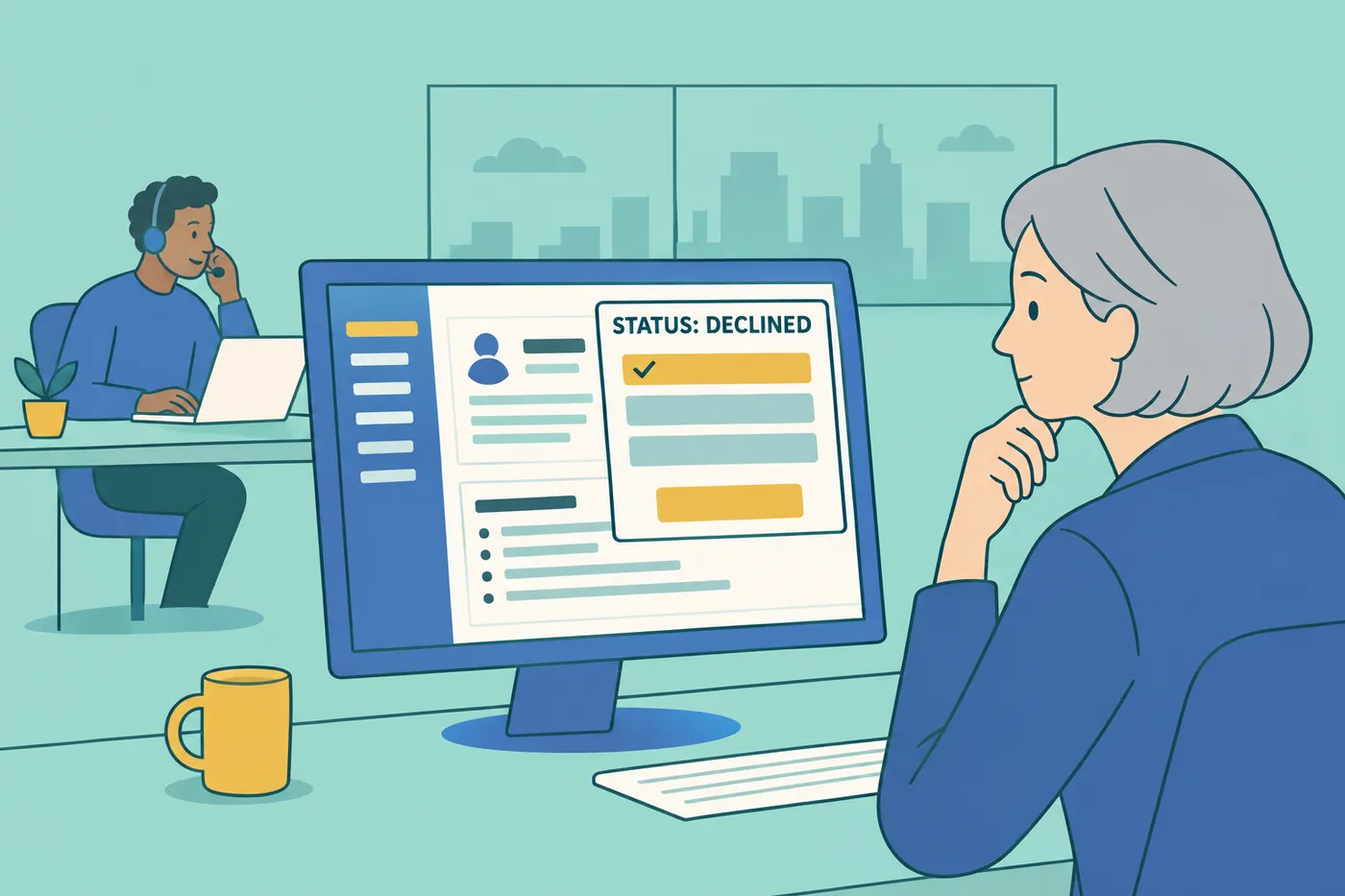
A recruiter cannot simply close the tab when you say no. In applicant tracking systems like Workday, Greenhouse, or Lever, an offer has to be closed with a reason, a disposition code, and that code feeds the company's offer-acceptance reporting. Declines on compensation, for example, are exactly the evidence a recruiting team uses to argue for a higher band. Your one-sentence reason is a data point in that argument.
Two lists matter to you afterward. The first is the talent pool, sometimes called the silver-medalist list: strong finalists the team wants back when a role reopens. You get there by interviewing well and declining gracefully with a specific reason and an explicit door-open sentence. The second is the do-not-contact flag, which is rare and almost always earned by behavior, ghosting an accepted offer, blowing up at a recruiter, or a no-show, not by the decline itself.
On re-application windows: some employers, especially large ones, set a waiting period before a rejected candidate can re-apply to the same role family. A decline is usually treated differently, because you said no to them, not the other way around, but policies vary. If you think you might come back, ask the recruiter directly in your decline thread; they can see the policy and will usually just tell you.

| Reason you give | Typical disposition code | What it means for you later |
|---|---|---|
| Accepted another offer | Declined, accepted other offer | Neutral. Strong finalists land on the silver-medalist list and get called when the role reopens. |
| Compensation | Declined, compensation | The most searchable code. Expect a call if the band changes or the role is re-leveled. |
| Role changed after interviews | Declined, role fit / withdrew | Useful if you named the scope you wanted; the recruiter knows which future req fits you. |
| Relocation | Declined, location | Pools filter by geography. You get matched against the location you named. |
| Commute / work arrangement | Declined, location or arrangement | Re-contacted if the hybrid or remote policy loosens, which happens when roles sit unfilled. |
| Better fit elsewhere / unspecified | Withdrew / declined, other | Generic bucket nobody searches. The relationship, not the code, carries you here. |
Sentences that read as rude when you did not mean them
Most bridge-burning in decline emails is accidental. The sender was aiming for honest or humble and landed on cold or passive-aggressive. These are the usual offenders.
| What you wrote | How it lands | Write instead |
|---|---|---|
| I've decided to go in a different direction. | Recruiter-speak turned back on the recruiter. Reads as a form rejection, which is exactly what it is. | I've accepted a role that's a closer match for the [X] work I want to do. |
| The salary just isn't enough. | A jab, or a last-minute attempt to reopen negotiation. Either way it invites an awkward reply. | The compensation is below the range I need to make this move, so I've decided to decline. |
| To be honest, the interview process gave me some doubts. | A critique nobody can act on now, and the line everyone in the debrief remembers. | Cut it. If the reason was the role itself: the scope turned out to be different from what I'm looking for. |
| Sorry to waste your time. | Implies the process was a waste, and obliges them to reassure you that it wasn't. | Thank you for the time you and the team invested; I don't take it lightly. |
| Maybe things could work out down the road? | Vague enough to mean nothing, so it gets logged as nothing. | I'd welcome being considered for future roles on this team, especially anything focused on [X]. |
| I don't think I can accept at this time. | Sounds negotiable. Expect a counter-offer you'll then have to decline a second time. | After careful thought, I've decided to decline the offer. |
Record the decline and keep your other applications moving
The last step is the one almost everyone skips: write down what you said. Log the date, the recruiter's name, the reason you gave, and the door-open sentence you used. If you re-apply in a year, the recruiter will have your old decline in their system word for word, and "declined on compensation, said she'd revisit if the band changed" plus a candidate whose story matches is a strong re-entry. A candidate whose story has drifted is not.
A declined offer also means the rest of your pipeline just became more important. If you track your search in an organized system rather than memory, this takes a minute: in Roleframe, the jobs you saved live in a tracker next to the resumes you tailored for them, so you mark this one declined and the applications still in flight stay visible instead of getting lost in the relief of having had an offer at all. One offer on the table usually means your materials are working. Keep sending them.
Frequently asked questions
- How do I turn down a job offer but keep the door open?
Give a specific reason and an explicit invitation. "I'd welcome being considered for future roles on this team" is the sentence that gets you added to a talent pool; without it, the recruiter closes the file. Pair it with a precise reason, compensation, location, or scope, so the recruiter knows exactly which future role to call you about. Then connect on LinkedIn the same day so the relationship outlives the requisition.
- How do I decline a job offer after accepting another one?
If you mean declining offer B because you already accepted offer A, that is the standard case: use the "accepted another offer" template above. If you mean backing out of an offer you already accepted, that is a renege, and it is a different animal. Call the recruiter first, keep it short, apologize once without a long justification, and confirm in writing. Before a signed agreement and a start date it happens more than people admit; after one, expect real damage to the relationship and possibly a do-not-rehire note. Do it fast, because every day of delay makes it worse for the team.
- What should you not say when declining a job offer?
Four things: critiques of the interviewers or process, since nobody can act on them now and they define how you are remembered; the competing company's name and numbers, unless directly asked; a soft maybe like "I don't think I can accept at this time," which reads as an invitation to counter; and apology spirals, which force the recruiter to comfort you. One thank-you, one clear decline, one reason, one door-open line.
- Can I decline a job offer and apply again later?
Usually, yes. Re-application waiting periods at large companies typically target rejected candidates, and a decline is a withdrawal on your side, not a rejection on theirs. Your decline stays in their applicant tracking system, though, so your future application should be consistent with the reason you gave. If you already know you might come back, ask the recruiter about the policy in your decline thread; they can see it and will usually tell you straight.
- How quickly should I respond when declining a job offer?
Within one to two business days of making the decision. You may use the full deadline the offer gives you to decide, but once you know, tell them. The team is holding the position for you, and a fast no lets them move to their backup candidate before that person accepts something else. Recruiters remember a prompt, clear decline kindly. They remember a decided candidate who went quiet for a week much less kindly.
- How do I say no to a recruiter politely when I don't even want to interview?
Shorter and lighter than an offer decline, but the same skeleton: thanks, a clear no, one line of reason, and a redirect. "Thanks for reaching out. I'm not looking to move right now, and this one isn't the right fit regardless, but a role focused on [X] at [level] would get my attention." That last clause turns a rejection into a search filter the recruiter will actually use, and good recruiters keep those notes for years.
- Should I tell the company which offer I chose instead?
You do not have to, and you should not volunteer it in the decline email. If the recruiter asks, sharing the company name is generally harmless and helps them benchmark; sharing the salary is your call and entirely optional. "I'd rather not say, but the role is a closer fit for [X]" is a perfectly polite answer that no reasonable recruiter pushes past.



Ready to start your new resume?
Writing a resume takes time, and even a polished one can miss what a hiring manager is looking for. Roleframe helps you build a clear, ATS-safe resume in minutes and tailor it to the job you want.


