How Do You Become an Electrician? Steps, Hours, and the License
by Larbi SahliLast Updated
How to become an electrician: apprenticeship steps, field and classroom hours, who issues your license, and what the journeyman exam actually tests.
On this page
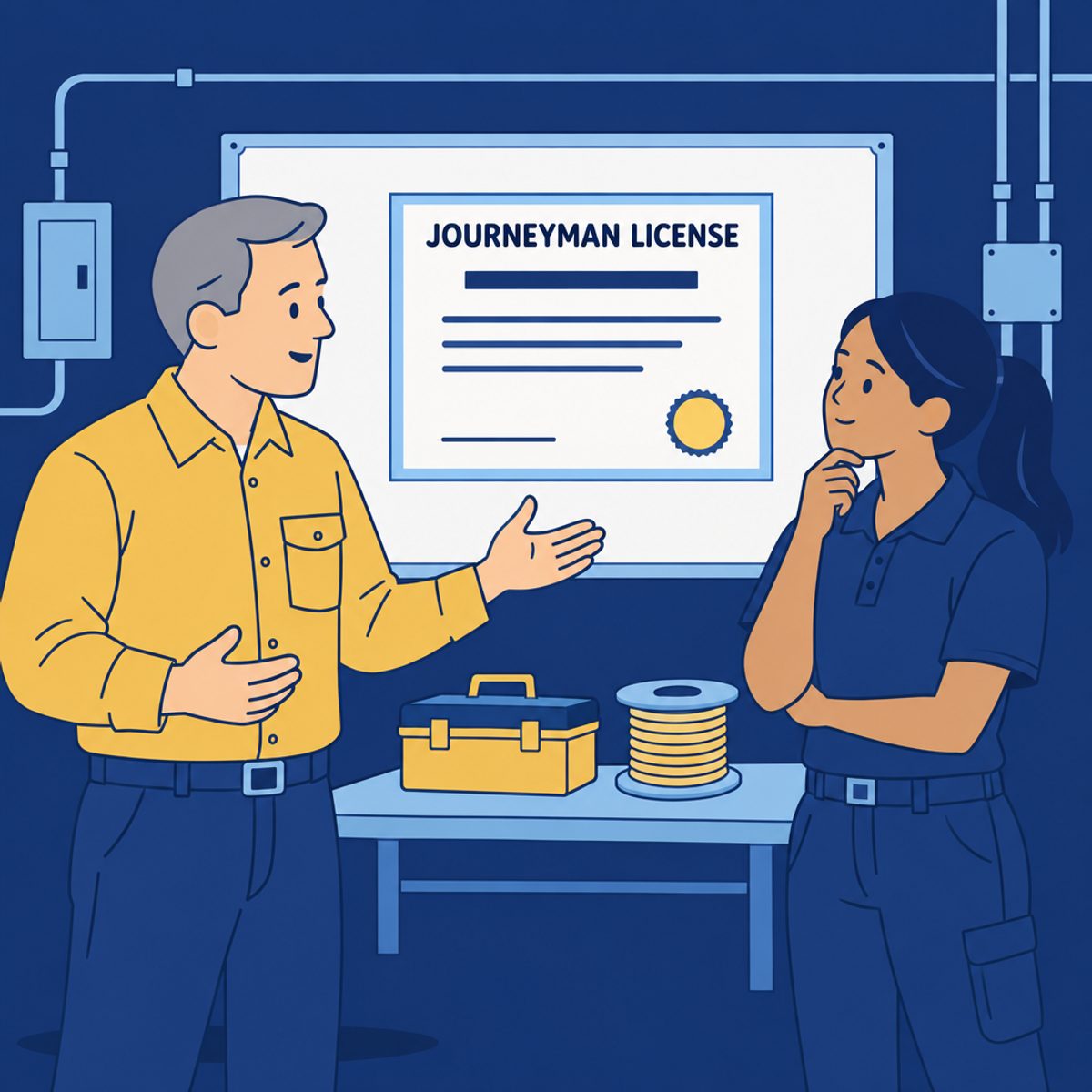
You become an electrician by completing a registered apprenticeship, usually four to five years of paid on-the-job hours plus classroom instruction, then passing a journeyman exam written to the National Electrical Code edition your state has adopted. No college degree is required. Depending on where you live, the license comes from a state electrical board, from your city or county, or in a few states no statewide license exists at all.
How long does it take to become an electrician?
Four to five years is the realistic answer for most people, because most registered apprenticeships are built as four- or five-year programs. The timeline is measured in hours rather than semesters. You bank on-the-job hours working under a licensed electrician during the day and complete related classroom instruction alongside, usually in evening classes or periodic day-release blocks.
Here is the part most guides get wrong. The exact hour totals are set by your state's statute and by your program's registered apprenticeship standards, and they differ by jurisdiction and by track. A specific number you read on a trade-school blog may describe a different state than yours. Before you plan anything, pull the hour requirements from your state licensing authority's own site and from the apprenticeship standards your program has on file with the Department of Labor or your state apprenticeship agency. That document is the contract; a blog is not.
Two things stretch the timeline. Gaps between employers, because hours only accrue while you are working under supervision, and falling behind in the classroom, because most programs will not advance you to the next wage step until your coursework is current. Two things shorten it. Credit for prior trade-school coursework where your program grants advanced placement, and credit for documented prior electrical work, which some boards accept if you can prove it with employer affidavits.
Which electrician are you becoming? Pick the track before you apply
The word electrician covers four different careers, and the apprenticeship you apply to locks in the track. Switching later usually means restarting a large share of your hours, so decide this before you fill out an application.
| Track | The work | Typical settings | What it means for your license |
|---|---|---|---|
| Inside wireman | Power distribution, lighting, motor controls and conduit inside buildings | Commercial sites and industrial plants | The default journeyman path; the full field-hour requirement applies |
| Residential wireman | Wiring in houses and apartment buildings | New construction and remodels | Often a shorter hour requirement, but the license may not cover commercial work |
| Low-voltage / VDV technician | Voice, data and video cabling, plus fire alarm and security systems | Offices, campuses and data centers | Many states license it separately, with its own smaller hour requirement |
| Outside lineman | Transmission and distribution lines, substations | Utility rights-of-way, with real storm-response travel | A different apprenticeship and exam entirely, run through utility-side programs |
If you are unsure, apply as an inside wireman. It is the broadest license, and the skills transfer down to residential work far more easily than residential skills transfer up. Choose low-voltage if you want in quickly and prefer data centers to conduit benders. Choose lineman work with open eyes about travel; the pay is strong, and so is the time away from home.
Getting in: IBEW training committees vs. ABC and IEC programs
The union route runs through a joint training committee funded by the International Brotherhood of Electrical Workers (IBEW) and the National Electrical Contractors Association (NECA), usually called the JATC or the ATC. You apply to the committee, not to an employer. The sequence looks like this:
- Find the training committee for the IBEW local that covers your address and check its application window. Many locals accept applications only during set periods each year.
- Submit the paperwork: proof of age and a high school diploma or GED, plus a transcript showing you passed an algebra course.
- Sit the electrical aptitude test. Your score must qualify before you move on.
- Interview with the committee panel.
- Land on the ranked list and wait for a class seat, which opens as contractor demand does.
The non-union route runs through Associated Builders and Contractors (ABC) or Independent Electrical Contractors (IEC) chapters, which operate their own registered apprenticeships. The practical differences matter. You typically get hired by a member contractor first, or the chapter matches you with one, so getting in feels like a job interview rather than a committee ranking. Start dates roll more often than a committee's annual class. Wages come from the employer's scale instead of a collective agreement.
My advice is to apply to both tracks at the same time. The committee cycle can be slow, there is no penalty for holding two applications, and the credential you finish with is the same state journeyman license either way.
The aptitude test, and how the interview is actually scored
The aptitude test measures two things, math and reading. The math is algebra-level: solving equations, ratios, and pattern or number-sequence reasoning. The reading section tests comprehension of short technical passages. No electrical knowledge appears on it, so a candidate who has never touched a wire competes evenly with an electrician's kid. If your last algebra class was a decade ago, a few weeks of honest review changes your score more than anything else you can do.
The interview is structured on purpose. A panel asks every candidate the same questions, each interviewer scores independently against the same rubric, and the combined score places you on a ranked list. Offers go down that list as class seats open. What gets scored is work history and reliability, comfort with physical work, why you want this trade specifically, and how clearly you communicate.
Bring specifics. A bartender who can describe covering short-staffed weekend shifts for two years is proving reliability with evidence; a candidate who says they are a hard worker is proving nothing. Treat the why-this-trade question as real and name something concrete you have done with your hands. If you rank low, ask about the retest and reapplication window; ranked lists expire and refresh, and plenty of journeymen got in on the second try.
Does trade school count toward the requirements?
It can count, but never fully. Trade school can satisfy or reduce the classroom-instruction side and sometimes earns you advanced placement in an apprenticeship, meaning a higher starting wage step. What it cannot do in most jurisdictions is replace field hours. A minority of boards credit a limited slice of classroom time against the field-hour requirement, and whether yours does is a question to put to the licensing authority in writing before you pay a dollar of tuition. Get the answer from the body that issues the license, not from the school's admissions office, which has an obvious interest in the answer.
Apprenticeship-first is usually the cheaper route because you are paid from your first day. School-first earns its cost in two situations: your local committee's ranked list is long and you want a stronger application, or you need to rebuild your math before the aptitude test. If you are still comparing trades, the structure repeats across the licensed trades; see how a plumbing apprenticeship and an HVAC apprenticeship stack up before you commit.

Who issues your license, and how the levels stack
There is no single American electrician license. States fall into three models, and knowing which one covers you decides where you register as an apprentice, whose exam you sit, and whose codebook you study.
| Licensing model | Who issues the journeyman license | What to verify first |
|---|---|---|
| Statewide license | A state electrical board or state licensing agency | The field-hour and classroom totals in the statute, and whether apprentices must register with the state before hours start counting |
| Local licensing | Cities or counties, each with its own exam and rules | Which municipality's license the contractors you want to work for require, since neighboring cities may not honor each other's cards |
| Hybrid, or no statewide license | The state licenses some tiers or none, and localities fill the gap | Whether your target city requires its own license even where the state does not |
Apprentice, journeyman, master, electrical contractor
- Apprentice: registered with a program and often with the state, working only under supervision. In many jurisdictions the registration itself is your first license event, and hours worked before it may not count.
- Journeyman: verified field hours plus a passed exam. You work unsupervised, though permits still run through a contractor's license in most places.
- Master: additional years at the journeyman level plus a harder exam. A master can design systems and, in many jurisdictions, qualify a business to pull permits.
- Electrical contractor: a business credential layered on top of a master license, or on employing one, with insurance and bonding requirements attached.
Does a journeyman license transfer across state lines?
Sometimes. Some state boards hold reciprocity agreements that honor each other's journeyman exams, usually with conditions such as holding the license in good standing for a minimum period. The lists change, so verify on both states' board sites before you move rather than relying on what a coworker remembers. Local licenses rarely reciprocate at all, and contractor licenses almost never transfer; a master planning a move should expect to re-test.
Which National Electrical Code edition is your exam written to?
The National Electrical Code (NEC) is revised on a regular cycle, and each state, sometimes each city, adopts a specific edition on its own schedule, often a cycle or two behind the newest book on the shelf. Your journeyman exam is written to the adopted edition, not the newest one. This is the detail that fails prepared candidates. Study the wrong cycle and you have memorized article numbers that moved.
The fix is cheap. The candidate bulletin from your state's exam vendor names the exact edition the exam references; read it before you buy a codebook. Then buy that edition, tab it, and practice lookups in it until you can find any article in seconds, because the exam is open-book and speed of lookup is the skill being tested.
What apprentices earn, and when the raises land
Apprentice pay is set as a percentage of the local journeyman scale, and it steps up by period. A raise lands when you complete the period's hour block and remain in good standing in the classroom; fall behind on coursework and the step freezes even if the hours are there. Union programs layer benefits on top of the check, typically health coverage and pension contributions from your first period.
The percentages and the journeyman scale itself are set locally, in the collective agreement or by the employer, so ask for the current wage schedule during your interview. Committees expect the question and respect it. The larger financial point is structural: you finish the program with years of paid experience and no tuition debt from the apprenticeship itself, which is why this path compares so well against a degree.
What the board checks before you sit the journeyman exam
Boards approve exam candidates on paper, and the paper is specific. Expect the application review to check:
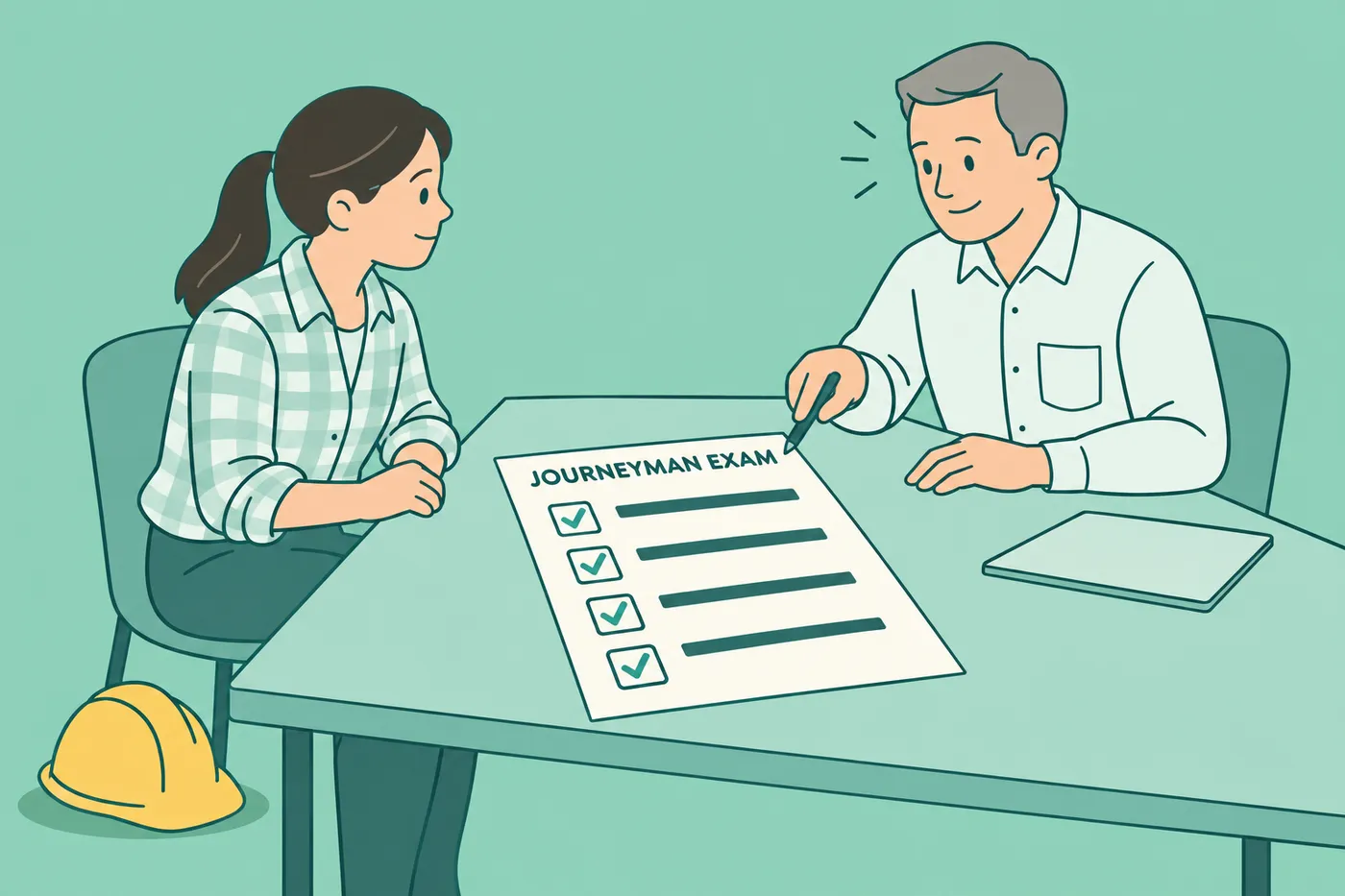
- Verified field hours, proven by employer affidavits or certified payroll, matching the total the statute requires for your track
- The classroom transcript from your registered program or approved school
- Your apprentice registration history, where the state requires registration for hours to count
- A completed application with photo identification, and in some states additional documentation the board's checklist names
The exam itself is open-book on the adopted NEC edition. It mixes code lookups under time pressure with calculations, conductor sizing and box fill being the classics, and a smaller share of theory. Candidates rarely fail on theory. They fail on speed, hunting through an untabbed codebook while the clock runs.
Documenting hours across multiple employers: the affidavit checklist
The single most common delay at the license stage is hours the applicant worked but cannot prove. Boards do not take your word for your hours; they take your employers'. Most apprentices work for more than one contractor across the program, and every one of those contractors owes you a signed affidavit. Each affidavit should carry:
- The contractor's letterhead and license number
- Your exact employment dates and total hours, broken out by category of work if your board's form asks for it
- The name and license number of the journeyman or master who supervised you
- A statement that the work was performed under direct supervision
- A signature from an owner or officer, notarized if your board's form requires it
Request the affidavit during your final week at each employer, not years later when the company may have been sold, renamed, or dissolved. Keep pay stubs and W-2s as a backup trail; some boards accept certified payroll when an employer has vanished. Log your hours weekly in a notebook or an app so your own totals and the affidavits agree, because a mismatch triggers exactly the review you are trying to avoid. Scan every document the day you receive it.
The application packet: your resume, the affidavits, and your OSHA card
An apprenticeship application packet usually asks for the program's form, proof of education and age, and increasingly a resume. An OSHA construction-safety card is rarely mandatory at the application stage, but it reads as seriousness to a committee, and many contractors require one before you step on a site anyway. Earning it before you apply is cheap signal.
The resume is where applicants with no electrical experience overthink it. Nobody expects trade experience; the committee is screening for reliability and work ethic. Keep it to one page in a reverse chronological format. Warehouse work, restaurant lines, retail floors and landscaping crews all translate if the bullets show attendance, physical stamina and composure under pressure. Name the algebra course you passed, list a valid driver's license, and put safety cards where a skimming reader sees them; here is where to put certifications on a resume so they register on the first pass.
You can build it in Roleframe's free resume editor with no account, and download a clean PDF with no watermark. That format point is practical, not cosmetic: committees photocopy packets, so a plain one-page PDF that prints crisply beats any design flourish, and PDF is the format to submit everywhere unless a program's instructions say otherwise.
Frequently asked questions
- How many years does it take to become an electrician?
Plan on four to five years for a journeyman inside-wireman track, since that is how most registered apprenticeships are structured. Residential and low-voltage tracks often run shorter. The floor is your state's field-hour requirement, so gaps between employers extend the calendar even when nothing else changes, and trade-school credit can trim classroom time but not the hours on the tools.
- Is 25 too old to become an electrician?
No, and committees would tell you the same. The interview scores work history and reliability, and a candidate with years of real jobs behind them often interviews better than a teenager with none. At 25 you can finish the apprenticeship with decades of licensed earning ahead of you.
- Can you become an electrician at 40?
Yes. Programs have no upper age limit, and career changers get in every year. The honest costs to plan around are physical, since the first years involve heavy conduit and ladder work, and financial, since apprentice pay starts as a fraction of journeyman scale before stepping up. Budget for that first period and the math works.
- Do you need a degree to be an electrician?
No. A high school diploma or GED plus a passed algebra course covers the education requirement almost everywhere. A college degree does not reduce the field-hour requirement, so it buys nothing on this path except the debt.
- How do you become an electrician with no experience?
Apprenticeship is built for people with no experience, so apply directly: find your local training committee's application window or an ABC or IEC chapter, pass the aptitude test, then interview. While you wait for a class seat, a helper job with an electrical contractor puts you around the work and gives your interview something concrete to point at.
- How long does it take to become an electrician in Nebraska?
The shape is the same as everywhere: a registered apprenticeship combining field hours with classroom instruction, then a journeyman exam. Exact hour totals and apprentice registration rules come from the state licensing authority, and that is where to confirm them, since totals differ by track and school marketing pages are often describing another state's numbers.
- How hard is it to become an electrician in Texas?
The sequence is the standard one, and the work at entry is learnable by anyone who passes the aptitude test. The step that actually trips people in state-licensed systems is working before registering as an apprentice, because unregistered hours may not count toward the license; confirm registration with the state licensing agency before your first day on the tools. After that, the real filters are the aptitude test and the wait for a class seat, not the difficulty of the trade itself.


Ready to start your new resume?
Writing a resume takes time, and even a polished one can miss what a hiring manager is looking for. Roleframe helps you build a clear, ATS-safe resume in minutes and tailor it to the job you want.


