What Are Your Strengths? Sample Answers by Career Stage
by Larbi SahliLast Updated
How to answer "what are your strengths": pick strengths the job needs, prove each with a real result, and adapt sample answers to your career stage.
On this page
Name one or two strengths the job posting actually asks for, prove each with a specific result from your own history, then connect it to the work you would do in this role. "I'm a strong communicator" loses; "I rewrote our onboarding emails and support tickets dropped in the first month" wins. The proof line is the answer. Everything else is setup.
What the interviewer is actually checking
This question is not a compliment-fishing exercise. The interviewer is running three checks at once, and a good answer passes all of them.
Self-awareness. Do you know what you are genuinely good at, and does your claim match what your resume, your references, and the rest of the interview say about you? A candidate who claims "attention to detail" with a typo in their resume fails this check on the spot.
Fit. Is the strength one this role actually consumes? "I'm great at public speaking" is a fine strength and a useless answer for a heads-down QA role. Interviewers hear it as: this person didn't read the posting.
Evidence. Can you back the claim with something that happened? Anyone can name a trait. Only people who actually have the strength can produce a specific story with a result attached, quickly and without rehearsed-sounding polish. That's why the proof line does most of the work.
There is a fourth, quieter check: calibration. An answer that is honest and slightly understated reads as senior. An answer that oversells reads as junior regardless of your title.
Pick your strengths from the job posting, not from a list
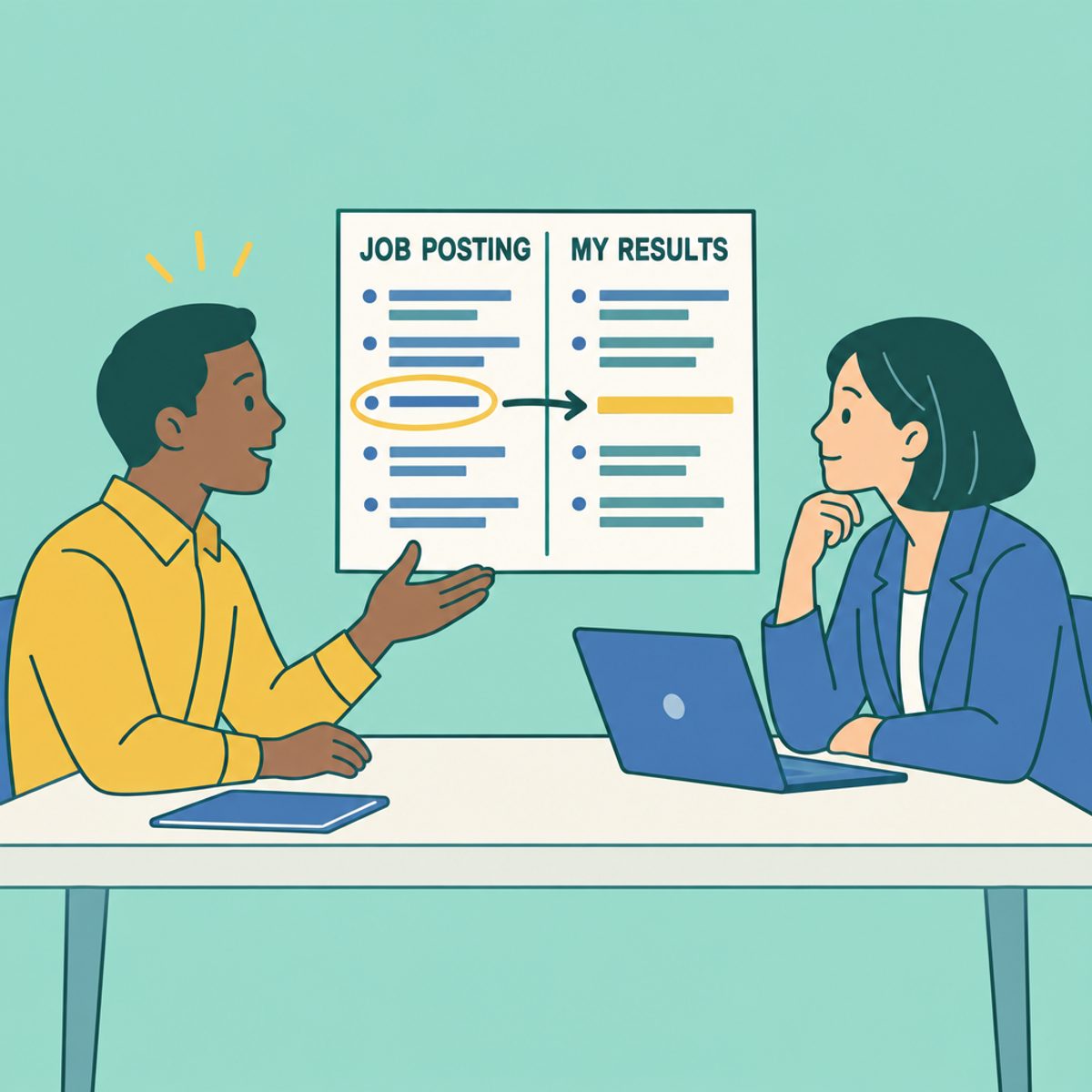
The lists of "top strengths employers want" are where generic answers come from. Your source material is the posting in front of you and your own history. The overlap between the two is your answer.
- Read the responsibilities section and mark what the role spends most of its time doing. The first three bullets usually carry the real job; the rest is boilerplate.
- Note any requirement that appears more than once, or shows up in both the summary and the bullets. Repetition is the posting telling you what the team is worried about.
- List three or four things from your own history you can prove with a result: a number, a shipped outcome, a promotion, a problem that stopped happening.
- Pick the one or two items that appear on both lists. That intersection, the job needs it and you can prove it, is your answer.
This is the same reading you do when you pull resume keywords from a job description, applied to the interview. If the posting says "cross-functional" three times, a strengths answer about coordinating engineering and legal on one project beats any trait word you could pick.
One more filter: choose a strength you actually enjoy using. Interviewers can hear the difference between a strength you live in and one you looked up, and the follow-up questions will expose it either way.
The three-part structure: claim, proof, link
Every strong answer to this question has the same skeleton, and it takes about forty-five to sixty seconds to deliver.
1. The claim, in the job's language. One sentence naming the strength, ideally using a word from the posting itself. "My greatest strength is getting cross-team projects over the line" for a posting that keeps saying cross-functional.
2. The proof, from your real history. One specific example with a concrete outcome. Name the situation, what you did, and what changed as a result. This is a compressed version of the STAR method: you don't need all four beats spelled out, but you do need the situation and the result.
3. The link to this job. One sentence connecting the strength to something this role will demand. "You mentioned this role owns the billing migration; that's the same shape of problem." This is the part almost everyone skips, and it's the part that separates a rehearsed answer from a targeted one.
The proof is where answers die. If you cannot fill part two with something true and specific, you have picked the wrong strength. Go back to your list and choose one you can prove, even if it sounds less impressive as a trait word. "I'm reliable under deadline pressure, and here's the quarter that proved it" beats "I'm a strategic visionary" with nothing behind it every single time.
"What are your greatest strengths?" How many to name and how long to talk
Interviewers phrase this question a half-dozen ways: greatest strength, biggest strengths, top three strengths, what would your manager say you're best at. They are all the same question, and the same answer structure works for all of them.
Singular ("your greatest strength"): give one, fully proven, in about a minute. Resist the urge to smuggle in a second.
Plural ("your strengths" or "greatest strengths"): give two. Lead with the stronger one and give it the full claim-proof-link treatment; give the second a claim and a one-line proof. Total time around ninety seconds.
"Top three": name three, prove the first two, headline the third. Three fully-storied strengths runs past three minutes and the interviewer stopped absorbing at two.
One deep answer beats three shallow ones because the follow-up question is where you win. An interviewer who asks "tell me more about that migration" is engaged. An interviewer who heard five trait words has nothing to grab onto and moves to the next question. This is the same logic as answering "why should we hire you?": a focused case, not a resume recital.
Sample answers for students and recent graduates
Your problem is thin work history, so your proof comes from coursework, part-time jobs, internships, and campus roles. That's fine. The interviewer knows you're a student; what they're checking is whether you can point to real behavior instead of reciting traits.
Sample: learning speed (for roles with unfamiliar tools)
"One strength I'd point to is how quickly I pick up new tools. In my retail job last summer, the store switched inventory systems mid-season. I learned the new system in my first two shifts, then wrote a one-page cheat sheet my manager used to train the rest of the team. I know this coordinator role uses a CRM and analytics tools I haven't touched yet, and my track record says I'll be productive in them fast."
Why it works: it concedes the gap the interviewer is already thinking about (you don't know our tools) and converts it into the strength. The cheat-sheet detail is small, specific, and checkable, which makes it believable.
Sample: organization under load (for coordinator, admin, and support roles)
"My biggest strength is staying organized when deadlines compete. Last semester I carried a full course load, worked twenty hours a week, and ran logistics for our club's fundraiser. I finished the term on the dean's list and the event beat its donation target. This role juggles requests from several account managers at once, and that's a load I've already handled, just with professors instead of AMs."
Why it works: the proof is the semester itself, not a claimed trait. The closing line does the translation from campus to office so the interviewer doesn't have to.
What to avoid at this stage: "I'm a hard worker" and "I'm passionate." Every graduate says both, neither is provable, and neither tells the interviewer what you'll be good at on Tuesday morning.

Sample answers for mid-career professionals
You have real results now, so the bar moves: your proof needs a number or a named outcome, and your strength should be one level more specific than a trait word. Not "communication" but "getting cross-team projects unstuck." Not "analytical" but "turning messy data into a decision someone acted on."
Sample: cross-functional delivery
"My greatest strength is getting projects over the line when they cut across teams. Last year I ran a website migration involving engineering, legal, and two outside vendors. It shipped two weeks early, mostly because in week one I found the dependency that would have stalled it, a legal review, and moved it to the front of the schedule. You mentioned this role owns the rollout of the new billing system. That's the same shape of problem: many owners, one deadline."
Sample: analytical problem solving
"I'd say my strongest skill is turning messy data into a decision. At my current company, our churn reporting mixed cancellations with failed payments, so the number looked worse than it was and we were spending retention budget in the wrong place. I rebuilt the report to separate the two, and we moved budget from discounts to fixing payment retries, which recovered a real share of what we'd been counting as churn. The posting asks for someone to own reporting for the growth team, and that's exactly the work I want to be doing."
Notice both answers name the mechanism, not just the outcome. "It shipped early because I found the dependency" tells the interviewer what you'll do here. "It shipped early" only tells them what happened there. Mid-career answers that skip the mechanism sound like luck.
Sample answers for career changers and mixed work histories
Your job in this answer is translation. The strength comes from the old field; the proof comes from the old field; the link to the new role has to be explicit, because the interviewer will not build the bridge for you. Done well, this answer is where a career changer wins the room, because it shows judgment that same-field candidates never have to demonstrate.
Sample: teacher moving into customer success
"My greatest strength is explaining complicated things to people who are frustrated. I spent six years teaching middle school science, which means six years of making hard concepts land with an audience that didn't ask to be there, and translating progress to parents who were often upset. Customer success is a different room with the same skill. The onboarding sequence I rewrote as a sample project for this application is how I'd apply it here."
Sample: operations manager moving into data analysis
"My strongest asset is process thinking. Running warehouse operations for five years meant finding the bottleneck every week, and in my last role I cut order-processing errors by redesigning one handoff between receiving and packing. Over the past year I've added SQL and Tableau on top of that instinct, and my portfolio project analyzes the same kind of fulfillment data I used to generate. I'll read your data with an operator's eye, which is what the posting is asking for when it says 'business context.'"
The pattern in both: name the transferable strength, prove it in the old context, then show one concrete thing you've already done in the new field (a sample project, a portfolio piece, a certification put to use). That third element answers the unspoken question, "is this person serious about the switch?", before it gets asked. The same translation logic drives a good career change resume: lead with what carries over, and make the bridge explicit everywhere.
Sample answers for senior and management roles
At the senior level, trait-word answers are disqualifying. The interviewer assumes competence; what they're probing is scope, judgment, and whether your strengths operate through other people. Your proof lines should carry team sizes, timelines, and organizational outcomes, the same scope numbers that belong on an executive resume.
Sample: developing people
"The strength I'm most confident in is building teams that outlast me. I inherited a team of eight with the highest attrition in the department. Over three years, four of those engineers were promoted, two into lead roles, and voluntary attrition dropped to near zero, without backfilling from outside. If this role is about scaling the platform group from twelve to thirty, the hiring is the easy half. Keeping and growing those thirty is where I've actually proven myself."
Sample: decisions under ambiguity
"My greatest strength is making sound calls with incomplete information. When our largest market changed its data-residency rules mid-quarter, the choice was pausing sales there or committing to a regional infrastructure build before the legal picture was final. I ran a two-week spike to price both paths, committed to the build, and we kept the market and signed our two biggest customers there the following year. A VP role in a regulated space is that decision on repeat, and I'm comfortable being the one who makes it."
A senior-specific warning: don't claim a strength your reference checks will contradict. At this level the company will talk to people who worked for you, and "builds great teams" gets tested against what your former reports actually say. Pick the strength your references would volunteer unprompted.

Strengths answers that cost offers
Most bad answers fail the same few ways. Each of these is common enough that interviewers have a reflexive discount for it.
- The generic trio. "I'm a team player, detail-oriented, and a good communicator" is the single most common answer to this question, and it carries zero information. If your answer could come from any candidate for any job, it did nothing for you.
- A claim with no proof. Naming a strength and stopping. The interviewer either has to interrogate you for evidence or, more often, quietly files the answer as unverified and moves on.
- A strength the role doesn't need. Leadership for an individual-contributor role, creativity for a compliance job. It signals you prepared a stock answer instead of reading the posting.
- A weakness in a costume. "My greatest strength is that I care too much about quality." Interviewers have heard the perfectionism dodge hundreds of times, on both the strengths and the weaknesses question, and it reads as evasion.
- Five strengths, none proven. Listing traits until the interviewer's eyes glaze. Depth beats breadth here without exception.
- Quoting a personality test as the proof. "CliftonStrengths says I'm an Achiever" is a starting point for self-reflection, not evidence. The assessment can inform which strength you pick; the proof still has to come from something you did.
- Overclaiming past your resume. If you call yourself a strategic leader and your resume shows two years as an individual contributor, the mismatch costs more than a modest answer would have.
The fix for every one of these is the same: go back to the claim-proof-link structure and make the proof do the talking. A modest strength with a sharp proof line outperforms an impressive strength with a vague one.
Build the answer from your resume, not from a template
The samples above show the structure, but your answer only works if the proof line comes from your history. The fastest way to find it is to reread your own resume asking one question per bullet: which of these is a strength this posting needs, stated with a result?
Roleframe turns that into a practice session. Duplicate your base resume for the job and you get a fit report that maps the posting's requirements against your real experience; then ask Remi, the career copilot, for interview practice. It builds questions from what is actually on your resume and, on a tailored version, from the posting itself, asks you one at a time, and tells you where an answer was thin, which for strengths answers is almost always the proof line. You leave with a claim and a proof drawn from your own history instead of a script borrowed from a sample-answer page.
Frequently asked questions
- What is the best answer to "What is your greatest strength?"
The best answer names one strength the job posting asks for, proves it with a specific result from your history, and links it to the role in a closing sentence. For example: the claim ("my greatest strength is getting cross-team projects over the line"), the proof (a named project with an outcome), the link ("your posting says this role owns the billing rollout, same problem"). Aim for about a minute.
- What are 5 examples of strengths for an interview?
Strengths that work across many roles include: learning new tools quickly, staying organized under competing deadlines, explaining complex topics to non-experts, turning messy data into decisions, and getting cross-functional projects finished. Each only works with a proof line from your own experience attached. Pick the one or two that match the posting rather than reciting a list.
- What are the top 3 work strengths?
There is no universal top three; the right strengths are the ones the specific posting repeats. That said, the strengths interviewers reward most consistently are ownership (you finish things without being chased), clear communication (proven with an outcome, not claimed as a trait), and problem solving (you found the mechanism, not just the symptom). If the posting names something more specific, that beats all three.
- How should I answer "What are your weaknesses?"
Name a real weakness that is low-stakes for this particular role, then describe the concrete thing you are doing about it. "I used to under-communicate project status, so I now send a Friday summary to every stakeholder" works because it is true, specific, and already being fixed. Skip the perfectionism dodge; interviewers hear it constantly and read it as evasion.
- How long should my strengths answer be?
About forty-five to sixty seconds for one strength, and up to ninety seconds if the question is plural and you give two. Long enough to include a real example with a result, short enough that the interviewer can follow up. If you are still talking at the two-minute mark, you are proving a different weakness.
- Can a soft skill be my greatest strength?
Yes, if the role consumes it and you can prove it with a result. "Explaining complicated things to frustrated people" is a soft skill and a winning answer for support, success, and teaching-adjacent roles when backed by a real example. What fails is the unproven trait word: "I'm a people person" tells the interviewer nothing. The test is the proof line, not whether the skill is hard or soft.


Ready to start your new resume?
Writing a resume takes time, and even a polished one can miss what a hiring manager is looking for. Roleframe helps you build a clear, ATS-safe resume in minutes and tailor it to the job you want.


