How to Edit a PDF Resume Without Breaking the Layout
A PDF resume breaks when you edit it directly. Here's how to edit a PDF resume properly: import it as editable blocks, fix the content, export clean.

On this page
A PDF resume is a snapshot, not a document. The format records where every character sits on the page and nothing about the paragraphs and sections those characters used to belong to. That is why a PDF looks identical on every device, and it is also why editing one directly so often ends in overlapping text and broken alignment.
If you need to change anything more than a comma, you have two real options. You can patch the PDF in place with an overlay tool and hope nothing shifts, or you can turn the file back into an editable document and work on that. This guide covers both, explains why the first approach keeps wrecking resume layouts, and walks through the second one step by step.
Why editing a PDF resume directly goes wrong
The core problem is what a PDF actually is. When your resume became a PDF, the software that made it threw away the document structure and kept only drawing instructions, in effect "place this character at this coordinate, in this font, at this size." The bullets and margins you see are an illusion your eyes reconstruct, not objects the file knows about.
So when you click into a PDF and change a word, the editor cannot reflow the paragraph the way a word processor would, because there is no paragraph. There is only a cluster of positioned characters. Make the replacement text one letter longer and it collides with whatever sits next to it. Delete a line and you leave a gap the file has no idea how to close.
Before you fight any of that, check one thing. If you still have the source file your resume was exported from, a Google Doc or an old builder account, editing the source and re-exporting the PDF is the cleanest fix there is. Most people reading this don't have it. The original lives on a dead laptop or inside an expired trial of some builder. That situation is what the rest of this guide is for.
Why generic PDF editors ruin resume formatting
Online PDF editors are built for contracts and forms, not resumes. Their editing model is an overlay. You draw a text box over the old content, cover the underlying text with a white rectangle or delete it, and type new text on top. For signing a lease, that works. For a resume, several things go wrong at once.
- The new text rarely matches. The editor guesses at the original font, and resumes often use fonts the tool doesn't have, so your edited line sits in a slightly different typeface than everything around it. Recruiters notice a mismatched line fast, because it looks like exactly what it is, a patch.
- Nothing reflows. Write one word more than the original line held and it overlaps the next line or spills past the margin. Trimming your edit to fit the old line means the layout is now editing your resume instead of you.
- The text layer gets messy. Overlays and covered-up text objects can leave duplicated or out-of-order text underneath the visible page. You can't see it, but software that extracts text from the file can, and an applicant tracking system (ATS) is exactly that kind of software.
The other common route is converting the PDF to a Word or Google Docs file and editing that. Conversion tools rebuild the layout out of whatever objects approximate it, which for a designed resume usually means invisible tables and floating text boxes. You spend your first half hour fixing conversion damage, misaligned dates and a skills section that turned into a table, before you touch a single word of actual content. Then you re-export and hope the second-generation file looks better than it deserves to.
| Method | How it works | Where it breaks |
|---|---|---|
| Online PDF editor (overlay) | Places a new text box on top of the existing page | Fonts don't match, nothing reflows, and the hidden text layer can end up scrambled |
| Convert to Word / Google Docs | Rebuilds the file as an editable document | Columns become invisible tables; you repair conversion damage before editing anything |
| Retype from scratch | A clean start in a new document | An hour or more of typing, and old mistakes get copied over by hand |
| Parse into a resume editor | Reconstructs the PDF as structured, editable blocks | Requires a text-based PDF; a scanned image has no text to parse |
The better way: turn the PDF back into an editable document
The layout breaks because you are editing pixels. The fix is to stop editing pixels and get the document structure back. That is what Roleframe's import does. Its parser reads your PDF and reconstructs it as editable blocks, with your work history, dates, and skills landing in the right fields of a real document rather than floating on a page. Each section becomes a block you can rewrite or drag to a new position.
This is different from a PDF editor in kind, not in degree. Once the file is parsed, there is no PDF anymore until you export a fresh one. There is a document that reflows when you type, grows when you add a bullet, and keeps its typography consistent because the whole thing shares one set of styles. The failure modes of overlay editing simply don't exist here.
The import also runs Roleframe's resume analysis on its own, so the first thing you see is not a blank canvas or a raw text dump. It is your own resume, scored, with the weak sections named. That matters if the reason you're editing is a job application: you see what needs fixing before you start fixing it.
Step 1: Upload your existing PDF resume
The one requirement is that your PDF contains real text rather than a picture of text. A resume that was scanned or photographed is an image, and there are no characters to parse. Almost anything exported from a word processor or a resume builder is text-based and imports fine. If you're not sure which kind you have, run this thirty-second check.
- Open the PDF and press Ctrl+A (Cmd+A on a Mac) to select everything.
- Copy it, then paste into a plain-text editor like Notepad or TextEdit.
- Read the result. If your roles and dates appear in a sensible order, the file is text-based and will parse. If you get nothing at all, it's a scan. If the order looks scrambled, a purpose-built resume parser will still handle it far better than a generic converter would.
A LinkedIn profile saved as a PDF imports the same way as any other PDF. Treat it as raw material rather than a finished resume, though. A profile export is written for browsing, not for a specific job, so plan on tightening it once it's in the editor. A free Roleframe account covers the import, and no card is needed.
Step 2: Review the automatically structured sections
Parsing an arbitrary PDF is an inexact science, and any tool that claims a perfect hit rate is overselling. Roleframe gets the structure right on the large majority of resumes, but two minutes of review here saves you from a subtle error surfacing later. Look at four things.
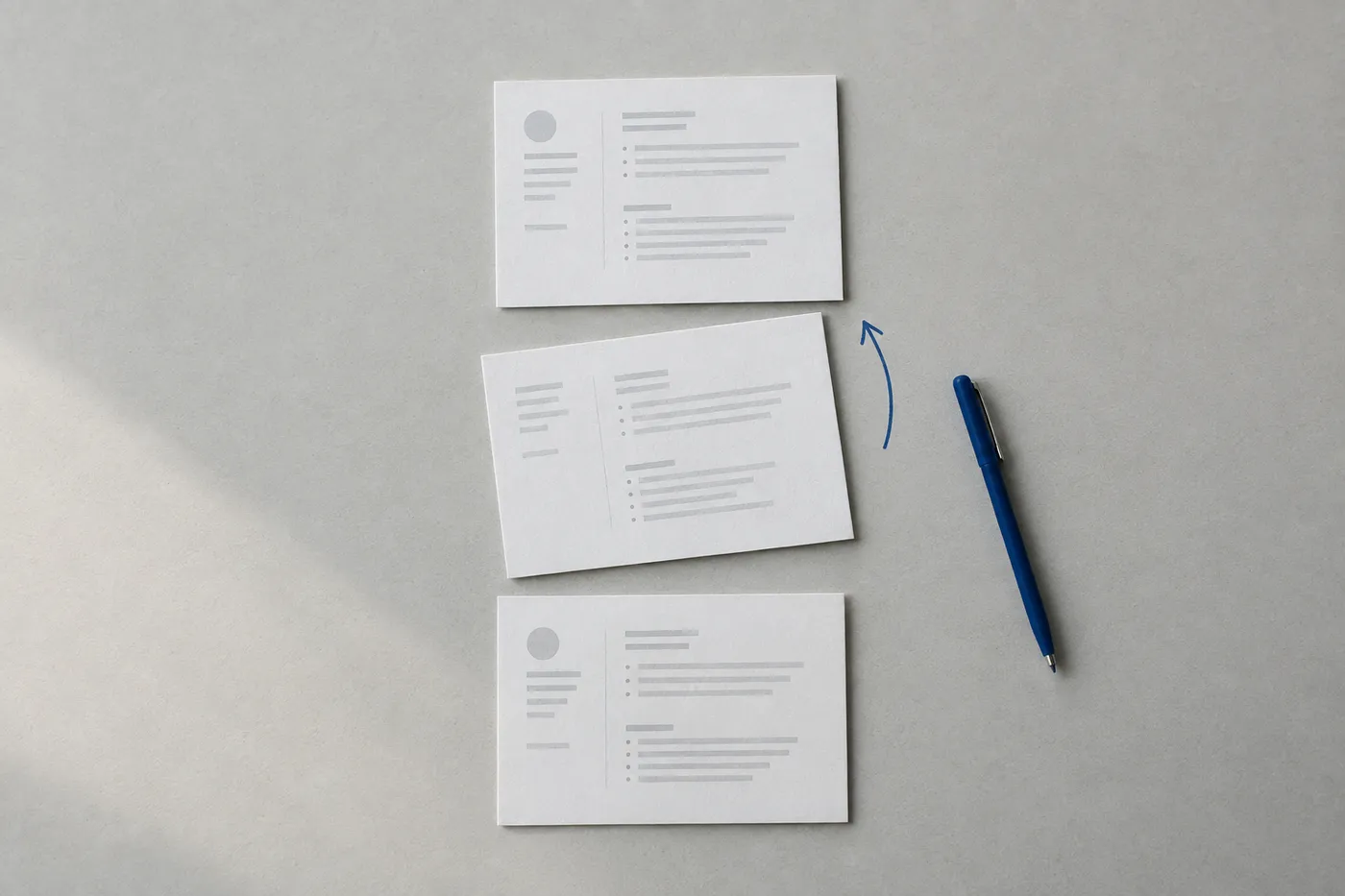
- Dates attached to the right role, especially if your original used a two-column layout where dates sat far from job titles.
- Bullets grouped under the correct job rather than drifting up into the one above.
- Contact details, because headers and footers are the flakiest region of any PDF.
- Section labels. If your original called the work history something like "Relevant Experience," confirm it landed as an experience section.
Everything here is fixable in place. A misfiled bullet is a drag away from its correct job, and a wrong date is a click and a retype. Compare that with a converted Word file, where fixing structure means wrestling invisible tables that fight back.
Step 3: Make your edits in a document-grade editor
Once the resume is blocks, editing behaves the way you expect from a word processor, with resume structure on top. Change a job title and the line reflows. Add a bullet and the section grows, pushing what's below it down the page instead of over it. This is the moment the "how do I change text in a PDF resume" problem stops existing, because you are no longer editing a PDF at all.
Reordering is a drag, literally. Grab the handle on the left edge of a selected block and drop it above another section or onto a different page entirely. The block keeps its content and formatting when it moves, which turns advice like "put your strongest section first" into a ten-second action. If you're unsure what order that should be, the answer depends on your experience level, and our guide to resume section order walks through it.
For the writing itself, Remi, Roleframe's career copilot, sits beside the document. Ask it to tighten a bullet or sharpen your summary and it proposes a rewrite as a word-by-word diff. Nothing reaches the document until you accept it, which is the point. You should never send a resume containing a sentence you didn't approve, because you will be asked about that sentence in an interview.
If a specific job posting triggered this whole editing session, duplicate the imported resume for that job first. Roleframe reads the posting and produces a fit report, showing the keywords you're missing and a prioritized plan of what to change, so your edits close named gaps instead of guessing. The base resume and tailored versions workflow keeps your master copy intact while you do it.
Step 4: Export a clean, ATS-friendly PDF
When the edits are done, export a fresh PDF. Roleframe's export is true WYSIWYG, meaning the PDF matches the editor exactly, and the templates are built to parse cleanly, with a single-column reading order and standard section labels. No hidden text layers, no leftover overlay artifacts, no second-generation conversion damage.
Two habits are worth keeping from this process. First, run the plain-text check from step one on your exported file too; if the copy-paste comes out in reading order, extraction software will read it the same way. Second, submit PDF by default. It preserves your formatting on every machine that opens it, and text-based PDFs parse reliably in modern hiring systems. The only reason to send a different format is an employer explicitly asking for one. For a deeper pass on formatting decisions, see how to make your resume ATS-friendly without ugly design.
How to edit a PDF resume for free
The import route above works on a free Roleframe account, no card required. If you'd rather rebuild from scratch, the same document-grade editor is open on Roleframe with no account at all, every template included, and the PDF download is free with no watermark. That combination is rarer than it should be, since most "free" builders let you build for an hour and then gate the download at the last step. We compared the options in is there a truly free resume builder if you want the full picture.
One honest caveat about free overlay tools, since they dominate the search results for this topic. They are genuinely fine for a one-character fix, a typo in your phone number or an updated email address. The moment the change alters line length, a new bullet or a rewritten summary, the overlay model works against you, and the time you save up front gets spent nudging text boxes.
Frequently asked questions
- How can I edit a PDF resume for free?
Two free routes work. If your PDF is text-based, import it into Roleframe on a free account and edit it as a structured document, with no card needed. If you only need to fix a typo, a free online overlay-style PDF editor can patch it, but match the font carefully and keep the new text no longer than the old text so nothing overlaps.
- How do I edit a PDF that I already saved?
First look for the source file the PDF was exported from. Editing that and re-exporting is always the cleanest path. If the PDF is all you have, patch it with an overlay tool for a one-word fix, or import it into an editor that parses it back into a document for anything bigger. Editing the PDF's own text layer directly is the worst of the options, because nothing reflows when the text length changes.
- What is the easiest way to edit a PDF resume?
Match the tool to the size of the change. For a single character, an online PDF editor is fastest. For anything that changes line length, a rewritten bullet or a new job entry, importing the PDF into a resume editor is easier overall, because you skip the layout repair that overlay edits and Word conversions force on you.
- How do I edit an already made resume for a new job?
Keep a master version and duplicate it for each application rather than overwriting your only copy. In Roleframe, duplicating a resume for a job produces a fit report that names the keywords you're missing and what to change, and you make the edits yourself with Remi proposing rewrites you approve. Our guide to the master resume explains the setup.
- Can I edit a PDF resume in Microsoft Word?
Word can open a PDF and convert it into an editable document, but for designed resumes the conversion usually mangles columns and spacing, so you inherit layout repair before you can edit any content. If you take this route, budget real time for fixing the structure, and export the finished file back to PDF rather than sending the converted document.
- Will an ATS reject a PDF resume?
A text-based PDF with a clean reading order parses fine in modern systems, so PDF remains the right default format. Trouble comes from scanned-image PDFs, which contain no text to extract, and from layouts where extraction order gets scrambled, such as heavy multi-column designs or critical details tucked into headers and footers. Run the copy-paste-into-Notepad test on your final PDF; if it reads in order, you're in good shape.
- Why does my PDF resume break when I edit it?
Because a PDF stores positioned characters, not paragraphs. Editors can't reflow text that has no paragraph structure, so any edit longer or shorter than the original collides with neighboring text or leaves a gap. The fix is structural rather than a better PDF editor: convert the file back into a real document, edit that, and export a fresh PDF.


Ready when you are
Send the tailored resume, not the generic one.
Paste a job posting and Roleframe scores your resume against it, then helps you close the gaps one approved edit at a time, so you apply while the role is still fresh.