How to Become an LPN: Approved Programs, Licensure and First Applications
How to become an LPN, verified step by step: state-approved programs, NCLEX-PN licensure, a dated cost plan and your first job applications.

On this page
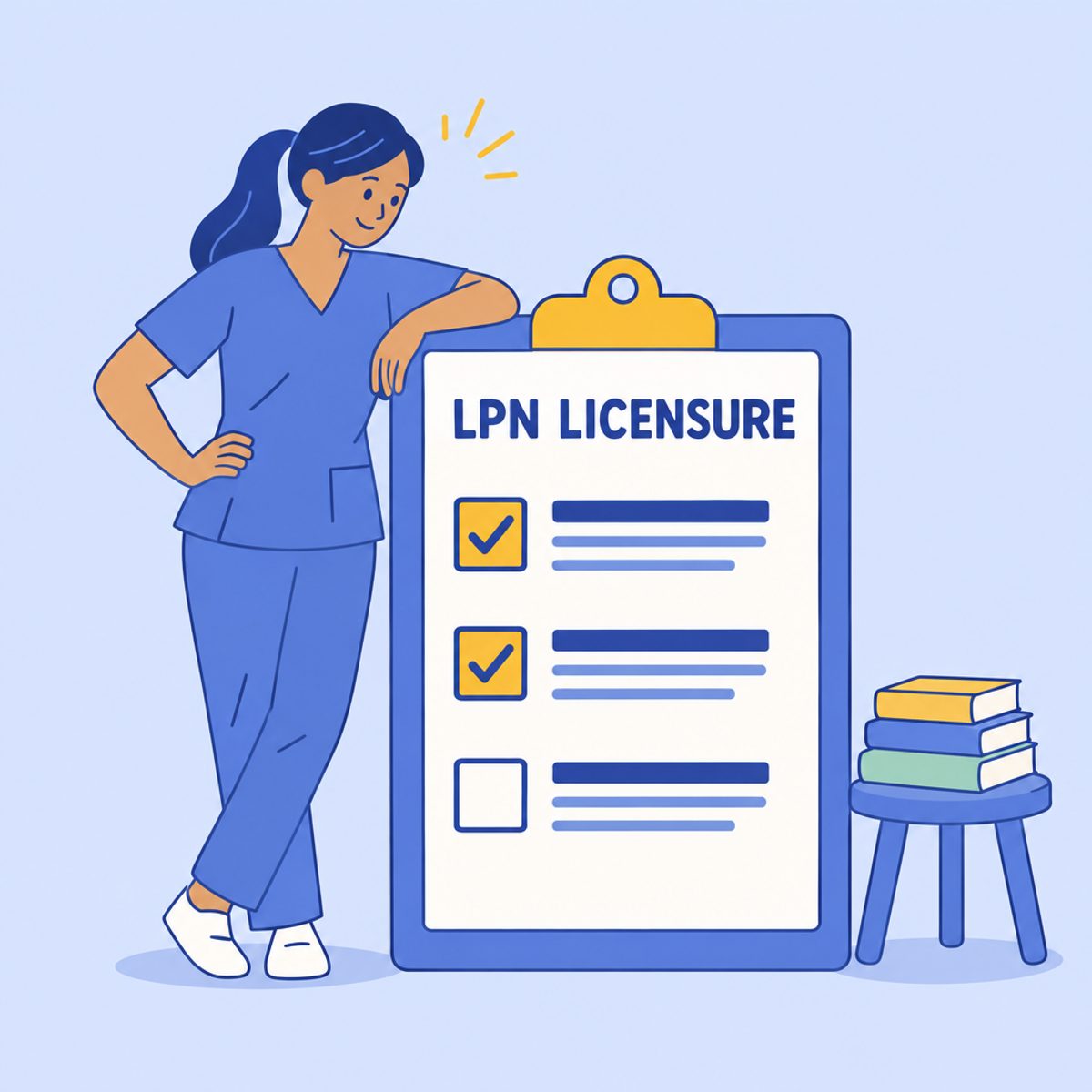
The usual U.S. practical nursing route is board-accepted education, an application to the intended nursing regulator, NCLEX-PN registration and examination, and completion of all licensing requirements. State rules and applicant categories determine the details.
Start with the board’s accepted-program guidance, then compare schools’ full academic and clinical calendars. This guide provides a verification worksheet, cost plan and a way to document supervised learning for your first application.
LPN and LVN: one occupation, two titles
Some states license the same occupation as a licensed vocational nurse (LVN). The education, the NCLEX-PN and the work are the same occupation; only the title on the license changes. Use the term your intended state uses when you search its board website, its approved program list and its job postings, or you will miss half the results.
And yes, an LPN is an actual nurse. You hold a state license, you are accountable for the nursing care you give within your legal scope of practice, and you work under the supervision or direction your state requires, often from a registered nurse (RN), an advanced practice nurse or a physician. The National Council of State Boards of Nursing (NCSBN), the body behind the NCLEX exams, treats safe entry to LPN practice as three things: qualifying education, jurisdiction-specific licensure eligibility, and a passed NCLEX-PN.
The verification rule: who confirms what
Every claim you will hear on this path has exactly one authority behind it. A school can be honest and still out of date; a blog can be well-meaning and describe a different state. Before you act on any claim, check it with the body that controls it. This table is the tracker to keep open through the whole process.
| Claim you will hear | Who controls it | How to verify |
|---|---|---|
| "This program qualifies you for licensure" | Your state board of nursing | Find the program, under its exact name and campus, on the board's published list of approved practical nursing programs |
| "Our graduates pass the NCLEX-PN at a high rate" | The state board | Check the board's published pass rates by program, not the number on the school's banner |
| "The exam has this many questions and this time limit" | NCSBN and Pearson | Read the official test plan and candidate bulletin for your examination date; do not assume that a plan update changed every testing parameter |
| "Tuition is X and you finish in Y months" | The institution | Get the cost sheet and the academic calendar for your specific start term, dated and in writing |
| "Your license will work in another state" | The board of the state where you want to practice | Ask that board directly before you enroll; never assume interstate eligibility |
The last row matters more than people expect. Per NCSBN (2026), every U.S. jurisdiction sets its own licensure requirements: application procedures, fees, background checks and eligibility conditions all differ. If you plan to study in one state and work in another, confirm the second state's rules before you pay the first state's tuition.
Find state-approved LPN programs and compare prerequisites
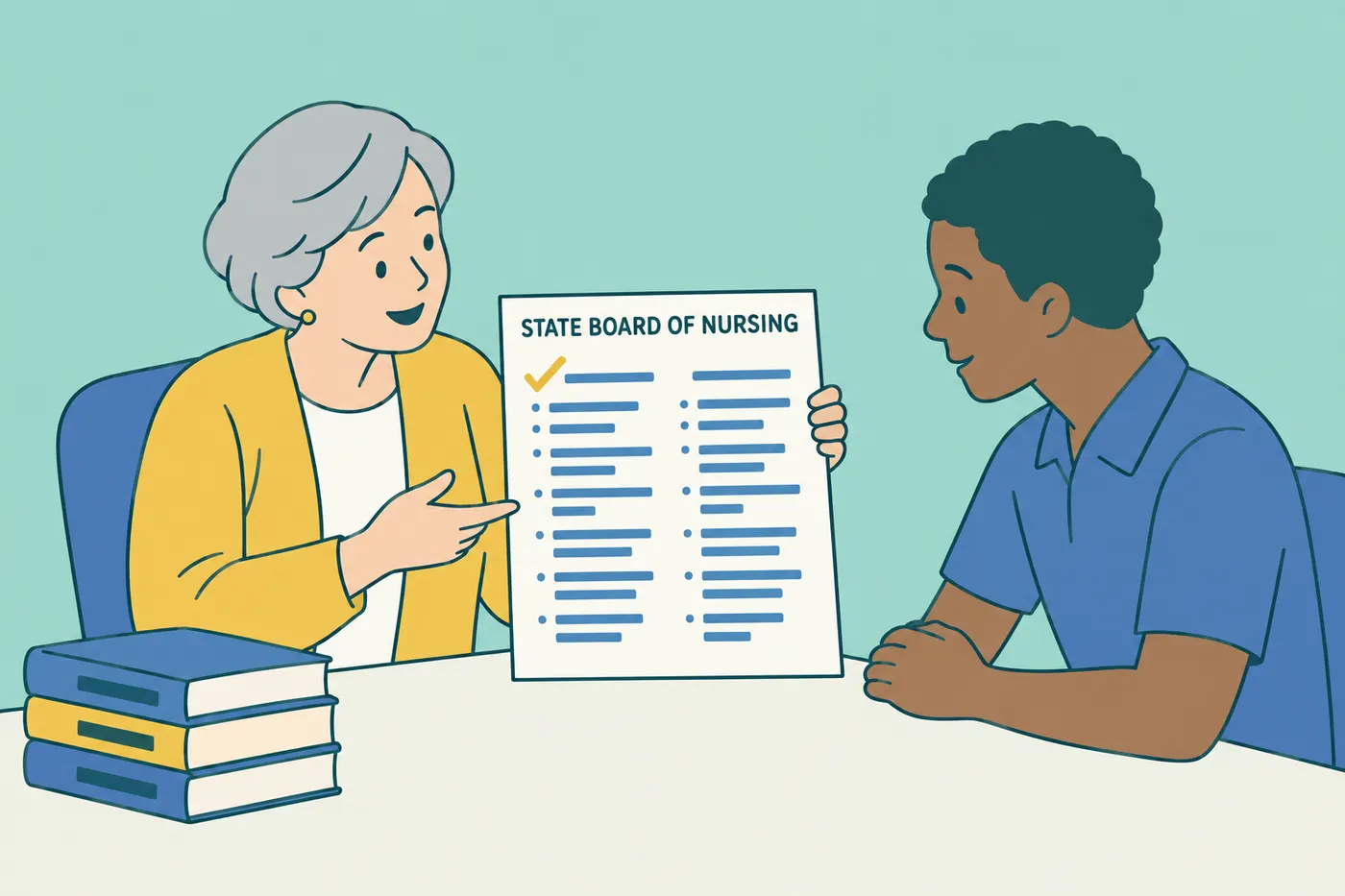
Use the intended state board’s approved-program list and guidance on out-of-state or other applicant categories. Verify the exact program and campus before enrolling. If it is outside the jurisdiction or your education history is unusual, ask the board whether it meets the relevant requirements rather than assuming a list from another state is sufficient.
- Open your state board of nursing's site and find its approved practical or vocational nursing program list.
- Shortlist the approved programs you can realistically attend, by location, schedule and format.
- Pull each program's published admission requirements for the current application cycle, from the program's own page.
- Record every prerequisite with a date: entrance exams, required courses, immunization and health records, background screening, and application deadlines.
Get the program’s current prerequisites in writing: education, entrance testing, prerequisite courses and clinical-clearance requirements. A nondegree practical nursing award may be an entry route, but it still must meet the board’s requirements.
For a hybrid course, check the in-person lab and clinical arrangements as well as board acceptance. Ask for the full calendar, including prerequisites and clinical placements. A short advertised theory component is not the entire route to licensure.
Judge the program: clinicals, standing and the real schedule
Once you have two or three approved programs, compare what actually determines your experience. Clinical placements are the core of it. That is where you learn the job, where instructors sign off your skills, and where your first professional references come from.
- Clinical sites: where are they, who secures the placement (the program or you), and in what settings will you rotate?
- Clinical hours: how many, and how are they scheduled against the classroom calendar?
- Pass rates: what first-time NCLEX-PN pass rate does the state board publish for this program, over more than one year?
- Approval status: is the program fully approved, or does the board flag it as conditional or provisional?
- The real week: which days, which evenings, and which labs are mandatory on campus? Can you hold your current job through it?
- Completion rates: if the program or board publishes how many students finish, read it before you commit.
Ask these questions in writing and keep the answers. A program that hesitates to put its clinical arrangements or pass rates in an email is telling you something useful.
Confirm licensure and the NCLEX-PN with official sources
The official NCLEX registration process separates the board application from registration with Pearson. Apply for licensure to the nursing regulator and complete examination registration as instructed. After the regulator declares you eligible and testing registration is complete, you receive an Authorization to Test (ATT). You need that authorization to schedule and must test within its dates.
Use the official NCLEX-PN test plan and candidate bulletin for your examination date to check the format, content areas and candidate instructions.
Passing the exam does not by itself issue a license. The board also decides education, identity, background and other application requirements. Check when any provisional permission is available and what it allows before accepting work.
Build a cost plan from dated primary sources
You will see total cost figures all over the internet for LPN programs. Ignore them. Tuition differs by school and term, board fees differ by state, and exam fees change. Build your own itemized plan instead, where every line has a primary source and a date you pulled it.
| Cost item | Primary source for the current figure |
|---|---|
| Tuition and mandatory program fees | The program's published cost sheet for your start term, confirmed in writing by the admissions or financial aid office |
| Books, uniforms, clinical supplies and equipment | The program's supply list for the current cohort |
| Entrance exam fee | The testing provider named on the program's admission page |
| Immunizations, physical exam and CPR certification | The program's health requirements document, plus your own provider's prices |
| Background check and fingerprinting | Your state board of nursing's instructions and fee schedule |
| Board application fee | The board's current fee schedule, on its own website |
| NCLEX-PN registration fee | Pearson’s official examination registration and fee instructions; the ATT follows completed registration and board eligibility |
| Initial license or temporary permit fee | The board's fee schedule |
Total the lines, add a buffer for retakes and renewals of time-limited items like background checks, and date the whole sheet. If a figure is more than a few months old when you enroll, pull it again. A cost plan with dates is also your best defense in a financial aid conversation: you can ask about a specific line instead of a vague total.
Build an evidence bank during clinicals
Keep required clinical encounter and competency documentation in the program or facility’s approved secure system. Ask how to obtain an authorized aggregate summary of your assessed learning for applications. Personal job-search notes should not contain patient-level records or case details.
- Instructor-verified competencies you are permitted to describe
- General clinical settings and supervised student responsibilities
- Authorized aggregate experience summaries, without patient-level details
- Documentation systems and equipment you actually used
- General instructor feedback you may share and authorized professional references
Protect confidentiality by leaving clinical records, identifiers, photographs and potentially identifying combinations of case details in the authorized system. Do not copy them into personal files, resumes or AI tools. Use only the program’s approved aggregate summaries for applications.
Describe rotations as supervised student learning and distinguish observation, assistance and tasks performed under supervision. The nursing skills guide and no-experience resume guide can help organize truthful, nonidentifying evidence.
Apply for your first role with accurate credential status
Look for vacancies explicitly open to new graduates and read their license-status requirements. State whether you are a student, a graduate, scheduled for NCLEX-PN or licensed; do not use LPN/LVN as an earned credential before the board issues it.
Support your application with approved summaries of clinical training and real transferable experience. Show student rotations as supervised education, and omit patient identifiers. Follow the employer’s requested upload format and prepare examples about teamwork, communication and escalation within your scope.
The expected-graduation guide and credential placement guide can help arrange the milestones clearly. Ask employers about orientation, preceptorship, supervision and shift expectations.
Frequently asked questions
- What is the difference between an LPN and a CNA?
An LPN is a licensed nurse: you complete a state-approved practical nursing program, pass the NCLEX-PN, and provide basic nursing care under the supervision your state defines. A certified nursing assistant (CNA) provides hands-on supportive care, such as bathing, feeding, mobility help and basic observations, under the direction of nurses, and does not independently perform licensed nursing functions. LPN education, responsibility and scope of practice are broader, and the specifics of both roles vary by state.
- Which is paid more, an LPN or an RN?
Compare current BLS regional wage data and local offers for the two occupations, accounting for hours, benefits and shifts. Registered nursing is a separate education and licensing route; a national wage comparison is not a promise of your individual earnings.
- Is an LPN an actual nurse?
Yes. An LPN, called an LVN in some states, holds a state nursing license, completes board-approved education, passes the NCLEX-PN, and is legally accountable for the nursing care given within the state-defined scope of practice. LPNs typically work under the supervision or direction of an RN, an advanced practice nurse or a physician, as each state requires.
- Is it hard to become an LPN?
It requires science coursework, practical skills and assessed clinical learning within a board-accepted program, followed by the licensing process. Ask about prerequisites, clinical schedules and student support. A typical program duration is not a guarantee that every applicant can qualify in that time.
- Do you need prerequisites for LPN programs?
Usually some, and they vary by program. A high school diploma or GED is common, many programs require an entrance exam, and some require prerequisite courses, immunization records and a background screen before clinicals. There is no national standard, so the only reliable answer is the current admission page of the specific program, confirmed for your application cycle.
- Can you become an LPN online in 6 months?
Check the exact program, clinical arrangements and board acceptance rather than relying on the advertised duration. Some theory can be online, but the complete route includes practical and clinical requirements and licensing steps. Ask for the full calendar and verify acceptance with the intended board before paying.
- Is the job outlook for LPNs good?
Look at current local vacancies open to new graduates, the required license status, scheduled hours and supervision. BLS projections describe broad occupational trends and cannot guarantee an opening in your area. Compare the complete training cost with realistic offers.

Ready to start your new resume?
Writing a resume takes time, and even a polished one can miss what a hiring manager is looking for. Roleframe helps you build a clear, ATS-safe resume in minutes and tailor it to the job you want.


