How to Become an EMT: Training, Certification and State Approval
Plan EMT training, National Registry certification, state-approved skills verification and state authorization, with program and application checklists.

On this page
Becoming an EMT involves state-approved education, the assessment required for your route and state authorization to practice. National certification and state authorization are different milestones.
Begin with the state EMS office’s approved-program list and current application instructions. Then confirm how the course documents completion, handles skills verification and prepares you for the relevant certification process.
The route at a glance
- Decide between EMT and paramedic as your target qualification, because they are separate pathways with different training and different scopes of practice.
- Contact your state EMS office and ask which certifications it requires, whether it uses National Registry certification, and where its list of approved training programs lives.
- Pick a state-approved EMT course that meets the National EMS Education Standards and confirms your exam eligibility in writing.
- Complete the course, including the supervised practical component, and keep your completion documents.
- Pass the National Registry EMT cognitive exam and the state EMS office-approved basic life support (BLS) skills competency requirement.
- Apply for your state license or certification, which is the step that actually authorizes you to work.
- Apply for your first EMT job with documented, verifiable evidence from your training.
The National Registry full-education pathway requires qualifying course completion within the past two years, program-director verification, the certification examination and state-approved BLS skills competency. Passed portions remain valid for 24 months only while other eligibility requirements are met. Read your actual Authorization to Test and handbook for scheduling deadlines.
EMT vs. paramedic: pick the target before you pick a course
EMT and paramedic are different qualifications with different scopes of practice, not two names for the same job. An EMT provides basic emergency care: responding to emergencies, assessing and triaging patients, and transporting them to or from healthcare facilities, as the U.S. Department of Health and Human Services describes the role. Paramedic training goes further and takes longer, and the National Registry treats the progression from EMT to Advanced EMT (AEMT) or paramedic as a separate education and certification pathway. AEMT applicants must already hold EMT-level or higher certification or licensure.
The practical consequence: almost everyone starts at EMT. If your goal is paramedic, you still complete the EMT route first, then enter a paramedic program. Choose your first course with that progression in mind if you plan to advance.
| EMT | Paramedic | |
|---|---|---|
| Scope | Basic emergency care, assessment, triage and transport | Advanced care; a separate, longer education pathway |
| Entry requirement | State-approved EMT course meeting the National EMS Education Standards | EMT-level certification or licensure first, then paramedic training |
| Pay comparison | Compare current local EMT vacancies and regional wage data | Compare paramedic vacancies separately; additional training does not promise a particular offer |
| Certification cycle | Renew every two years | Separate certification with its own requirements |
Compare duties, required preparation and the actual shifts available in local postings. Wage differences depend on setting, employer and location; they should be assessed alongside tuition and time away from work.
Step 1: Check prerequisites with state-approved programs, not with articles
Prerequisites vary by state and by program, so the only reliable source is the program itself, cross-checked against your state EMS office. Articles, this one included, can tell you what to ask. They cannot tell you what your state requires this year.
Call or email two or three state-approved programs and ask these questions before you commit to anything:
- Is this course currently on the state EMS office's approved list, and does it meet or exceed the National EMS Education Standards?
- What are the entry prerequisites: minimum age, education documents, CPR/BLS certification before or during the course, background check, immunization records?
- Does completing this course make me eligible for the National Registry EMT exam and the state's skills competency requirement, and will you confirm that in writing?
- How is the supervised practical component structured: where do clinical or field hours happen, and how far will I travel for them?
- What is the course completion documentation, and how quickly is it issued after the final day?
A program that hesitates on the approval question or the exam eligibility question is telling you something. The course must be state approved and must meet the National EMS Education Standards; a general first-aid or CPR class does not substitute for EMT education, however good it is.
Step 2: Choose training by approval, supervised experience and exam eligibility
Rank programs on three things, in this order: official approval status, the quality of the supervised practical component, and confirmed assessment eligibility. Price and schedule come after, because a cheap course that does not qualify you to test is the most expensive option on the list.
The practical component is where the job gets real. EMT training involves assessing medical and trauma patients and demonstrating hands-on skills under supervision, and this is the part of the course that produces the evidence your first employer will ask about. A program that gives you more structured, supervised patient-contact time is worth a longer commute.
On fully online EMT training: the cognitive parts of a course can run online in some programs, but the supervised practical component and the skills verification cannot. If a program advertises itself as entirely online with no in-person component, confirm with your state EMS office that it satisfies the state's requirements before paying anything. The current pathway requires a state EMS office-approved BLS skills competency verification in addition to the written exam, and that is done in person.
Step 3: Exam, national certification and state authorization are three separate checkpoints
Certification assessment. The National Registry’s EMT route includes the certification examination and state-approved BLS skills competency. The state may integrate skills verification into the course. The Registry does not require one national order for examination versus skills verification, so confirm your program’s arrangement.
Scheduling. Complete the application, fee and program-verification steps, then follow the dates on your Authorization to Test. Do not treat the validity of passed examination portions as an extension of your ATT or other deadlines.
State authorization. Ask the EMS office how national certification, background screening and any additional documents fit its licensing or certification process. Do not start work solely on the strength of a national exam pass, and check the destination state before relocating.
Step 4: Build a cost and schedule checklist before you enroll
Course tuition is the visible cost. The route has several less visible ones, and listing them before you enroll prevents the mid-course scramble that pushes people past their exam windows. Exact figures vary by state, program and year, so fill in current numbers from the program and the testing organization directly.
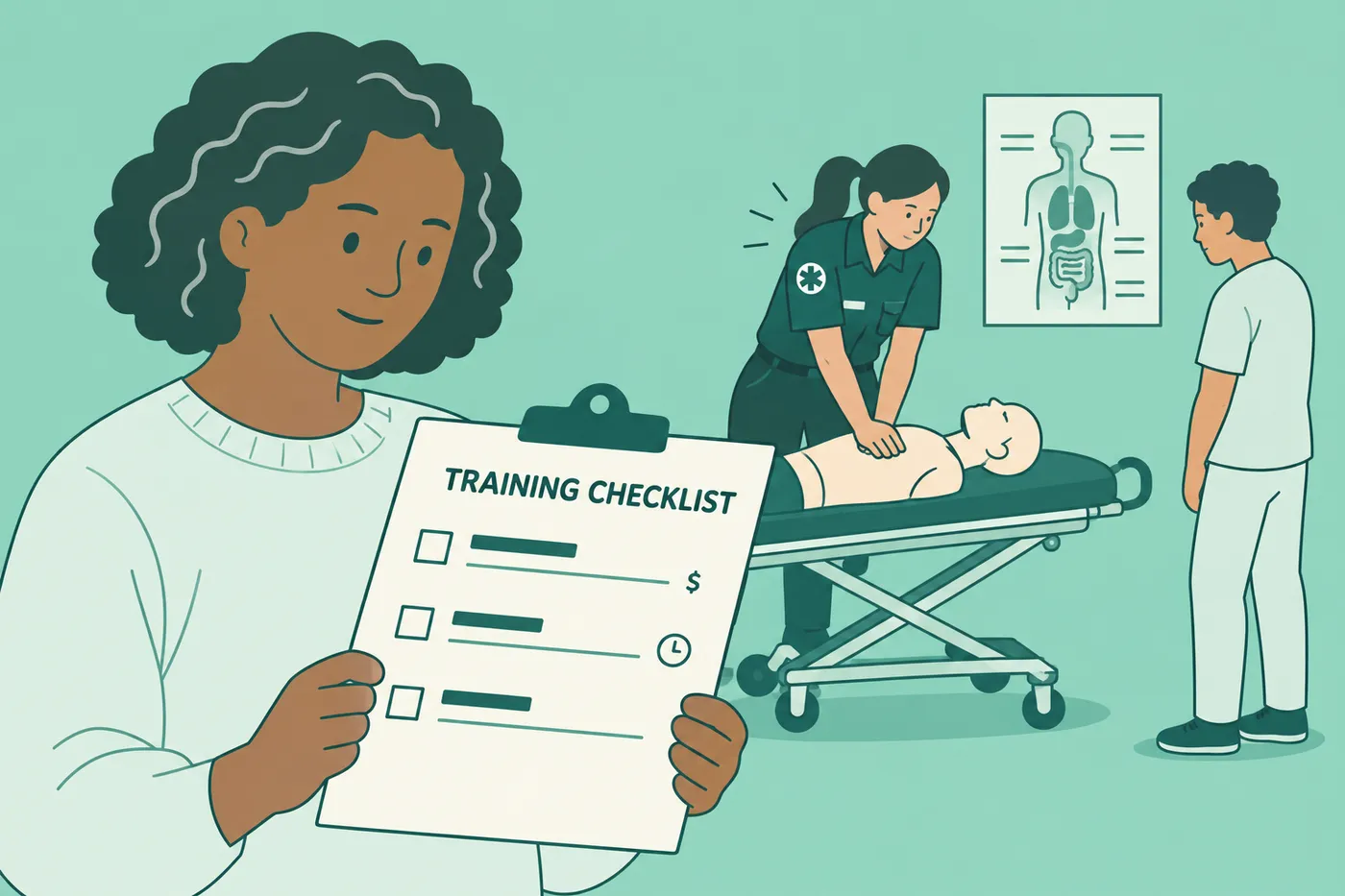
- Course tuition and any registration or materials fees, confirmed in writing by the program.
- CPR/BLS certification cost, if it is a prerequisite rather than included in the course.
- Uniform and equipment the program requires: boots, a watch with a second hand, eye protection, whatever the syllabus lists.
- Travel and parking for clinical or field placements, which often happen at sites away from the classroom and at odd hours.
- Background check, fingerprinting and immunization or health-screening costs, where required.
- Exam fees for the National Registry cognitive exam and any separate state skills assessment fee.
- The state license or certification application fee.
- Schedule reality: class hours plus supervised placement hours plus study time, mapped against your current job. Placements rarely fit a nine-to-five week.
Read the dates on the actual Authorization to Test and check available appointments promptly. Allow time for travel or an alternative testing center rather than relying on a presumed local waiting time.
Step 5: Collect evidence from your supervised experience, without patient data
Your first EMT employer cannot see your course. They can only see what you can document and describe, so collect evidence as you train rather than reconstructing it from memory later.
What to record, during or right after each supervised shift or scenario:
- Communication under pressure: handoffs you gave, how you reported findings to a supervisor or preceptor, radio or verbal reports you practiced.
- Scene teamwork: your specific role in multi-person scenarios, what you were responsible for, and what you did when the plan changed.
- Procedure adherence: protocols you followed step by step, checks you performed, and feedback a preceptor gave you on technique.
- Numbers that are yours to share: supervised patient contacts completed, scenario assessments passed, skills signed off.
The hard rule: no patient data, ever. No names, no identifying details, no case specifics that could point to a person, not in your notes, not on your resume, not in an interview answer. Describe what you did and what you were evaluated on, never who the patient was. A candidate who volunteers patient details in an interview fails the judgment test the interview exists to run, because handling sensitive information is part of the job.
These notes become your interview material. Questions in EMS hiring lean behavioral, and the behavioral interview question format rewards candidates who can walk through a specific supervised scenario: what the situation was, what their role was, what they did, what the preceptor's feedback was.
Step 6: Prepare your first EMT application
Your resume at this stage is short, and that is fine. What it must do is make your authorization status unmissable. Put your certifications and license at the top, each with the issuing body, the credential number where appropriate, and the expiration date, because the first thing a hiring manager checks is whether you are actually authorized to work in their state. Here is where to put certifications on a resume when they are the core qualification rather than a footnote.
Below the credentials, describe your training evidence: the program, the supervised hours, the skills you were signed off on, and any patient-contact or scenario counts you recorded in step 5. If this is your first job of any kind, the structure in this no-experience resume example shows how to carry a page without an employment history. Use the employer’s requested file format and inspect the exported document.
Before you send it, check the resume against the posting itself. Agencies name specific requirements, state certification first among them, and your resume should answer each one visibly. Roleframe's live checks flag vague bullets and missing details while you edit, and on a version tailored to a specific posting it shows which of the job's keywords and requirements your resume still does not cover, so you can fix the gaps before an agency screener finds them.
Then flip the interview around. You are evaluating the employer too, and the questions below tell you more about your first year than the salary number will:
- What does orientation look like, how long is it, and what must I demonstrate before riding without a field training officer?
- Who supervises new EMTs on shift, and how is feedback given in the first months?
- What are the actual shift patterns: lengths, rotation, nights, weekend frequency, mandatory holdover policy?
- What is the call mix here: emergency response, interfacility transport, or both?
- What does progression look like for an EMT who wants to move toward AEMT or paramedic?
An employer with a vague answer on orientation and supervision is asking a brand-new EMT to learn the job unsupported. Take the structured answer over the bigger logo.
After you are hired: keep the certification alive
EMT certification is not permanent. National Registry EMT certification must be renewed every two years, through continuing education or a recertification examination. Put the expiration date in your calendar the day you are certified, with a reminder months ahead, and ask your employer early which continuing education it provides or pays for. Letting a certification lapse turns a renewal into a reinstatement problem, and state rules on lapsed licenses vary, so the state EMS office is again the place to ask if it ever happens.
Frequently asked questions
- How difficult is it to become an EMT?
The route combines classroom learning, hands-on skills and assessed emergency-care knowledge. Check your program and state’s entry requirements, including when any CPR or BLS credential must be held. The work can involve physical demands, irregular hours and stressful situations, so compare the course support and the duties of actual local roles.
- How fast can you become an EMT?
Build the timeline around your program and state requirements: any required CPR or BLS preparation, state-approved EMT education, the relevant certification examination and skills verification, and state authorization. Some steps may overlap or occur within the course. Prerequisites, practical placements, testing availability and application processing determine the complete timeline.
- Does passing the National Registry exam let me work in any state?
No. Many states require National Registry certification, but state licensing rules control whether you may work there, and federal EMS guidance updated in 2026 directs candidates to check state-specific requirements rather than assume national certification alone authorizes practice. Treat your state EMS office as the final authority on licensing and scope, and contact the destination state's office before relocating.
- Who gets paid more, an RN or an EMT?
Compare current BLS data and local offers for the specific occupations and schedules. Nursing and EMT work require different education and legal authorization; an occupational median does not determine an individual starting offer. Consider tuition, study time and the duties you want as well as wages.
- Can EMTs make a lot of money?
Earnings depend on employer, region, hours, overtime rules and experience. Compare base pay and scheduled hours before counting on overtime. Advancing to another EMS qualification requires additional education and authorization and does not guarantee a particular wage.
- Can you become an EMT online?
Partially, in some programs: the cognitive coursework may run online, but the supervised practical component and the state-approved BLS skills competency verification happen in person. Before paying for any online-heavy program, confirm with your state EMS office that the program is approved and that completing it makes you eligible for the exam and the skills verification.
- How often do EMTs have to recertify?
National Registry EMT certification must be renewed every two years, through continuing education or a recertification examination. Your state license may carry its own renewal requirements on its own schedule, so track both dates and ask your employer which continuing education it provides.



Ready to start your new resume?
Writing a resume takes time, and even a polished one can miss what a hiring manager is looking for. Roleframe helps you build a clear, ATS-safe resume in minutes and tailor it to the job you want.


