How to Become a Dental Assistant: Training Routes and State Requirements
How to become a dental assistant: compare training routes by state, verify radiography and expanded-duty rules, and budget the exams with a worksheet.

On this page
Dental assisting has several entry routes, and your state’s permitted duties determine which one fits. Some states allow employer-based training for entry-level work; radiography or expanded functions may need separate education, an exam or a permit.
Start by listing the duties you want to perform and checking the state dental board’s requirements for each. Then compare schools, employer training and national certification against those requirements. This guide helps you build that task-permission worksheet before you spend money.
What dental assistants do, and what they don't
The BLS describes the core of the job as patient care, taking dental radiographs, maintaining records and scheduling appointments. In practice that means seating and preparing patients, passing instruments during procedures, running sterilization, capturing X-rays where your state permits it, and keeping the front and back of the office in sync.
A dental assistant is not a dental hygienist. Hygiene is a separate occupation with a longer education path and its own state credential, and the two are hired and paid differently. If you are weighing both careers, research each on its own terms; the dental hygienist resume example shows how different the credential evidence looks on paper.
Within assisting itself there is a second split that trips up most newcomers: basic chairside duties versus expanded functions, the state-specific list of tasks such as coronal polishing or sealant placement that an assistant may perform only with extra training, an exam or a permit. Because authorized duties vary by state, the title "dental assistant" can describe a noticeably different scope of work from one state to the next. Keep that in mind every time an article or a program brochure promises what "dental assistants can do." The honest answer is always: in which state?
Step one: find out what your state and your employers accept
Ask the state dental board which assistant levels it recognizes and whether employer-based entry is permitted. Then compare the qualifications in actual local vacancies. A state minimum and an employer preference can differ, so record both before choosing a course.
- Find your state dental board's website and locate its dental assistant page. The board, not a school's admissions office, is the authority on what you may legally do.
- Write down every assistant title or level your state defines. Many states have more than one tier, each with its own permitted duties.
- For each duty you care about, note the required evidence: a course, an exam, a permit, verified work hours, or nothing.
- Confirm whether on-the-job training is an accepted entry route, and for which tier.
- Then read five local job postings. Employers often ask for more than the state minimum, such as a program certificate or radiography credential, and the posting is where you find out.
That last step matters because the legal minimum and the hiring bar are two different lines. A state may allow untrained entry while every practice in your city hires only program graduates. You need both answers before you spend money.
Compare the three training routes
Most people enter dental assisting through one of three doors: a program accredited by the Commission on Dental Accreditation (CODA), a non-CODA program such as a shorter school or online course, or employer-based on-the-job training. Each is legitimate somewhere; none is legitimate everywhere.
| Route | Timing | Credential planning | Verify before committing |
|---|---|---|---|
| CODA-accredited program | Use the program’s actual academic and clinical calendar | An established CDA route, subject to DANB’s current requirements | Program/campus accreditation, clinical placements and accepted hands-on CPR |
| Other postsecondary program | Varies by program | State acceptance and exam eligibility require separate checks | Ask DANB whether this exact program supports an available pathway; school accreditation alone is insufficient |
| Employer-based training | Depends on duties and employer | May support an experience-based CDA route where work is legally authorized | State permission, paid-training terms, supervisor verification and a plan to document hours |
The decision rule: if your state requires approved education, the route is chosen for you, so spend your energy comparing accredited programs on clinical access, the number of supervised patient-facing hours you actually get. If your state allows on-the-job entry and local employers hire for it, starting paid and certifying through the experience pathway is a defensible plan, provided you log hours from day one.
Build a task-permission worksheet before you spend a dollar
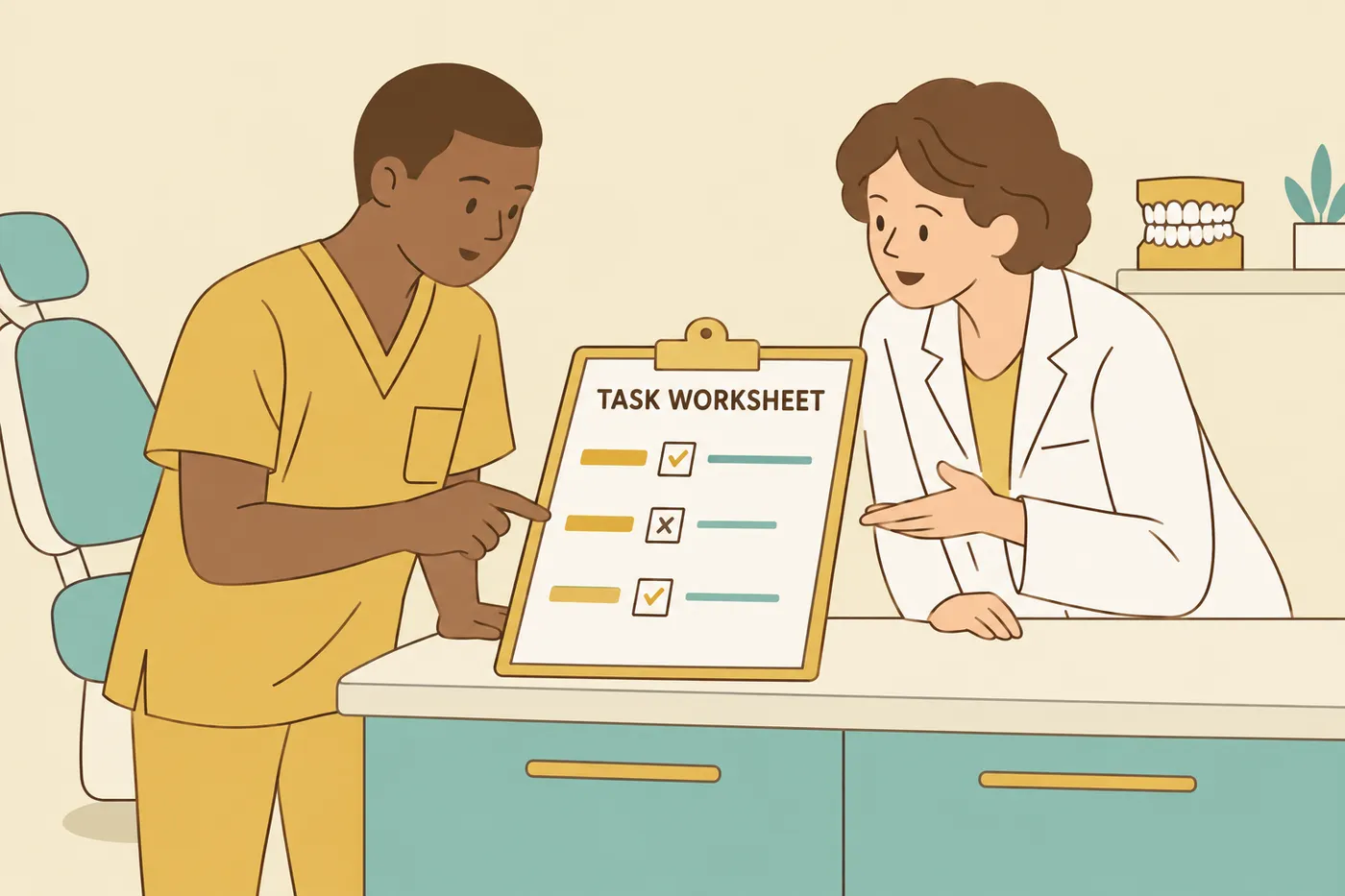
Here is the mistake that costs new assistants the most money and time: treating "becoming a dental assistant" as one permission. It is a bundle of separate permissions, and each one has its own evidence requirement, its own official source, and its own employer expectation. A certificate that covers chairside assisting does not automatically cover radiography, and a radiography permission does not cover expanded functions. DANB is explicit that state rules, not your certificate, determine which duties you may perform.
So build a worksheet with four columns, one row per task, and fill it from primary sources only: your state board's pages, DANB's eligibility pages, and real job postings. Here is the template with the rows most people need.
| Task | Evidence usually asked for | Official source to check | What employers add on top |
|---|---|---|---|
| Basic chairside assisting (seating, instrument transfer, suction) | Ranges from nothing to registration or approved coursework, depending on the state | Your state dental board's dental assistant page, the tier definitions specifically | Many postings want a program certificate or prior chairside experience even where the state requires neither |
| Sterilization and infection control | Typically covered under the basic tier, plus practice-level training; DANB tests it nationally through its Infection Control exam | State board rules for your tier, plus the employer's own protocol training | Some practices prefer candidates who have passed the infection control component of a DANB credential |
| Dental radiographs (X-rays) | Frequently a separate permission with its own course, exam or permit; never assume it rides along with your certificate | Your state board's radiography requirements, read as their own section, not inferred from the general assistant rules | Postings often name a specific radiography credential; note the exact wording, it is a keyword you will need on your resume |
| Each expanded function (coronal polishing, sealants, and similar) | State-specific: extra training, an exam or a permit per function | Your state board's expanded-functions rules, checked function by function | Confirm the employer’s training, supervision and credential requirements for each duty, alongside the state rules |
| National certification | The requirements of the exact DANB credential and an available pathway | DANB’s own current eligibility and renewal pages | Confirm whether the state and employer accept the credential for the specific duties |
Fill this in for your state and your five sample postings, and the whole career question collapses into a short, concrete to-do list. The worksheet also protects you from the most common sales pitch in this field: a program that is perfectly real but does not produce the specific permission your state or your target employers require.
One warning the worksheet makes visible: never generalize one state's rules to another. If you are applying across a state line, or planning a move, run two worksheets. The task list, the evidence and the fees can all differ.
The DANB credentials, pathway by pathway
The Certified Dental Assistant examination covers General Chairside Assisting, Radiation Health and Safety, and Infection Control. DANB sets its eligibility requirements; your state board sets legal permissions.
- The established education route includes graduation from a CODA-accredited dental assisting or hygiene program and current hands-on CPR, BLS or ACLS from a DANB-accepted provider.
- The experience route includes a high school diploma or equivalent, at least 3,500 hours of approved work experience and the accepted hands-on emergency-care credential.
- DANB also lists routes for certain previously certified applicants and dental students or graduates. Read the current requirements for your own background.
- DANB announced another program-based route in September 2026, but says it will be available in early 2027. Do not count an announced pathway as current exam eligibility.
Before enrolling, ask DANB to confirm the pathway you intend to use. Its new-pathway announcement distinguishes program approvals during 2026 from candidate availability in early 2027.
National certification does not grant the same duties in every state. If you pursue the entry-level NELDA credential instead, use its own current eligibility requirements rather than the CDA rules. Check renewal and continuing-education obligations for whichever credential you earn.
Budget it: the enrollment and exam cost checklist
Costs in this field change with every enrollment cycle and differ by state and provider, so a number printed in an article is stale the day it changes. Instead, build a checklist and pull current figures from each provider's own pricing page, dated for your enrollment term. These are the line items that catch people out:
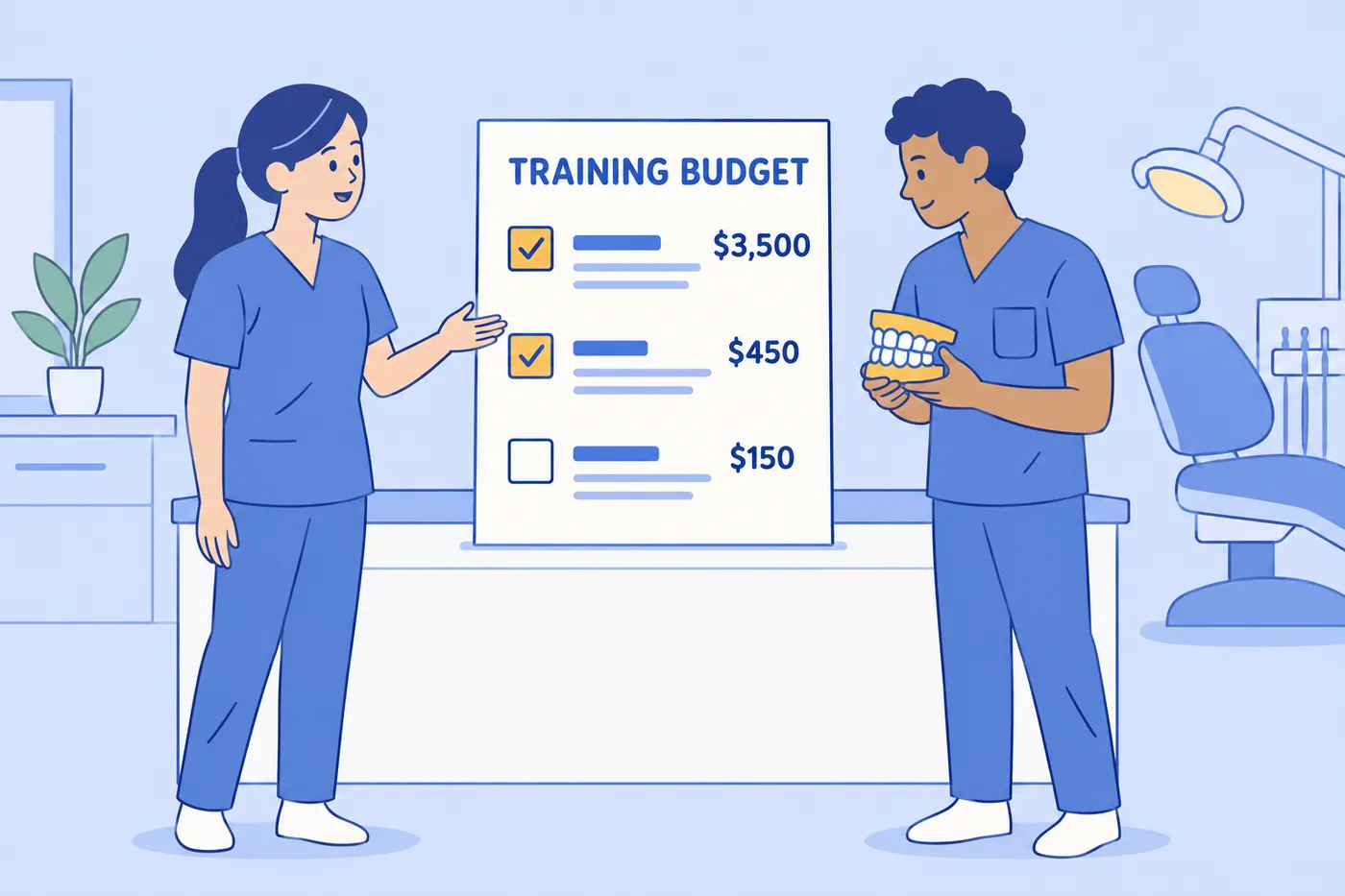
- Program tuition, plus registration and technology fees that often sit outside the headline price.
- Books, scrubs, and the clinical supply kit, which some programs include and some bill separately.
- A hands-on CPR, BLS or ACLS course from a provider DANB accepts. Online-only CPR cards are the classic wasted purchase; DANB's pathways specify hands-on training.
- The radiography course or state permit fee, if your state treats radiography as its own permission (your worksheet tells you).
- State registration, licensure or permit fees for your assistant tier, from the board's current fee schedule.
- DANB exam fees for the credential and pathway you chose, from DANB's current pages.
- Background check, immunizations and any screening your clinical placement site requires.
- Recurring costs after you start: annual DANB renewal and its continuing-education credits.
Price the whole column before enrolling anywhere. A cheaper program that excludes the radiography course, the kit and the exam fees can cost more by graduation than an honest all-in price.
Turn supervised experience into application evidence
Keep supervisor-verifiable training and work records using the program or employer’s approved process. For a personal resume, summarize authorized duties, setting and verified experience without patient information.
A fictional bullet format is: “Prepared operatories and processed instruments under supervision in a [type of practice], following the practice’s documented infection-control procedures.” Add volumes only if your own records support them. State credentials accurately as earned, in progress or scheduled, and do not imply you hold radiography permission before it is issued.
The dental assistant resume example and credential-placement guide can help arrange that evidence. Follow the employer’s file-format instructions.
Frequently asked questions
- How hard is it to become a dental assistant?
It is one of the more accessible healthcare careers, but the difficulty depends on your state, the duties you want to perform, and whether you pursue certification. Some states allow entry-level assistants to begin without formal education, while others require approved coursework, exams, or specific training for duties such as radiography or expanded functions, per DANB. Where formal education is the route, a typical program takes about a year, per the BLS.
- What is the fastest way to become a dental assistant?
In states that do not require formal education for entry-level assistants, the fastest route is getting hired into an entry-level role and completing employer-provided training; there is no single national minimum timeline. Where education is required, many programs take about a year, with the exact duration depending on the state, the school, clinical requirements, and whether radiography or expanded functions are included. Check your state board first, because the fast route in one state is illegal in another.
- Can you become a dental assistant without going to school?
In some states, employer-based entry is allowed for basic duties. Additional training or permits may still be required for radiography and expanded functions. Check state rules first; a later national credential has its own documented education or experience requirements.
- What pays more, a CNA or a dental assistant?
Compare current local offers, scheduled hours, benefits and shift premiums for both roles. The BLS publishes separate occupational wage data, but a national median is not a guaranteed starting offer. Your state’s required training also changes the cost of entering each occupation.
- Can dental assistants make $30 an hour?
Some advertised roles may pay that amount, but it is not a guaranteed entry-level wage. Compare local postings with similar duties, experience requirements and hours; separately check what additional duties your state permits you to perform.
- Can you train as a dental assistant online or for free?
Partly. Classroom content can be delivered online, but chairside skills, sterilization and radiography are hands-on, so any credible path includes supervised clinical time. Before paying for an online program, confirm in writing that your state board accepts it for the duties you want and that its hours count toward the DANB pathway you plan to use. The closest thing to a free route is an on-the-job position in a state that allows untrained entry, where the employer trains you while you earn.



Ready to start your new resume?
Writing a resume takes time, and even a polished one can miss what a hiring manager is looking for. Roleframe helps you build a clear, ATS-safe resume in minutes and tailor it to the job you want.


