How to Become a CNA: Find Approved Training and Prepare to Apply
How to become a CNA: verify state-approved training, pass the competency exam, join the nurse aide registry, and build your first resume. Checklist inside.

On this page
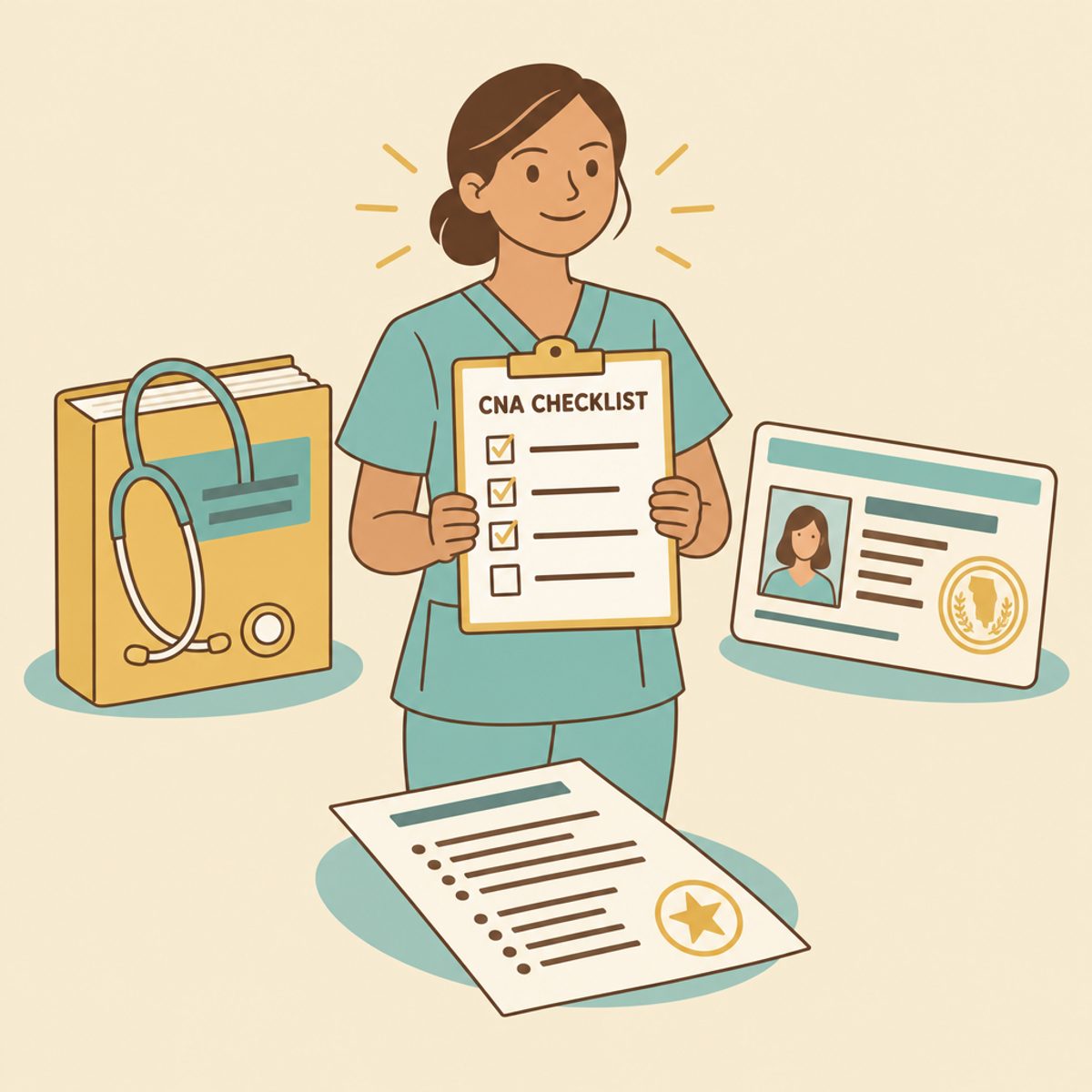
To become a certified nursing assistant (CNA), start with the nurse aide authority in the state where you intend to work. The usual new-entrant route is state-approved training, a competency evaluation and placement on the state nurse aide registry. States also define alternative routes for some previously trained applicants.
Federal nursing-facility rules establish training requirements that states administer and may exceed. Before paying for a course, check the exact program and campus on the state-approved list, then confirm the exam, registry and renewal steps. This guide supplies questions for that check and a worksheet for comparing programs.
What a CNA does, and how the role differs from a nursing license
CNAs help with basic personal care, mobility, meals and observations within their training and the employer’s care plan, under the required nursing supervision. Nurse aide, nursing assistant and certified nurse aide are related titles, but use the title and status recognized by your state.
A CNA credential does not authorize practical or registered nursing. Those roles require separate nursing education and licensure. Compare the work setting, physical demands, shift pattern and local starting pay before choosing the route; a nursing-facility job may differ considerably from a hospital vacancy.
Step one: find your state's approved-program list and registry rules
Find your state’s approved nurse aide training list and registry instructions through its health department, nursing board or designated regulator. Follow links to any official testing contractor from that authority; a contractor need not have a .gov address.
42 CFR 483.152 establishes at least 75 clock hours for covered state-approved nurse aide programs, including at least 16 hours of supervised practical training. Separately, it requires 16 hours of specified introductory subjects before direct resident contact. These are different requirements: the rule does not say that all supervised practical training must precede resident contact. A state may require more training.
| Requirement | Federal rule for covered programs | What to verify with your state |
|---|---|---|
| Total training | At least 75 clock hours | Approved program hours and accepted alternative routes |
| Supervised practice | At least 16 hours under qualified supervision | Required lab/clinical settings and additional hours |
| Before resident contact | 16 hours of specified introductory subjects | How the approved course schedules and verifies this preparation |
| Registry and renewal | Separate competency and registry rules also apply | Exam, work-history, renewal and continuing-education instructions |
Use the state-approved course requirements to plan your enrollment. The federal minimum does not establish one course length or one exam fee for every applicant.
The state approval checklist: run every program through it
Use these questions to identify missing information before enrolling. Approval is essential, but it does not guarantee a school’s financial stability, a clinical placement or a job. Check its refund terms and clinical arrangements as well.
- The program appears, by name and location, on your state's current approved nurse aide training list. Verify on the state site itself, not on the school's site.
- The program states its total hours and its supervised clinical hours in writing, and both meet or exceed your state's requirement.
- Ask how supervised practical instruction is delivered and which in-person lab and resident-care experiences the state approves. An online theory course alone does not provide all required supervised practice.
- The program tells you which competency exam its graduates sit, who administers it in your state, and whether exam fees are included in tuition or billed separately.
- Admission requirements are listed up front: minimum age, health screening or immunization records, background check, and any reading or language assessment. These checks are set by the state and the program, so get them in writing.
- The program explains what happens if you fail a portion of the exam: how many retakes your state allows and what each costs.
- The program's completion paperwork is accepted by your state registry. Ask directly: "When I finish, what document do I receive, and is it what the registry requires for exam eligibility?"
Compare programs on the three things that actually differ
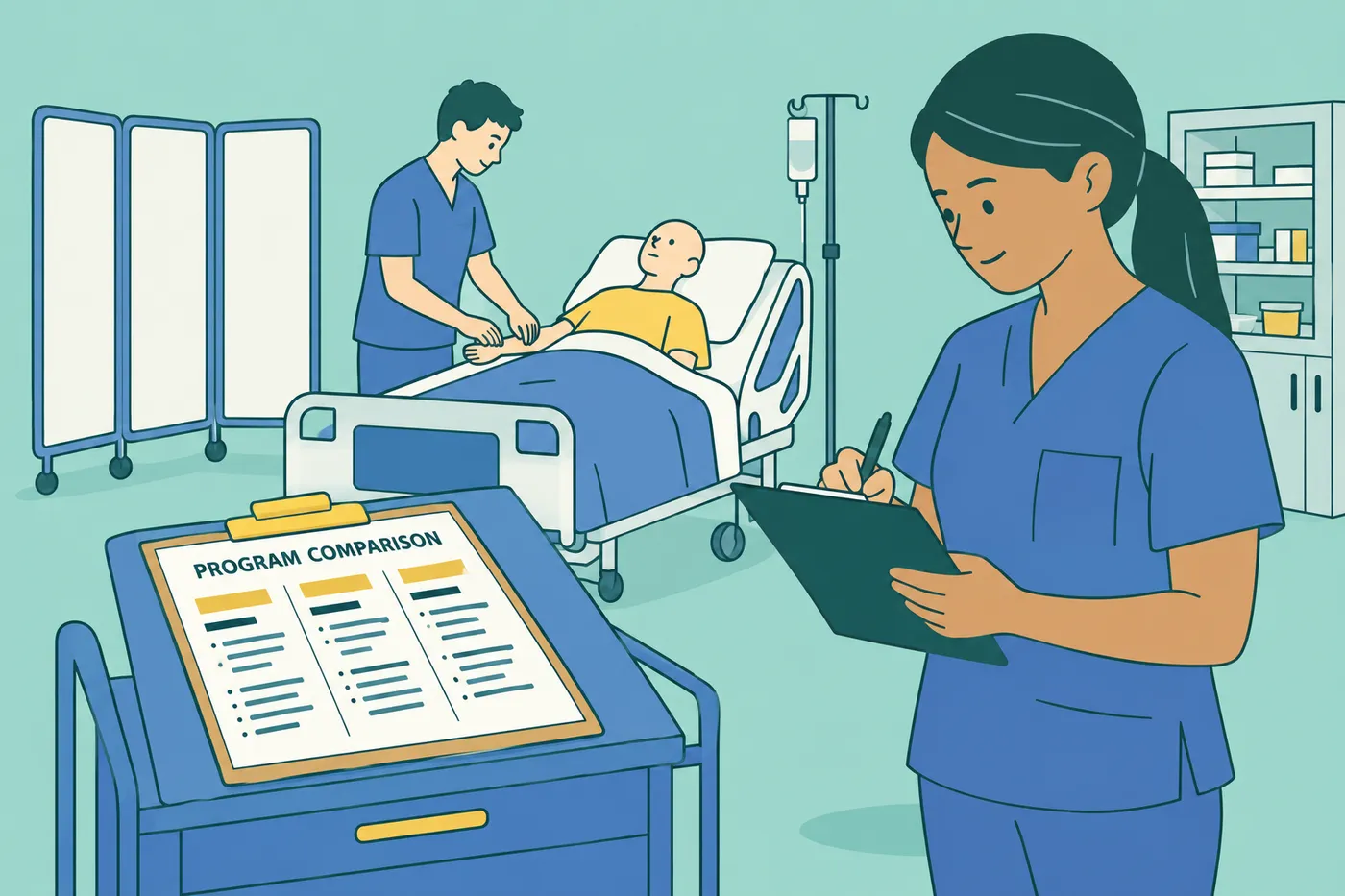
Admission checks. Get the age, education, health-clearance and background-screening requirements in writing, including which checks the placement facility adds.
Supervised training. Ask for the location, shift times, transportation requirements and missed-session policy. Confirm whether the school secures placements and what happens if a placement is delayed.
Assessment. Confirm the knowledge and skills evaluation required for your pathway, the authorized test provider, accommodations, retake rules and the next available test dates. On-site testing can reduce travel, but it does not guarantee faster certification.
Confirm the full pathway before you commit: exam, registry, renewal
Completing a class and holding an active registry status are separate milestones. Ask how the program verifies exam eligibility, who transmits results, and how you confirm your own registry entry.
Save the registry’s renewal instructions and record the deadline when your credential is issued. Work-history and education requirements vary. If you plan to move, ask the destination registry about endorsement or reciprocity and any additional training or testing before assuming you can work there.
Build a real cost and scheduling worksheet
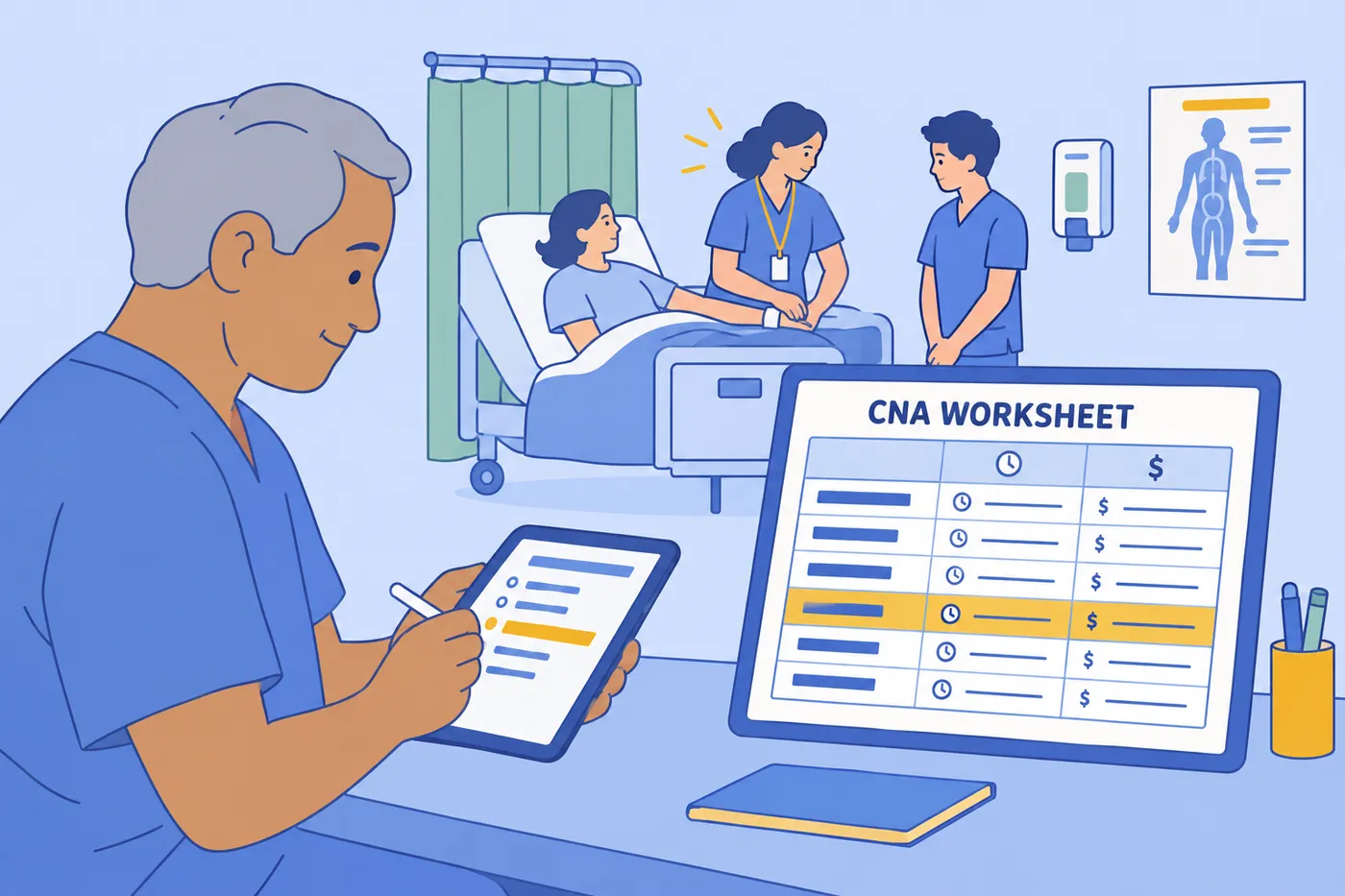
CNA training costs more than tuition, and the hidden lines are what derail people mid-program. Build a worksheet before you enroll and fill every line with a figure or date from the program's own paperwork, never from an estimate on a blog. The table below is a hypothetical example, labeled as such: "Maya" is an invented applicant comparing two approved programs in her state, and her entries show what a completed line looks like. Your figures will be your own.
| Worksheet line | What to confirm before enrolling | Maya's example entry (hypothetical) |
|---|---|---|
| Tuition and registration | The all-in price in writing, plus the refund policy if you withdraw | Written quote from the program office, refund terms attached to her enrollment packet |
| Books, uniform, supplies | Whether scrubs, a watch with a second hand, and a textbook are included or extra | Program includes the textbook; scrubs and shoes bought separately before week one |
| Pre-admission checks | Costs and deadlines for the health screening, immunization records and background check | Immunization records requested from her old clinic two weeks before the start date |
| Competency exam fees | Whether the knowledge and skills exam fees are in tuition or billed by the test vendor, and the retake cost | Exam and retake fees recorded separately; permitted attempts and any retraining conditions confirmed with the state-authorized testing provider |
| Class schedule | Days, times and the attendance policy for classroom hours | Evening classes twice a week; two absences allowed before repeating a module |
| Clinical schedule | The facility's location, shift times, and the make-up policy for missed clinical days | Clinical block runs mornings for two weeks at a nursing home 20 minutes away; missed days wait for the next rotation |
| Exam-to-registry gap | How soon after completion she can test, and how results reach the registry | Program hosts testing on site in the final week; results sent to the registry by the vendor |
Ask the program, local workforce office and potential employers about grants, employer sponsorship or reimbursement. Funding and eligibility vary. Read any work commitment or repayment clause before accepting sponsorship, and confirm the course is state-approved regardless of who pays.
Collect resume material while you train, not after
Keep an approved summary of the setting, supervised hours and skills your instructor signed off. Use school-authorized records for competency evidence; keep patient-identifying information out of personal notes and applications.
A fictional bullet format is: “Completed [verified hours] of supervised nurse aide clinical training, assisting with [tasks actually performed] in [setting].” Replace the brackets with your own record. Family caregiving, retail or volunteer work can show relevant communication and reliability, but label unpaid or nonclinical experience accurately. See how to present volunteer work.
Prepare the application with verified status
Check your registry status before applying and state it accurately: enrolled, completed training, exam scheduled or active on the registry. Place the issuing state and credential name where the employer can find them; this credential-placement guide gives examples.
Select CNA skills you can demonstrate and describe student practice as supervised training. Prepare an interview example about following instructions, communicating a concern or protecting a resident’s dignity. Follow the vacancy’s requested file format and inspect the exported resume before submitting.
Frequently asked questions
- What is the fastest way to become a CNA?
Compare approved courses you can actually attend, including placement dates, testing availability and registry processing. Choose a complete accepted route rather than the shortest advertised classroom component.
- Is becoming a CNA hard?
The work combines personal care, communication, physical activity and reliable safety routines. Ask to see the course’s assessment criteria and talk with employers about the demands of the setting you are considering.
- How long does it take to become a CNA in the USA?
It depends on the state-approved course schedule, required practical training, testing dates and registry processing. Ask for dates for the whole route, not just the classroom portion.
- How can you become a CNA in Texas for free?
Ask a workforce office, approved training providers and potential employers about funding or sponsorship. Availability depends on your eligibility and current funding. Read repayment or employment commitments and verify program approval before enrolling.
- Can you become a CNA at 16?
Check the training provider, state registry and prospective employer separately. Admission to a high-school or youth training course does not automatically satisfy employment-age or facility requirements.
- Can you do CNA training online?
Some approved courses deliver theory online, but required supervised practical training still has to be completed through the approved program. Confirm the lab and clinical arrangements before paying.
- Does CNA certification expire?
Registry status must be maintained under your state’s rules. Check the renewal cycle, qualifying work and education requirements on the registry’s official instructions and keep evidence as you earn it.

Ready to start your new resume?
Writing a resume takes time, and even a polished one can miss what a hiring manager is looking for. Roleframe helps you build a clear, ATS-safe resume in minutes and tailor it to the job you want.


