How to Become a Surgical Tech: Choose a Training Route and Apply
How to become a surgical tech: compare certificate and degree routes, verify accreditation and CST eligibility, and build evidence for your first application.

On this page
To prepare for surgical technology work, compare programs that provide the education, supervised clinical experience and credential eligibility your state and intended employers accept. Program length depends on prerequisites, the award and clinical arrangements; a short course name does not establish readiness for operating-room work.
This guide helps you verify the program and CST pathway, compare real costs and schedules and present supervised training accurately in a first application.
What a surgical tech does, and what the role does not authorize
A surgical technologist is the operating room's sterile-field specialist. Per the Association of Surgical Technologists (AST), the job is to prepare instruments and supplies before a procedure, maintain the sterile field throughout it, pass instruments to the surgeon, and support the team during the case. You are the person who knows where every clamp is, keeps counts accurate, and notices when sterility is broken before anyone else does.
Know the boundaries before you commit to training. A surgical technologist is not a surgical first assistant: BLS treats them as separate occupational roles with different training and certification pathways. A first assistant actively helps perform the surgery (retracting tissue, controlling bleeding); a surgical tech supports the procedure from the sterile field. Surgical techs also do not diagnose, prescribe, or make independent clinical decisions about the patient. If assisting in surgery itself is your goal, treat surgical tech as a possible first step, not the destination.
Most surgical techs work in hospitals, with ambulatory surgery centers and outpatient-care settings as the other common employers, according to AST. The schedule follows the OR: early starts, on-call rotations in many hospital roles, and long stretches on your feet.
Certificate or associate degree: compare the two main routes
The NBSTSA eligibility page identifies graduation from a CAAHEP- or ABHES-accredited surgical technology program as an education route to the CST examination and separately addresses military program graduates. Confirm the status of the exact program and your applicant category before enrolling.
Do not assume every award type is offered under every accreditor’s current standards. Verify the program’s actual award, accreditation and completion requirements rather than choosing by a generic “certificate versus degree” comparison.
| Question | What to compare | Where to confirm |
|---|---|---|
| Award and duration | Actual degree/diploma and full calendar including prerequisites | Current program catalog |
| CST route | Accredited surgical technology program or applicable military route | NBSTSA and accreditor |
| Clinical preparation | Named sites, supervised roles, case requirements and placement contingency | Clinical coordinator |
| Longer-term study | Transfer-credit acceptance if you plan another degree | Receiving institution; no automatic bridge assumption |
| Cost | Tuition, clinical requirements, travel, equipment and exam fees | Dated program and credentialing-body schedules |
Admission requirements are set by each program, so read the actual admissions page of the two or three programs you are considering rather than a generic list. Expect a high school diploma or GED as the floor, and commonly some mix of prerequisite coursework, immunization records, a background check, and a drug screen before clinical placement. If a program's admission bar looks unusually low and its length unusually short, that is a signal to check accreditation twice, not a bargain.
One route the comparison tables usually miss: military surgical-technology training. NBSTSA recognizes graduates of military surgical-tech programs as an exam-eligibility category, documented with a DD214, Joint Services Transcript, or military graduation certificate. If you trained as a surgical tech in service, you may not need a civilian program at all; confirm your documentation with NBSTSA before enrolling anywhere.
The enrollment checklist: verify three things before you pay a deposit
Most people who regret their surgical tech program regret one of three things: the program was not accredited, it did not make them exam-eligible, or it did not meet their state's rules. Each is checkable in an evening, from the official source, before you sign anything. Do not take the admissions office's word for any of them; verify independently.
- Verify the exact program and campus through CAAHEP or ABHES and ask NBSTSA whether your applicant category qualifies. If accreditation is pending, ask NBSTSA directly about its conditions before paying; a school’s expected approval is not a guarantee.
- Verify certification eligibility with the credentialing body. Check NBSTSA's current eligibility rules yourself. Eligibility generally requires proof of graduation, such as an official transcript, diploma, or an institutional letter documenting the program and your graduation date. Ask the program how it documents graduation for NBSTSA and how long transcripts take to issue, because that paperwork gates your exam date.
- Verify your state's rules with the official state source. Certification eligibility and legal employment requirements are separate questions. Per current AST guidance, national certification is not legally mandatory in every state, even though accredited programs and employers commonly expect it. Some states regulate surgical techs, others do not, and the rules change. Find your state's health department or licensing board page and read what it actually requires before assuming the CST is mandatory, or that skipping it is safe.
If a program passes all three checks, ask two more questions before enrolling: where its students do clinical rotations (named facilities, not "local hospitals"), and what share of recent graduates sat and passed the CST exam. A program that hesitates on either answer has told you something.
Why the clinical experience matters more than the classroom
Ask the program which current clinical competencies and case requirements you must complete, how cases are allocated and how it supports progression through supervised roles. Confirm what happens if a placement ends or the required case mix is unavailable.
Do not infer readiness from classroom hours alone. Compare access to supervised practice, the quality of feedback and documentation of completed competencies. Report observed, assisted and performed procedures separately.

Certification: the CST exam, timing rules, and renewal
Apply to NBSTSA under the category that matches your education and documentation. Use the current eligibility instructions and candidate handbook for approval, test scheduling, retakes and maintenance requirements; those details can change independently of a school’s materials.
A short online course without the accepted education and clinical preparation is not equivalent to the CST pathway. National certification, state employment rules and employer preferences are separate checks.
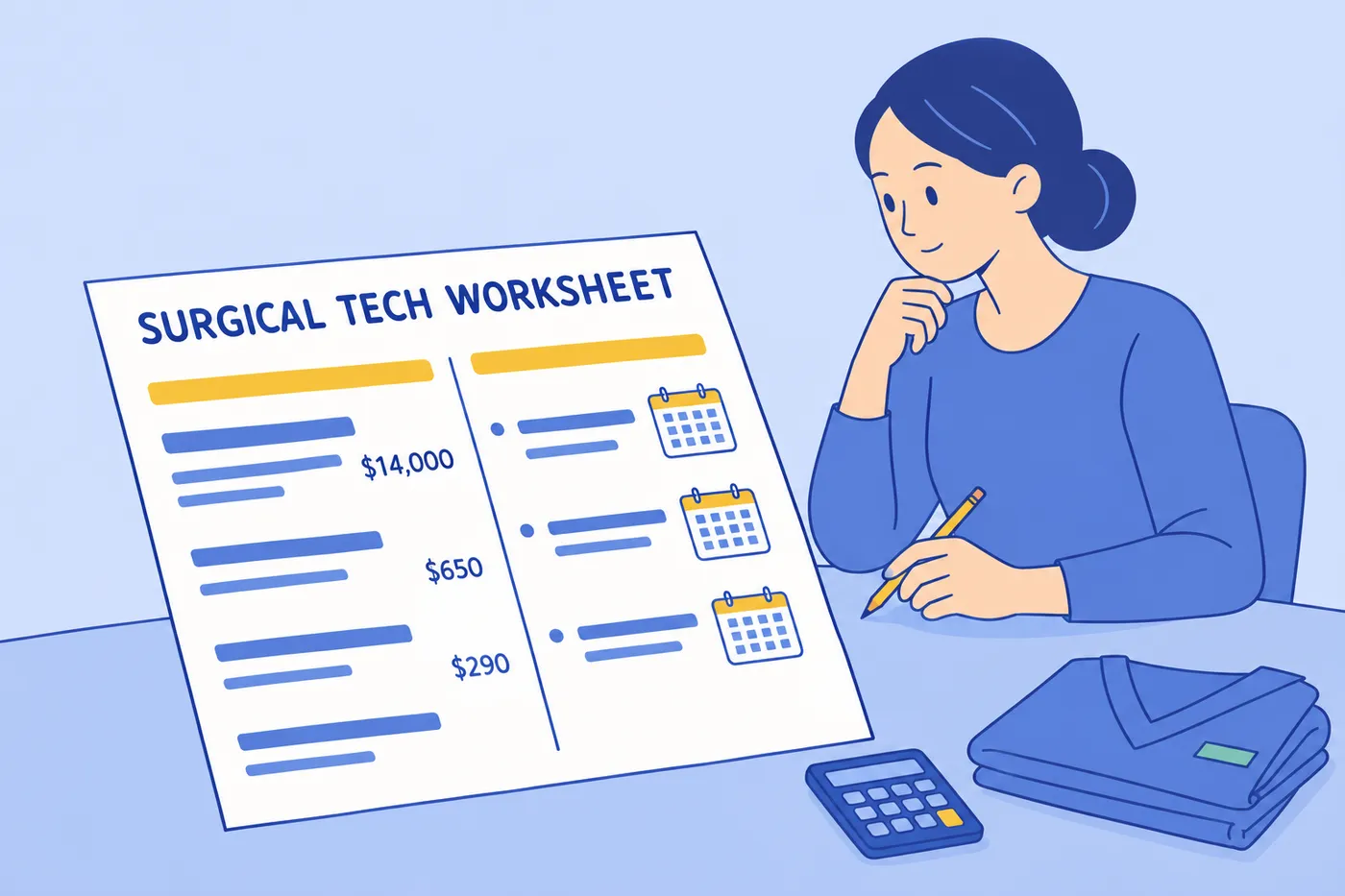
Build a cost and schedule worksheet before you enroll
Tuition is the number programs advertise; it is rarely the full cost. Build a simple worksheet, one column per program you are comparing, and fill every row with a real figure from the program's own documents or a phone call. The rows below are the ones that surprise students after enrollment.
| Cost or schedule item | What to ask the program |
|---|---|
| Tuition and mandatory fees | Total for the whole program, not per term. Ask what fees are added at clinical placement. |
| Books, scrubs, and supplies | Is there a required kit or uniform vendor? What did last year's cohort actually spend? |
| Pre-clinical requirements | Immunizations, titers, background check, drug screen: who pays, and what do they cost locally? |
| Certification exam | The CST exam fee, plus a retake buffer in case the first attempt misses. |
| Travel to clinical sites | How far are the named sites from your home? Clinical rotations often start before public transit runs. |
| Clinical schedule | What days and shifts do rotations run? Can you keep a part-time job through the clinical phase? |
| Lost income | If clinicals make your current job impossible, count the missing paychecks as a program cost. |
The schedule rows matter as much as the money rows. The classroom phase of a program often fits around work; the clinical phase usually does not, because you follow the OR's hours. Students who plan for the clinical phase as a near-full-time commitment finish; students who discover it mid-program often drop. If you want a structured way to track these comparisons alongside applications later, a job search spreadsheet adapts well to program comparison too.
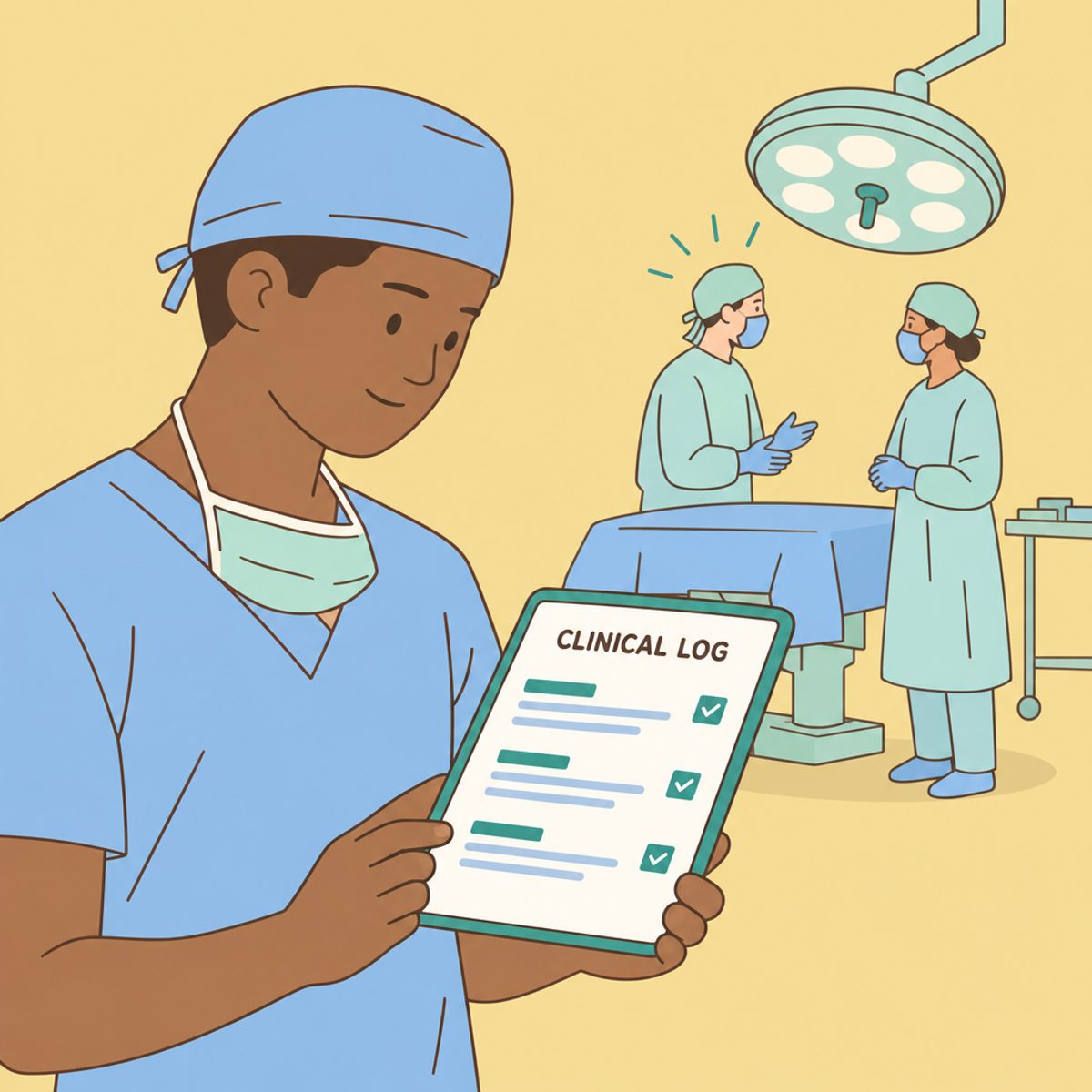
Keep a clinical-evidence log from day one of training
Ask the program how to obtain an authorized summary of completed clinical competencies and supervised roles. Use its secure process for official case records. Your personal application notes should summarize your own work and permitted aggregate counts without patient details.
For each skill, be able to explain what you actually did, who supervised it and what feedback you received. An observed case is useful learning, but it is not first-scrub experience.
- Clinical setting and specialty in a nonidentifying aggregate summary
- Your role: observed, assisted, second scrub or first scrub, as verified by the program
- Competencies signed off by the supervising instructor or preceptor
- General feedback about teamwork, sterile technique and escalation
- Authorized references and aggregate experience totals you are permitted to share
Use these summaries to prepare accurate resume bullets and interview examples. Keep official case documentation in the authorized system and follow the program’s confidentiality policy when discussing any clinical experience.
Prepare your first hospital application
State your status accurately: student, program graduate, exam scheduled or CST once earned. Use actual dates; do not copy a future credential date from an example. Place a required credential where the employer can find it using this placement guide.
A fictional bullet format is: “Completed supervised surgical technology rotations in [verified specialties], supporting [tasks actually performed] under preceptor supervision.” Add case counts only when your own authorized record supports them. Follow the application’s required file format.
Ask employers about orientation, preceptorship, case mix, call requirements and continuing-education support. Those answers help you judge the first role as well as prepare your application.
Frequently asked questions
- How many years does it take to become a surgical tech?
Use the full calendar for the program you are considering, including prerequisites, clinical placements and the credential process. Award types and current accreditation standards differ, so a universal one-year certificate route should not be assumed.
- How much does a surgical tech make?
Compare current local surgical technologist vacancies and BLS regional wage data. Look at scheduled hours, call duties, overtime, benefits and experience requirements; a national median is not a promised new-graduate wage.
- Who gets paid more, a CNA or a surgical tech?
Compare actual local offers and the training investment for each role. They have different responsibilities, preparation and working conditions; a national comparison alone cannot determine your likely starting pay or total cost.
- Is it hard to become a surgical tech?
It requires science study, instrument knowledge, sterile technique and assessed supervised clinical performance. Ask programs about clinical schedules, case requirements and support for students. Difficulty and completion time depend on the individual and the program.
- Can you become a surgical tech without college?
A bachelor’s degree is not the universal requirement, but do not assume a short certificate establishes CST eligibility. For certification, verify graduation from a program NBSTSA accepts for your applicant category, or an applicable military pathway, and provide the required documentation. Check state employment rules and the specific employer’s requirements separately.
- Are 6-week surgical tech programs legitimate?
Be skeptical. A six-week course cannot deliver the supervised clinical experience that accredited programs include, and graduating from a CAAHEP- or ABHES-accredited program is the standard CST eligibility route. Before paying for any short program, look it up in the accreditor's own directory and check NBSTSA's eligibility rules. If it appears in neither place, it will likely leave you ineligible for certification and short on the OR experience employers screen for.
- Do you have to renew surgical tech certification?
Yes. The CST credential is maintained on a two-year cycle through approved continuing education or retesting, per the Association of Surgical Technologists. Certification is not permanent once earned, so budget renewal into your career plan and ask prospective employers whether they support continuing-education costs.
- Is a surgical tech the same as a surgical first assistant?
No. They are separate occupations with different training and certification pathways, per the BLS. A surgical tech maintains the sterile field, prepares instruments, and passes them during procedures. A surgical first assistant actively assists in performing the surgery. Many first assistants started as surgical techs, so the tech role can be a step toward it, but the jobs and credentials are distinct.



Ready to start your new resume?
Writing a resume takes time, and even a polished one can miss what a hiring manager is looking for. Roleframe helps you build a clear, ATS-safe resume in minutes and tailor it to the job you want.


