How to Become a Radiology Tech: Programs, Credentials and Applications
Plan a radiography career with checks for your degree, ARRT-approved education, clinical placements, examination eligibility and state authorization.

On this page
For the usual ARRT primary radiography pathway, you need an associate degree or higher from an accepted institution, an ARRT-approved program in radiography, satisfaction of the ethics requirement and a passed examination. State authorization is a separate check.
ARRT’s education requirements allow the degree to be in another subject, but it must meet ARRT’s institutional-accreditation rules. This guide helps you check the degree, program, clinical placements and state requirements before committing to school.
Step 1: Make sure radiologic technologist is the occupation you mean
Imaging careers get collapsed into "radiology" in everyday speech, and people enroll in the wrong program because of it. The jobs have different training routes, different credentials and very different timelines.
| Title | What the job is | How you enter |
|---|---|---|
| Radiologic technologist (radiographer) | Performs diagnostic imaging examinations, X-ray being the core modality | Associate degree or higher plus an ARRT-approved radiography program, then the certification exam |
| MRI technologist | Operates MRI scanners to produce diagnostic images; BLS classifies this as distinct work from radiography | ARRT offers both primary and postprimary MRI routes; check the specific program and eligibility route |
| Diagnostic medical sonographer | Performs ultrasound examinations | A separate education and credentialing track; a radiography program does not lead here |
| Radiologist | A physician who interprets imaging and directs diagnosis | Medical school and residency, an entirely different career |
Radiography, MRI, CT, mammography and sonography have different education and credential routes. Radiography can support some later specialties, but it is not a universal prerequisite for every imaging career. ARRT offers both primary and postprimary pathways for MRI.
Choose the credential that fits the work you want, then verify its requirements directly. A program preparing radiographers is not automatically an entry program for ultrasound or every other modality.
Step 2: Check entry prerequisites against your existing education
The entry credential is settled: radiologic technologists typically enter the occupation with an associate degree, per the BLS, and ARRT's standard primary pathway explicitly requires an associate degree or higher plus completion of an ARRT-approved radiography program. A short certificate alone does not make you an ARRT-registered radiographer, whatever a brochure implies.
Your starting point determines which route is open to you.
- High school diploma or GED: you are applying to associate-level radiography programs. Most require prerequisite coursework before admission, commonly in anatomy, physiology and math, and admission to the radiography cohort is often competitive and separate from admission to the college itself. Ask each school for both sets of requirements in writing.
- Existing degree: an associate degree or higher may satisfy the degree component if the institution’s accreditation is accepted by ARRT. You still need an ARRT-approved radiography program and its clinical competencies. Ask how prerequisites and transfer credits apply to you.
- Current healthcare worker (CNA, medical assistant, EMT): your patient-care experience helps in admissions and in clinicals, but it does not substitute for the approved program or the degree. Verify whether any of your completed coursework transfers; the school's registrar decides, not the admissions brochure.
One timing note for every route: programs admit cohorts, often once or twice a year, and prerequisites must usually be finished before the application deadline, which can sit months before the start date. Map the deadlines first and work backward.
Step 3: Verify the program, degree and placements separately
Use the following matrix to distinguish the degree award, program recognition, clinical arrangements and state acceptance. A certificate program may be appropriate for someone who already holds an accepted degree; the concern is an unexplained claim of exam eligibility.
| What to verify | The question to ask | Who actually confirms it | Red flag |
|---|---|---|---|
| Degree award | Does this program award an associate degree or higher, or a certificate only? | The school's registrar and its current published catalog | No explanation of how the degree requirement is met, particularly if the program awards only a certificate |
| ARRT program recognition | Is this program ARRT-approved for radiography, so graduates qualify for the primary pathway? | ARRT's own program information, plus written confirmation from the program director | "Prepares you for the ARRT exam" wording with no confirmable approval status |
| Accreditation | Who accredits the program, and is that status current? | The accreditor's public directory; for many radiography programs that is the Joint Review Committee on Education in Radiologic Technology (JRCERT) | "Accreditation pending" with no date and no documentation |
| Clinical placement | Where will I rotate, are placements guaranteed for every admitted student, and who arranges them? | The program's clinical coordinator, in writing | You are responsible for finding your own clinical site |
| Exam eligibility | Will I meet all ARRT primary-pathway requirements at graduation: degree, approved program, ethics review? | ARRT's current candidate requirements, read by you directly | The school answering for ARRT instead of pointing you to ARRT's own rules |
| State authorization | Does my intended state license or register radiologic technologists, and does this program satisfy its rules? | The state's radiation control or health licensing authority | The program only addresses its home state and you plan to work somewhere else |
Clinical placement deserves extra scrutiny because ARRT-approved programs include required clinical competencies alongside the didactic coursework. The clinical component is not an add-on; without it you cannot complete the pathway. Ask how many clinical sites the program partners with, how far they are from campus, what shifts students rotate through, and what happens if a site drops out mid-cohort. A program with strong classroom instruction and shaky clinical capacity will still leave you stuck.
The state question matters even if you plan to stay put. Certification alone does not guarantee the right to work anywhere in the United States; state requirements exist separately from ARRT and must be checked with the state authority before you count on a job. If there is any chance you will move after graduation, run the matrix against the second state too.
Step 4: Build your credential-and-state checklist
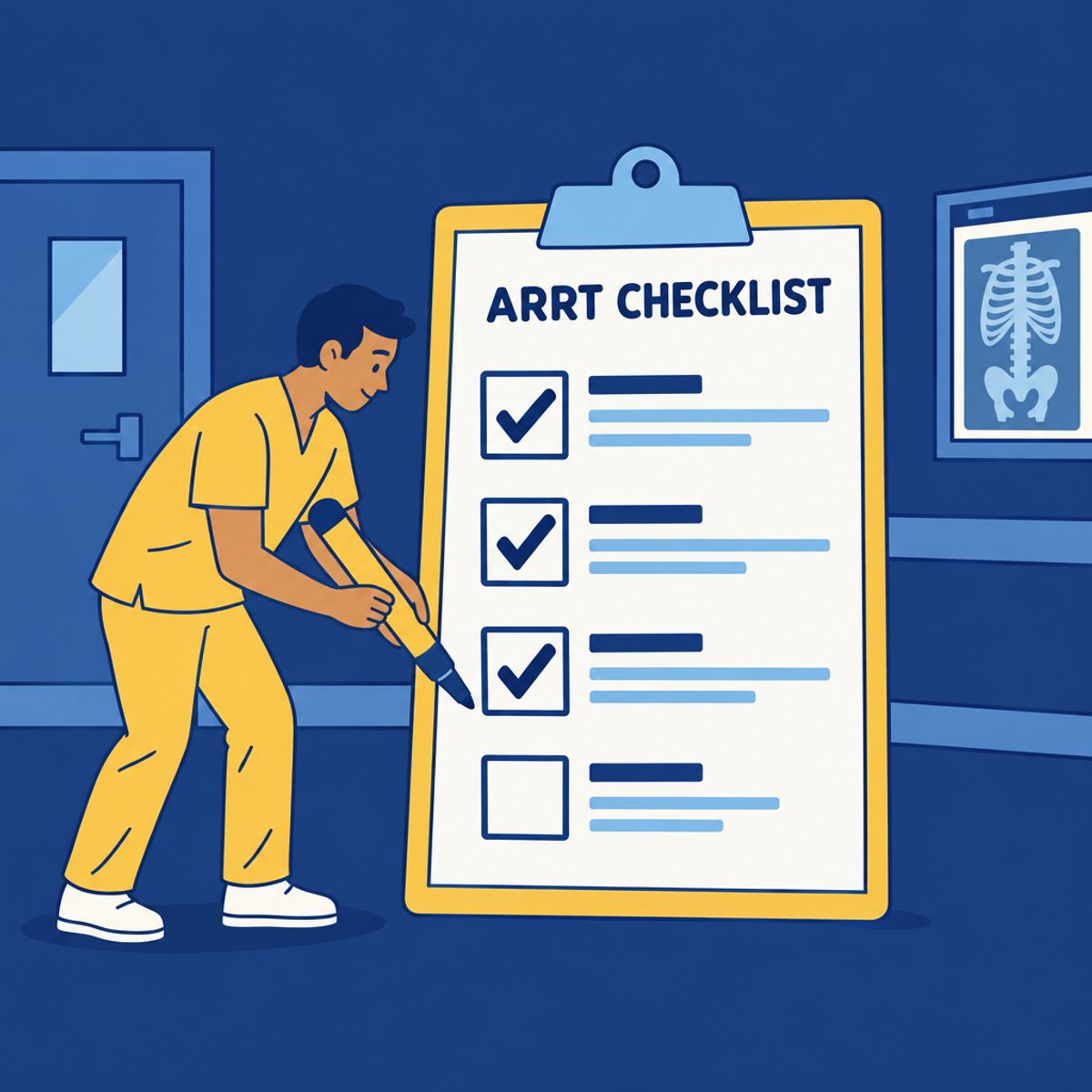
Under ARRT's current rules, as of 2025, primary-pathway candidates must satisfy the education requirement, meet the ethics requirement, and pass the certification examination. Turn that into a dated checklist before you enroll, not after you graduate.
- Education: associate degree or higher, plus completion of an ARRT-approved radiography program with its clinical competencies signed off. Confirm your program's approval status at enrollment and again in your final year; statuses can change.
- Ethics: ARRT reviews candidate standing under its professional conduct rules. If anything in your history raises a question for you, contact ARRT early rather than discovering a problem at application time, after two years of tuition.
- Examination: the certification exam comes after the education and ethics requirements are met. Get the current application steps and fee schedule from ARRT directly; do not rely on a classmate's numbers from a previous year.
- State authorization: contact your intended state's radiologic health or licensing authority and ask exactly what a new graduate needs, in what order, and how long processing takes. States differ, and the rules change, so verify close to your graduation date.
- Sequencing: ask your program when in the final term you can begin the exam application, and ask the state whether you can start its process before certification is in hand. The gap between graduation and first paycheck is often a paperwork gap, and it shrinks when you file in the right order.
Step 5: Price the training from named schedules, not a universal number
Any article that tells you what radiography school costs is guessing, because the honest answer lives in each program's current published tuition schedule and nowhere else. Community college, university and hospital-based programs price differently, in-district and out-of-district rates diverge, and schedules change year to year. The useful move is a spreadsheet, built from the three to five programs on your shortlist, with one row per cost and the source document named next to each figure.
Capture every line, not just tuition. The categories below show up across programs; the amounts are yours to pull from each school's own schedule.

- Tuition and mandatory fees, at your residency rate, for the program's full length
- Prerequisite courses you still need before admission
- Clinical requirements: immunization records, background check, drug screening, uniforms and any required equipment
- Travel to clinical sites, which can be substantial if rotations sit far from campus
- Books, lab fees and program-specific supplies
- ARRT application and examination costs, from ARRT's current fee information
- State license or registration fees, from the state authority's current schedule
Treat duration the same way. The typical entry credential is an associate degree, and most associate programs run on roughly two-year calendars, but prerequisite semesters, cohort start dates and part-time options stretch the real timeline. Pull the actual academic calendar for each program and count the months from your first prerequisite to the earliest exam window. That number, not the catalog's headline, is your timeline.
Step 6: Keep a clinical evidence log from day one
Keep clinical encounter and competency documentation in the program or facility’s approved secure system. Ask the program for an authorized aggregate competency summary you can use for applications. Do not create a parallel personal log of patient-level cases or copy clinical records, images, identifiers or combinations of case details into job-search notes.
Your application can describe verified modalities, equipment, general settings and supervised responsibilities at a level the program permits you to share. Separate observation, assistance and performance under supervision, and use aggregate counts only when authorized and documented.
For interviews, discuss what you learned about communication, preparation, teamwork or escalation without identifiable case details. Your own assessed competencies and approved summaries provide evidence without reconstructing a patient’s encounter.
Step 7: Apply with accurate status and a role-specific resume
State your current status as a student, program graduate, examination candidate or credential holder. Use the credential only when earned, and list the issuing body and state authorization accurately. See how to show an expected graduation date and credential placement.
Support your application with authorized summaries of supervised clinical work. Name modalities and equipment only where you have genuine experience, and distinguish observation from performance under supervision. Tailor the evidence to the actual setting and follow the employer’s file-format and submission instructions.
Frequently asked questions
- How much do rad techs make per hour?
Use current BLS data for radiologic technologists and technicians, separately from MRI technologists, then compare local offers by shift, setting, hours and benefits. A combined imaging-category statistic can obscure differences and is not an entry-level promise.
- Is becoming a radiology tech harder than becoming an RN?
They require different education, clinical competencies and licensing processes. Compare radiographic positioning, imaging equipment and radiation-safety work with the nursing duties that interest you. Program length alone does not decide which route is harder for an individual.
- Can you be a radiology tech with no degree?
For the standard ARRT radiography pathway, no. Candidates must complete an ARRT-approved radiography program and hold an associate degree or higher before sitting the certification exam, as of 2025. Some limited imaging roles, such as certain assistant or equipment-support positions, may not require the same credentials, but they are not equivalent to working as a certified radiologic technologist, and state rules on them vary.
- Is becoming a radiology tech difficult?
Challenging but attainable. The coursework covers anatomy, medical terminology, radiation physics, positioning and patient care, followed by clinical rotations and a certification exam. Your science and math background, your clinical performance and your program's structure drive most of the difficulty. Students who treat clinicals as the core of the program, not an interruption to it, tend to come out strongest.
- What is the fastest way to become a radiology tech?
Plan prerequisites, the approved program, required degree, clinical competencies and examination eligibility together. An existing degree may satisfy the degree component if it meets ARRT’s accepted-accreditation rules. Ask each program and the intended state about your actual requirements and calendar; no short course bypasses the standard radiography pathway.
- How do I become a radiology tech if I already have a bachelor's degree?
Check whether your degree meets ARRT’s accepted-institution requirements. You still need the ARRT-approved radiography program and clinical competencies, ethics eligibility, examination and any state authorization. Ask programs about prerequisite transfer and the complete calendar for degree holders.
- How long does radiology tech school take?
The typical entry credential is an associate degree, and most associate programs run on roughly two-year calendars, but the real timeline includes prerequisite semesters before admission and the paperwork gap after graduation. Pull the actual academic calendar from each program on your shortlist and count from your first prerequisite course to the earliest exam window. That count is your honest answer, and it differs by program.



Ready to start your new resume?
Writing a resume takes time, and even a polished one can miss what a hiring manager is looking for. Roleframe helps you build a clear, ATS-safe resume in minutes and tailor it to the job you want.


