How to Become a Phlebotomist: Training, Clinical Practice and Applications
Compare phlebotomy training, supervised clinical practice, certification eligibility and state requirements, with a program checklist and application advice.

On this page
To train as a phlebotomist, check what your intended state and target employers require, then choose a course that provides the right instruction, supervised clinical practice and credential eligibility. An online theory certificate alone does not establish that you are qualified for live patient work.
This guide separates those checks and works through California’s regulated pathway as an example. The program comparison and cost checklist help you assess the whole route, including clinical placement and exam eligibility.
What a phlebotomist does, and how the role differs from lab technician work
Phlebotomy is the collection of blood, usually by venipuncture (from a vein) or skin puncture (a fingertip or heel stick), for laboratory testing, transfusion, donation, or research. Per O*NET's 2026 occupation data, phlebotomists work with evacuated tubes, syringes, and butterfly devices, explain procedures to patients, label and handle specimens, and respond when a patient has an adverse reaction, such as feeling faint during a draw.
The job sits at the front end of the laboratory pipeline. You collect and label the specimen; laboratory technicians and technologists analyze it, and those analysis roles typically require more formal education. If you want a fast entry into healthcare with patient contact, phlebotomy is the shorter route. If you later want to move into lab analysis, the specimen-handling habits you build as a phlebotomist carry over, but the credential does not. Plan for additional schooling if that is your long-term goal.
Two skill sets matter in equal measure. The technical one: finding veins, choosing the right collection device, filling tubes in the correct order, labeling at the bedside. The human one: a lot of your patients are anxious, elderly, very young, or very sick, and the draw goes better when you can keep them calm while you work. Interviewers test for both, which matters later in this guide.
Prerequisites: what programs ask for before you can enroll
Check the admission page of the actual programs you are considering, because prerequisites vary and the only authoritative list is the program's own current materials. That said, you will see the same categories again and again:
- Education: most programs ask for a high school diploma or an equivalency such as a GED. Confirm against the program's current catalog, not a third-party summary.
- Age and ID: a minimum age (commonly 18) and government identification, because you will be placed in clinical facilities.
- Health clearances for clinical placement: immunization records, tuberculosis screening, and sometimes a physical exam. Clinical sites set these rules, so programs rarely waive them.
- Background check and drug screen: many clinical sites require both before you can touch a patient. If something in your history concerns you, ask the program directly before enrolling; discovering a placement bar after you have paid tuition is the expensive version of this conversation.
- Basic life support certification: some programs require CPR or BLS before the clinical portion begins.
Treat the health-clearance list as a timeline item, not a formality. A tuberculosis screen or an immunization series can take weeks, and clinical placement cannot start without it. Request your immunization records now, not the week your externship is scheduled.
Compare training routes by what they actually deliver
Compare classroom preparation, supervised collections, the intended certification route and any state authorization. These requirements can differ by state and credential, so ask what the specific program actually delivers.
Get a written clinical-placement plan: who secures the site, what happens if it is delayed, how collections are supervised and how competency is documented. Practice on a training arm and verified successful collections from patients are different kinds of experience; do not claim one as the other.
| Route | Classroom instruction | Supervised collections | Credential eligibility | State authorization |
|---|---|---|---|---|
| Community college certificate | Structured curriculum, often a semester or part of one | Usually includes a clinical externship at a partner site; confirm it is guaranteed, not waitlisted | Often designed around a named certification route; verify which one | Public programs in regulated states are usually approved; still verify with the state agency |
| Hospital or employer-sponsored training | Taught in-house, tied to the employer's procedures | Built in, on that employer's patients; often the strongest practice volume | Varies; ask which certification the training qualifies you for | Usually aligned with the state the employer operates in; confirm in writing |
| Private career school | Varies widely in quality and length | Ranges from a full externship to minimal live sticks; get the collection plan in writing | Verify the program's approval status with the certifying body directly, not the school's website | Verify the school's approval number with the state agency, not the school |
| Online-only course | Theory only, on your schedule | None; blood is not drawn over the internet | Rarely sufficient alone; most certifying bodies require documented clinical experience | Insufficient alone in states that require approved hands-on training |
The decision rule, in order: start with the state where you plan to work and find out what it legally requires. Then pick the certification your target employers accept. Only then pick a training program, and pick it because it satisfies both. People who run this backwards, choosing the cheapest or fastest course first, are the ones who finish training and discover they cannot sit the exam they need.
One myth to retire now: a short online course alone does not qualify you to draw blood everywhere. As the BLS notes, jurisdictions and certifying bodies may require approved education, supervised clinical collections, examinations, and demonstrated practical competency. An online theory course can be a useful component. It is never the whole route.
Verify your state's requirements and your credential's eligibility rules
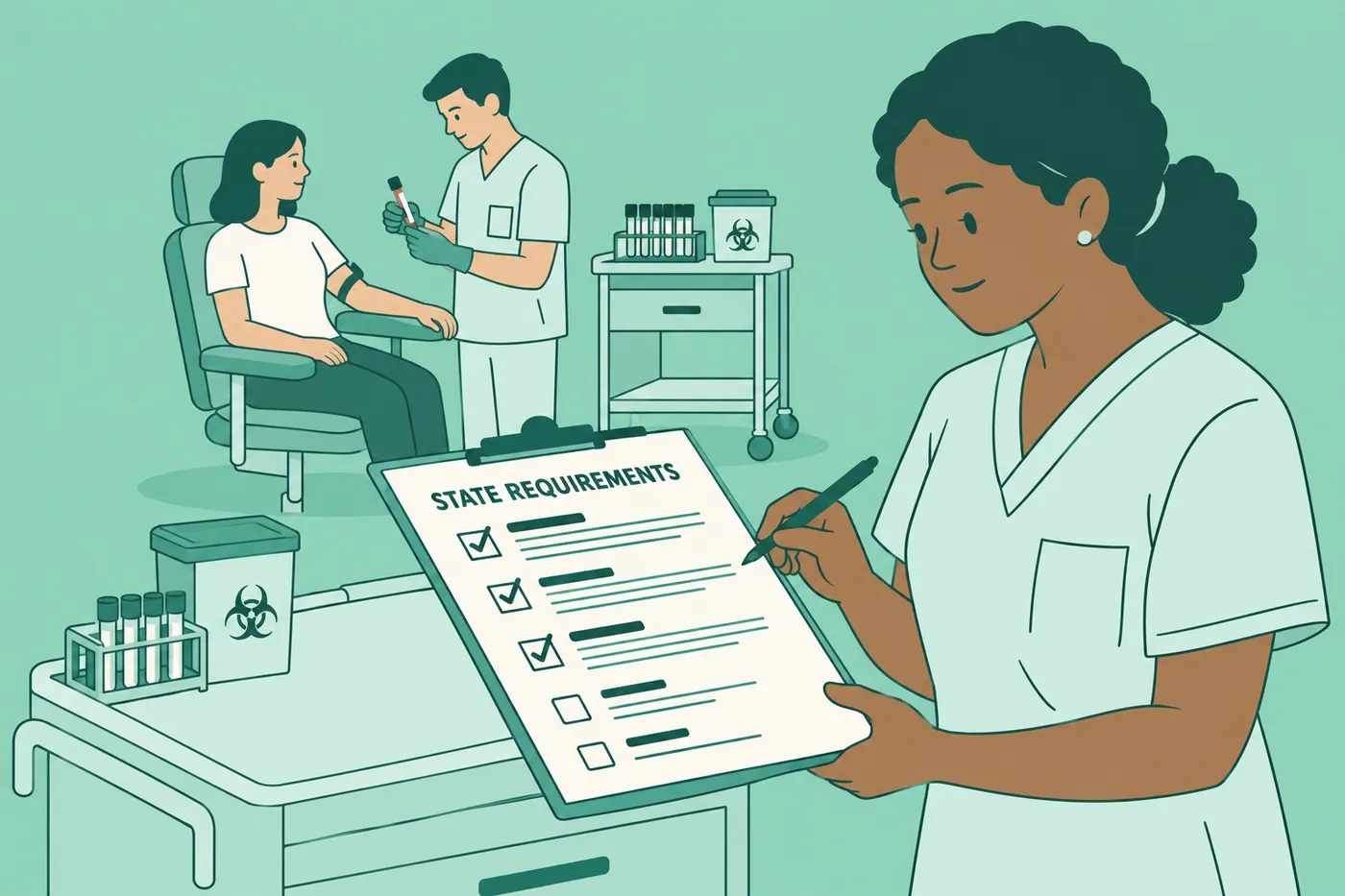
There is no national phlebotomy license. Per the BLS, some states require an approved training program, a license or certification, or other requirements, and some require none of these. The only reliable move is to check the licensing agency in the state where you plan to work, using its current pages, before you enroll anywhere. A requirement you read in a two-year-old article may have changed.
California: the worked example of a regulated state
California shows why "phlebotomy certification" is not one uniform thing. The California Department of Public Health (CDPH) recognizes three distinct levels, each with its own legal scope, per its 2026 materials:
- Limited Phlebotomy Technician (LPT): may perform skin punctures only. The published pathway requires 20 hours of basic classroom training and at least 25 qualifying skin punctures in a clinical setting, and the certificate must be renewed annually with a fee and continuing-education documentation.
- Certified Phlebotomy Technician I (CPT I): may perform skin punctures and venipunctures. Applicants generally need training from a CDPH-approved program, documented clinical collections, and a national examination from a CDPH-approved certifying organization. The published pathway includes documentation of at least 50 venipunctures and 10 skin punctures, with observation of arterial punctures.
- Certified Phlebotomy Technician II (CPT II): may also perform arterial punctures.
For a new applicant with no prior qualifying experience, California’s CPT I pathway includes approved classroom and practical instruction, documented venipunctures and skin punctures, observation of arterial punctures and an approved national examination. Its requirements vary with prior qualifying experience, so use the route that matches your record.
For example, CDPH specifies 40 hours of didactic instruction and 40 hours of clinical practice for its no-experience route, including at least 50 venipunctures and 10 skin punctures plus arterial-puncture observation. These are California requirements for that route, not universal national totals.
The certification bodies: compare eligibility routes, not just names
Ask employers which professional certifications they accept and then check the certifying organization’s current education, experience, collection and examination requirements. ASCP, AMT, NHA and NCCT have distinct routes; acceptance of one does not establish eligibility for the others.
Where the state approves particular examination providers, confirm that the intended credential is on that list as well. Keep the state application and national certification paperwork separate.
What training and the exam cost, and how to compare without a universal number
There is no single honest figure for what phlebotomy training costs, because routes differ in length, in what they include, and in what your state adds on top. Any page quoting one universal price is describing one program, not the field. What you can do is build a total for each option you are considering, from current published materials, across five lines:
- Tuition, from the program's current catalog or fee schedule, including lab fees and supplies.
- Clearance costs: immunizations, TB screening, background check, drug screen, and CPR certification if required. Programs often leave these out of the headline price.
- The certification exam fee, from the certifying organization's current fee page.
- State application and certificate fees, where your state regulates the role, from the state agency's current fee schedule.
- Renewal costs: some credentials and state certificates renew on a cycle with fees and continuing education. California's LPT certificate, for instance, renews annually.
Then apply the real test: cost per qualification, not cost per course. A cheap course that does not make you eligible for the exam your state or employer requires costs you its full price plus the price of the program you then have to take properly. Employer-sponsored training can be the lowest-cost route of all, sometimes free in exchange for a work commitment, so ask local hospitals and lab networks whether they train before you pay a private school.
Build a supervised clinical log that becomes your proof
Use the school or clinical site’s approved secure system for required collection records. Ask how you can obtain an authorized competency summary for future applications. Personal job-search notes should contain only permitted aggregate experience, without patient identifiers or patient-level case details.
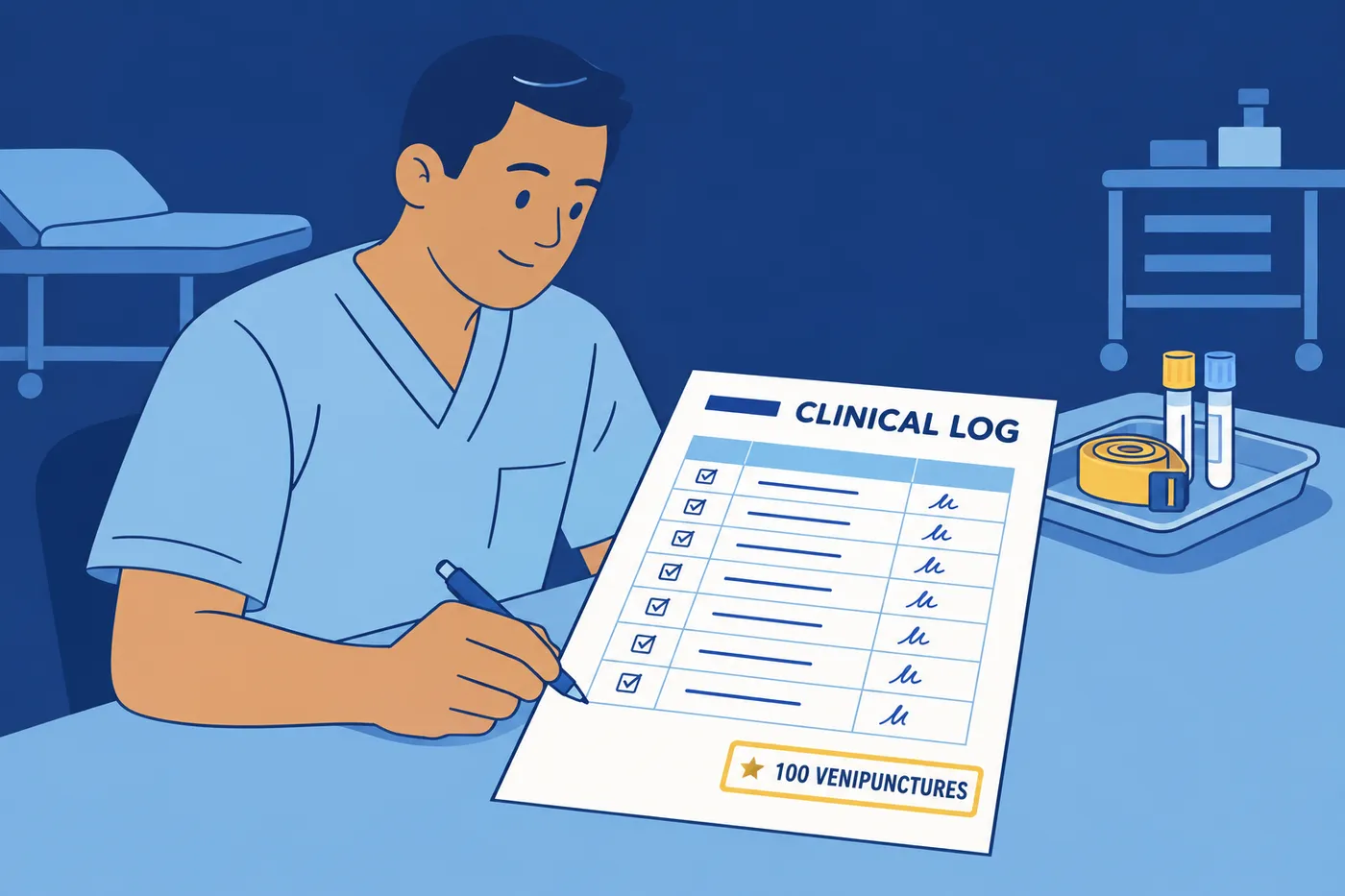
- Approved placement dates and setting, without patient-level details in personal notes
- Supervisor-verified aggregate collection totals, separated by collection type
- Clear separation of observed, assisted and successfully performed procedures
- Competencies signed off through the official program process
- General feedback about communication, preparation and adherence to the site’s protocol
Follow the program and facility’s confidentiality rules. Keep patient-level records in the authorized system, and do not copy records, photographs or identifiers into a private log, resume, AI tool or interview preparation file. Describe your own training and approved aggregate experience instead.
Apply for entry jobs: the resume and the interview
Entry-level phlebotomy hiring turns on three things: accuracy, communication, and procedure adherence. Your resume and your interview answers should both be built from those three, with your clinical log as the raw material.
The resume
Put your credential and your collection evidence in the top third. A recruiter scanning for a phlebotomist wants to see the certification name and status (including "exam scheduled" with a date, if that is where you are), the state certificate if your state issues one, and concrete practice volume: "completed supervised clinical externship with documented venipunctures and skin punctures across inpatient and outpatient settings" beats "hardworking team player" every time. Use real counts from your log. See where to put certifications on a resume for placement when the posting makes the credential a hard requirement.
If this is your first healthcare job, structure the page around the externship as your experience section and let earlier work carry the transferable evidence: customer-facing roles prove you can calm an anxious person, and detail-heavy roles prove you can follow a checklist exactly. The approach in how to write a resume with no experience maps directly onto a new phlebotomist's situation, and the medical assistant resume example shows how clinical scope and credential status read in an allied-health format. Follow the employer’s requested file format and check the exported file. If you build the resume in Roleframe's editor, the live checks flag vague bullets and missing details on each entry as you write, which catches exactly the "performed blood draws" filler that sinks entry-level clinical resumes.
The interview
Expect scenario questions, and prepare answers from real moments in your log. The recurring themes:
- How did you follow the site’s patient-identification and labeling procedure?
- How did you communicate with an anxious patient while working under supervision?
- How did you report a possible collection or labeling concern through the proper process?
- What did you learn from a supervisor’s feedback about safe practice?
Structure each answer as situation, action, result, drawn from a specific supervised collection. The STAR method guide shows how to build that story bank, and the general preparation plan in job interview tips covers the rest of the room. One honesty rule above all: never inflate your collection counts or claim procedures you only observed. Your log is verifiable, and in a role where a mislabeled tube can harm a patient, employers screen hardest for people who report the truth under pressure.
Frequently asked questions
- What is phlebotomy?
Phlebotomy is the collection of blood, usually by venipuncture or skin puncture, for laboratory testing, transfusion, donation, or research. Per O*NET's 2026 data, phlebotomists use evacuated tubes, syringes, or butterfly devices, explain procedures to patients, label and handle specimens, and help patients who experience adverse reactions during a draw.
- How much does a phlebotomist usually get paid?
Check current BLS wage data for your state or metropolitan area and compare local vacancies by hours, shift, setting and benefits. A national median describes the occupation, not a guaranteed entry offer.
- How do I do a phlebotomy course?
Choose a recognized postsecondary certificate program, verify its admission requirements against its current catalog, and confirm whether your state or target employers require a specific approval or certification before you enroll. Programs generally cover venipuncture, capillary collection, specimen handling, safety, regulations, and patient care, and NAACLS standards specify clinical education with supervised successful collections. After graduating, you can pursue certification through organizations such as ASCP, AMT, NHA, or NCCT, subject to each agency's own eligibility rules.
- How do I become a good phlebotomist?
Competence comes from formal training, supervised practice, and strict adherence to patient-identification, infection-control, specimen-labeling, and safety procedures. Per O*NET, strong communication, active listening, careful monitoring, and calm patient support are core skills, along with recognizing and responding to adverse reactions. A quality program includes clinical experience and successful, unaided blood collections before you practice independently, so choose training that guarantees live supervised draws, not just classroom hours.
- Can I become a phlebotomist with an online course alone?
Generally no. An online course can cover theory, but jurisdictions and certifying bodies may require approved education, supervised clinical collections, an examination, and demonstrated practical competency, per the BLS. California's CPT I pathway, for example, documents at least 50 venipunctures and 10 skin punctures. Treat online coursework as one component and confirm how you will get documented supervised collections before paying for anything.
- Do all states require a phlebotomy license?
No. Requirements vary by state: some require an approved training program, a license or certification, and others require none of these, per the BLS. California is a regulated example, with three distinct credential levels (LPT, CPT I, CPT II) that each permit different procedures. Check the licensing agency in the state where you plan to work, on its current pages, before enrolling in any program.
- How long does it take to become a phlebotomist?
It depends on the route and the state, so no single timeline is honest. The typical entry credential is a postsecondary nondegree award rather than a degree, which puts most routes in the months range, not years. The variables that stretch a timeline are clinical placement scheduling, health clearances such as immunization series and TB screening, exam scheduling, and state application processing, so confirm each of those against your specific program and state agency.

Ready to start your new resume?
Writing a resume takes time, and even a polished one can miss what a hiring manager is looking for. Roleframe helps you build a clear, ATS-safe resume in minutes and tailor it to the job you want.


