How to Become a Pharmacy Technician: Training, Registration and First Job
Compare pharmacy technician training and experience routes, state registration, PTCB and ExCPT eligibility, costs and first-job application steps.


On this page
Start with your state pharmacy board’s technician and trainee requirements. Depending on the jurisdiction, you may need registration, licensure, approved training or national certification before particular work is permitted.
Then compare training routes against the credential your target employers accept. This guide separates state authorization, education or documented experience, national certification and employer requirements so you can plan the whole route.
What the job looks like in retail, hospital and other settings
Before you spend money on training, decide which setting you're training for, because the day-to-day work and the hiring bar differ. Pharmacy technicians work in community (retail) pharmacies, hospitals, mail-order pharmacies and other healthcare settings, handling prescription processing, inventory, customer service and medication preparation under a pharmacist's supervision, per BLS.
Retail is the widest entry door. Chains hire trainees, the work is heavily customer-facing, and the register, the drive-through and insurance rejections are as much of the job as counting tablets. Hospital pharmacy pays attention to different skills: sterile and non-sterile compounding, unit-dose preparation, and inventory for an entire facility, with little or no public contact. Hospital postings more often require national certification up front and sometimes prior experience, which is why many technicians start in retail and move. Mail-order and specialty pharmacies sit in between: high volume, production-line accuracy, limited patient interaction.
| Setting | Core daily work | What a beginner should check in postings |
|---|---|---|
| Retail / community | Prescription-processing support, inventory, transactions and routing clinical questions to the pharmacist | Whether the chain hires uncertified trainees and runs its own training program |
| Hospital | Compounding, unit-dose prep, floor stock, IV room support | Whether certification and prior experience are required, and which shifts are open to new techs |
| Mail-order / specialty | High-volume fulfillment, inventory control, quality checks | Production metrics expected, and whether the state requires registration for non-patient-facing roles |
Pick the setting you want in two years, not just the first job. If hospital work is the goal, choose a training route that includes compounding practice, because retail experience alone rarely covers it.
Checkpoint 1: your state board's rules come before everything else
Use the board’s current technician application page to check entry categories, approved training and examinations, screening and renewal. Ask whether a trainee status is available before paying for a course or applying for a job.
Texas provides a worked example: a trainee registration may last up to two years and is issued once without renewal. The initial registered-technician route recognizes current PTCB or NHA ExCPT certification. Applicants need to follow the board’s application and screening process and wait for active status before working. Texas also describes technician training requirements; do not interpret a choice between school and employer training as no training requirement at all.
Use the current board processing notice in your timeline. Registration is not a promise that you can begin work within weeks.
- Does the state require registration or a license before you work, and is there a trainee status that lets you start earlier?
- Does the state require a board-approved training program, a specific exam, or both? Which exams does it accept?
- What are the fingerprinting, background check and renewal requirements, and on what cycle?
Checkpoint 2: choose a training route with current documentation, not reputation
Employer training may combine paid work with structured learning where state rules allow it. Ask who pays for materials, examinations and retakes, and whether sponsorship includes a repayment condition.
A school or college program may provide structured classroom work and clinical preparation. Verify state acceptance and the specific certification route rather than judging the course by its length alone.
Experience-based eligibility differs by certifying organization. PTCB accepts a recognized training program or at least 500 hours of equivalent technician work experience, with other eligibility conditions. NHA’s ExCPT lists an education route and an alternative requiring one year of experience with at least 1,200 supervised pharmacy-related hours within the last three years. Meeting an hours threshold alone does not waive education, disclosure or other requirements.
| Route | Cost to you | What to verify before committing |
|---|---|---|
| Employer on-the-job training | Confirm wages, fees, exam sponsorship and any repayment terms | That the posting accepts uncertified hires in your state, and whether the employer sponsors certification |
| School / college program | Tuition, typically months of study | That the program appears on PTCB's recognized list or meets NHA's eligible-program rule, and that it includes an externship if you want hospital work |
| Work experience pathway | Time in a trainee or support role | PTCB: at least 500 equivalent technician work hours. NHA experience route: one year and at least 1,200 supervised pharmacy-related hours in the last three years, plus the other eligibility conditions. |
Checkpoint 3: state registration and national certification are separate things
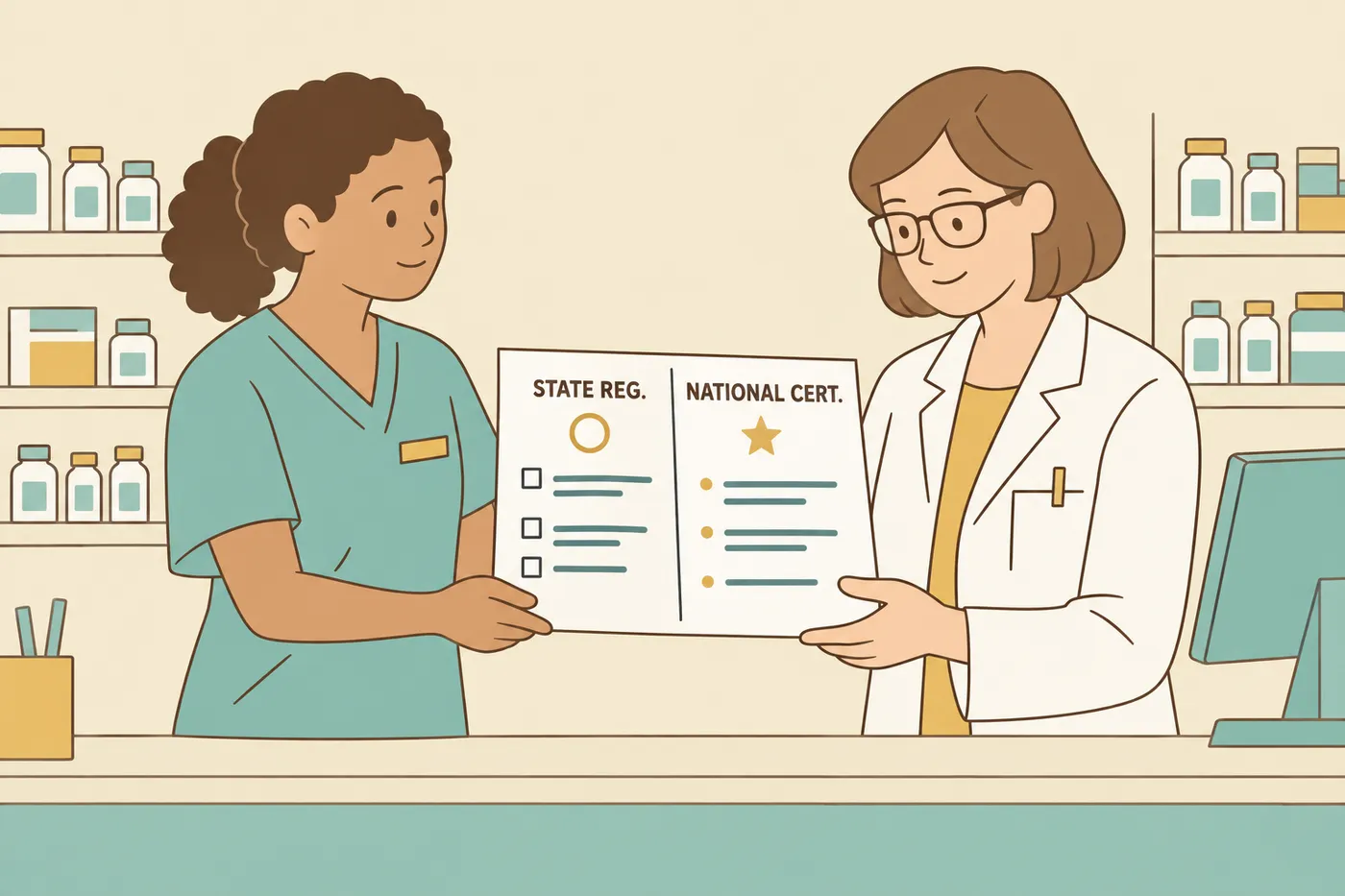
A national certificate and state authorization serve different purposes. Check the exact credential accepted by the board and employer before selecting an examination. A passing score alone does not complete every certification or registration requirement.
For PTCB, review the recognized-program or experience route, residence rules, policy requirements and disclosures before applying. For NHA, review the full ExCPT eligibility route and education requirements. Keep each organization’s decision and documentation separate from the state application.
After certification, follow that body’s renewal and continuing-education rules and the state’s separate renewal instructions. Moving states requires another state-specific check; national certification is not an automatic work authorization.
Checkpoint 4: build your own fee and timeline checklist
No article can give you a single total cost or timeline, because the numbers live in three different places and change on their own schedules. What you can do in one evening is build a checklist with a line for each item, filled in from the current source rather than from a blog's estimate. Fees and processing times drift; a figure copied from a two-year-old page is the most common way candidates mis-budget this process.
- State board: initial registration or license fee, trainee registration fee if applicable, fingerprinting and background check cost, stated processing time, and the renewal fee and cycle. Source: the board's own fee schedule page.
- Certification body: exam application fee, retake policy and cost, recertification fee and the continuing-education hours required. Source: PTCB or NHA's current candidate pages.
- Training program: tuition, materials, externship requirements, and the calendar length from enrollment to certificate. Source: the program's current catalog, confirmed by phone if the website is undated.
- Employer: whether they reimburse exam fees or sponsor training, and whether a conditional offer can precede registration. Source: the posting and the recruiter.
Map the timeline from the first date you can legally work, using the board’s current processing information and the employer’s hiring conditions. If a trainee category is available, confirm its permitted duties and deadline for upgrading. Leave room for application review, screening and examination scheduling.
Collect evidence of your skills while you train, not after
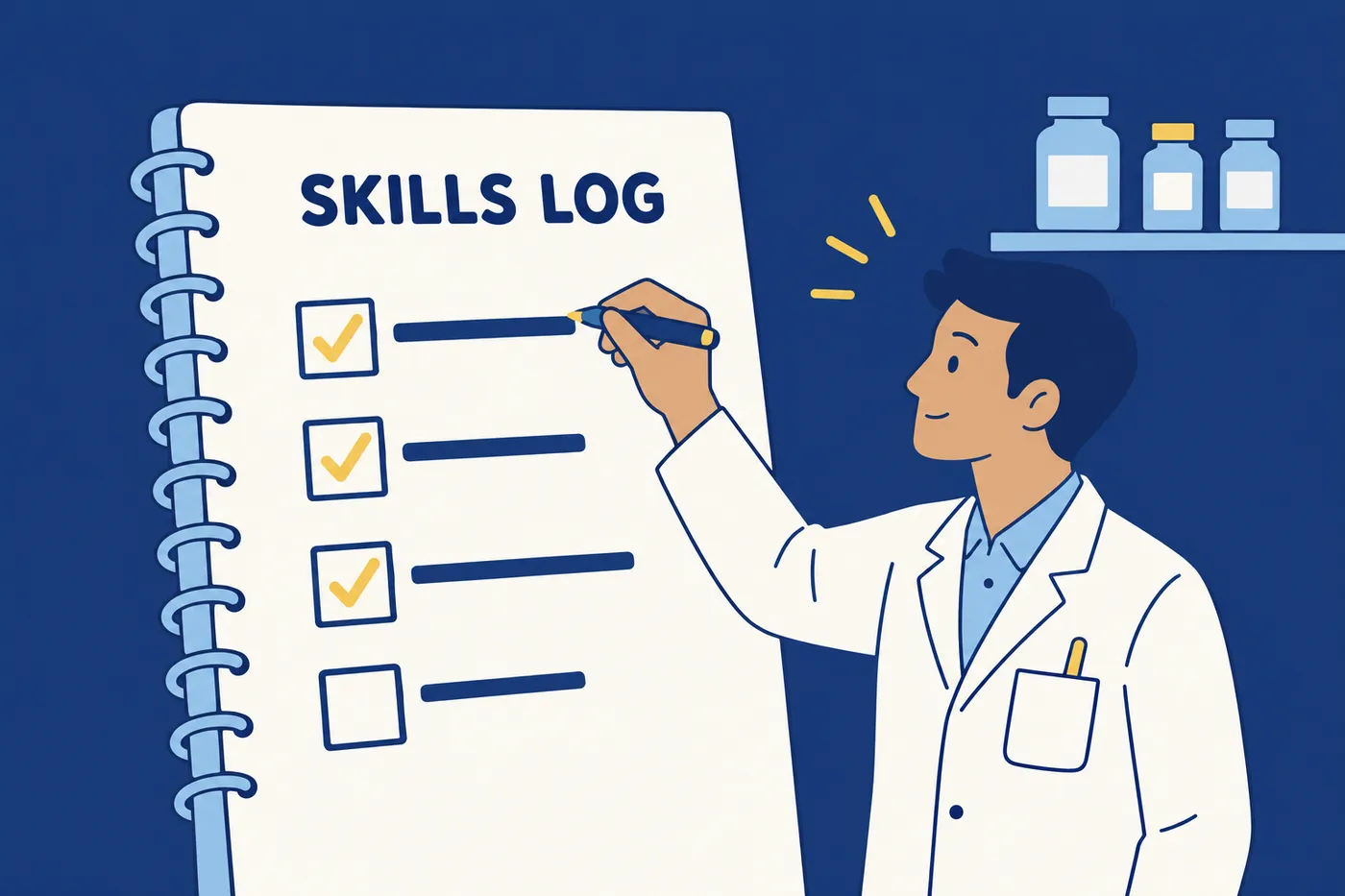
Keep supervisor-verifiable records of authorized training and work using the employer’s approved system. For certification eligibility, retain permitted evidence of dates, hours and duties; do not keep patient or prescription identifiers in personal job-search notes.
Your resume can describe relevant inventory, customer-service, systems and supervised pharmacy experience. Distinguish classroom calculations and simulations from work actually performed, and do not imply independent clinical judgment. Patient counseling and clinical questions should be handled through the pharmacist and the workplace’s procedures.
Turn the checkpoints into a first resume
With a credential in hand or in progress, the resume becomes a matching exercise. Start from the pharmacy technician resume example, which shows how to order the sections and phrase the bullets for this role. Then check each vacancy's actual requirements line by line: one posting says "CPhT required," another says "PTCB or ExCPT," a third accepts "registered trainee." Your resume should mirror the posting's exact credential language, with your registration number and status stated plainly. Where a certification is a hard requirement, it belongs near the top; where to put certifications on a resume walks through the placement decision.
If you're coming in with no pharmacy history, the evidence log from the previous section fills the gap: cash handling, inventory counts, customer volume from any prior job all transfer. The guide to writing a resume with no experience shows how to build those bullets from scratch.
Tailoring to each posting is where most first-time applicants lose time or skip the step entirely. Roleframe handles the slow part: keep one base resume for your technician target, make a tailored copy per job with the posting attached, and the job match shows which of the posting's keywords and requirements your resume still misses, with live checks flagging weak bullets as you edit. You write every word; the tool shows you what to fix. Follow the employer’s file-format instructions and submit before the deadline.
Frequently asked questions
- Is a pharmacy technician a good job?
It can suit someone who values accurate process work and healthcare support. Compare actual local offers, shifts, supervision, workload and advancement opportunities. Retail, hospital and specialty roles can differ substantially, and a credential does not guarantee a particular job or wage.
- How long does it take to become a pharmacy technician?
It depends on the state authorization route, training or qualifying experience, certification eligibility and application processing. Check each deadline separately. A trainee registration may permit supervised work sooner in some states, but approval and an employer offer are still necessary.
- How do you become a certified pharmacy technician in Texas?
Use the Texas board’s initial, trainee or upgrade route appropriate to your history. Its registered-technician route recognizes PTCB or NHA ExCPT certification and has application and screening requirements. A trainee registration is issued once for up to two years. Wait for active registration and follow the board’s training rules before working.
- Can you work as a pharmacy technician without certification?
In some states, yes. State boards decide whether certification, registration or licensure is required, and some states allow uncertified trainees to work under supervision while they earn a credential. Some employers, especially hospitals, require certification regardless of state law. Check your state board's rules first, then the specific posting.
- Who gets paid more, a pharmacy tech or a CNA?
Compare local offers with similar schedules and benefits rather than assuming one occupation always pays more. BLS occupational data can provide regional context, but setting, shift, experience and employer determine the actual offer.
- Is 35 too old to become a pharmacy technician?
Check the program, state and employer requirements, then compare the training commitment with your budget and work goals. Pharmacy technician and pharmacist are different education and licensing routes; this guide covers technician entry.
- What's the difference between the PTCB and NHA certifications?
They are different certification programs with different eligibility rules. PTCB offers a recognized-training or minimum-500-hour experience route. NHA’s experience route requires one year with at least 1,200 supervised hours in the previous three years; it also has an education route. Check all conditions and your state’s accepted credentials before choosing.



Ready to start your new resume?
Writing a resume takes time, and even a polished one can miss what a hiring manager is looking for. Roleframe helps you build a clear, ATS-safe resume in minutes and tailor it to the job you want.


