How to Become a Paramedic: Check Prerequisites and Plan the Route
How to become a paramedic: EMT prerequisites, accredited paramedic school options, the National Registry exam, and state licensure, step by step.

On this page
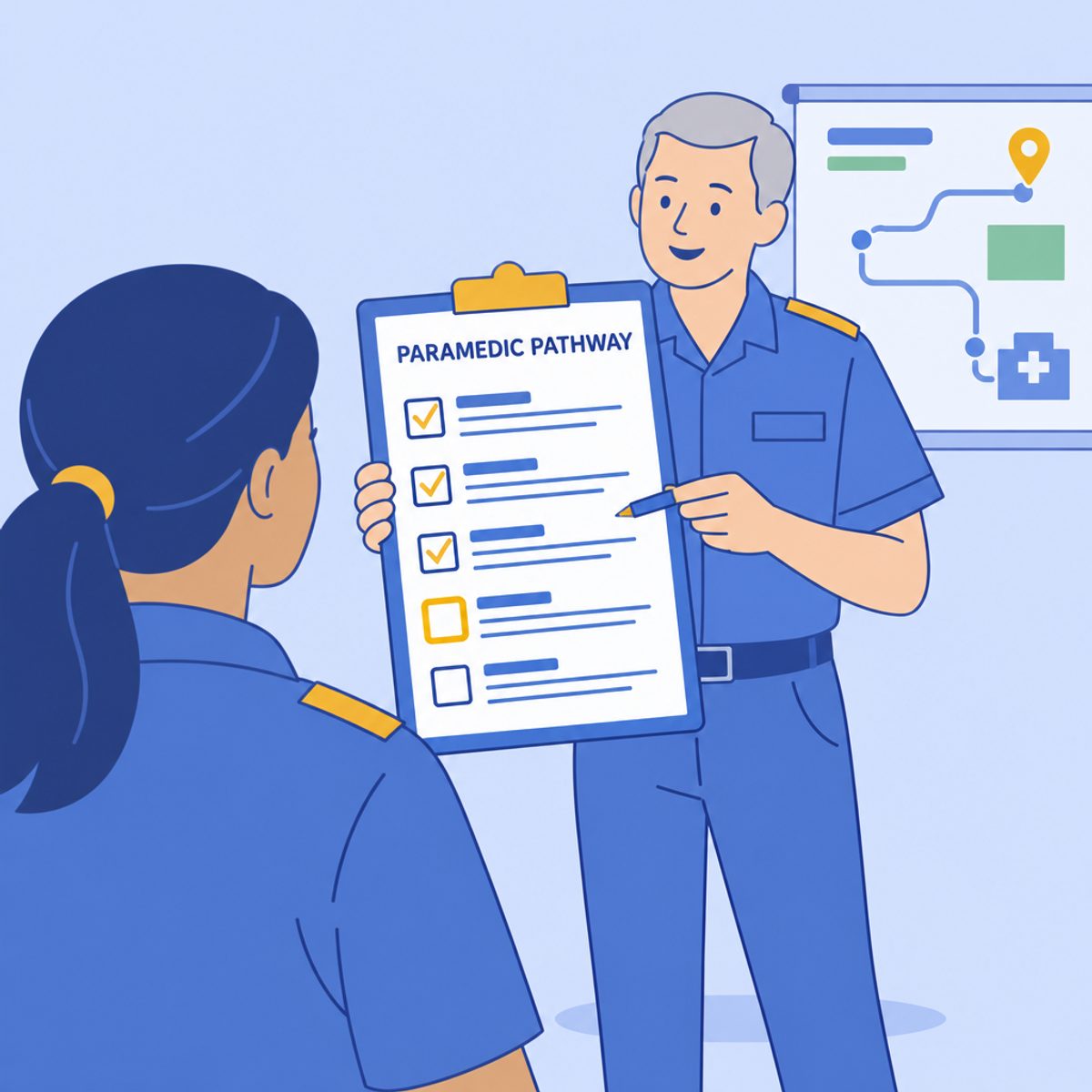
The usual new-entrant paramedic route starts with current EMT-level certification or licensure, followed by qualifying paramedic education, documented student competencies, the required certification assessment and state authorization. Program admission and state application steps can overlap, so confirm the sequence with both the school and state EMS office.
This guide separates the checks that matter before enrollment: your EMT status, program accreditation, clinical arrangements, exam eligibility and the state permission needed to practice.
Paramedic vs. EMT: two different qualifications, not two ranks
EMT education prepares you for basic emergency care. Paramedic education adds more advanced assessment, pharmacology and interventions, with supervised hospital and field learning. The exact authorized practice remains subject to state rules and medical oversight.
The National Registry’s full-education paramedic route requires current National Registry certification or a state license at EMT level or higher. Ask each program when that prerequisite must be met for admission; do not assume a paramedic course can replace initial EMT preparation.
The prerequisite matrix: four things to verify before you apply anywhere
Treat these as four separate verifications, because they come from four separate authorities. A paramedic school confirms its own admission rules, the NREMT confirms exam eligibility, and only your state EMS office confirms what it takes to be licensed where you intend to work. No one of them can answer for the others.
| Requirement area | What it usually means | Who verifies it |
|---|---|---|
| EMT status | A current, unexpired EMT certification or state EMT license. Most paramedic programs require it at admission; the NREMT requires EMT-level certification before paramedic certification. | Your state EMS office (license status) and the program (admission rule) |
| Education | High school diploma or equivalent, plus current CPR/BLS certification, per the Bureau of Labor Statistics. Some programs add anatomy and physiology coursework or entrance testing; rules vary by state and school. | The paramedic program's published admission requirements |
| Clinical evidence | Completion of a CAAHEP-accredited program or a CoAEMSP Letter of Review program, plus the required student competency documentation (see the placement section below). | The program director, who verifies completion to the NREMT |
| State authorization | A state-issued paramedic license. Some states require National Registry certification; others accept an equivalent state exam. Background checks and age minimums vary; Texas, for example, requires applicants to be at least 18. | Your state EMS office, in the state where you plan to work |
Two of these trip people up constantly. First, accreditation: the NREMT requires completion of a paramedic program accredited by the Commission on Accreditation of Allied Health Education Programs (CAAHEP) or one holding a Letter of Review from the Committee on Accreditation of Educational Programs for the EMS Professions (CoAEMSP). A course without one of those two statuses can leave you ineligible for National Registry certification no matter how good the instruction was. Check the program's status on the CAAHEP or CoAEMSP listings yourself rather than taking a brochure's word for it.
Second, the state question. National Registry certification does not itself grant the legal authority to practice; a state license does. States also differ on whether NREMT certification is mandatory or whether they run an equivalent state examination, so the credentialing route is jurisdiction-specific. If you might move, verify requirements in each state you are considering. Do not assume your credentials transfer automatically between states; some states make recognition of out-of-state credentials quick and some do not, and the state EMS office is the only authority on how yours handles it.
A practical note from the employer side: the Bureau of Labor Statistics notes that employers typically require a driver's license and may prefer ambulance-driver certification. Check the program and employer’s driving-record requirements separately if the role includes driving duties.
Comparing paramedic school options: entry, clinical exposure, scheduling
Once your prerequisites check out, the real decision is which program format fits your life. Paramedic school is delivered in several formats, and the accreditation requirement applies to all of them equally. Many programs take roughly one to two years after EMT training, with the exact timeline depending on course format, prerequisites, clinical availability, and whether the program awards a degree.
| Program type | Typical entry requirements | Clinical exposure | Scheduling fit |
|---|---|---|---|
| Community college certificate | Current EMT, diploma or GED, CPR/BLS; sometimes prerequisite coursework or entrance testing | Scheduled hospital and field rotations arranged by the program | Often daytime, semester-based; some evening cohorts |
| Associate degree program | Same as certificate plus general education courses | Same clinical structure, spread over a longer degree timeline | Longest route, but the degree can help with later career moves into education or management |
| Hospital- or agency-based academy | Current EMT, often an employment or sponsorship relationship with the agency | Rotations frequently inside the sponsoring system, sometimes with paid field time | Built around the agency's shift patterns; competitive entry |
| Hybrid (online didactic + local clinicals) | Current EMT plus the ability to arrange local clinical placements | Didactic work online; hands-on skills, hospital and field hours completed in person | Most flexible for people working full time, but clinical scheduling still demands real availability |
Three questions separate strong programs from weak ones, and you should ask them before enrolling. Where exactly will my hospital and field rotations happen, and does the program place me or am I expected to find sites? What is the program's recent first-time pass rate on the certification exam, and will they show it to you? And is the program's accreditation current, verified on the CAAHEP or CoAEMSP site, not just claimed?
Clinical exposure deserves the most scrutiny. The didactic content is standardized, because every eligible program must meet or exceed the National EMS Education Standards for Paramedic. What varies is how much patient contact you actually get, how competitive the placement sites are, and whether you will log the specific competencies you need to graduate. A hybrid program that leaves you to arrange your own rotations in a saturated market can stall your whole timeline.
One deadline to plan around: per the NREMT as of 2026, an initial paramedic course is valid for two years from the course-completion month and year. Finish your program, then let the exam slide too long, and you can age out of eligibility and face remediation. Book the exam while the course is fresh.
Exams, national certification and state licensure: the order of operations
Check the program’s completion verification and your state’s application instructions before graduation. National certification and state authorization are distinct, and completing one does not automatically complete the other.
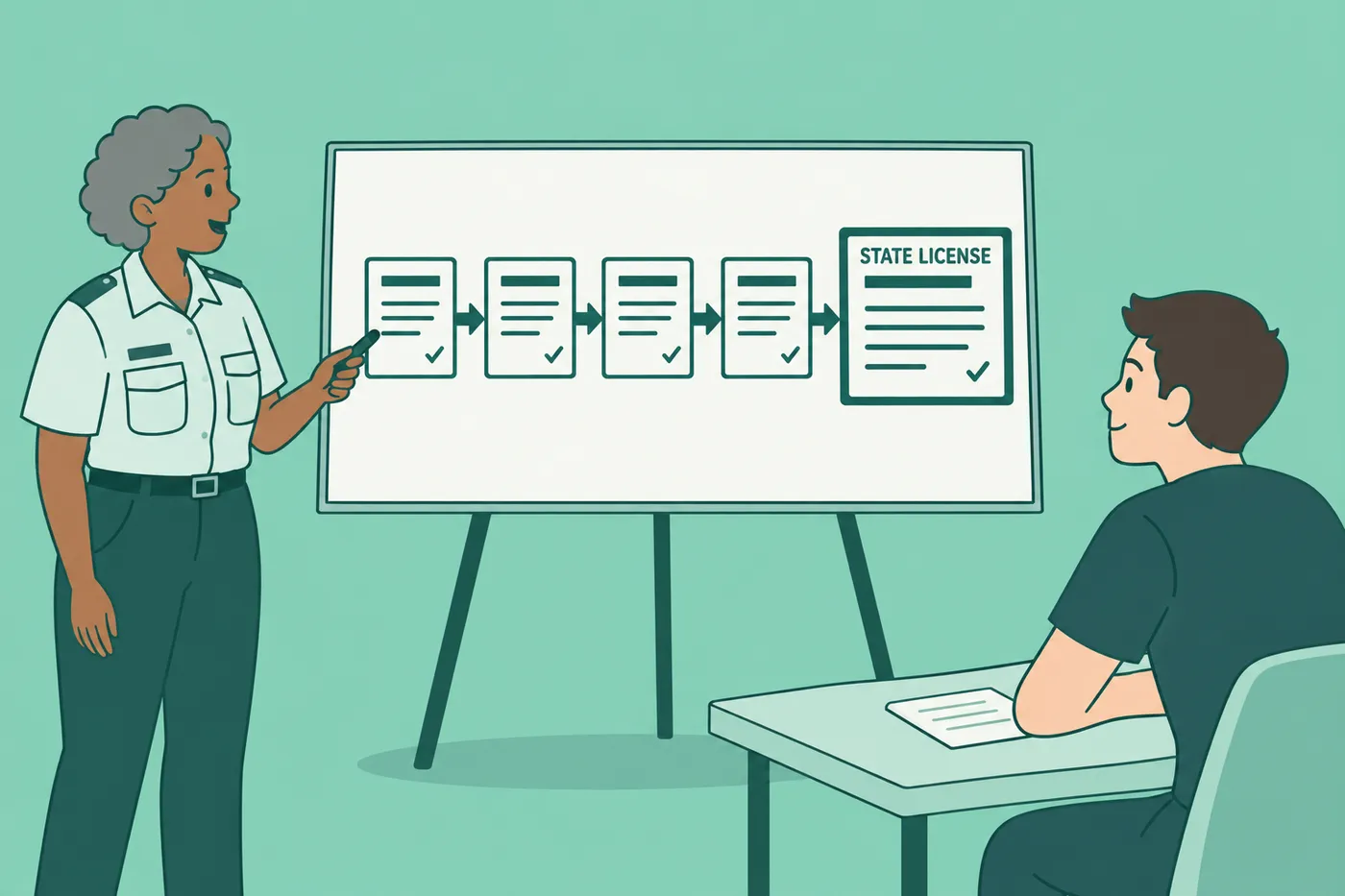
- Your program director verifies your course completion to the National Registry. You cannot sit the exam before this happens.
- You take the National Registry Paramedic Certification Examination, assuming your state uses it. Some states accept an equivalent state exam instead; confirm which applies to you before scheduling anything.
- You apply for a state paramedic license from your state EMS office. This is the step that legally authorizes you to practice. National certification alone does not.
- Record national certification and state license renewal requirements separately. Check the current recertification model for your credential and ask the employer which education it provides or reimburses.
Two myths are worth killing here. Passing the National Registry exam does not automatically let you work anywhere in the country; the state license is the legal instrument, and states set their own rules. And paramedic certification is not permanent once earned; the two-year recertification cycle through continuing education or examination is part of the job for as long as you hold the credential. Budget those recertification hours into your working life from the start.
Build an itemized budget from primary sources
Costs vary so much by state, program type and residency status that any single dollar figure in an article would mislead you. What does not vary is the list of line items. Build your budget by pulling the current number for each line from the primary source: the program's published tuition schedule, the NREMT's current fee page, and your state EMS office's license fee schedule.
- EMT course and certification, if you do not already hold it, including that exam fee
- Paramedic program tuition and fees, from the program's own current schedule
- Textbooks, uniforms and equipment the program requires you to supply
- Clinical costs: immunizations, background check, drug screening, liability insurance where the program requires it
- Transportation to clinical sites, which are often not where the classroom is
- National Registry paramedic exam fee, from the NREMT's current fee schedule, plus a buffer for a possible retake
- State license application fee, from your state EMS office
- Lost or reduced income during clinical rotations, which is the line most people forget and the one that sinks the most budgets
That last line deserves a plan, not a hope. Clinical rotations demand daytime weekday availability in most programs, which collides directly with a full-time EMT job. Many students drop to part-time hours during the clinical phase; price that into the budget before you enroll, not after.
Documenting your clinical placements without overclaiming
The National Registry paramedic education pathway requires a CAAHEP-accredited program or one with a CoAEMSP Letter of Review, completion within the applicable two-year window and program-director verification. Current applicants must satisfy the applicable student minimum competency requirements.
For initial advanced-level certification, the new certification examination introduced in July 2024 replaced the former separate National Registry cognitive/psychomotor examination sequence. This did not remove hands-on learning or program competency documentation.
Retain authorized copies of competency sign-offs and evaluations. Personal resume notes should contain only permitted, nonidentifying summaries. Distinguish observing, assisting and performing under preceptor supervision; never imply independent paramedic practice during student rotations.

Preparing the paramedic job application
When you apply for your first paramedic role, credential precision is the whole game. State your exact status as of the application date in one line, such as "NREMT Paramedic, certified [month/year], [State] paramedic license #, current BLS/ACLS." If you are between checkpoints, say so plainly. "Paramedic program completed [month/year]; NREMT exam scheduled [date]; state license application pending" tells a hiring manager exactly where you stand. Hiring managers deal with pipeline candidates constantly and a clear status line builds trust; a vague one makes your status harder to assess. Put the credentials where they get read, which for a new paramedic usually means above or immediately after experience; the guide on where to put certifications on a resume walks through the placement logic.
Your EMT work history carries more weight than new graduates expect. Call volume and service type tell a hiring manager what kind of paramedic you will be, and so does the concrete responsibility you held. A 911 service reads differently from interfacility transport, so name the service you worked. After that come the student clinical entries, written with the supervised framing above. Use the employer’s requested file format and inspect the exported document.
Before you submit, check the resume against the specific posting, because agencies differ in what they screen for, from specific certifications to shift availability. If you want that check done systematically, Roleframe's resume keyword scanner shows which terms from a posting your resume covers and which it misses, so a listed requirement like "current ACLS" never goes unanswered just because you forgot to write it down.
Ask about transition-to-practice support in every interview, because it varies enormously and shapes your first year more than pay does. Ask how long the field training program runs for a new paramedic and who the field training officers are. Find out whether there is a structured probationary evaluation and what it measures. It is also fair to ask what happens if a new paramedic needs more ride time before being cleared to practice independently. An agency with crisp answers invests in new medics. An agency that waves the question off is telling you something too.
Frequently asked questions
- How hard is it to become a paramedic?
Paramedic education combines anatomy and pharmacology with emergency assessment, supervised clinical practice and field learning. The usual route requires current EMT-level National Registry certification or state licensure; confirm when your program requires it. How demanding the route feels depends on your preparation, the program and the time available for study and placements.
- Is paramedic harder than RN?
Neither is universally harder; they are difficult in different ways. Paramedic training emphasizes rapid assessment and stabilization, plus invasive and medication-based emergency care delivered in unpredictable field conditions. RN education generally involves broader and often longer coursework with supervised clinical practice, followed by state nursing licensure after an approved program. Which is "harder" depends on whether you mean academic breadth and sustained inpatient workload or emergency decision-making and physical demands.
- How fast can you become a paramedic?
You must first qualify as an EMT, then complete an approved paramedic program before taking the certification exam, so the floor is set by those two stages. Many paramedic programs take roughly one to two years after EMT training. The exact timeline depends on course format and prerequisites, and on whether clinical slots are available when you need them; a degree program runs longer than a certificate. One deadline to respect: per the NREMT, an initial paramedic course is valid for two years from the completion month, so take the exam promptly after graduating.
- Is 27 too late to become a paramedic?
Age 27 is not by itself a reason to rule out the route. Check program and state eligibility, occupational demands and any employer-specific requirements. Build a realistic budget for EMT prerequisites, paramedic study and supervised placements; do not assume an age rule from one agency applies everywhere.
- Does passing the National Registry exam let me work in any state?
No. National Registry certification does not itself grant the legal authority to practice; a state-issued paramedic license does, and every U.S. state requires one. States also differ on whether NREMT certification is mandatory or whether they accept an equivalent state exam. Check with the EMS office in each state where you plan to work, and never assume credentials transfer automatically between states.
- Does paramedic certification expire?
National certification and state authorization both require maintenance. Read the current National Registry recertification instructions for your cycle and the state’s renewal rules, then keep the required education and expiration dates separately.
- Do I need to go through an accredited paramedic school?
For National Registry eligibility, yes. The NREMT requires completion of a CAAHEP-accredited paramedic program or a CoAEMSP program holding a Letter of Review, and the program must meet or exceed the National EMS Education Standards for Paramedic. Verify a program's status on the CAAHEP or CoAEMSP listings directly before paying a deposit; an unaccredited course can leave you ineligible regardless of its quality.



Ready to start your new resume?
Writing a resume takes time, and even a polished one can miss what a hiring manager is looking for. Roleframe helps you build a clear, ATS-safe resume in minutes and tailor it to the job you want.


