
Returning to a Previous Employer: Cover Letter Example
A full returning to previous employer cover letter example, plus phrasing for why you left, what you learned away, and how to prove you've upgraded.


On this page
The hardest part of a returning to previous employer cover letter is tone. Write it wrong and it reads like you're crawling back. Write it right and you're the safest hire on the shortlist: someone who already knows the product, the people, and the politics, and who now brings skills the company didn't have access to before.
This page gives you a complete boomerang employee cover letter example, line-by-line phrasing for the awkward parts (why you left, what changed), and a method for proving the one thing that makes this letter work: that you're coming back upgraded, not unchanged.
The Boomerang Employee Advantage
A returning employee removes the two biggest risks in any hire. The company already knows how you perform, so there's no interview-theater guesswork. And you already know how the company works, so your ramp-up is weeks instead of months. Hiring managers understand both points instantly; your letter's job is to remind them, then add the third point they can't assume.
That third point is growth. The quiet worry about any boomerang candidate is that they're the same person who left, applying for a bigger title. If your letter is one long nostalgia trip about how much you loved the team, you feed that worry. If it spends most of its space on what you built, learned, and shipped while you were away, you kill it.
So here's the structural rule for the whole letter: roughly one third familiarity, two thirds growth. One paragraph on your history and results there, two paragraphs on what you gained outside and how it maps to the new posting. Every example below follows that ratio.
Cover Letter Example: Returning to Your Old Company
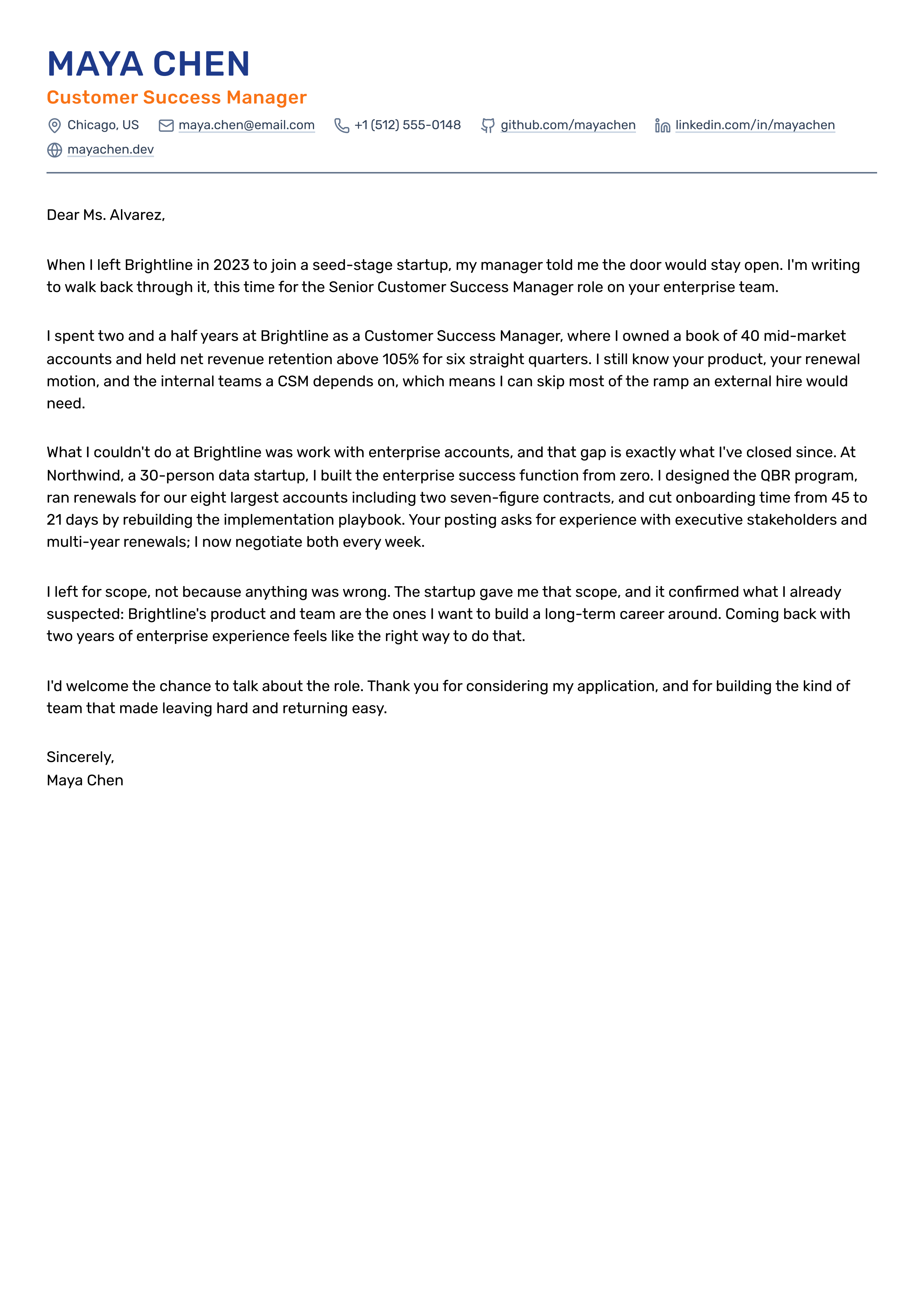
The scenario: Jordan spent two and a half years as a Customer Success Manager at Brightline, left for a startup to get enterprise-level scope, and is now applying back for a Senior Customer Success Manager role. Names and numbers are placeholders; the structure is the point.
Why this letter works
- The opening names the elephant immediately. No coy build-up to the reveal that Jordan used to work there; it's the hook, delivered with confidence in the first sentence.
- Paragraph two proves fit with numbers from the first stint (40 accounts, 105% NRR), then converts familiarity into a business benefit: a shorter ramp.
- Paragraph three is the growth paragraph, and it's the longest one. It names a specific gap from the old role and shows it closed, with the posting's own requirements quoted back.
- The 'why I left' explanation is one sentence, positive, and framed as a decision that made Jordan a stronger candidate for this exact job.
- Nowhere does the letter apologize, plead, or lean on friendship. Warmth shows up in the last line, after the case is already made.
How to Highlight What You Learned While You Were Away
The strongest boomerang letters are built on a delta: the gap between the role you left and the role you're applying for, closed by what you did in between. To find yours, put three things side by side. The job description you held when you left. The new posting. Your resume bullets from the time away.
Then look for requirements in the new posting that your old role never touched but your recent experience covers. Those are your growth paragraph. Everything else is supporting material.
| Requirement in the new posting | What you had when you left | What you gained away | Line for your letter |
|---|---|---|---|
| Enterprise account ownership | Mid-market book only | Renewals for two seven-figure contracts | "The posting asks for multi-year enterprise renewals; I now negotiate them every week." |
| People management | Individual contributor | Built and led a team of four | "I left as an IC. I'm returning having hired, coached, and retained a four-person team." |
| Cross-functional program leadership | Executed within one team | Ran a company-wide onboarding rebuild | "At Northwind I owned a program spanning sales, product, and support, the kind of scope this role centers on." |
Two rows of that table, translated into prose, beat five paragraphs of general enthusiasm. Be literal about the mapping. Quote the posting's language where it's natural, because the hiring manager wrote or approved those words and will recognize them.
If you left for something adjacent rather than a straight-line promotion, say a move into a different function, the delta framing still works; you're just mapping transferable wins instead of like-for-like ones. Our career change cover letter example shows that version of the move.
Referencing Past Successes and Internal Relationships
Your first stint is evidence, so treat it like evidence. One or two quantified results from your time there does more than a paragraph of fond memories. Pick outcomes that are still legible to whoever reads the letter: revenue retained, projects shipped, systems that are still running. If something you built is still in use, say so. "The onboarding sequence I wrote in 2022 is still the one your CS team runs" is one of the most persuasive sentences a boomerang candidate can write.
Name relationships carefully. Mentioning a manager or team you worked with is useful when that person is still there and thought well of you. It backfires when they've left, or when the reader wasn't around for your first stint and can't verify anything. If the hiring manager is new, write the letter as if for a stranger who happens to have your personnel file: results first, warmth second.
One caution on tone. Avoid "as you know" and "as you'll remember" constructions. They assume the reader was paying attention to your career three years ago. State your results plainly instead, the way you would to someone new.

Addressing Why You Left (Briefly and Positively)
One sentence. Two at most. The reason you left is the question in the reader's head, so you answer it, but the answer is not the story of the letter. The formula: a neutral or positive reason, followed immediately by what the move gave you.
| Why you actually left | How to phrase it in the letter |
|---|---|
| Bigger scope or a promotion you couldn't get internally | "I left to lead a team of my own, and I'm returning with three years of management experience." |
| Money | "I left for an opportunity I couldn't turn down at the time." Never mention compensation. |
| Layoff or restructuring | "My role was eliminated in the 2024 restructuring. My results before it, including [result], are why I'm reapplying now." |
| Relocation or family reasons | "I relocated for family reasons that have since resolved, and I'm settled back in [city] long term." |
| Burnout or a difficult manager | "I needed a different challenge at the time. The product and the people here are why I'm back." Keep it this neutral, always. |
Two rules override everything in that table. Never criticize the company, a former manager, or the team, even mildly, even if the criticism is fair. The person reading your letter may be friends with the person you're describing. And never apologize for leaving. "I regret leaving" sounds like weakness; "leaving taught me X, and X is what I'm bringing back" sounds like strategy.
Five Mistakes That Sink Boomerang Cover Letters
- Leading with nostalgia. "I loved my time at Acme" is a fine closing note and a weak opening argument. Open with the role and your fit for it.
- Assuming the letter is optional. Even if your old boss knows you, the application goes through a pipeline with recruiters and an applicant tracking system (ATS) that don't. Write the formal letter; send the warm email separately.
- Rehashing your old resume. If two thirds of the letter describes work the company already saw you do, you've argued for rehiring the person who left, not the person applying.
- Over-explaining the departure. A paragraph of justification reads as guilt. One sentence reads as confidence.
- Ignoring the new posting. The role has almost certainly changed since you held it or sat near it. A letter tailored to the 2022 version of the job tells the reader you didn't read the 2026 version.
How Roleframe Analyzes the Delta Between Your Old Role and the New Posting
The delta exercise above is the part most people skip, because doing it by hand means reading the new posting line by line against two versions of your own history. This is exactly what Roleframe's tailoring pipeline automates. Paste the former employer's new job description into a role workspace and the keyword extraction and matching agent pulls the exact requirements and keywords recruiter filters scan for, then checks them against your resume, including everything you added after you left.
The output splits into three buckets that map directly onto this letter. Requirements you covered in your first stint become your familiarity paragraph. Requirements covered only by your recent external experience become your growth paragraph, the proof you're returning upgraded. Requirements you don't cover at all are the gaps to address honestly or prepare for in the interview. From there, Roleframe generates a job-specific cover letter built on that analysis and a resume tailored to the same posting, so the two documents make the same argument with the same language. If you want the background on how keyword matching against a posting actually works, start with our guide to ATS resume keywords.
One practical note for boomerang candidates specifically: keep your first stint at the company on the tailored resume even if it's older, because it's the strongest evidence you have. Our guide to base resumes and tailored versions covers how to keep one master resume and adjust emphasis per application without rebuilding anything.

Reconnecting with Former Managers Before You Apply
Reach out before you apply, not after. A former manager who hears from you first can flag your application, tell you what the team actually needs, or warn you off a role that looks better on paper than in practice. An application that lands cold, then gets followed by a "hey, saw you got my resume" message, wastes the entire advantage of knowing people inside.
Keep the first message short and low-pressure. Something like this works as an email or a LinkedIn note:
Hi Dana, I saw Brightline posted a Senior CSM role on the enterprise team and I'm seriously considering applying. Since leaving I've spent two years building the enterprise success function at a startup, which is exactly the experience the posting asks for. Before I apply, I'd love 15 minutes to hear how the team has changed and whether you think I'd be a strong fit. Either way, it would be great to catch up.
Notice what that message does. It names the role, previews the upgrade in one sentence, and asks for input rather than a favor. If the answer is encouraging, apply within a day or two while the conversation is fresh; postings move fast, and applying early matters even more when someone inside is expecting your name.
If your old manager has left the company, find the closest remaining connection: a peer, a skip-level, someone on the team. And if you have no contacts left at all, the formal letter carries the full weight, which is one more reason to write it properly rather than treating it as a formality.
Draft Your Boomerang Cover Letter
You have everything you need: the structure (one third familiarity, two thirds growth), the example to model, the phrasing for why you left, and the delta table to fill in from the new posting. Write the letter, keep it under a page, and export both the letter and your tailored resume as PDFs so the formatting survives every ATS and inbox on the way to the hiring manager.
Then send the reconnection email the same week. A boomerang application with an internal advocate and a letter that proves growth is about as strong as a candidacy gets.
Frequently asked questions
Is it a good idea to return to a former employer?
Usually yes, if the reasons you left have changed or no longer apply. You'll ramp faster than any external hire, and the company hires with less risk because they've seen your work. It's a bad idea when the thing that pushed you out, a manager, a culture, a ceiling on growth, is still there. Ask a trusted former colleague what has actually changed before you apply.
Do I need a formal cover letter if my old boss already knows me?
Yes. Your application still passes through recruiters, hiring committees, and an applicant tracking system, and most of those people don't know you. Write the formal letter for the pipeline and send a short, warm email to your old boss separately. The two do different jobs.
How do I write an email to a previous employer about rejoining?
Keep it to four or five sentences. Name the role you saw posted (or ask whether openings exist), give one sentence on what you've done since leaving, and ask for a short conversation rather than a job. End with a genuine note about catching up. Send it to the manager or colleague you had the strongest relationship with, before you submit anything formal.
What are the most common cover letter mistakes when reapplying to a former employer?
Five come up constantly: opening with nostalgia instead of fit, spending the letter rehashing your old resume, over-explaining why you left, criticizing anything about the company or a former manager, and tailoring to the job as you remember it instead of the posting as written. The fix for most of them is the same ratio: one third familiarity, two thirds growth since you left.
How do I write a cover letter when I'm returning to the workforce after a break, not from another job?
Same structure, different growth paragraph. Lead with your results from your first stint, address the gap in one honest sentence, then fill the growth section with anything current: certifications, freelance or volunteer work, tools you've kept up with. The message is identical to the boomerang case: you're returning current and capable, not picking up where you paused.
Should I apply for my exact old job or aim for a higher role?
Aim for the role your combined experience justifies now, which is often one level up. Applying for your exact old job after years of growth elsewhere can read as stagnation, and it undersells your delta. If only your old level is posted, apply for it but make your expanded scope explicit in the letter, so a promotion conversation starts on day one rather than year two.
What if I left on bad terms?
Be honest with yourself about what "bad terms" means. A tense resignation or a counteroffer you declined usually fades within a year or two, and a neutral one-line explanation handles it. A bridge-burning exit, a performance dismissal, or a conflict with someone still in power is a different story; in those cases reach out informally first, and only apply if the response is warm. The formal letter should never relitigate the past either way.

Larbi is a self-taught software engineer and the founder of Roleframe. He built it after getting tired of rewriting his resume for every single application. Having built ATS software himself, he knew exactly what those filters do to resumes on the other side. He writes about what actually gets you past ATS and in front of recruiters, based on thousands of real job descriptions, not recycled advice.



Ready when you are
Send the tailored resume, not the generic one.
Paste a job posting and Roleframe tailors your resume for it in about a minute, so you apply while the role is still fresh.